Space: analysis of 12 November 2026
Back to the Chronology · Current news in this section
Analysis
NASA relaunches its stalled Mars Sample Return effort under a new 'Perseverance Sample Retrieval Architecture' as SpaceX prepares a Starship flight with a first-ever double catch attempt.
The past 48 hours combined institutional news from NASA with a busy commercial launch calendar. NASA announced a fresh initiative to retrieve the samples cached by Perseverance on Mars 4, while separate reporting framed procurement reform as a potentially decisive factor in the agency's lunar competition 8. On the commercial side, SpaceX is targeting 13 November for Starship Flight 15, including an orbital attempt and the first double catch 24, Rocket Lab has raised the price of its Neutron launcher by more than 25% citing demand 14, and Anduril described its first satellite's ability to observe objects in orbital darkness 7. In the science domain, several papers revisited the origins of life's building blocks [12, 17] and the strange interiors and magnetic fields of Uranus and Neptune [3, 11].
Key developments
- Mars Sample Return rebooted. NASA has started a new Mars Sample Return initiative called the Perseverance Sample Retrieval Architecture [4]. Mars Sample Return has been under prolonged cost and schedule scrutiny, so a renamed architecture suggests an attempt to restructure rather than abandon the goal of bringing Perseverance's cached samples to Earth; details of cost, timeline and partners were not stated in the item [4]. 4
- Starship Flight 15 and the double-catch test. SpaceX plans to launch Starship Flight 15 on 13 November, attempting to reach orbit and perform its first double catch [24]. A successful recovery of both stages would be a significant step toward the full reusability on which Starship's economics and NASA's lunar plans depend [24, 8]. 248
- Launch demand pushes Neutron price up. Rocket Lab has raised the launch price of its Neutron rocket from $55 million to $70 million, an increase of more than 25% that the company attributes to high demand amid an expected launch bottleneck [14]. The move signals a seller's market for medium-lift capacity, consistent with Moog's reminder that rideshare infrastructure such as the ESPA ring has been in use for 25 years to stretch scarce launch slots [14, 15]. 1415
- Procurement reform in the lunar race. Ars Technica reports that NASA's edge in the lunar space race may come from procurement reform, quoting a source describing the pace and nature of procurements as 'unprecedented' [8]. Faster contracting would matter for commercial partners and for the Artemis timeline, though the item gives no specific policy details [8]. 8
- Anduril enters space domain awareness. Anduril says its first satellite can observe adversary spacecraft manoeuvring in orbital night, citing a 'huge dynamic range' that allows imaging in full dark [7]. This marks a defence-technology company's entry into on-orbit surveillance, part of a broader militarisation of low Earth orbit monitoring; the capability claim is the company's own and not independently verified in the item [7]. 7
- Starlink's terrestrial 5G build-out. SpaceX has selected Qualcomm's Dragonwing platforms for a nationwide US 5G rollout for Starlink Mobile, with deployment expected to begin in 2027 and tens of thousands of sites planned [25]. It indicates SpaceX intends to pair its satellite network with terrestrial infrastructure, extending its competition with established mobile operators [25]. 25
Themes
- Rethinking the origin of life's building blocks. Two studies pull in different directions: new modelling suggests organic molecules delivered by comets would not have survived impact with Earth [12], while analysis of Bennu samples and the Murchison meteorite finds protein-building molecules that may have formed through a shared, unexpected process [17]. Together they shift attention from delivery mechanisms toward how organics form in space in the first place [12, 17]. 121731
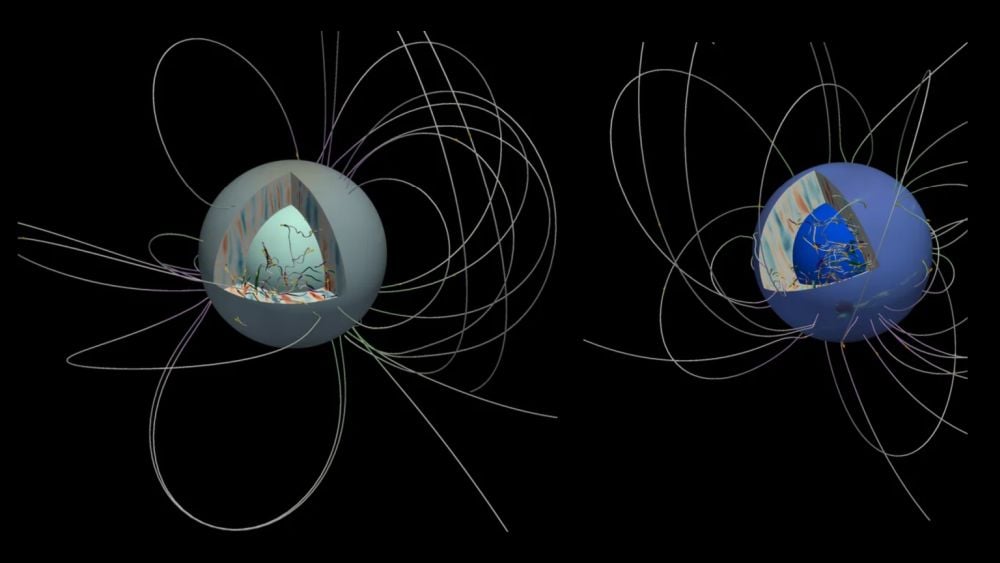
- Ice giants back in focus. Separate papers examine the tilted, messy magnetic fields of Uranus and Neptune using interior models [3] and use argon isotope measurements to probe whether their interiors are ice- or rock-dominated [11]. The convergence reflects renewed interest ahead of any future mission, given Voyager 2 remains the only spacecraft to have visited either planet [3, 11]. 311
- Extreme-universe puzzles for new observatories. A compact quasar pair found 900 million years after the Big Bang has no theoretical explanation for its rapid black hole growth [29], while simulations now explain the bright-edged jets of Centaurus A [10]. Forthcoming instruments such as UVEX [22] and LISA [30] are being positioned to address exactly these high-energy and gravitational-wave frontiers. 29102230
What to watch
- Watch the outcome of Starship Flight 15 on 13 November, since a successful orbital flight and double catch would validate full reusability central to SpaceX's and NASA's lunar plans [24, 8]. 248
- Look for further detail on NASA's Perseverance Sample Retrieval Architecture, including budget, schedule and the role of international or commercial partners, which the initial announcement did not specify [4]. 4
- Monitor whether Rocket Lab's price rise is followed by competitors, which would confirm a sustained launch capacity bottleneck [14]. 14
- On 17 November NASA invites the public to flash 'VGR' in Morse code as Voyager 1 reaches a light-day from Earth, a symbolic milestone for the ageing probe [18]. 18
Stories this analysis is based on (17)
- The Ice Giants' Magnetic Fields are Very Strange Compared to Earth's Universe Today
- NASA kick-starts a fresh push to bring Mars samples home Space.com
- Anduril says its first satellite can see adversaries maneuver in orbital night Ars Technica
- NASA's secret weapon in the lunar space race may be ... procurement reform? Ars Technica
- Centaurus A in the spotlight: Plasma simulations reproduce black hole jets' mysterious bright edges Phys.org Space
- Argon on Uranus and Neptune may reveal more about their origins than their interiors Phys.org Space
- Did comets bring building blocks of life to Earth? Scientists aren't so sure anymore Space.com
- 'There's tremendous demand': Rocket Lab raises price of Neutron launch from $55 million to $70 million Space.com
- Moog Marks 25 Years Since ESPA Design Milestone: Innovating Space Rideshare SpaceNews
- Bennu asteroid analysis suggests unexpected origins for organics in space Phys.org Space
- NASA asks Earthlings to wave as Voyager 1 reaches a light-day away The Register
- NASA's new UVEX space telescope will peer deep into the universe's most violent events Space.com
- What time will SpaceX launch Starship Flight 15, its 1st double landing test, on Nov. 13? (Full mission timeline) Space.com
- SpaceX Taps Qualcomm for Starlink Mobile’s Nationwide 5G Network eeNews Europe
- Earliest known compact quasar pair poses a black hole growth puzzle Phys.org Space
- How ripples in space-time can reveal new exoplanets Phys.org Space
- Nucleation of water ice under weak ionization via clustering on negative ions arXiv (research papers)
Written by Claude Fable 5.1 (Anthropic), based on 36 recent headlines and excerpts in this section, Nov 12. AI analysis can misread or miss things: the numbers link to the original reporting, which is the authority.