Alibaba sued over alleged Megaspeed ties, export risks
The lawsuit alleges Alibaba concealed ties to Megaspeed and understated export-control risks in its 2024 to 2026 annual reports.
30 news articles and 3 research items in this section, back to 8 May 2026. Browse the news ↓ Research ↓
8 stories from 5 publishers in the last 24 hours, 19 from 11 this week; 1 story was covered by more than one newsroom.
The lawsuit alleges Alibaba concealed ties to Megaspeed and understated export-control risks in its 2024 to 2026 annual reports.
Companies deploying AI agents have the illusion of control, but several incidents demonstrate that businesses need to be ready to enforce directions.
Everful has raised $48.5 million to expand its factory-direct sourcing platform, helping retailers source products from overseas manufacturers.
Alibaba is China's largest ecommerce company, but it has lost some of its edge to nimbler rivals.
Most mentioned in Alibaba news headlines, last 3 days: Alibaba 10Cloud 4services 2revenue 2push 2chip 2
Most active this week: Tech in Asia (7), Nikkei Asia (2), South China Morning Post (2), Dark Reading (1). Built automatically from headlines; the top items are the stories the most newsrooms covered in the last three days.
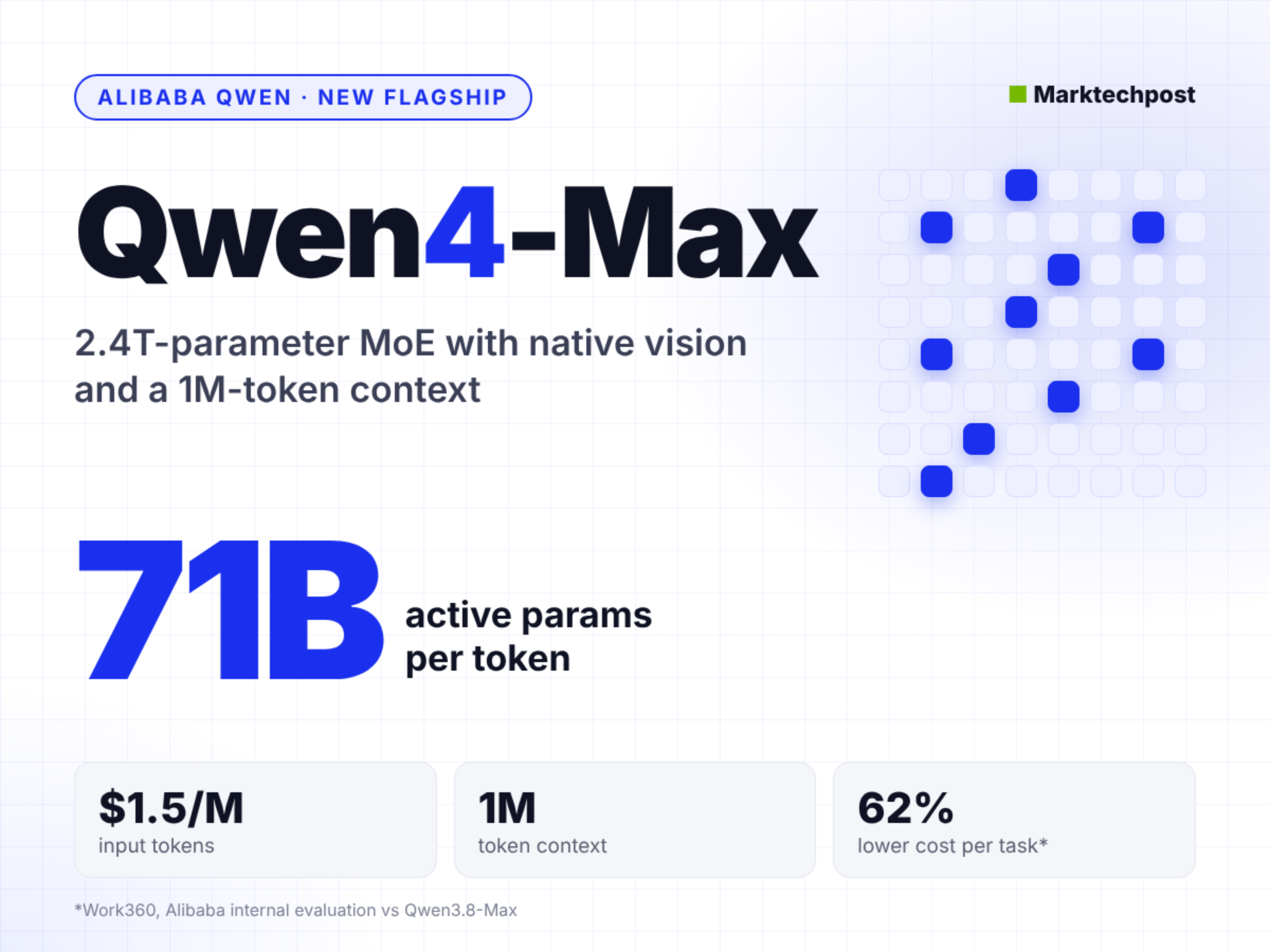
Alibaba launched Qwen4-Max, a 2.4-trillion-parameter proprietary flagship model pitched on lower costs, a 1-million-token context and tighter security guardrails.
Alibaba's Qwen team has unveiled Qwen4-Max, the first model in its next-generation Qwen4 family, described as its most capable large language model to date 246. The model is a mixture-of-experts design with 2.4 trillion total parameters but only 71 billion active per token, native vision capabilities and a 1-million-token context window 135. Alibaba is positioning it on price and efficiency, citing a 60%-plus reduction in cost per task and $1.5 per million input tokens, and on cybersecurity guardrails amid concern about AI-enabled attacks 56. Notably, the flagship is proprietary rather than open-weight, although Alibaba says it remains committed to open sourcing and plans smaller Qwen4 releases 346.
Written by Claude Fable 5.1 (Anthropic), based on 6 recent headlines and excerpts in this section, 1d ago. AI analysis can misread or miss things: the numbers link to the original reporting, which is the authority.
Journal articles, academic blogs, think-tank reports and papers, kept apart from the news below.
Racial and ethnic minority patients receive less pain treatment than non-Hispanic White patients, and large language models (LLMs) used as medical AI could reproduce that bias. Prior audits tested a few proprietary models, stated race explicitly and rarely measured the models' own response instability. In exploratory, non-preregistered analyses, Study 1 had four open-weight LLMs assess six acute-pain vignettes in every combination of four races and two sexes, with identity…
ABSTRACT State platform capitalism and China's digital exports are frequently viewed as geopolitical frameworks, emphasizing zero‐sum competition and structural dominance. This paper challenges such conceptualizations by investigating the market‐making capabilities of transnational technology firms and the strategic agency of host countries. Focusing on Alibaba's expansion into Indonesia, we argue that Chinese digital exports and the Digital Silk Road are better understood…
Indirect prompt injection remains a persistent weakness in retrieval-augmented and tool-using LLM systems, and the problem becomes harder to characterise in multilingual settings. We present MIPIAD, a defense framework evaluated on English and Bangla that combines a sequence classifier fine-tuned from Qwen2.5-1.5B via LoRA (XLPID), TF-IDF lexical features, and validation-tuned ensembling through late fusion, stacking, and gradient boosting. The framework is evaluated on a…
The lawsuit alleges Alibaba concealed ties to Megaspeed and understated export-control risks in its 2024 to 2026 annual reports.
Companies deploying AI agents have the illusion of control, but several incidents demonstrate that businesses need to be ready to enforce directions.
Everful has raised $48.5 million to expand its factory-direct sourcing platform, helping retailers source products from overseas manufacturers.
Alibaba is China's largest ecommerce company, but it has lost some of its edge to nimbler rivals.
Alibaba Group Holding’s external recurring revenue tied to AI cloud and computing surged 67 per cent during the quarter ended September 30, lifting total revenue 10 per cent to a better-than-expected 271.5 billion yuan (US$40.5 billion) as the company doubles down on full-stack AI capabilities. The tech and e-commerce giant’s AI Cloud and Compute Services segment, comprising its cloud computing business and chip design unit T-Head, which filed for an initial public offering…
Recurring revenue from external cloud customers grew 67%. Its free cash flow outflow widened to US$5.1 billion.
Alibaba Cloud also said it unveiled its Qwen4-Max AI model at the event.
Nvidia previously developed modified chips, including the H20 for China, to comply with US export restrictions as sales to China.
Nvidia's sales team reportedly connected Alibaba with Alice Huang in 2022, helping establish a chip-rental business relationship that later came under scrutiny amid US investigations into suspected semiconductor smuggling.
Alibaba Group Holding Ltd. today introduced Qwen4-Max, its newest and most capable large language model. The algorithm not only generates higher-quality output than its predecessor but also costs less. Those improvements are the result of a new architecture, Qwen4, that made the LLM’s training run more efficient. Additionally, Alibaba has equipped the model with an
Alibaba launches Qwen4-Max, a new flagship model with 2.4 trillion parameters that activates only 71 billion per token. A hybrid architecture sharply cuts costs on long contexts. Qwen4-Max lands just behind Kimi K3.1 Pro on the Artificial Analysis Intelligence Index, and Alibaba plans to release smaller Qwen4 models as open source. The article Alibaba's Qwen4-Max takes on Opus 5.5, GPT-6, and Kimi K3.1 Pro at much lower prices appeared first on The Decoder.
Alibaba has officially unveiled Qwen4-Max, the first model in its next-generation Qwen4 family, with a focus on complex professional tasks
The 2.4-trillion-parameter model includes a 1-million-token context window, native vision capabilities and security improvements across coding and other tasks.
Read at Analytics India Magazine
Also at Tech in Asia
Alibaba released Qwen4-Max, a proprietary 2.4T-parameter MoE model with 71B active parameters, native vision and a 1M-token context. It costs $1.5/M input tokens and cuts Work360 cost per task by 62%.
Alibaba Group Holding has launched its most advanced artificial intelligence model to date, Qwen4-Max, with strict cybersecurity guardrails, as the tech giant balances safety with a continued commitment to open sourcing amid growing global concerns over AI-enabled cyberattacks. The release highlights a growing focus on safety in China’s AI industry as Alibaba said it intentionally filtered the model’s training data to remove offensive cyberattack capabilities while retaining…
Ant’s public leadership page lists Chen as senior vice president and CMO, showing the role is part of the company’s top management.
Open weight model can now say things Chinese authorities don't like
Founded in 2018, T-Head had shipped 560,000 Zhenwu AI chips as of April 2026.
Also at South China Morning Post
The model helps robots process touch signals from different sensor types through a shared representation.
A config-verified comparison of how 10 open MoE models route tokens: total and active parameters, expert counts, top-k, shared experts, gating functions and load-balancing methods.
A company whose machines are trained to predict the next word has left one for us to supply. On Friday (November 6), Alibaba’s Qwen released a poster without a model name or a benchmark. Birds gather above a dark sea, their flock taking…
The companies said the deal aims to improve global mobile payment connectivity and speed up the development of account and treasury management services.
Yesterday's hot paper was Sparks of Weight-Space Programming: LLMs can natively read & write neural network weights by Rikiya Takehi, Jayden Teoh, Alex Zhang, and Omar Khattab. The paper (OK, the authors classify is as a "blog post", but it's paper-shaped) found that frontier models, in particular GPT-6 Astra, can both interpret and modify the raw weights of a machine learning model - literally a text description of the model containing a bunch of floating point numbers…
Testing of the Qianwen-powered features begins November 4 in the latest iOS developer beta.
An AI model said it wouldn’t use any tools, then tried to send something to a server in Beijing anyway, and while researchers say it’s probably a training quirk and not espionage, the whole thing has people asking how much to trust free Chinese AI.
DoD’s public document describes Alibaba as indirectly affiliated with China State Council's supervision body, and a “military-civil fusion contributor to the Chinese defense industrial base”.