Quantum Physics Can Verify a Person’s Location, NIST Researchers Show
Insider Brief PRESS RELEASE — Imagine a corporate treasurer directing her company’s financial network to make a $50 million wire transfer.
Also at Phys.org Quantum Physics
Quantum technology: quantum computers and qubits, error correction, quantum communication and sensing, post-quantum cryptography, and the companies, labs and governments racing to build them, from The Quantum Insider, Quantum Computing Report, IEEE Spectrum, Phys.org and Quanta Magazine, with research from arXiv, npj Quantum Information and the journal Quantum.
257 news articles and 489 research items in this section, back to 11 September 2026. Browse the news ↓ Research ↓
22 stories from 3 publishers in the last 24 hours, 142 from 11 this week; 6 stories were covered by more than one newsroom.
Insider Brief PRESS RELEASE — Imagine a corporate treasurer directing her company’s financial network to make a $50 million wire transfer.
Also at Phys.org Quantum Physics
Alice & Bob has unveiled an accelerated quantum computing roadmap, aiming for 200 logical qubits from 3,600 physical cat qubits by 2030 in their Carbon system, and scaling to 2,048 logical qubits by 2034.
Also at The Quantum Insider
A diamond's most useful quantum properties come from defects, places where the regular arrangement of carbon atoms is broken.
Also at The Quantum Insider
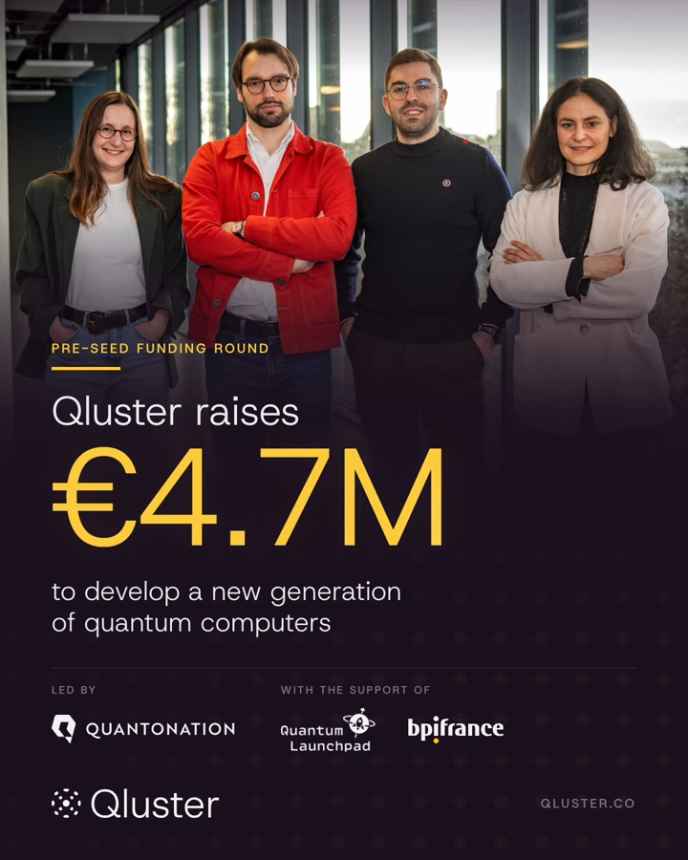
Qluster, a Paris-based photonic quantum computing startup, has secured €4.7 million in pre-seed funding.
Also at The Quantum Insider
Most mentioned in Quantum technology headlines, last 3 days: Quantum 56Computing 7Across 6Launches 6Qubits 6Photonic 6Demonstrates 5IBM 5Using 5NVIDIA 5
Most active this week: The Quantum Insider (63), Quantum Computing Report (50), Phys.org Quantum Physics (21), SiliconANGLE AI (1). Built automatically from headlines; the top items are the stories the most newsrooms covered in the last three days.
SC26 became the stage for a coordinated push by NVIDIA, IBM, AMD and partners to make quantum processors first-class, schedulable components of supercomputing infrastructure, with GPU-accelerated error correction as the connective tissue.
The week was dominated by announcements at the SC26 supercomputing conference, where NVIDIA extended the Slurm workload manager to treat quantum processors as schedulable resources, IBM and AMD open-sourced a GPU decoder framework for qLDPC codes, and IBM, Fermilab and NVIDIA unveiled a modular quantum-classical co-design platform 1121719. Hardware vendors and control-system firms lined up behind this hybrid model, from IQM and Oxford Quantum Circuits to AQSolotl and PsiQuantum, the latter deepening its tie to AMD with an equity investment 41417. Capital continued to flow, with Q-CTRL raising $290 million at a valuation above $1 billion and Atom Computing finalising a $100 million US Department of Commerce agreement 23. Alongside this commercial activity, the research pipeline delivered incremental advances in photonic components, cryogenic electronics and error-correction decoding, while post-quantum security deals spread to Qatar and Africa 61523273137.
Written by Claude Fable 5.1 (Anthropic), based on 45 recent headlines and excerpts in this section, 3d ago. AI analysis can misread or miss things: the numbers link to the original reporting, which is the authority.
Journal articles, academic blogs, think-tank reports and papers, kept apart from the news below.
We prove that, above a constant temperature threshold, Gibbs states of local noncommuting qudit Hamiltonians exhibit exponential decay of mutual information and conditional mutual information (CMI). Specifically, we prove exponential decay of the CMI for arbitrary spatial tripartitions $A \sqcup B \sqcup C$ which need not comprise the entire system, thereby establishing a \textit{uniform Markov property} for high-temperature Gibbs states. A central obstruction to proving…
We demonstrate local velocimetry for atomic superfluids in two dimensions (2D). Using matter-wave interferometry based on Raman--Bragg beam splitters, we map the local gradient of the phase of the superfluid's wavefunction onto displacement of the interference fringes and reconstruct the 2D velocity field. We illustrate the capabilities of this technique by applying it to two canonical problems. First, we directly observe the self-similar evolution of the velocity field in…
We propose a quantum minimum-finding algorithm for objectives accessed via numerical estimators that avoids the logarithmic query overhead of amplifying the confidence of estimates before the search. A coherent estimator that is $\varepsilon$-accurate with probability at least $2/3$ on each of $N$ labels suffices to find a $2\varepsilon$-optimal label using $O(\sqrt N)$ base-estimator queries at constant confidence. The query bound and the additive-error constant are…
Arithmetic operations are a fundamental building block in the design of quantum algorithms, with their implementation cost expected to have a significant impact on the viability of a wide variety of quantum applications. In this work, we present novel algorithms for a number of in-place quantum arithmetic operations that are highly efficient in terms of their space and gate count overheads compared to the current state-of-the-art. We show that in-place modular multiplication…
Accurate simulations of strongly correlated electrons remain a central challenge in computational physics. We introduce neural-network Gaussian projected entangled-pair states (NN-GPEPS), which exploit the locally-entangled subspace of Gaussian states to give an architecture more compatible with modern neural networks and an exact contraction cost of $O(N^{3/2})$ on two-dimensional lattices. For the Hubbard model at $U/t=8$ and $1/8$ hole doping, we obtain state-of-the-art…
The University of Amsterdam (UvA) has launched the Q-SIM4MMD initiative, investing €800,000 across four quantum simulation projects. These projects aim to explore quantum simulation and machine learning for molecular and materials discovery, focusing on applications like molecular design, bioinformatics, and developing safer molecules. The initiative connects researchers across various disciplines and seeks to integrate quantum approaches with classical modeling.
UCLA researchers have developed a theoretical model for enhancing microwave-to-optical quantum transduction using superconducting qubits. Their proposed architecture collectively couples multiple qubits to a shared optomechanical resonator, aiming to overcome limitations in current optical interconnects. The study shows that this collective coupling can improve conversion efficiency and bandwidth, with an auxiliary transmon further boosting single-photon optical target…
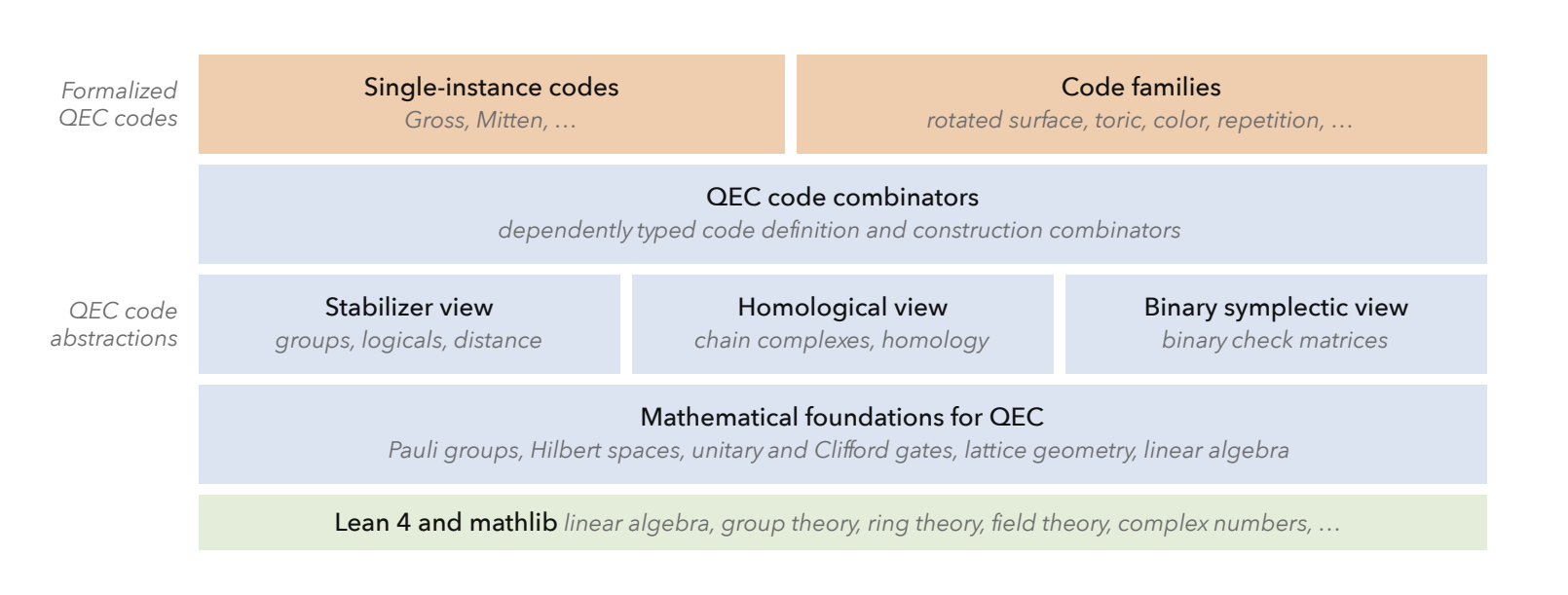
Researchers have developed QECLean, an open-source framework using Lean 4 to formally verify quantum error-correcting codes, addressing the difficulty of verifying complex, algorithmically discovered codes. It has successfully verified parameters for several significant QEC codes, including an IBM 360-qubit code and infinite planar code families. QECLean aims to validate AI-discovered codes and future quantum compilers by linking different mathematical representations within…
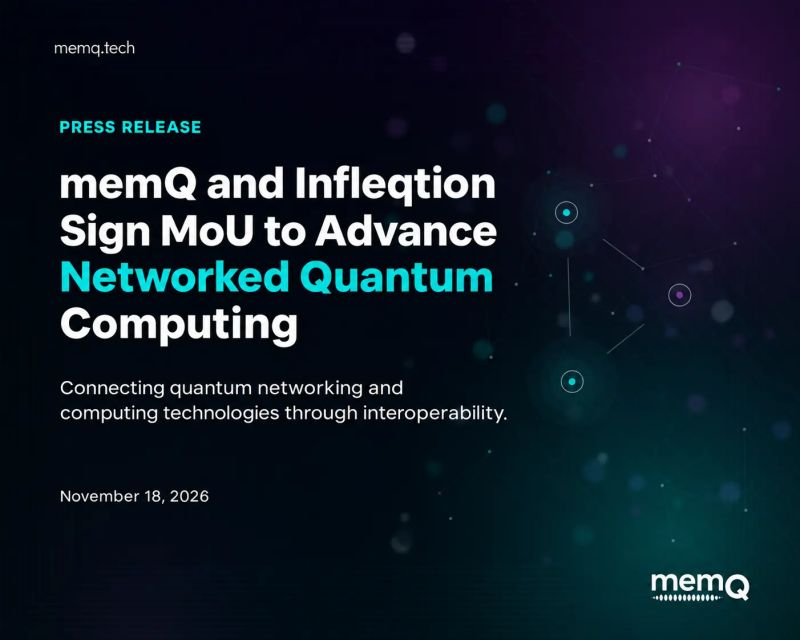
memQ and Infleqtion have signed an MoU to validate interoperability between memQ’s quantum network architecture and Infleqtion’s quantum computing platform. This collaboration aims to enable modular multi-processor scaling by connecting separate quantum processing units. The initiative is crucial for enterprise and high-performance computing data centers to adopt standardized QPU-to-QPU networking.
Mastercard has launched a Quantum Advisory Practice with QIZ Security to help financial institutions transition to post-quantum cryptography, addressing immediate "harvest now, decrypt later" risks. This initiative, aligned with G7 and FS-ISAC guidance, offers services like cryptographic asset discovery and remediation roadmaps. Mastercard is also conducting quantum research with Oxford Quantum Circuits, focusing on financial fraud protection.
BMO Financial Group, in collaboration with DUTH and IBM, has demonstrated a quantum machine learning feature-selection workflow on IBM quantum processors. They applied quantum game theory to identify high-value predictive variables in financial datasets, achieving comparable quality to classical methods with significantly fewer algorithmic samples. This milestone builds on BMO's earlier entry into the IBM Quantum Network and the launch of their AI & Quantum Institute.
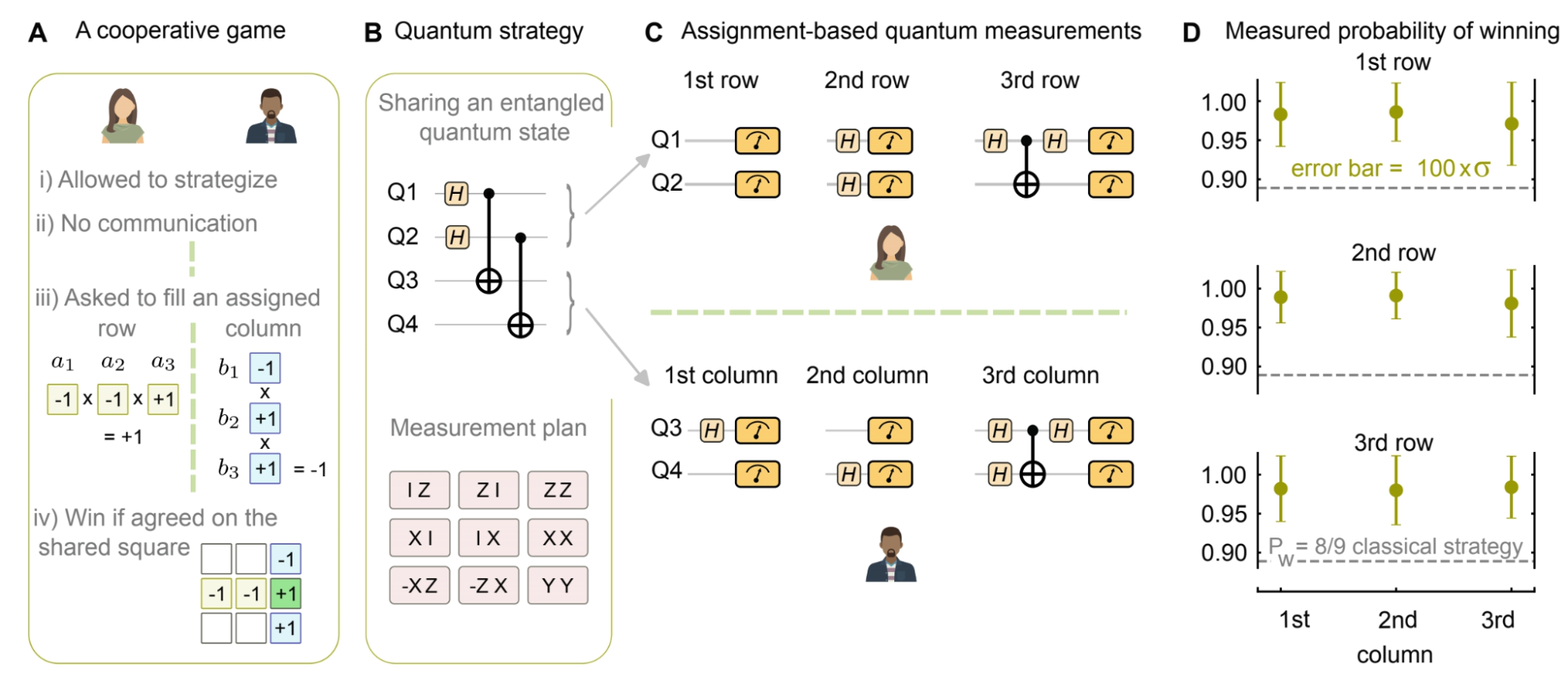
Google Quantum AI has demonstrated quantum measurement contextuality on 72-qubit and 105-qubit Willow processors, moving contextuality testing to large two-dimensional qubit arrays. This research, published in Science, establishes a hardware benchmark for coherent control errors and has implications for fault-tolerant computing and molecular simulations. The experiments verified that quantum observables do not have predetermined values independent of compatible measurements.
A description of how AI is playing an increasingly important role in assisting engineers developing new quantum error correction codes and quantum error correction decoders.
In an ordinary metal, electrons behave like well-defined particles that occasionally bump into imperfections or vibrations of the crystal. Many materials with strong electron–electron interactions, including the copper-oxide (cuprate) superconductors, break these rules. In these "strange metals," electrical resistance rises in a straight line with temperature over a very wide range. Electrons seem to lose their momentum at the fastest rate quantum mechanics allows, the…
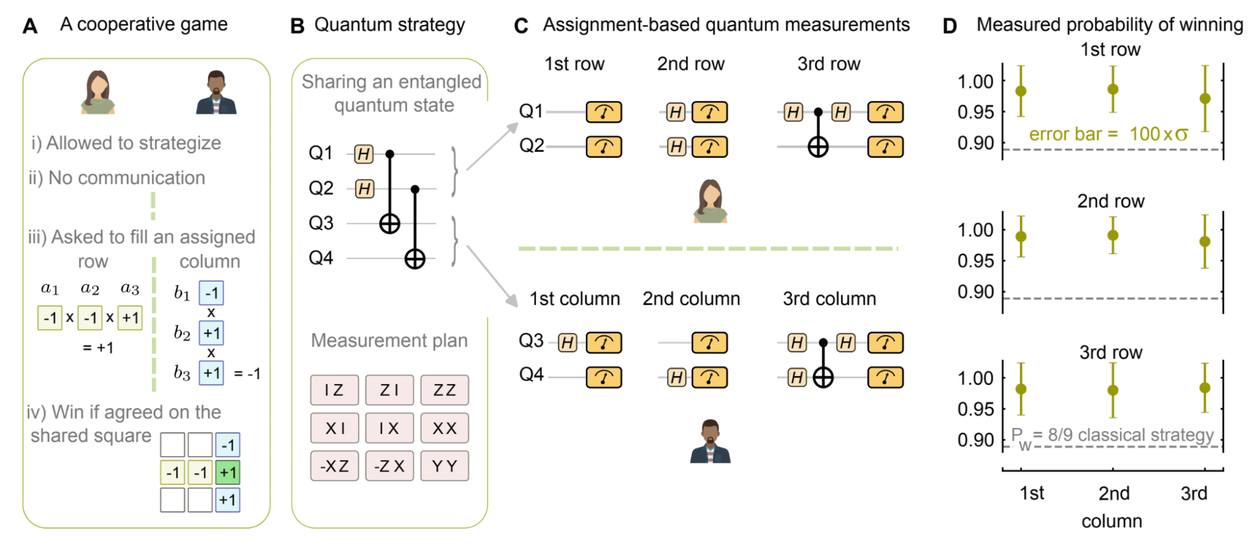
Insider Brief It turns out teamwork can indeed make the dream work, even when the team isn’t allowed to talk. It helps to have a few entangled qubits, though. In a study, a Google-led team of researchers used a quantum chip to beat the best classical strategies in games that barred players from communicating, demonstrating
Magnets are usually associated with a familiar property: they produce a magnetic field because the magnetic moments of their electrons align. But nature allows much more unusual forms of magnetic order. An international research team has now identified compelling experimental evidence for p-wave magnetism in europium silicide (EuSi), a chemically simple metallic compound.
With new equipment funding at Penn State and the University of Toronto, Delta Gold Technologies has launched a dedicated quantum sensing program, allowing its gold nanoclusters to get to work on navigation and magnetic sensing while the quantum computing effort continues. Insider Brief For most of us, day-to-day navigation happens somewhere overhead. Our phones listen
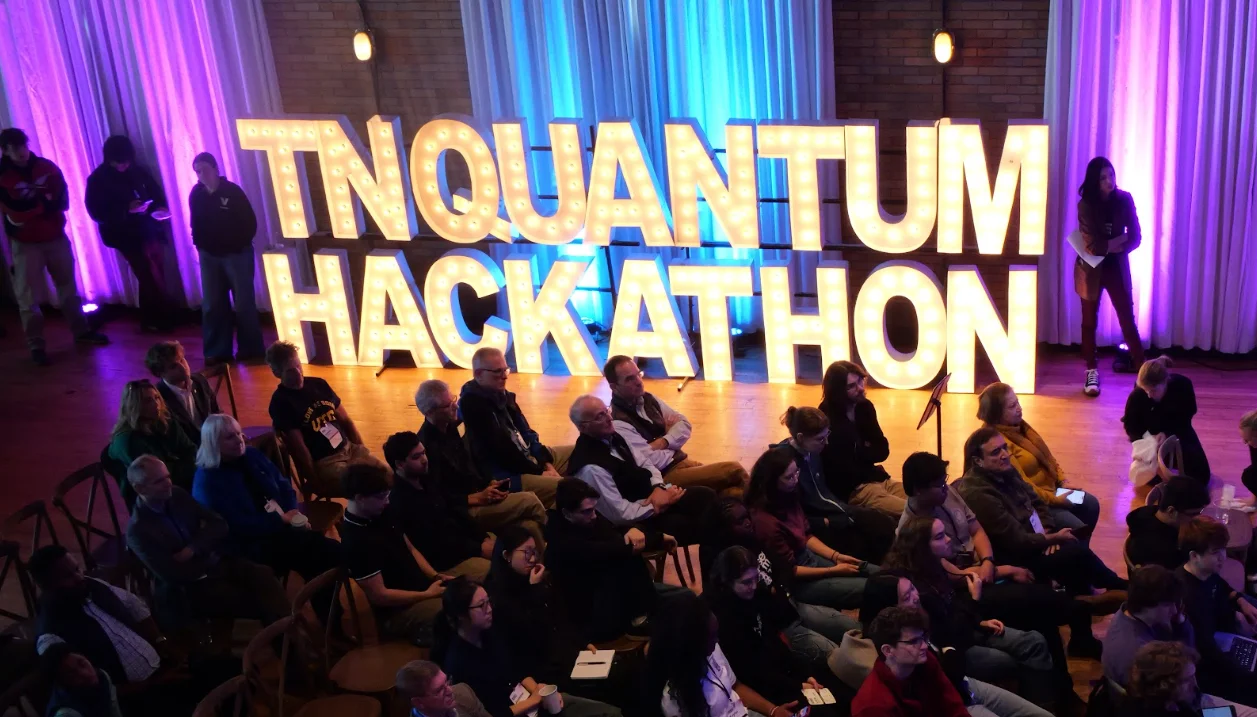
Insider Brief PRESS RELEASE — A team of students from Tennessee State University and Vanderbilt University took first place and a $2,500 prize at the Tennessee Quantum Hackathon, a 36-hour, in-person competition that challenged college students to use quantum technology to solve real problems facing the electric grid. The Chattanooga Quantum Collaborative (CQC) and CO.LAB
Insider Brief PRESS RELEASE — WISeQey Corp. (formerly known as WISeKey International Holding AG, “WISeQey”) (Nasdaq/SIX: WQEY), a global quantum cybersecurity and space IoT company, today announced that its subsidiary, SEALSQ Corp (NASDAQ: LAES) (“SEALSQ”), a company that develops and sells Semiconductors, PKI, and Post-Quantum technology hardware and software products, has signed a non-binding letter
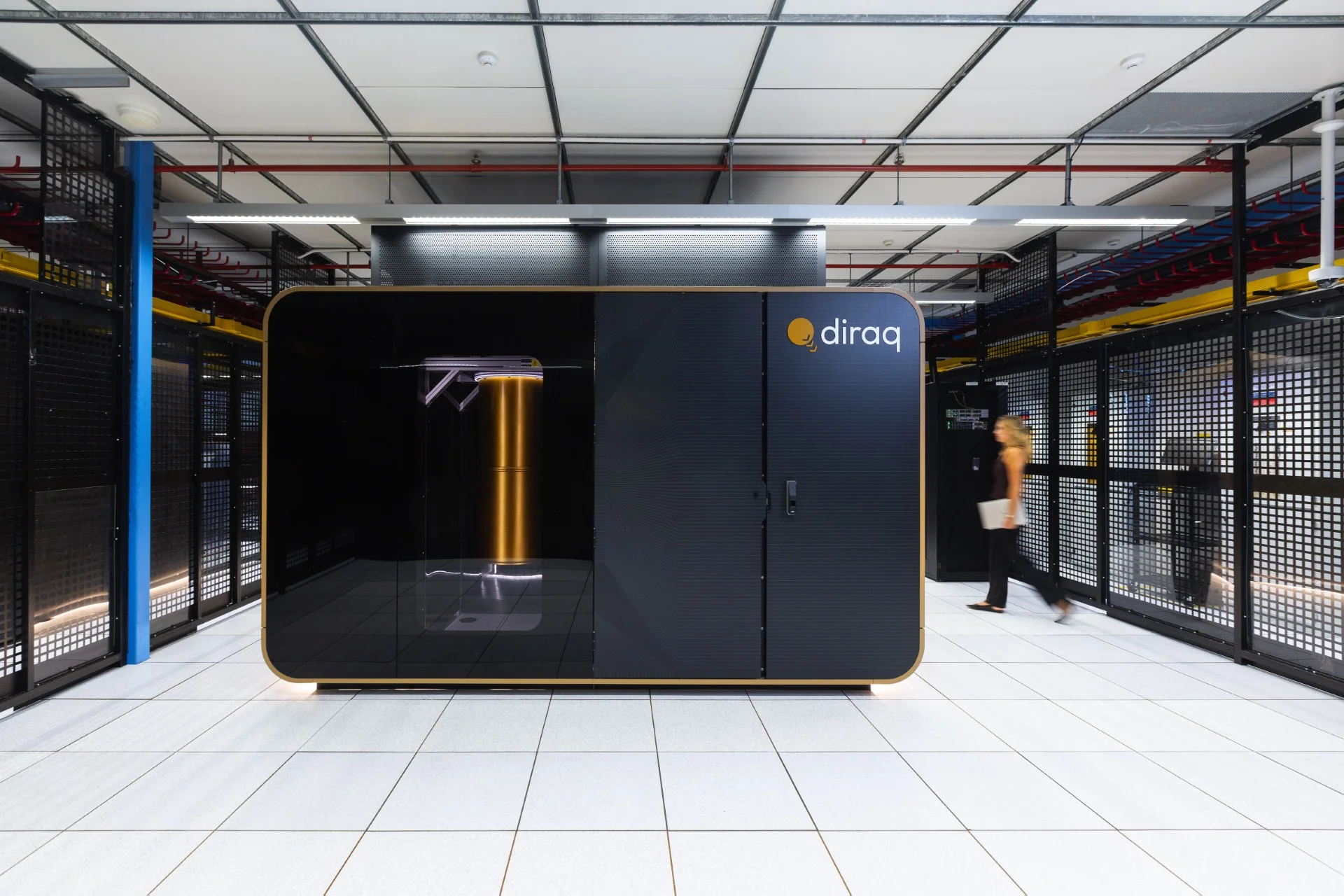
Behind Equinix and Diraq’s collaboration to bring a silicon spin quantum computer into a commercial data center … and what it actually takes to get there. Insider Brief The recent headlines around Diraq and Equinix’s collaboration have focused on a milestone: a silicon spin quantum computer, installed inside an operational commercial data center in Sydney.
Insider Brief PRESS RELEASE — Pasqal (Nasdaq: PSQL), a global leader in neutral-atom quantum computing, today announced an integration with the Hierarchical Resources (HRES) capability recently added to Slurm, the open-source workload manager widely used in supercomputing centers. In a latest release, NVIDIA has expanded Slurm to allow quantum processing units (QPUs) to be addressed
Insider Brief PRESS RELEASE — memQ™, the industry leader in quantum networking solutions for distributed quantum computing, and Infleqtion (NYSE: INFQ), a global leader in quantum computing and quantum sensing powered by neutral-atom technology, have announced a joint memorandum of understanding (MoU) to pursue validation and certification of interoperability between memQ xQNA quantum networking technologies
Insider Brief Financial markets are still in the early stages of preparing for quantum computers that could break the security protecting trades, payments and confidential records, a global group of securities regulators said. And they might not be moving fast enough to manage the threat. The International Organization of Securities Commissions (IOSCO) urged regulators and
Insider Brief PRESS RELEASE — BMO today announced it has demonstrated quantum utility in a machine learning application using IBM quantum computers, meaning the work was performed reliably at a scale beyond what exact traditional computing methods can practically reproduce. The work explores how quantum computing could help AI models identify which information matters most
Insider Brief A quantum security test network spanning countries is to be built on the Busan-Singapore stretch of SJC2, a subsea cable that connects Asia, SK Broadband said on the 19th, according to Seoul Economic Daily. The company’s aim is to check how Korean quantum technology performs abroad and to put in place a system
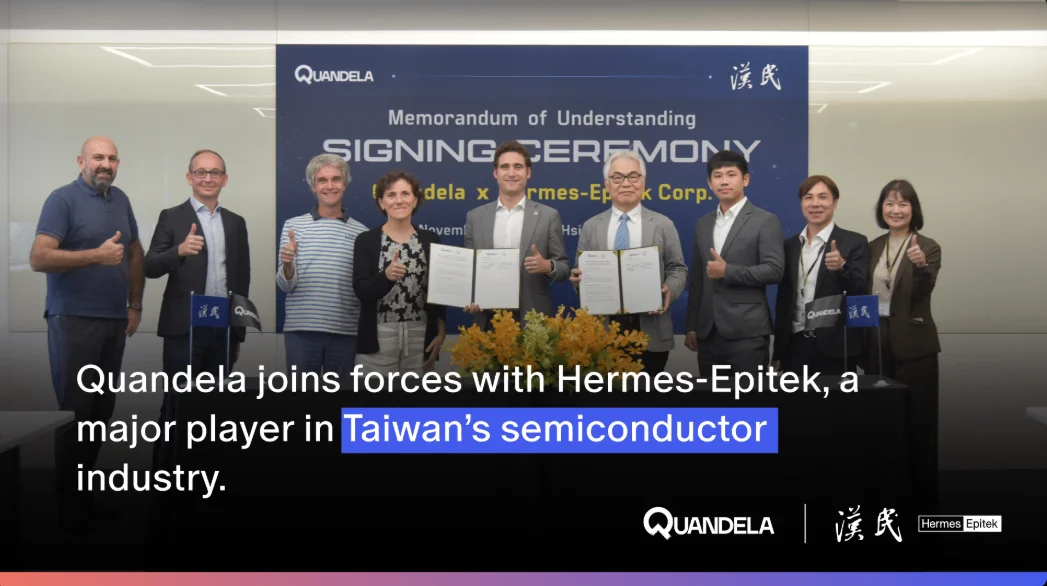
Insider Brief PRESS RELEASE — Quandela and Hermes-Epitek Corporation (“Hermes-Epitek “) have signed a memorandum of understanding (MoU) at Hermes-Epitek’s premises in Hsinchu Science Park. The MoU outlines two companies’ intention to develop and industrialize photonic quantum technologies, beginning with a proposed joint R&D program. A subsequent phase would involve the installation of a quantum computer
Insider Brief PRESS RELEASE — NPL and Sungkyunkwan University (SKKU) have signed a Memorandum of Understanding (MoU) to expand collaboration in quantum technologies. The agreement builds on an established relationship between NPL and SKKU, which has already included joint research projects, intercomparison studies, access to quantum devices developed by SKKU for research and development purposes,
When scientists shine a laser beam into a crystal, they typically expect a steady glow as the crystal's atoms are energized and begin to emit light. But in early 2024, while searching for something else entirely, researchers in the lab of Caltech's Andrei Faraon saw a crystal flash in a regular rhythm, like a metronome keeping a beat. The flashes came from billions of atoms embedded in the crystal. Coupled to a tiny superconducting circuit, the atoms had become synchronized…
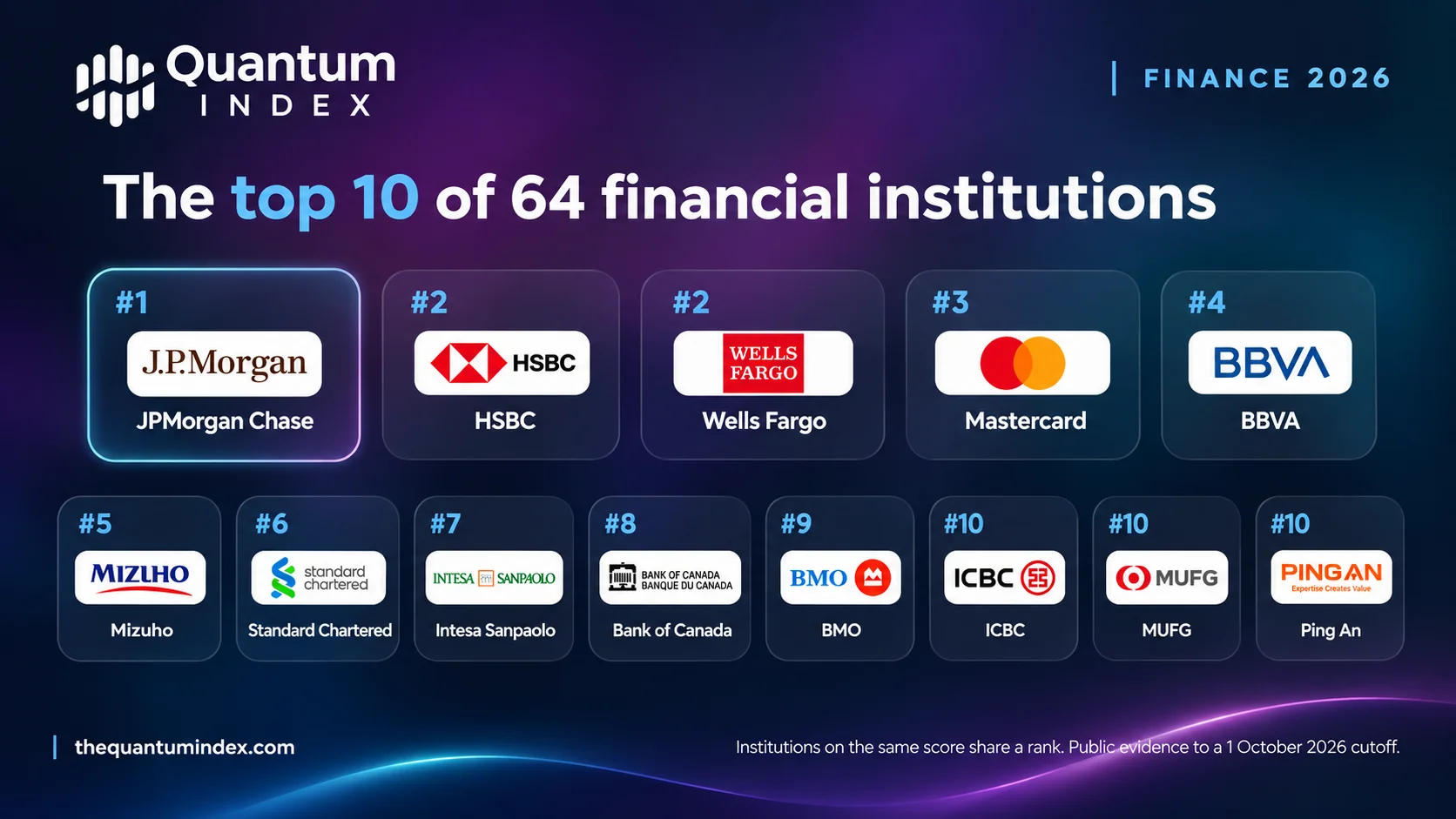
Guest Post by Steve Suarez, Founder and CEO of HorizonX and Co-founder of The Quantum Index The 2026 Finance Quantum Index brings together 64 financial institutions across eight regions, more than doubling its coverage from 28 institutions in 2025. With 36 new additions, this year’s edition provides a broader view of quantum activity across banking,
Photonics-based quantum computers open up new possibilities for investigating highly complex problems in mathematics and have the potential to revolutionize fields ranging from energy and chemical research to secure communications. By utilizing the unusual properties of light particles, they can perform calculations that pose enormous challenges even for the most powerful supercomputers—or remain entirely beyond their reach. At Paderborn University, researchers are now…
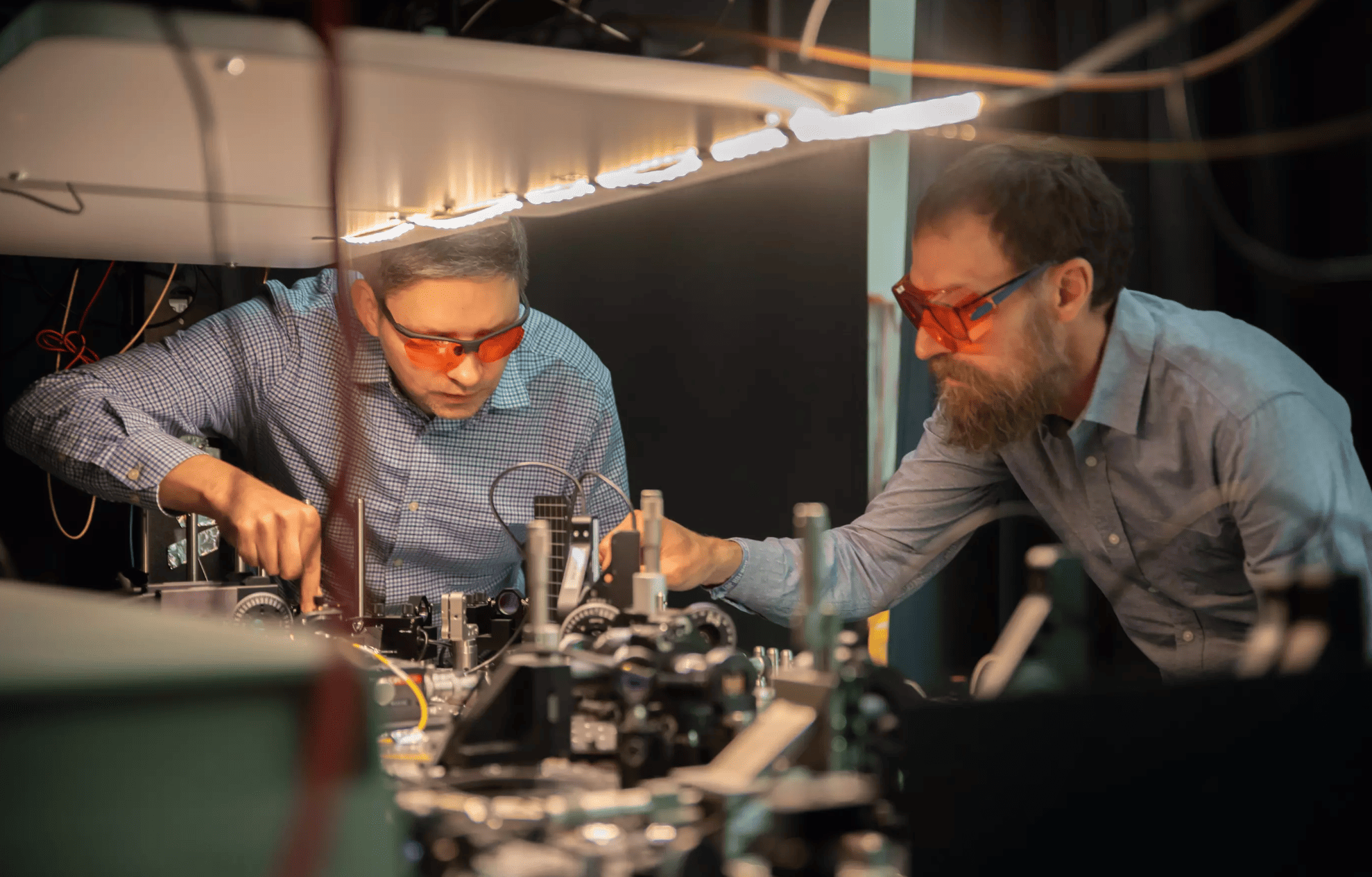
Insider Brief PRESS RELEASE — Imagine a corporate treasurer directing her company’s financial network to make a $50 million wire transfer. How can the network be certain the command is coming from a secure terminal in the company’s headquarters, and not a hacker’s laptop across the globe? In a first-of-its-kind experiment, scientists at the National
Also at Phys.org Quantum Physics
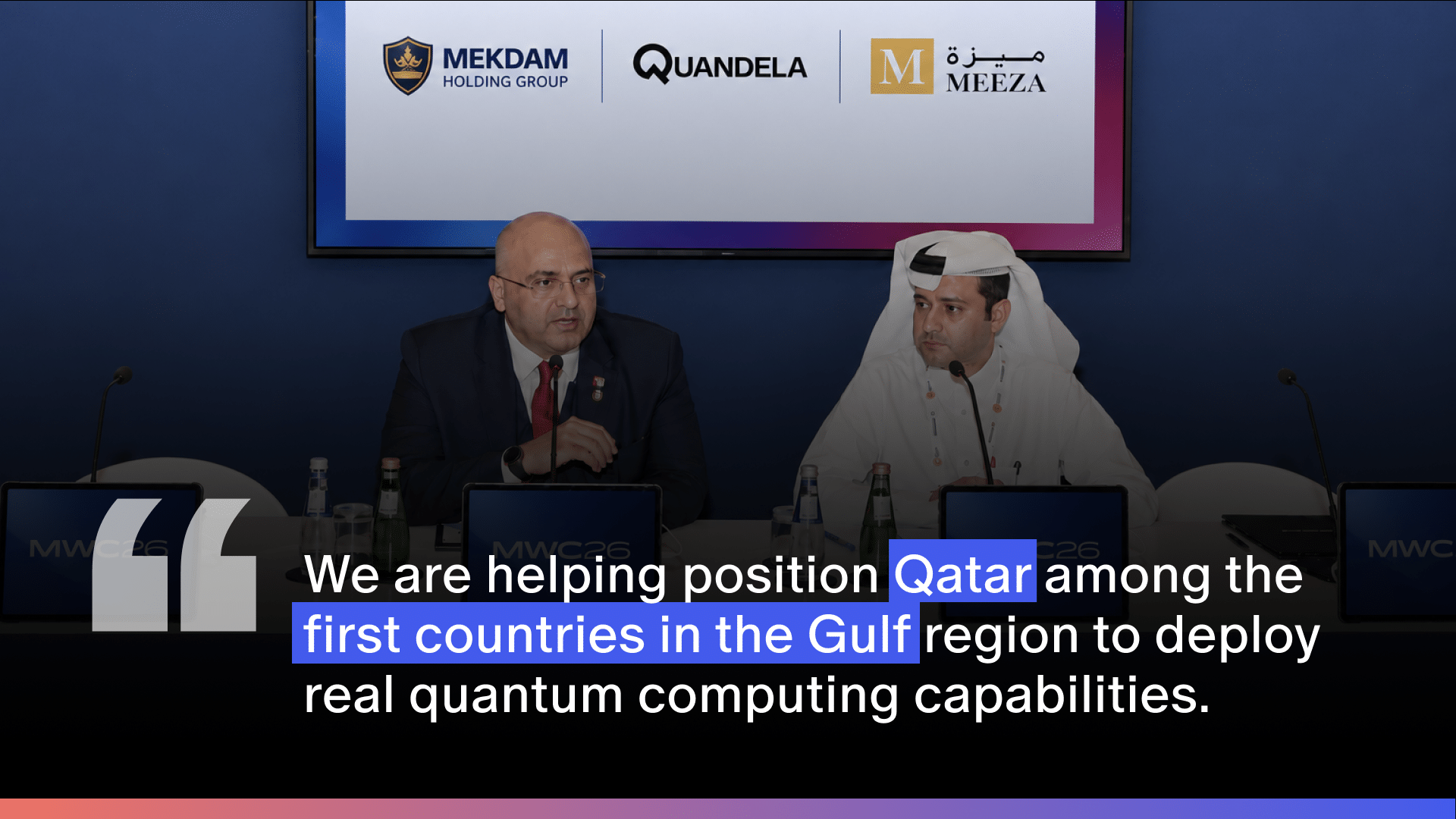
Qatar and France have signed a Letter of Intent to enhance cooperation in AI, digital transformation, and quantum technologies. This agreement, formalized at the ITU Plenipotentiary Conference 2026, aims to strengthen their digital sectors and foster strategic autonomy. It also builds on existing commercial ties, including a recent deal for quantum computing deployment in Qatar by French company Quandela.
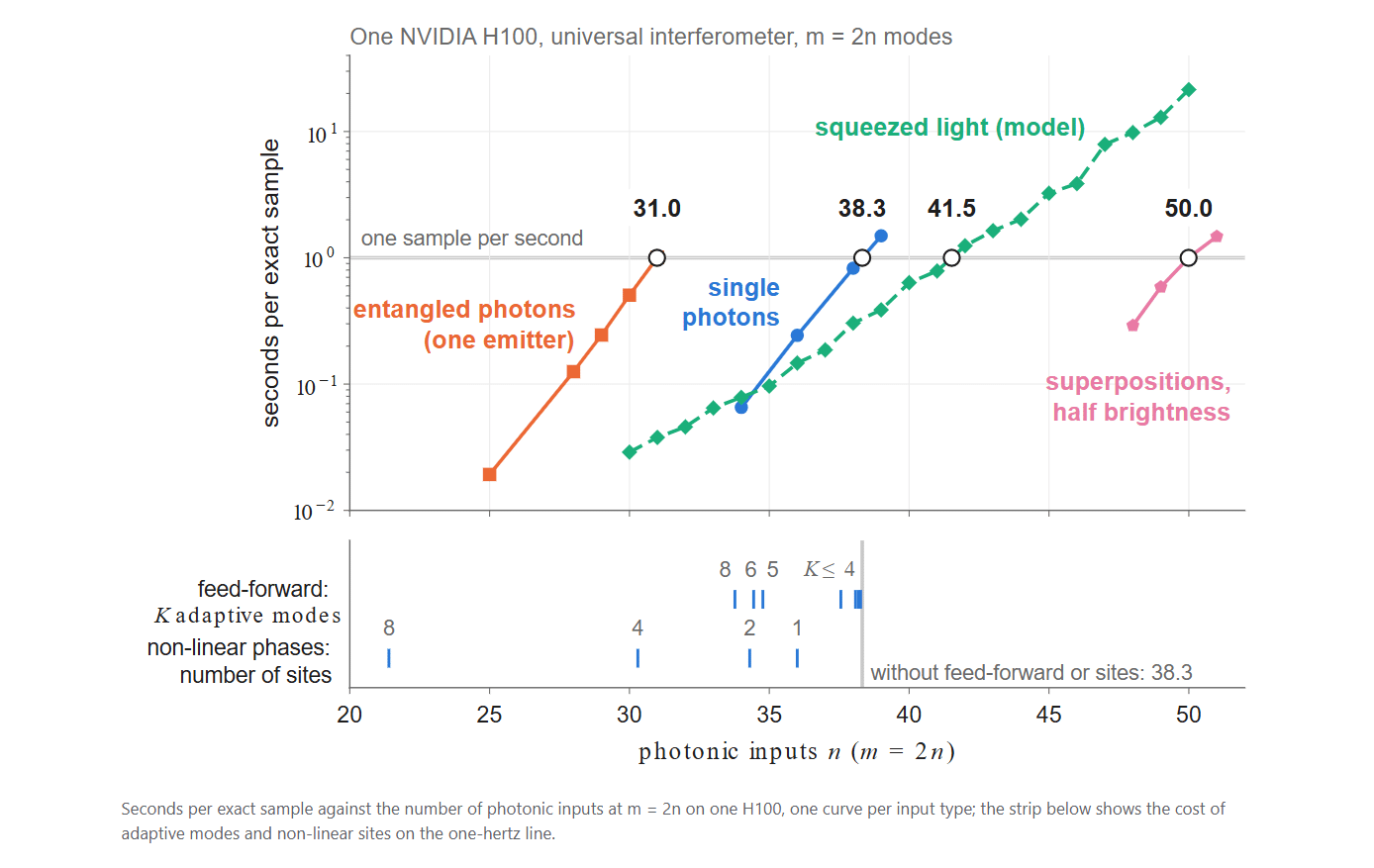
Quandela, CNRS, and NVIDIA have established a "simulability frontier" for photonic quantum processors using NVIDIA H100 GPUs. Their research defines a unified metric for when quantum processors outperform classical simulations, moving beyond varying photon count thresholds. They've also released an open-source library, photonic-engines, to support this work.
Insider Brief PRESS RELEASE — The National Energy Research Scientific Computing Center (NERSC) at Lawrence Berkeley National Laboratory and QuEra Computing, the leader in neutral-atom quantum computing, today announced the publication of a new study in Nature. Using Aquila, QuEra’s analog neutral-atom quantum computer, coupled with classical calculations on NERSC’s Perlmutter supercomputer, the team observed
On November 18, 2026, Quandela announced two international collaborations: a tripartite partnership in Qatar with Mekdam Holding Group and MEEZA to deploy photonic quantum systems across GCC states, and a memorandum of understanding with Taiwan-based Hermes-Epitek Corporation to co-develop and industrialize integrated photonic quantum hardware. These agreements aim to advance sovereign quantum infrastructure in the Middle East and photonic component industrialization in Asia.