Robotics: analysis of 13 November 2026
Back to the Chronology · Current news in this section
Analysis
Capital and foundation models converge on industrial humanoids: SoftBank leads a $500m round in Agile Robots as Google DeepMind's Gemini Robotics 2.5 and Nvidia's GR00T 2 push video-trained 'robot brains' onto real production lines.
The week's robotics news is dominated by two reinforcing trends: large late-stage funding for industrial humanoid and automation companies, and a new generation of vision-language-action models from Google DeepMind and Nvidia that aim to let robots learn tasks from video rather than laborious teleoperation [1, 5, 9, 17, 22, 23]. Consumer robotics also moved, with Amazon's Ring launching a robotics division built around a home security drone and a rover, raising surveillance questions alongside convenience claims [19, 21, 25, 29]. Beneath the headlines, a supporting ecosystem of chips, memory, validation tools and wireless infrastructure is being certified and funded for 'physical AI' deployments [3, 7, 10, 18, 26]. Meanwhile, the arXiv research stream and the AI100 report highlight that memory, safety and sim-to-real generalisation remain open problems, tempering the commercial optimism [11, 31, 43].
Key developments
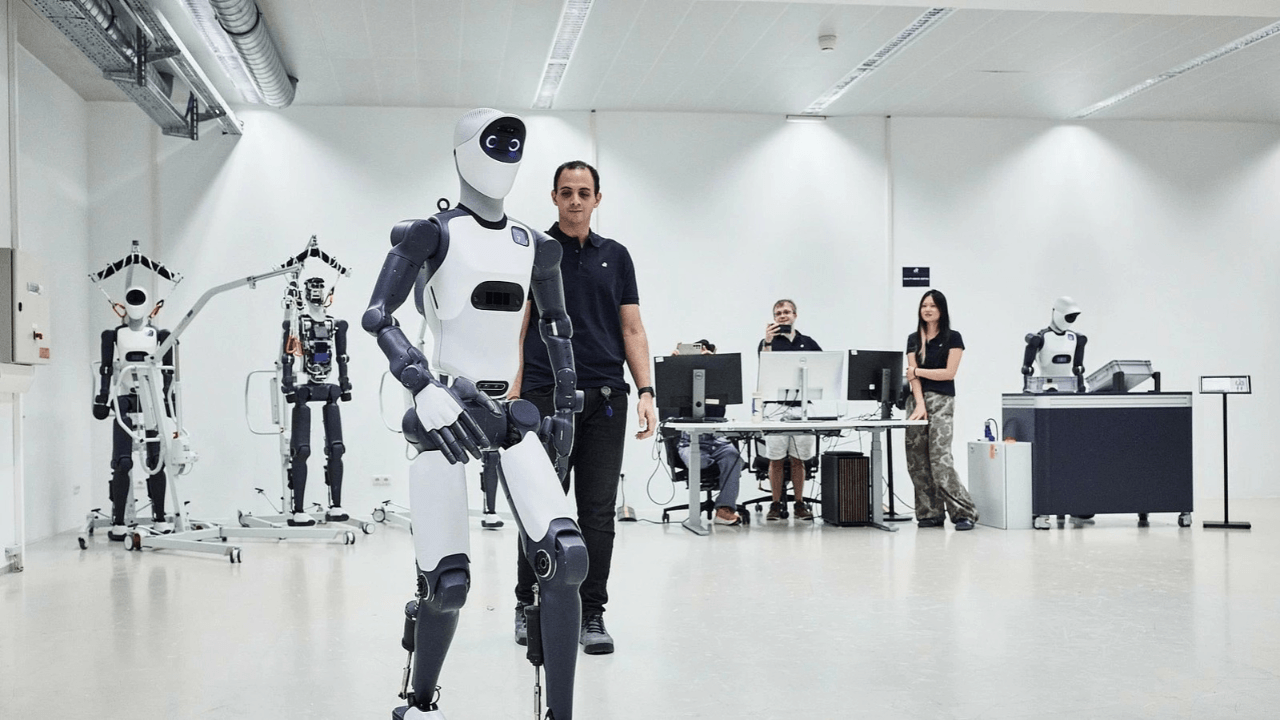
- SoftBank's $500m bet on Agile Robots. SoftBank led a $500m Series F round in German humanoid and industrial automation startup Agile Robots, with Nvidia also reported among participants [1]. The company plans US expansion, added production capacity including in Germany, and entry into new markets [5]. The round underlines that investor appetite for industrial-grade humanoids remains strong and that Europe, not only the US and China, is producing scaled contenders [1, 5]. 15
- Gemini Robotics 2.5 tested on Mercedes-Benz lines. Google DeepMind released Gemini Robotics 2.5, described as its most capable vision-language-action model, and rolled it out to partners with claimed gains in task success, completion speed and physical safety controls over earlier baselines [9, 17]. With Apptronik's Apollo 2 humanoid, it reportedly sorted metal parts at a 96 per cent success rate on active Mercedes-Benz production lines in Hungary and Germany [23]. The figures are company-reported from a pilot rather than independently verified, but they mark a notable move from lab demos to live factory settings [17, 23]. 91723
- Nvidia GR00T 2 learns from human video. Nvidia's GR00T 2 is designed to transfer human hand movements from roughly 400,000 hours of video to robot arms, avoiding costly teleoperation data collection [22]. Reported success rates range widely from 10 to 80 per cent depending on the task, showing the approach is promising but far from robust [22]. It connects to academic work such as DexSeed, which likewise seeks to turn human hand-object datasets into executable robot demonstrations [45]. 2245
- Amazon Ring enters home and business robotics. Amazon's Ring launched a Robotics division with a $250 indoor Drone Cam and a $1,000 Rover Cam, plus a business patrol bot, framed as 'proactive protection' and offering room-to-room surveillance where fixed cameras cannot reach [21, 25, 29]. Devices are due in late 2026 and early 2027 [19]. Coverage ranged from product-focused to sceptical, with The Register characterising the pitch as aimed at 'paranoids', signalling that privacy debate will accompany the launch [21, 24]. 1921242529
- Physical AI infrastructure: chips, memory and validation. Qvyon launched with $8m to validate autonomous vehicles and robots before deployment, led by MaC Venture Capital [3]. SK hynix's LPDDR5X memory received safety certification for cars and robots, Mobilint began mass production of edge AI chips with Chips&Media video codec technology aimed at multi-camera humanoids, and Nexperia launched new GaN FETs for power density [10, 18, 26]. NXP's CTO framed physical AI as extending beyond humanoids, with edge trust and geopolitics as central concerns [7]. 37101826
- Robots in the field: war, space and farms. Ukrainian forces evacuated a wounded soldier using a drone to deliver blood, an electric unicycle and a ground robot that carried him 14 km, illustrating uncrewed systems in casualty extraction [15, 28]. Separately, a robot autonomously built part of an antenna in orbit, reported as a first for in-space structural assembly [27]. A Nature Communications study modelled that small electric field robots could cut onion growing costs by 75 per cent, though the figures are theoretical and not from field trials [16]. 15162728
Themes
- Video as the new training data. Across industry and academia, the dominant technical bet is that robots can learn from video rather than hand-collected demonstrations, from Nvidia's GR00T 2 and Google's VLA model to world-action models built on video diffusion and hobbyist projects using OpenAI models [8, 9, 22, 37, 40, 45]. Research papers warn, however, that memory in such policies can degrade into mere time-keeping and that fixed refinement budgets limit efficiency, so the gap between benchmark and deployment remains real [31, 40]. 89223137
- Safety and validation move centre stage. As foundation models take control of physical systems, safety is emerging as both a product category and a research priority, seen in Qvyon's validation funding, Google's emphasis on physical safety controls, and the LEASH paper's finding that foundation-model control poses serious risks [3, 17, 43]. The AI100 report's framing of embodied AI as a grand challenge, and NXP's focus on edge trust, reinforce that reliability rather than capability may be the binding constraint [7, 11]. 37111743
- Asia's robotics diplomacy. Vietnam is actively seeking robotics partnerships, with a VNU-HCM–KIRIA framework with South Korea and analyst calls for joint field-testing with Malaysia in inspection, warehousing, agriculture and medical logistics [12, 20]. Public robot displays in Ho Chi Minh City suggest the sector is being promoted culturally as well as industrially, though state media sources should be read with that framing in mind [12, 14]. 121420
What to watch
- Whether Gemini Robotics 2.5's 96 per cent sorting result holds across more varied tasks and whether Mercedes-Benz or Apptronik move from pilot to production deployment [17, 23]. 1723
- How Agile Robots deploys its $500m, particularly the timing of US expansion and new German capacity, as a test of whether European humanoid firms can scale against US and Chinese rivals [1, 5]. 15
- Regulatory and consumer reaction to Ring's drone and rover ahead of their late-2026 and early-2027 launches, given existing scrutiny of home surveillance [19, 21, 25]. 192125
- Whether Serve Robotics' open developer portal, giving third parties and AI agents access to a fleet of 2,000 sidewalk robots, attracts meaningful usage or raises new safety and liability questions [13]. 13
Stories this analysis is based on (30)
- SoftBank leads $500M funding round in Agile Robots Tech.eu
- Qvyon launches with $8M to improve safety for physical AI deployments SiliconANGLE AI
- SoftBank leads $500m bet on German robot maker Agile Robots Tech in Asia
- NXP CTO Lars Reger on Physical AI, Robots, Drones, and Trust EE Times
- I Saw the Future of Robotics in a Virtual Duck That Chases My Cat WIRED AI
- Google DeepMind releases new advanced robotics AI model and next-generation gene prediction model SiliconANGLE AI
- Why Video Processing Matters for the Next Generation of Robots SemiWiki
- AI100 report released: embodied AI highlighted as grand challenge Robohub
- Vietnam, RoK cooperate in robot industry VietnamPlus (Vietnamese state media)
- Serve Robotics wants to democratize sidewalk delivery robots The Verge
- Robots perform martial arts, dance in lion costumes on HCMC's Nguyen Hue Walking Street VnExpress International
- Blood by drone, then a monowheel and a robot: how Ukrainian Guardsmen got one wounded soldier out Euromaidan Press
- Study: Small field robots could cut onion growing costs by 75% Future Farming
- Google DeepMind rolls out Gemini Robotics 2.5 to partners Tech in Asia
- SK hynix memory gets safety certification for cars, robots Tech in Asia
- Ring cameras go mobile as Amazon debuts AI-powered security drone and robot Ars Technica AI
- Vietnam, Malaysia hold potential for cooperation in robotics industry VietnamPlus (Vietnamese state media)
- Ring robots ready to patrol paranoids’ pads The Register
- Nvidia's model GR00T 2 watches humans on video, then imagines itself as the robot The Decoder
- Google DeepMind's Gemini Robotics 2.5 scores 96 percent sorting metal parts in a Mercedes-Benz assembly pilot The Decoder
- Amazon wants to put a flying security camera in your home, and it has a new rover robot, too. Digital Trends
- Amazon’s Ring debuts security robots including a drone NBC News
- Nexperia adds ultra-low-resistance GaN FETs for next-gen power density and efficiency Semiconductor Today
- A robot just built a structure autonomously in space for the 1st time ever Space.com
- Ukrainian forces rescue wounded soldier using bomber drone, electric unicycle and ground robot Ukrainska Pravda
- Amazon’s new Ring cameras are mounted to roving robots, including $250 Drone Cam 9to5Google
- Is Your Robot's Memory Just a Clock? Temporal Shortcuts in Memory-Augmented VLA Policies arXiv (research papers)
- From Video Frames to Robot Meta-Frames: A Unified Latent Interface for World Action Models arXiv (research papers)
- LEASH: Stay Safe in Agentic Robotics arXiv (research papers)
- DexSeed: Expanding Human Hand-Object Interactions into Robot Demonstrations for Dexterous Policy Learning arXiv (research papers)
Written by Claude Fable 5.1 (Anthropic), based on 45 recent headlines and excerpts in this section, Nov 13. AI analysis can misread or miss things: the numbers link to the original reporting, which is the authority.