Quantum technology: analysis of 17 November 2026
Back to the Chronology · Current news in this section
Analysis
SC26 became the stage for a coordinated push by NVIDIA, IBM, AMD and partners to make quantum processors first-class, schedulable components of supercomputing infrastructure, with GPU-accelerated error correction as the connective tissue.
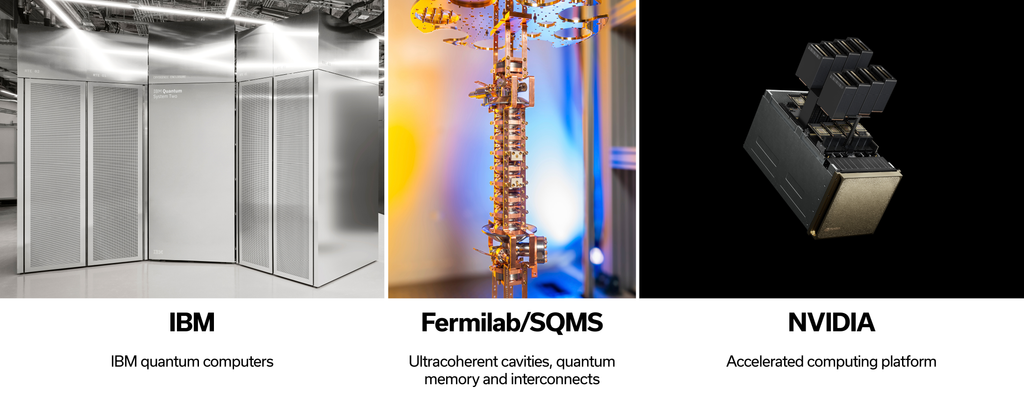
The week was dominated by announcements at the SC26 supercomputing conference, where NVIDIA extended the Slurm workload manager to treat quantum processors as schedulable resources, IBM and AMD open-sourced a GPU decoder framework for qLDPC codes, and IBM, Fermilab and NVIDIA unveiled a modular quantum-classical co-design platform 1121719. Hardware vendors and control-system firms lined up behind this hybrid model, from IQM and Oxford Quantum Circuits to AQSolotl and PsiQuantum, the latter deepening its tie to AMD with an equity investment 41417. Capital continued to flow, with Q-CTRL raising $290 million at a valuation above $1 billion and Atom Computing finalising a $100 million US Department of Commerce agreement 23. Alongside this commercial activity, the research pipeline delivered incremental advances in photonic components, cryogenic electronics and error-correction decoding, while post-quantum security deals spread to Qatar and Africa 61523273137.
Key developments
- Slurm learns to schedule QPUs. NVIDIA announced native quantum resource scheduling in Slurm 26.11, citing a near-sevenfold growth in quantum processor deployments at supercomputing centres over five years and nearly 30 centres now deploying over 50 QPUs [19][1]. IQM publicly backed the effort by integrating its superconducting machines, and the IBM/Fermilab/NVIDIA co-design platform was announced alongside it [17][1]. This matters because Slurm is the workhorse scheduler of scientific HPC; making QPUs routine resources lowers the barrier for hybrid workflows and strengthens NVIDIA's position as the integration layer. 11719
- GPU decoders go open source. IBM and AMD released Pelagos, a vendor-neutral GPU-accelerated framework for simulating qLDPC decoding at supercomputing scale, while NVIDIA shipped CUDA-Q QEC tooling including the TCBP-JOBS algorithm [12][1]. A separate arXiv paper, Beyond Blossom, claims a faster CPU-based minimum-weight perfect matching decoder for surface codes using local predecoding [37]. Together these signal that real-time decoding has become a central engineering bottleneck for fault tolerance and that classical hardware vendors see it as a market. 11237
- Big cheques for control software and neutral atoms. Q-CTRL's $290 million Series C, led by Salesforce Ventures, values the control-software firm at over $1 billion and is earmarked for AI-driven control and commercial deployments [3]. Atom Computing finalised a $100 million R&D agreement with the US Department of Commerce to scale manufacturing of fault-tolerant systems in Boulder [2]. Both deals show investors and governments funding the enabling layers, control and manufacturing, rather than only headline qubit counts. 23
- Photonics pushes on loss and scale. Xanadu and HyperLight reported optical switch insertion loss of 7 millidecibels using thin-film lithium niobate, described as nearly a threefold improvement on their previous milestone [6]. QuiX Quantum is leading a Dutch national mission with eight partners to build a 100-plus-qubit universal photonic processor by December 2028, and PsiQuantum secured an AMD equity investment to co-design its classical infrastructure [4][7]. Switch loss is a known hard constraint for photonic architectures, so these component-level gains are meaningful even if system-level results remain to be shown. 467
- Quantum-classical chemistry result. IBM, RIKEN and NVIDIA reported a 79-fold improvement in energy accuracy for simulations of iron-sulfur clusters by seeding sample-based quantum diagonalisation with broken-symmetry Hartree-Fock reference states [11]. Iron-sulfur clusters are a long-standing benchmark for correlated chemistry, and the result reinforces IBM's strategy of hybrid algorithms that lean heavily on classical compute, though it is a reported research claim rather than an independently validated advantage. 11
- Post-quantum security goes global. Qatar's communications ministry signed with SignQuantum on quantum-risk readiness, Liquid C2 and Graphiant launched a quantum-secure network-as-a-service in Africa, and Saltgrain with NTT Research claimed the first practical large-universe post-quantum encryption scheme [15][23][27]. All three are press-release announcements, but they illustrate that migration to post-quantum cryptography is now being marketed well beyond the US and Europe. 152327
Themes
- NVIDIA as the hybrid hub. NVIDIA appeared in at least six of the week's announcements, spanning scheduling, decoders, co-design, chemistry and low-latency control links such as AQSolotl's 6.94-microsecond NVQLink test and the Altera/OQC FPGA controller [1][11][12][14][17][19][21]. AMD's parallel moves with IBM and PsiQuantum suggest a competitive race among GPU makers to own the classical side of fault-tolerant quantum systems [4][12]. 14111214
- Fault tolerance as an engineering stack. Beyond decoders, the week brought a picowatt cryoCMOS multiplexer, a near-quantum-limited diamond microwave amplifier, work on defects that return lost qubit energy, teleportation of encoded logical information and agentic AI for discovering fault-tolerant circuits [8][20][25][31][34]. The pattern is a shift from isolated qubit demonstrations to the many ancillary components needed for scaled, error-corrected machines. 820253134
- Enterprise adoption and talent. JPMorgan Chase topped a 64-institution finance quantum index, Classiq and Ventum targeted German enterprises, and a hackathon drew over 1,000 participants in 37 countries [13][22][24]. These items point to demand-side maturation, though indices and hackathons measure engagement rather than deployed value. 13222426
What to watch
- Whether Slurm 26.11's quantum scheduling and the Pelagos decoder see uptake at centres beyond the launch partners, which would confirm the hybrid model is becoming standard rather than vendor-driven [12][17][19]. 121719
- Q-CTRL's and Atom Computing's use of fresh capital, including any manufacturing milestones from Boulder and whether the Department of Commerce deal is followed by similar awards to other firms [2][3]. 23
- Photonic system-level results from Xanadu and PsiQuantum that translate component gains such as 7 mdB switch loss into working error-corrected modules [4][6][7]. 467
- IonQ's finance leadership change, with a new CFO and chief accounting officer framed around a path to profitability, ahead of its next earnings cycle [29]. 29
Stories this analysis is based on (25)
- IBM, Fermilab, and NVIDIA Unveil Modular Quantum Co-Design Platform, Slurm HRES Integration, and GPU QEC Tools at SC26 Quantum Computing Report
- Atom Computing Finalizes $100 Million U.S. Department of Commerce R&D Agreement for Fault-Tolerant Quantum Systems Quantum Computing Report
- Q-CTRL Raises $290 Million in Series C Funding Led by Salesforce Ventures to Scale Quantum Infrastructure Software Quantum Computing Report
- PsiQuantum and AMD Expand Partnership with Equity Investment to Co-Design Utility-Scale Quantum Infrastructure Quantum Computing Report
- Xanadu and HyperLight Cut Optical Switch Loss to 7 mdB Using Thin-Film Lithium Niobate Quantum Computing Report
- QuiX Quantum and Dutch Photonics Consortium Form National Mission for 100+ Qubit Computer Quantum Computing Report
- Ultracold diamond microwave laser amplifies quantum signals 1,000-fold Phys.org Quantum Physics
- IBM, RIKEN, and NVIDIA Achieve 79x Accuracy Gain in Quantum-Classical Simulations of Iron-Sulfur Clusters Quantum Computing Report
- IBM and AMD Open-Source Pelagos GPU Decoder Framework for Large-Scale qLDPC Error Correction Simulations Quantum Computing Report
- From First-Timers to PhDs: 1,000+ Builders Take on Quantum at the Qollab × IonQ Hackathon The Quantum Insider
- AQSolotl Reports 6.94-Microsecond Latency in NVIDIA NVQLink Integration Test The Quantum Insider
- Saltgrain and NTT Research Develop Large-Universe Post-Quantum Encryption The Quantum Insider
- IQM Supports NVIDIA’s Work to Make Quantum Computers Schedulable in Slurm The Quantum Insider
- NVIDIA Expands Slurm to Bring Quantum Computing Into Supercomputing NVIDIA Blog
- Hidden defects return a qubit's lost energy Phys.org Quantum Physics
- JPMorgan Chase Tops The 2026 Finance Quantum Index; HSBC, Wells Fargo Share Second Place The Quantum Insider
- Liquid C2 and Graphiant Partner on Quantum-Secure Networking in Africa The Quantum Insider
- Classiq and Ventum Consulting Partner on Enterprise Quantum Computing in Germany The Quantum Insider
- Quantum teleportation method uses weaker entanglement to transfer encoded information Phys.org Quantum Physics
- 15 Finalists Named in Global Quantum + AI Challenge The Quantum Insider
- Qatar’s MCIT Partners with SignQuantum on Post-Quantum Cybersecurity The Quantum Insider
- IonQ Appoints Gary Merrill as CFO and Thomas Austin as Chief Accounting Officer The Quantum Insider
- CryoCMOS RF multiplexer for superconducting qubit control, readout and flux biasing at millikelvin temperatures with picowatt power consumption npj Quantum Information
- Agentic AI for Discovering Fault-Tolerant Quantum Circuits arXiv (research papers)
- Beyond Blossom: Accelerating MWPM Decoding for Surface Codes With Local Predecoding and Architecture-Aware Optimizations arXiv (research papers)
Written by Claude Fable 5.1 (Anthropic), based on 45 recent headlines and excerpts in this section, 3d ago. AI analysis can misread or miss things: the numbers link to the original reporting, which is the authority.