Nationalism: analysis of 12 November 2026
Back to the Chronology · Current news in this section
Analysis
Across Poland, Israel and the United States, the week's reports show nationalist politics contesting who belongs to the nation—ethnically bounded commemoration in Warsaw, a right-wing campaign to delegitimise Arab citizens' unprecedented 19 Knesset seats, and a post-midterm fracturing of the transat
The dominant pattern is boundary-drawing: Poland's 11 November march proceeded days after a deadly Krakow attack reported as linked to far-right ideology 12, Israel's right is reported to be contesting the legitimacy of a record Arab electoral result 22, and Taiwan's entry procedure for a mainland tourist turned a bureaucratic form into a sovereignty test 3. A second pattern is the external shock of the US midterms, described by several outlets as a heavy Republican defeat, which is prompting European far-right leaders to distance themselves from Donald Trump 19 while American allies continue to hedge 12303135. Third, states continue to instrumentalise memory and culture—Moscow decorating Transnistria's leader for 'Russian values' 17, Vietnam converting cultural identity into soft power 510, and scholarship on monuments and textbooks in Estonia, Romania and Moldova 3334. Many items are opinion or state-media pieces and are flagged as such below.
Key developments
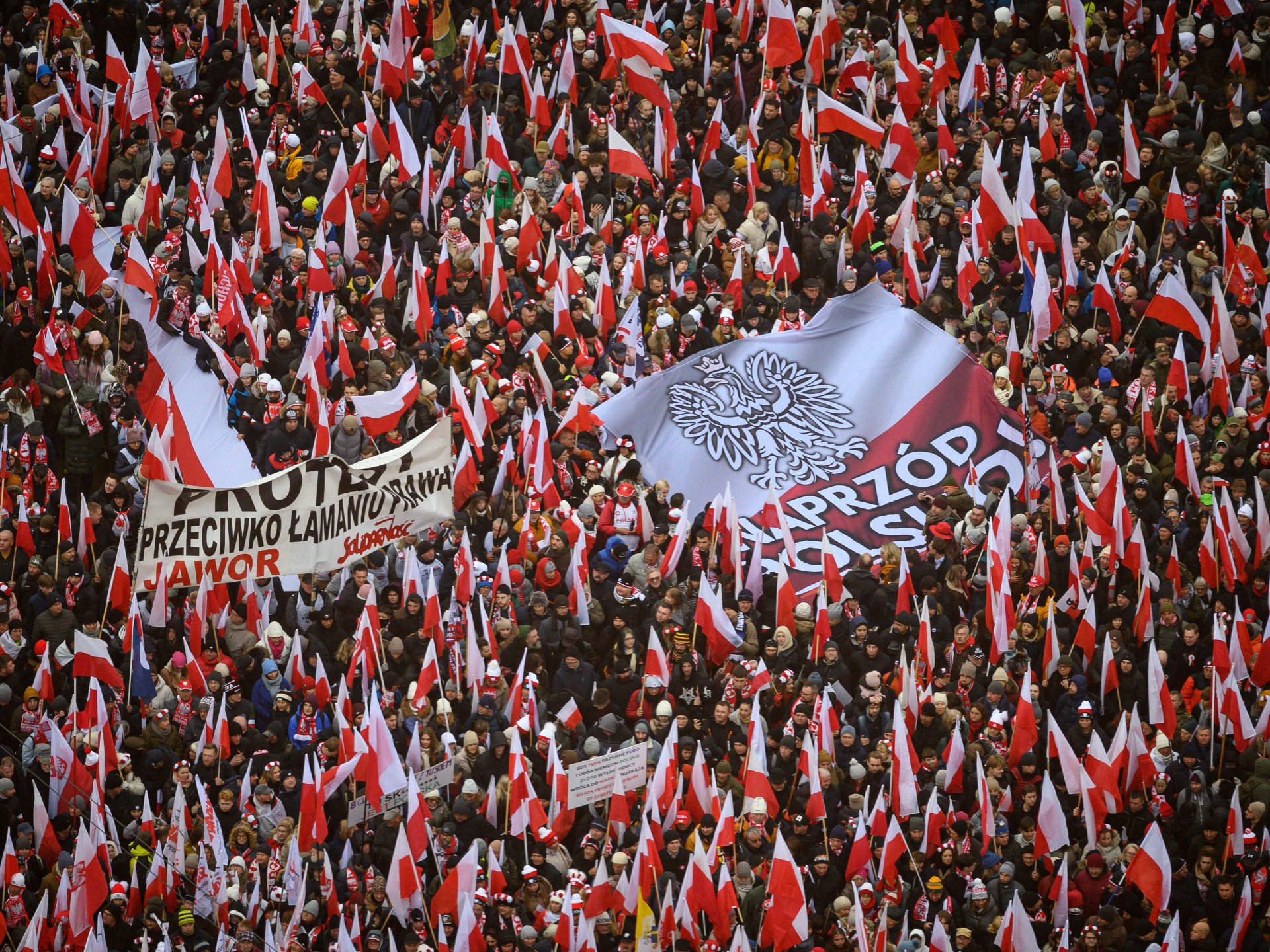
- Poland: commemoration under the shadow of violence. Tens of thousands joined the annual nationalist Independence Day march in Warsaw, held to mark the 1918 end of 123 years of partition, days after a deadly attack in Krakow that reports link to far-right ideology; Prime Minister Donald Tusk called for restraint and unity [1][2]. The juxtaposition matters because it tests whether a civic-governmental narrative of 1918 can coexist with an ethnonationalist street mobilisation; UnHerd's commentary that Poland's 'multiethnic model is history' amid an anti-migrant backlash is an interpretive claim, not an established fact [7]. 127
- Israel: contesting the Arab vote after an inconclusive election. Following inconclusive election results, Arab citizens' representatives secured 19 of the Knesset's 120 seats, and the political right has united behind Benjamin Netanyahu in seeking to delegitimise that outcome, according to Verfassungsblog [22]. The Guardian letters page debates whether the anti-Netanyahu opposition can win without common cause with Palestinian citizens, raising the question of Israel's self-definition [16]; the episode is a live case of ethnic-majority nationalism confronting the arithmetic of a civic electorate. 1622
- US midterms ripple through the nationalist international. After what the Guardian describes as a historic Republican midterm defeat, European far-right leaders moved quickly to distance themselves from Trump and emphasise domestic priorities [19], while within MAGA a new group, American Ascent, seeks to push the GOP further right with young 'America First' candidates [13] and records reportedly tie a college Republican coalition to white supremacist Nick Fuentes [8]. Responsible Statecraft (restraint-oriented) frames Marjorie Taylor Greene's break with Trump as vindicated [14]; analysts advise that allies should keep hedging regardless of the result [12][30][31]. 812131419
- Taiwan: an entry form becomes a sovereignty dispute. A mainland Chinese tourist was asked to sign a declaration recognising Taiwan as an independent state to obtain an entry permit, prompting Beijing to condemn the DPP for imposing political conditions [3]. The incident illustrates how everyday administrative practice can perform statehood and how Beijing reads such performances as provocation, connecting to scholarship on Russia's and China's self-image as 'anti-colonial' yet imperial powers [32]. 332
- Transnistria and the politics of patronage. Moldova imposed a travel ban on Transnistria's leader Vadim Krasnoselsky after Vladimir Putin awarded him for upholding 'Russian values', generating controversy in the EU candidate state [17]. The award exemplifies a patron state conferring symbolic recognition on a separatist entity, reinforcing a civilisational boundary that research on Soviet monuments in Estonia and textbooks in Romania and Moldova shows is fought across the region through memory politics [33][34]. 173334
- Bangladesh–India friction over Hasina's documents. Ousted Prime Minister Sheikh Hasina, described by Asia Times as a convicted fugitive facing extradition, has sought a new passport and identity card via London lawyers, setting Dhaka and New Delhi on a collision course [9]. A new article frames her regime's legitimation as 'BengaliAwamism', a party-centric secular ethnopopulism that de-democratised the state [28]—a reminder that exclusionary nationalism is not confined to the religious right. 928
Varieties of nationalism
- Christian nationalism's cultural turn. The Illiberalism Studies Program reads Pete Hegseth's D-Day remarks and Tolkien's mythopoeia as a search for a 'new founding text' for white Christian nationalism [23], while a British study shows theology used both to justify exclusion and to inspire hospitality towards migrants [26]. These analyses suggest religious nationalism is being re-mythologised through literature and theology, not only mobilised through policy. 112326
- Secular ethnopopulism and de-democratisation. The 'BengaliAwamism' framework argues that an exclusive, party-centric secular Bengali nationalism undermined Bangladeshi democracy [28], complicating the common equation of illiberal nationalism with religious revival. Read alongside Hindu-nationalist influence being challenged among South Asian American voters [18], the South Asian cases show nationalism's democratic effects depend more on exclusivity than on secular or religious content. 91828
- Restraint versus order on the American left. Liberal Currents argues that progressive 'restrainers' offer an incoherent proposal for world order [6], while Project Syndicate contends that even a post-'America First' US will not return to reliable leadership [12]. The debate is over whether sovereigntist retrenchment is a right-wing aberration or a bipartisan structural trend. 61230
- Anti-ethnonationalist civic mobilisation. An ECPS interview argues Serbia's student movement shows the Western Balkans are 'not condemned to tyranny and ethnonationalism' [21], an optimistic reading that should be weighed against entrenched elite control described elsewhere in the region [20]. It frames youth-led civic protest as a counter-current to both nationalist and oligarchic capture. 2021
Themes
- Membership as the battlefield. Whether in Israel's contest over Arab representation [22][16], Poland's anti-migrant mood [7], European deportation regimes reshaped by ethnonationalist politics [27], or British Christian attitudes towards migrants [26], the core dispute is who counts as a full member of the political community. The pattern suggests that electoral and administrative instruments—seat legitimacy, deportation, entry permits [3]—are now primary sites where ethnic and civic conceptions clash. 37162226
- Transnational nationalism's fragility. The post-midterm distancing by Europe's far right [19], the Fuentes–college Republican links [8] and the Hegseth-focused critiques [11][23] show that 'America First' functions as a transnational brand whose value fluctuates with US electoral fortunes. Nationalist internationals are structurally awkward: each movement claims sovereignty yet depends on a foreign standard-bearer, as the Czech case of a 'MAGA spirit' culture war illustrates [20]. 811192023
- State-curated identity as resource. Vietnam's state media explicitly treats cultural identity and cuisine as inputs to international standing [5][10], while Moscow rewards 'Russian values' abroad [17] and Estonia re-signifies Soviet monuments [33]. Across regime types, identity is managed from above as a strategic asset rather than merely expressed from below. 5101733
By region
- Europe. Poland's march and the Krakow attack [1][2][7], the Czech government's reported culture-war pressure on the press [20], Moldova's ban on Transnistria's decorated leader [17] and the far right's post-midterm recalibration [19] point to a continent where nationalism is both electorally mainstream and internally divided. Scholarship on deportation regimes [27], Estonian monuments [33] and Romanian–Moldovan textbooks [34] shows the state apparatus itself as a vehicle of national boundary-making. 1271719
- North America. The midterm defeat has exposed fissures within 'America First'—youth insurgents [13], Fuentes-linked networks [8], and the Greene–Trump feud [14]—while South Asian American progressives outpaced identity-based and Hindu-nationalist-aligned candidates [18]. Analyses of the Anglo-American relationship and allied hedging suggest sovereigntist unpredictability outlasts any single administration [12][30]; Quebec's shifting secession dynamics among younger cohorts add a separatist dimension [29]. 812131418
- East Asia. Taiwan's independence declaration for a mainland tourist [3] and Vietnam's conversion of cultural identity into soft power [5][10] show two Asian polities performing nationhood through administrative and cultural channels. Note that the Vietnamese items are state media; the Taiwan item reports Beijing's condemnation of the DPP. 351032
- Middle East. Israel's post-election struggle over the legitimacy of 19 Arab-held seats [22][16] is the sharpest test of ethnic versus civic definitions of the state this week. Iran's state media claim of arresting five 'separatist terrorists' in Kermanshah and elsewhere [4] is unverified and reflects Tehran's securitised framing of minority-region dissent. 41622
- Latin America. Jacobin (socialist) reports that Lula defeated Flávio Bolsonaro for a fourth term and argues austerity now splits his coalition [15], suggesting that the nationalist-populist right's electoral setback does not resolve distributive conflict. Experts surveyed by the Inter-American Dialogue expect US midterm results to shape regional policy but offer no single verdict [31]. 1531
- Africa. An LSE blog warns that 'America First' cuts to health assistance and proposed replacements raise questions about African control over health systems and data [35]. This frames sovereignty not as rhetoric but as practical capacity, inverting the usual direction of sovereigntist discourse. 35
Analytical lenses
- Civic versus ethnic nationalism. The dichotomy illuminates Israel's right contesting Arab citizens' votes [22][16], Poland's commemoration-versus-backlash tension [1][7] and the Hasina regime's exclusionary secular nationalism [28]: in each, formal citizenship is uncoupled from substantive membership. It misses how states like Vietnam [5][10] or Taiwan [3] deploy civic-sounding cultural and administrative tools that nonetheless harden external boundaries. 1371622
- Ontological security and memory politics. The concept—states' need for a stable self-narrative—explains why Estonia re-signifies Soviet monuments [33], why Moscow decorates a Transnistrian leader for 'Russian values' [17], why textbooks curate rival pantheons in Romania and Moldova [34], and why Poland's 1918 date mobilises crowds [2]. It explains persistence of symbolic conflict but says less about why memory sometimes turns violent, as the Krakow attack suggests [1]. 12173334
- Transnational diffusion of populist nationalism. Diffusion theory accounts for the 'MAGA spirit' in Czech politics [20], Fuentes-linked student networks [8] and European leaders' rapid distancing once the US model faltered [19]: ideas travel via brands and exemplars whose prestige is contingent. It struggles to explain cases moving against the current, such as South Asian American voters rejecting Hindu-nationalist-aligned candidates [18] or Serbia's civic student movement [21]. 818192021
What to watch
- Whether Israel's right translates rhetorical delegitimisation of the Arab vote into institutional measures during coalition bargaining, which would mark a shift from majoritarian to formally exclusionary nationalism [22][16]. 1622
- How Tusk's government handles investigation of the Krakow attack and policing of nationalist mobilisation without ceding the 1918 commemoration to the far right [1][2][7]. 127
- Whether European far-right parties' distancing from Trump is tactical or signals a durable 'national-first' rebranding, and whether youth-oriented MAGA groups capture the post-defeat GOP [13][19]. 1319
- Beijing's response beyond condemnation to Taiwan's entry-permit practice, and whether Taipei revises the requirement under pressure [3]. 3
Stories this analysis is based on (31)
- Tens of thousands join Poland’s nationalist Independence Day march Al Jazeera
- Tens of thousands attend Polish nationalist march days afer shootings Euractiv
- Outcry after Taiwan asks mainland Chinese tourist to sign independence statement SCMP China
- Iran dismantles terrorist cell, arrests arms smugglers IRNA (Iranian state media)
- “Cultural Crossroads — Beyond Flavours” promotes Vietnamese culinary arts Nhân Dân (Vietnamese state media)
- The Left Needs to Get Serious About World Order Liberal Currents
- Poland's anti-migrant backlash UnHerd
- White supremacist Nick Fuentes linked to college Republican group, records show The Guardian US
- Hasina’s passport bid puts Dhaka and Delhi on a collision course Asia Times
- Building trust and enhancing Viet Nam’s international standing Nhân Dân (Vietnamese state media)
- John Oliver on Pete Hegseth’s military plans: ‘Dr Seuss for concussed bigots’ The Guardian US Politics
- The Midterms Won’t Change Much for US Allies Project Syndicate
- ‘Old ideas are for old people’: A new MAGA group looks to push GOP further right Politico
- The vindication of Marjorie Taylor Greene Responsible Statecraft
- Austerity Is Now the Central Conflict in Brazilian Politics Jacobin (socialist)
- Israel’s election and self-definition invite questions | Letters The Guardian Israel
- Transnistria’s Separatist Leader Decorated by Moscow, Denounced by Moldova Balkan Insight
- The Midterms Mark a Progressive Turn for South Asian Americans New Lines Magazine
- Europe’s far right has a Trump problem after Republican US midterms wipeout The Guardian Far right
- The Czech government's new culture war assault on press freedom shows the Maga spirit is still alive in Europe | Jan Bělíček The Guardian Far right
- Prof. Turčalo: Serbia’s Student Movement Showed That the Western Balkans Are Not Condemned to Tyranny and Ethnonationalism European Center for Populism Studies
- The Delegitimisation of the Arab Vote in Israel Verfassungsblog
- “A New Founding Text for Our People”: White Christian Nationalism and Tolkien’s Mythopoeia Illiberalism Studies Program (GWU)
- Theology at the Intersection of Mission and Christian Nationalism: Exploring Attitudes Among British Christians in an Age of Anti-Migration Anxiety Journal articles (OpenAlex)
- From liberation to prohibition: BengaliAwamism, ethnopopulism and the de-democratisation of Bangladesh Journal articles (OpenAlex)
- The second Trump administration and the Anglo-American special relationship: A test of alliance persistence Journal articles (OpenAlex)
- What Will the U.S. Midterms Mean for Latin America? Inter-American Dialogue
- Anti‐Colonial Colonialism: Imperialist Identities of Russia and China in Their Quest for Post‐Subalternity Nations and Nationalism (journal)
- Re‐Signifying Soviet Monuments: State Self‐Description, Memory Politics and Ontological Security in Estonia Nations and Nationalism (journal)
- Pantheon(s) of National Heroes: A Content Analysis of History Textbooks in Post/Socialist Romania and the Republic of Moldova Nations and Nationalism (journal)
- What does an America First global health strategy mean for African sovereignty? Africa at LSE blog
Written by Claude Fable 5.1 (Anthropic), based on 35 recent headlines and excerpts in this section, Nov 12. AI analysis can misread or miss things: the numbers link to the original reporting, which is the authority.