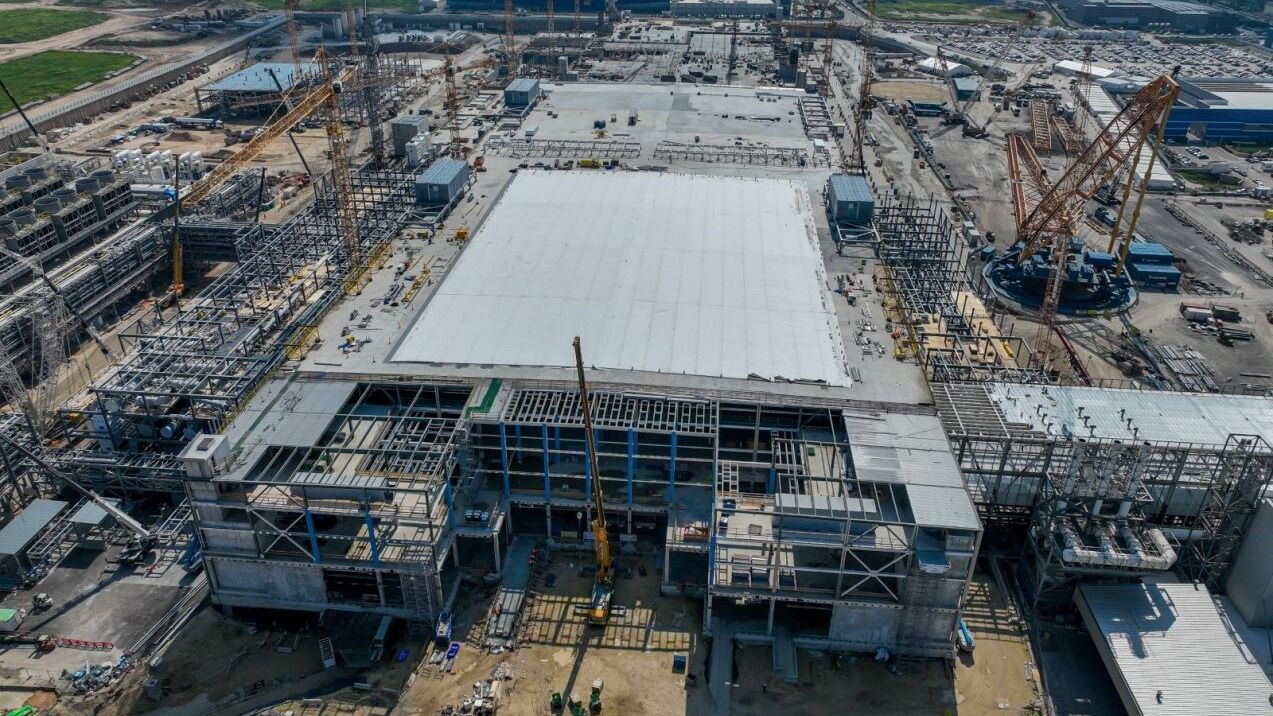
This $4 billion industrial park would make it easier for smaller Taiwanese companies who can't afford to build their own sites in the U.S. to expand and follow major Taiwanese manufacturers like TSMC and Foxconn.
Seattle startup TriMagnetix has $1 million in new funding to build semiconductors that use electrical pulses to process data, drawing a fraction of the energy needed by traditional chips. The two-person team is setting its sights on space, where satellite companies need radiation-resistant, efficient hardware.
SK Hynix’s Solidigm is reportedly seeking U.S. approval to send more chipmaking equipment to China as it weighs building a new NAND chip factory in America.
Taiwan-based Winbond Electronics, led by University of Washington alumnus Arthur Chiao, is giving $12 million to the university's College of Engineering. The fund will support scholarships, research, and faculty hiring across high-impact fields including semiconductors, AI, quantum tech and advanced manufacturing.
In today's era, the marginal benefits of transistor scaling are continuously decreasing, and Chiplet heterogeneous integration has become the mainstream path for scaling AI chip computing power. Meanwhile, on-chip interconnect performance is increasingly becoming the key factor limiting system computing power and energy efficiency. This paper focuses on on-chip network technology for Chiplet-integrated AI chip architectures, providing a systematic review and analysis of its…
In the current era of the 21st century, as the world's population has already reached a historic milestone of 8 billion, the urban scale has expanded and the population density of cities has tremendously risen. Similar to the trend of urban construction, the chips have also developed. For instance, the SoC (System-on-Chip) has some key additions, including upgraded ray tracing-supportive GPUs, new CPU microarchitectures and dedicated artificial intelligence accelerators…
As the semiconductor industry rapidly embraces chiplet-based architectures to satisfy AI-driven high-performance computing demands, the flexible, scalable I/O‑Die (IOD) chiplet offers a promising path toward solving the AI memory wall. However, the design of these IOD chiplets for flexibility and reuse across products dictates a fixed peripheral placement for all memory controllers and die-to-die interfaces, creating unique and largely unexplored challenges. This rigid…
The integration of rigid microscale electronics onto soft and flexible polymer substrates remains a key challenge for flexible electronics, biointegrated systems, and body-first microrobotics, where the mechanical body, material architecture, morphology, and primary functions are designed first, while the electronic processing unit (e.g., a Si CMOS chiplet), acting as the brain to control the robot´s functionalities, is integrated later. Existing approaches, including…
Consumer electronics powered by on-device artificial intelligence face a structurally coupled dual threat: adversarial attacks that manipulate model outputs, and side-channel attacks that exploit physical implementation characteristics to extract cryptographic keys and neural network weights. Prior work addresses these threats independently, leaving exploitable gaps when both attack vectors are applied in a coordinated manner. This paper presents ChipGuard-AI, a…
Figure 1: CUDA-to-MLX optimization translation map. CUDA optimization knowledge can be translated into architecture-native MLX strategies rather than copied instruction-for-instruction. We face a new epoch in computing. Hardware is changing rapidly — not just faster GPUs, but a growing range of chips from different vendors, each with its own architecture and often tailored to specific AI workloads. Software is changing just as fast, and AI coding tools now generate in…
The US–China rivalry is focusing attention on how geoeconomics impacts corporate operations and global production networks. States are seeking to weaponize interdependence through policies like sanctions and export controls, and through instrumentalizing corporations as tools to secure relative gains over geopolitical rivals. This article examines how firms’ territorial embeddedness complicates states’ weaponization efforts. To illustrate this phenomenon, we investigate…
This article explores how the Artificial Intelligence (AI) race has intensified global com- petition but also created avenues for international cooperation and developments in inter- national law. The study refines the concept of ‘Tech Diplomacy’ and introduces a novel definition of ‘AI Diplomacy’ as distinguished from ‘AI Statehood’ and ‘AI Sovereignty’. The examination concludes by identifying how ‘AI Diplomacy’ through governance and capacity-building can become a tool…
Since the late 2010s, the global economy has been confronted with immense challenges – from geopolitical tensions and climate change to the COVID-19 pandemic, territorial wars, trade conflicts and so on. While the unfettered economic globalisation of the 1990s and the 2000s might be over, a renewed interest in the global shift of industrial production (back to developed countries and their allies) has now preoccupied the policy priorities of many state authorities and…
This paper presents an empirical examination of the Arsal hostage crisis in Lebanon, when Jabhat Al-Nusra and Islamic State kidnapped over 35 soldiers and police officers in 2014. Following interviews with 30 hostages’ families and analysis of the jihadists’ propaganda, three themes emerge. First, the hostage-taking had intrinsic emotional value for the jihadists and was not only a means to secure extrinsic concessions. Second, the crisis was often shaped by local…
Against the backdrop of the digital age, technological competition has become an important factor shaping great-power relations. U.S. export controls on high-end chips to China have pushed technology issues from the economic domain into the domain of strategic competition, thereby transforming the mode of China-U.S. diplomatic interaction. This paper argues that current China-U.S. diplomatic interaction exhibits the coexistence of strategic competition, policy contestation…
Semiconductor and AI-enabling supply chains face unprecedented disruption from export-control regimes such as the U.S. CHIPS and Science Act. While these policies are intended to safeguard national security, they can also fragment global supply chains and accelerate technological advancement in rival nations. This study develops a quadripartite gametheoretic model involving a regulator, a key technology supplier, a regulated firm, and a rival nation to explore how fines…