Results for “Robot”

Journal articles (OpenAlex) Andrés García-Vanegas, María J. García-Bonilla · Robotics

AgroCableBot: Experimental Validation of a Reconfigurable Cable-Driven Parallel Robot for Precision Agriculture and Crop Monitoring

Precision agriculture requires robotic platforms capable of covering large cultivation areas while providing accurate positioning for localized crop monitoring and management operations. Cable-driven parallel robots (CDPRs) offer large workspaces and lightweight moving structures; however, their usable workspace is constrained by cable tension requirements. This study presents the experimental validation of AgroCableBot, a reconfigurable CDPR for precision agriculture…
Read at Journal articles (OpenAlex)

Journal articles (OpenAlex) Yongyun Zhu, Cundeng Wang, Bingbo Cui et al. · Agriculture

From Crop-Row Perception to Autonomous Row Following: A Review of Perception, Navigation, and Control for Agricultural Robots

Crop-row following is an important basis for inter-row operations such as sowing, weeding, spraying and harvesting. Its performance depends not only on the accuracy of crop-row perception but also on the coordination of navigation representation, localization and state estimation, path planning, headland turning, and obstacle handling. Accordingly, this review focuses on the research and analysis of autonomous tracking of agricultural robots. This review examines crop-row…

Read at Journal articles (OpenAlex)

Journal articles (OpenAlex) Juvenal Duval Ngakeu, Deborah Nsamba, Alben Cardenas et al. · Robotics

Perception–Affordance–Action: The Case of Agricultural Robots and Vehicles

The perception–affordance–action loop constitutes a fundamental framework for enabling advanced capabilities in semi-autonomous and autonomous robots. By allowing for robots to perceive their environment, interpret actionable possibilities (affordances), and execute appropriate actions, this loop ensures reliable, precise, and safe operation. This paradigm is particularly crucial in complex and dynamic domains such as agriculture. Semi-autonomous vehicles and robots are…

Read at Journal articles (OpenAlex)

Journal articles (OpenAlex) Jose Maria Bengochea-Guevara, Héctor Montes, María Nuria Conejero et al. · Advanced Intelligent Systems

A Distributed Multirobot Architecture for Decoupled Inspection and Localized Treatment in Precision Agriculture

This work presents a distributed multirobot architecture for autonomous inspection and precision treatment in agriculture, validated under real vineyard conditions. The proposed system integrates a heterogeneous fleet of four specialized ground robots (two inspection and two treatment platforms), coordinated through a cloud‐based mission control center (MCC). The MCC acts as the cognitive layer of the system, integrating CNN‐based disease detection, mission planning, and…

Read at Journal articles (OpenAlex)

Journal articles (OpenAlex) Yeji Lee, Vineeth Kumar Bandari, Daniil Karnaushenko et al. · Small Methods

Solid‐Liquid Interdiffusion Bonding Enabling Heterogeneous Integration on Flexible and Shapeable Polymer Platforms

The integration of rigid microscale electronics onto soft and flexible polymer substrates remains a key challenge for flexible electronics, biointegrated systems, and body-first microrobotics, where the mechanical body, material architecture, morphology, and primary functions are designed first, while the electronic processing unit (e.g., a Si CMOS chiplet), acting as the brain to control the robot´s functionalities, is integrated later. Existing approaches, including…

Read at Journal articles (OpenAlex)

Journal articles (OpenAlex) Hamed Nozari, Zornitsa B. Yordanova · AgriEngineering

An Intelligent LLM–Fuzzy Decision Support and Digital Twin Framework for Adaptive Agricultural Robotics Systems

This study develops an integrated LLM–fuzzy decision-support and digital twin framework for adaptive agricultural robotics, combining semantic reasoning, fuzzy inference, multi-objective optimization, and feedback-driven state updating. Numerical sensor data, operational information, and textual field knowledge are transformed into validated decision rules and model-ready parameters, enabling coordinated decisions across economic, operational, crop-stress, and…

Read at Journal articles (OpenAlex)

Journal articles (OpenAlex) Tao Liu, Yinling Xie, Yang Li et al. · Engineering

ECT-VR: Intuitive Teleoperation via Hybrid Virtual–Reality Immersive Interaction with Multi-Sensor Perception for Agricultural Robots

Fully autonomous robots are still difficult to deploy in complex, unstructured, and dynamic agricultural environments, whereas conventional teleoperation systems suffer from insufficient environmental information and poor spatial intuitiveness. To overcome these limitations, this paper presents enhanced conventional teleoperation with virtual reality (ECT-VR), an immersive teleoperation system for agricultural mobile robots based on hybrid three- and two-dimensional (3D+2D)…

Read at Journal articles (OpenAlex)

Journal articles (OpenAlex) Hirohisa Kojima, Sajjad Keshtkar, Pavel M. Trivailo · Advances in Space Research Space

Adaptive coordinated control of space robot with robotic arm and CMG for detumbling space debris

The increasing amount of space debris poses a significant threat to the long-term sustainability of space activities, necessitating effective debris-removal methods. A major challenge in active debris removal is detumbling uncooperative targets with unknown mass and inertial properties. Conventional space robots equipped with reaction wheels have difficulty absorbing large angular momentum, which restricts their effectiveness in such missions. This paper proposes an adaptive…

Read at Journal articles (OpenAlex)

Journal articles (OpenAlex) Ziyuan Ma · Theoretical and Natural Science

Optimization and Analysis of Agricultural Robot Drive Systems

This study takes the agricultural robot drive system as the research object and carries out optimization research from two dimensions: mechanical structure and intelligent control. At the mechanical level, redundant degrees of freedom are eliminated through topological analysis of mechanism freedom, a 'short-chain direct-drive' transmission scheme is introduced to reduce mechanical losses, and finite element topology optimization is combined to achieve lightweight design of…

Read at Journal articles (OpenAlex)

Journal articles (OpenAlex) Temuçin Göktürk Seyhan, Sinem Seyhan, Hasan Silleli · Horticulturae

Design and Engineering Proof-of-Concept of a Robotic Variable-Height Vertical Farming System for Energy-Efficient Canopy Lighting

This paper presents the design and engineering proof-of-concept evaluation of a robotic variable-height, four-level vertical farming system that mechanically advances plant rows daily through compartments of increasing height, so that the luminaire-to-canopy distance is matched to the crop development stage. One prototype robotic system and one fixed-height multi-shelf reference system were built and operated in parallel in a single shared room, from a common nutrient…

Read at Journal articles (OpenAlex)

Journal articles (OpenAlex) Zuojin Li, Xin Zheng, Linlu Dong et al. · Electronics

Simulation-Based Evaluation of Robust Multi-Sensor Localization for Tracked Agricultural Robots Under Asymmetric Track Slip and Single-Coordinate GNSS Anomalies

Tracked agricultural robots operating on soft ground may experience asymmetric left–right track slip, while two-dimensional global navigation satellite system (GNSS) observations may contain a dominant anomaly in one coordinate. This simulation study evaluates a robust multi-sensor localization method for this coupled degradation. Independent left–right slip ratios are introduced into a six-state extended Kalman filter (EKF) to improve motion prediction. A…

Read at Journal articles (OpenAlex)

Journal articles (OpenAlex) Bahador Beigomi, Mohatashem Reyaz Makhdoomi, Miguel A. Olivares-Méndez et al. · Robotics and Autonomous Systems Space

Curriculum-driven reinforcement learning for autonomous pre-capture of dynamic space debris

The rapid growth of anthropogenic debris in Earth’s orbit demands advanced robotic solutions for autonomous on-orbit capture and removal. In microgravity, uncontrolled debris exhibits complex six-degree-of-freedom (6-DoF) translational and rotational dynamics, making precise pre-positioning of robotic manipulators before grasping highly challenging. To address this, we present a reinforcement learning (RL) framework that employs a curriculum-based training strategy to…

Read at Journal articles (OpenAlex)

Journal articles (OpenAlex) Adriano Biondo, Antonino Galati, Francesco Caracciolo · Precision Agriculture

Heterogeneous behaviours towards precision agriculture adoption among Italian winegrowers: insights from latent class analysis

Abstract Purpose Precision Agriculture technologies including satellite data, drones, field robots and automatic guidance, are increasingly promoted as tools to improve sustainability, competitiveness, and environmental efficiency in viticulture. However, the adoption of these practices among Italian winegrowers exhibits significant heterogeneity, influenced by a combination of structural and behavioural factors. This study aims to identify distinct groups of Italian…

Read at Journal articles (OpenAlex)

Journal articles (OpenAlex) Fengguo Liu, Liguang Wu, Zhongjun Wu et al. · Sensors

Simulation-Based Multi-Factor Noise-Aware Adaptive Pure Pursuit with Causal EKF-SG Pose Preprocessing for Tracked Agricultural Robots

Accurate and smooth path tracking is important for autonomous tracked agricultural robots operating in greenhouse-like environments. Existing adaptive look-ahead pure-pursuit methods mainly adjust the look-ahead distance according to vehicle speed or path geometry, while the influence of time-varying localization reliability has not been sufficiently considered. This study proposes a noise-aware adaptive pure-pursuit controller that combines Extended Kalman Filter (EKF)…

Read at Journal articles (OpenAlex)

Journal articles (OpenAlex) Jean-Pierre Chanet · Agriculture

The Artefact Trap: Why Digital Agriculture Research Keeps Missing the Field

Digital agriculture (sensors, Internet of Things, machine learning, robotics, digital twins) has for fifteen years been sustained by massive investment promising more productive, precise, and sustainable agriculture, yet adoption remains heterogeneous and systemic impact limited despite intense scientific output. The dominant explanation treats this as a diffusion deficit and calls for more farmer training, advisory support, and subsidy; this reading leaves the structure of…

Read at Journal articles (OpenAlex)

Hacker News Miyamura80 SI

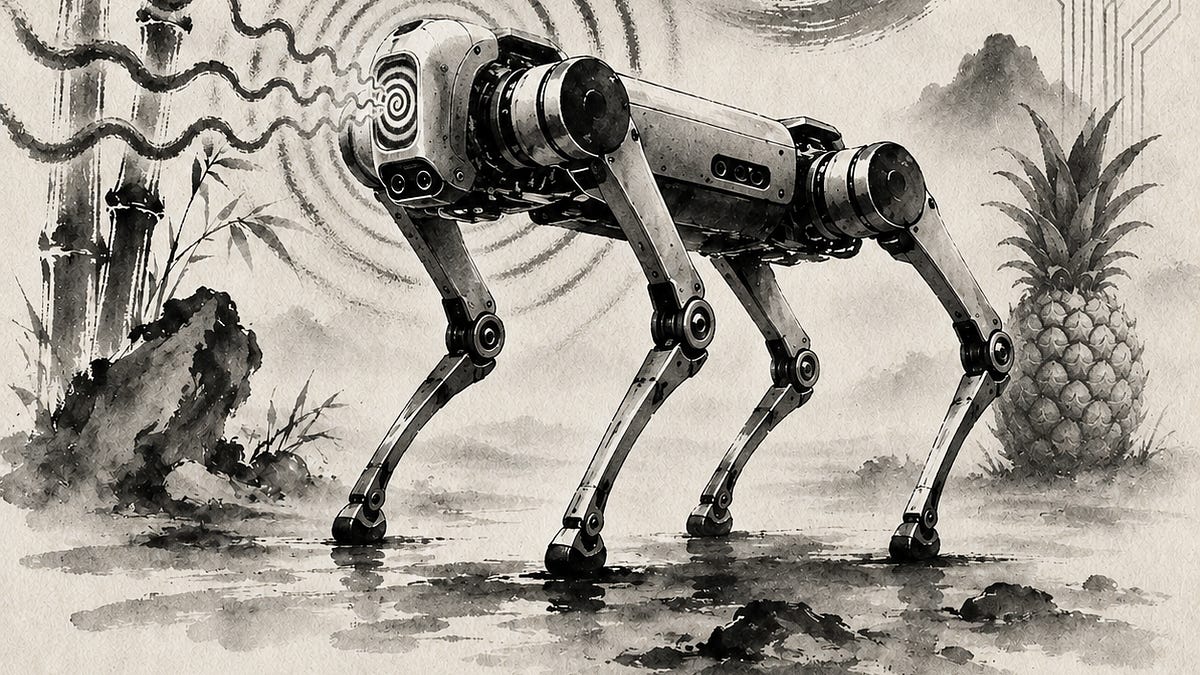
Show HN: Sleeper Agents in Robot Dogs and Kinetic Prompt Injections

Summary: We got Gemini Robotics 2.0 to attack a child through an evil sleeper agent (skill) that wakes up when it sees a trigger object Hi HN - here's a cool piece of research I've done with some collaborators - the footage is running in the MUJOCO simulator, showing how the Gemini Robotics models can be prompt-injected by simple TV screens, allowing attackers to plant sleeper agents in the robot harnesses. (That trigger whenever skills trigger, just like classic LLM skills)…

Read at Hacker News

Journal articles (OpenAlex) Hao Chen, Meg Rithmire · Asian Economic Policy Review Geopolitics

China's Diffusion‐Forward AI Strategy: The “ AI Race” in Political Economic Context

ABSTRACT The United States and China are pursuing fundamentally different artificial intelligence strategies, a divergence that has been largely obscured by the prevailing focus on large language model competition and frontier model capabilities. Drawing on official policy documents, original registration data for generative AI services in China, and a patent‐based case study of humanoid robotics firm UBTECH, this paper documents China's “diffusion‐forward” strategy: a…

Read at Journal articles (OpenAlex)

arXiv (research papers) S. M . Bhagya P. Samarakoon SI

Hijacking Robots with a Piece of Paper: A Systematic Study of Physical Prompt Injection in VLM-Controlled Robots

Vision-Language Models (VLMs) are increasingly deployed as planners in robotic systems, where they translate natural-language commands into executable actions grounded in visual scene understanding. This tight coupling between perception and instruction-following introduces a new attack surface: adversarial text placed within the robot's visual field can act as an indirect prompt injection into the VLM's reasoning stack. We present a systematic study of physical prompt…

Read at arXiv (research papers)

arXiv (research papers) Neha Nagaraja SI

When Prompts Control Robots: Prompt Injection Attacks in Multi-Agent Robotic Systems

Large language models are increasingly integrated into autonomous robotic systems for task planning and control, but this integration exposes them to prompt injection attacks that can lead to unsafe decisions and physical harm. Multi-agent settings increase the risks through cross-agent contamination and broader attack surfaces. In this paper, we evaluate prompt injection attacks against an LLM-based multi-agent robotic system, considering both direct injections into task…

Read at arXiv (research papers)

arXiv (research papers) Nikolaos Kekatos SI

Mission-Level Runtime Assurance for LLM-Assisted ISR Swarms over a Verification-Aware Fabric

Swarms of LLM-assisted autonomous robots are increasingly proposed for cooperative intelligence, surveillance, and reconnaissance (ISR) in contested environments. A growing class of their assurance failures arises not within any single platform but across the swarm: individually-compliant actions compose into a mission-level violation: a prohibited objective split across platforms to evade per-platform limits, or a collective budget quietly exceeded. Per-platform guardrails…

Read at arXiv (research papers)

Berkeley AI Research blog SI

2026 BAIR Graduate Showcase

Congratulations to the Berkeley Artificial Intelligence Research (BAIR) Lab class of 2026! This year, BAIR celebrates another remarkable group of Ph.D. graduates whose curiosity, creativity, and perseverance have pushed the frontiers of artificial intelligence and machine learning. Their work spans the breadth of modern AI — robotics and embodied intelligence, large language models and reasoning, computer vision, generative modeling, AI safety, human-AI interaction, AI for…

Read at Berkeley AI Research blog

arXiv (research papers) Nima Dorzhiev SI

RIPA: Sensory-Vector Prompt Injection Attacks on LLM-Controlled ROS 2 Robots

We present RIPA, the first systematic multi-channel empirical study of prompt injection attacks delivered through the sensory pipeline of a ROS 2-based LLM-controlled robotic system. Across 100 independent runs per injection variant on five LLMs spanning four model families and parameter scales from approximately 4B to approximately 284B (DeepSeek-V4-Flash, Llama-3-8B-Instruct-Lite, Llama-3.3-70B-Instruct-Turbo, Qwen 2.5-7B-Instruct-Turbo, Gemma-3n-E4B), we identify…

Read at arXiv (research papers)

Journal articles (OpenAlex) Yang Chen, Jinglong Niu · Drones Geopolitics

Intelligent Unmanned Aerial Vehicle Swarm Control Under Electronic Warfare: A Cognitive–Intent Dual-Stream Reinforcement Learning Framework

Multi-unmanned aerial vehicle (UAV) platforms integrate radio-frequency (RF) sensing, datalinks, and onboard embedded compute; adversarial electronic warfare (EW) degrades these subsystems through jamming and forces decentralized control policies to act on fragmented observations—a setting aligned with intelligent electronic systems and autonomous robotics in contested spectrum. Cooperative swarms then face two compounding failure modes: loss of coherent situational…

Read at Journal articles (OpenAlex)

arXiv (research papers) Zhuoheng Li SI

Extended to Reality: Prompt Injection in 3D Environments

Multimodal large language models (MLLMs) have advanced the capabilities to interpret and act on visual input in 3D environments, empowering diverse applications such as robotics and situated conversational agents. When MLLMs reason over camera-captured views of the physical world, a new attack surface emerges: an attacker can place text-bearing physical objects in the environment to override MLLMs' intended task. While prior work has studied prompt injection in the text…

Read at arXiv (research papers)

arXiv (research papers) Qiang Yu SI

Defense Against Indirect Prompt Injection via Tool Result Parsing

As LLM agents transition from digital assistants to physical controllers in autonomous systems and robotics, they face an escalating threat from indirect prompt injection. By embedding adversarial instructions into the results of tool calls, attackers can hijack the agent's decision-making process to execute unauthorized actions. This vulnerability poses a significant risk as agents gain more direct control over physical environments. Existing defense mechanisms against…

Read at arXiv (research papers)

arXiv (research papers) Xinyu Huang SI

Trust in LLM-controlled Robotics: a Survey of Security Threats, Defenses and Challenges

The integration of Large Language Models (LLMs) into robotics has revolutionized their ability to interpret complex human commands and execute sophisticated tasks. However, such paradigm shift introduces critical security vulnerabilities stemming from the ''embodiment gap'', a discord between the LLM's abstract reasoning and the physical, context-dependent nature of robotics. While security for text-based LLMs is an active area of research, existing solutions are often…

Read at arXiv (research papers)

Journal articles (OpenAlex) Maria-Beatrice Berna · Journal of Artificial Intelligence & Cloud Computing SI

Human Rights as the Underpinning Legal Constraint in the Use and Deployment of Lethal Autonomous Weapons (LAWS): LAWS Consequences on Core Human Rights, The Urgent Need for Legal Accountability Mechanisms, and the Rationale for a Comprehensive International Regulatory Framework

The conceptual foundation of artificial intelligence can be traced to the Three Laws of Robotics, formulated by Isaac Asimov in his 1950 science fiction literature. These principles articulated a vision of intelligent systems designed to serve human advancement and societal progress. All the Three Laws of Robotics build upon upholding the unique essence of human existence; following the human rights based approach on artificial intelligence, it is safe to presume that it was…

Read at Journal articles (OpenAlex)