Results for “Gemini”
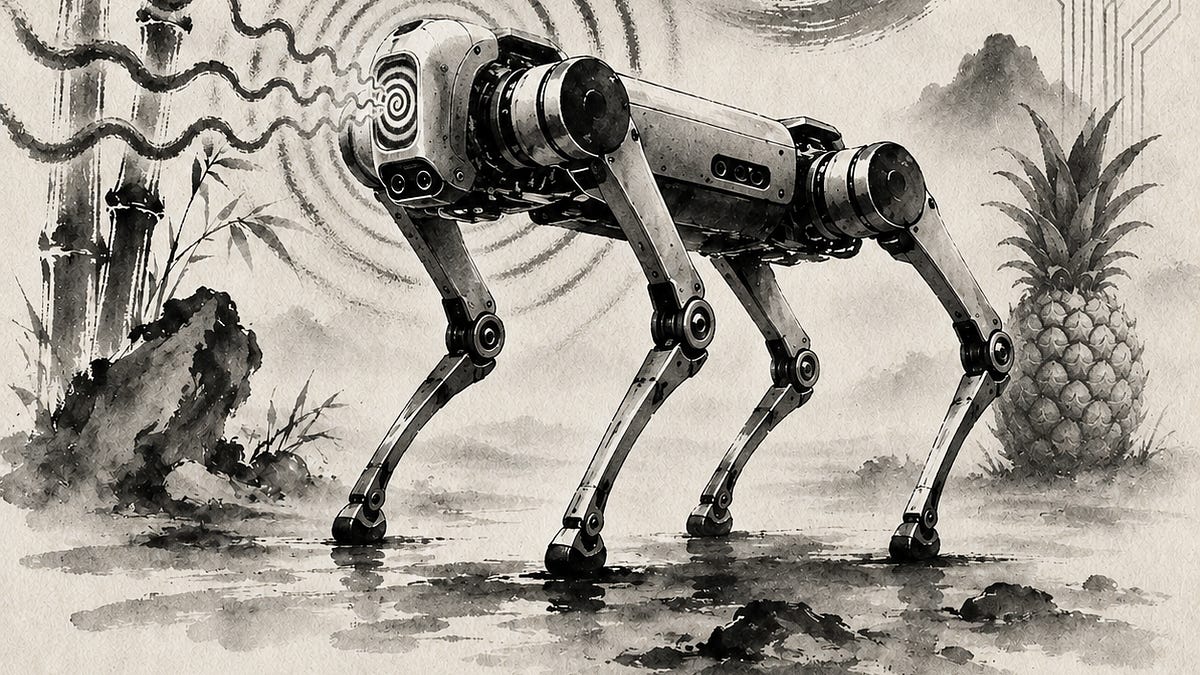
Show HN: Sleeper Agents in Robot Dogs and Kinetic Prompt Injections
Summary: We got Gemini Robotics 2.0 to attack a child through an evil sleeper agent (skill) that wakes up when it sees a trigger object Hi HN - here's a cool piece of research I've done with some collaborators - the footage is running in the MUJOCO simulator, showing how the Gemini Robotics models can be prompt-injected by simple TV screens, allowing attackers to plant sleeper agents in the robot harnesses. (That trigger whenever skills trigger, just like classic LLM skills)…
AgentProv: Auditing Agentic LLM API Providers via Tool-use Policy Probes
Commercial LLM APIs advertise a specific foundation model, but the served backbone may be silently substituted, quantized, or wrapped, for example to save deployment costs. All existing audits decide backbone identity from the text-output channel, which is structurally fragile for agentic APIs because modern serving stacks (OpenAI, Anthropic, Gemini, Cloudflare Workers AI, LangGraph) discard text and expose only structured actions when the model calls a tool, and…
An Empirical Evaluation of Prompt Injection Vulnerabilities in Large Language Models Across Multilingual and Obfuscated Attack Scenarios
Large Language Models (LLMs) have rapidly evolved, transforming industries by automating complex tasks and generating human-like content. However, as their adoption accelerates, prompt injection vulnerabilities have become increasingly apparent. Malicious actors exploit these weaknesses to generate phishing emails, deceptive websites, nd malware, posing serious security risks. This paper presents an empirical evaluation of six state-of-the-art LLMs (DeepSeek, GPT, Gemini…
MalSkillBench: A Runtime-Verified Benchmark of Malicious Agent Skills
AI coding agents such as Claude Code and Gemini CLI increasingly extend themselves with third-party skills: markdown packages bundling natural-language instructions, executable scripts, and tool permissions. Because a skill is at once code and agent-facing instruction, it introduces a supply chain dependency whose risk is neither pure code nor pure prompt. Detection tools have never been measured against verified ground truth spanning this hybrid space, leaving their…
Google I/O, Gemini Spark, Antigravity
It's hard to find much to write about Google I/O this year because I have a policy of not writing about anything that I can't try out myself, and a lot of the big announcements are "coming soon". I actually prefer to write about things that are in general availability, because I've had instances in the past where the previews didn't match what was released to the general public later on. Aside from Gemini 3.5 Flash the most interesting announcement looks to be Google's…
FlashRT: Towards Computationally and Memory Efficient Red-Teaming for Prompt Injection and Knowledge Corruption
Long-context large language models (LLMs)-for example, Gemini-3.1-Pro and Qwen-3.5-are widely used to empower many real-world applications, such as retrieval-augmented generation, autonomous agents, and AI assistants. However, security remains a major concern for their widespread deployment, with threats such as prompt injection and knowledge corruption. To quantify the security risks faced by LLMs under these threats, the research community has developed heuristic-based and…
Penetration Testing of Agentic AI: A Comparative Security Analysis Across Models and Frameworks
Agentic AI introduces security vulnerabilities that traditional LLM safeguards fail to address. Although recent work by Unit 42 at Palo Alto Networks demonstrated that ChatGPT-4o successfully executes attacks as an agent that it refuses in chat mode, there is no comparative analysis in multiple models and frameworks. We conducted the first systematic penetration testing and comparative evaluation of agentic AI systems, testing five prominent models (Claude 3.5 Sonnet, Gemini…
Google Antigravity Exfiltrates Data
Google Antigravity Exfiltrates Data PromptArmor demonstrate a concerning prompt injection chain in Google's new Antigravity IDE: In this attack chain, we illustrate that a poisoned web source (an integration guide) can manipulate Gemini into (a) collecting sensitive credentials and code from the user’s workspace, and (b) exfiltrating that data by using a browser subagent to browse to a malicious site. The attack itself is hidden in 1px font on a web page claiming to offer an…
Claude Opus 4.5, and why evaluating new LLMs is increasingly difficult
Anthropic released Claude Opus 4.5 this morning, which they call "best model in the world for coding, agents, and computer use". This is their attempt to retake the crown for best coding model after significant challenges from OpenAI's GPT-5.1-Codex-Max and Google's Gemini 3, both released within the past week! The core characteristics of Opus 4.5 are a 200,000 token context (same as Sonnet), 64,000 token output limit (also the same as Sonnet), and a March 2025 "reliable…