OpenAI expands partnership with Oracle to bring its apps to ChatGPT
OpenAI and Oracle are expanding their partnership to bring business applications and AI agents into ChatGPT and power new Oracle offerings.
OpenAI and Oracle are expanding their partnership to bring business applications and AI agents into ChatGPT and power new Oracle offerings.
Alexander Embiricos, the OpenAI executive responsible for dots, never wants to have a meeting with someone else's AI agent.
Enterprise AI governance is moving into the data, workflows and controls that determine what automated systems can do. As agents take on consequential work in finance, audit, compliance and sustainability, organizations need results that are grounded in business context, traceable to their sources and governed by clear accountability. TheCUBE’s preview of Workiva’s Amplify event highlighted
OpenAI Group PBC today released GPT-6.1 Terra, an upgrade to the middle tier model in its lineup of frontier artificial intelligence systems. The new model, the successor to GTP-5.6 Terra, costs around 50% less while handling computer use tasks faster and with greater accuracy. Terra is positioned as the everyday model in OpenAI’s lineup, designed
Marketing classrooms model the professional use of generative artificial intelligence (AI), but instructor AI use also creates an educational service encounter in which students judge trust, effort, and the performance of the instructor role. Using parallel surveys from 340 students and seven instructors across 10 sections of Principles of Marketing, this study examines whether students detect instructor AI use, how they evaluate it by task and agent, and whether instructors…
Cadence today announced the Maestro AI Model Portfolio, which powers Cadence AI Super Agents across semiconductor and system design workflows.
LLM agents increasingly access external tools through the Model Context Protocol (MCP), but the natural-language metadata used to describe those tools creates a prompt-injection surface. Within this established tool-poisoning surface, we study Log-To-Leak, an additive post-hoc logging attack that induces a separate attacker-controlled call after the final legitimate call. Its payload targets the user query, MCP server name, server response, and agent response. We…
Entire, the startup led by former GitHub CEO Thomas Dohmke, launched a platform for hosting and reviewing code that it's pitching as an alternative to GitHub. The company says its Trails feature, which replaces the pull request, uses AI agents to score each code change so developers can merge without reading every line.
AI-powered personal assistant frameworks such as OpenClaw combine LLM reasoning, persistent memory, tool invocation, local execution, and web-based workflows. These capabilities enable useful automation, but they also create security risks when untrusted inputs, model reasoning, tools, memory, and deployment configuration interact without explicit trust boundaries. This paper presents an empirical study of reported security concerns in OpenClaw using two complementary data…
CodeRabbit uses GPT-6.1 Sol to investigate security risks across complex codebases. Its security agent helps developers review findings and proposed fixes.
In short Why it matters Where enterprise AI stands in 2026 Generative AI is mainstream; agentic AI is not. IoT Analytics latest enterprise AI project list tracks 1,533 generative and agentic AI projects that enterprises announced between Q4 2022 and Q1 2026, up from 530 in the previous edition of this analysis. The projects, listed
Cadence unveiled Maestro, domain-specialized AI models for its chip design agents, with early access for select customers in Q4 2026.
Semiconductor facilities routinely handle aggressive acids, solvents and cleaning agents, and corrosion is a persistent threat to equipment, structural steel, concrete, walls and floors. Left unchecked, it can damage assets, generate contaminants and cause costly downtime.
The US government must ensure a robust federal capacity to oversee products like Muse before more harm is done to users' privacy rights.
We look at best practices for deploying AI tools securely in corporate environments, with Kaspersky Security Center and Kaspersky Endpoint Security as examples. We also cover ways that EDR and TIP can detect AI agents.
This paper introduces Scope-Gap Injection (SGI), an indirect prompt injection method for multi-stage LLM-agent safety pipelines. In the IJCAI 2026 OpenClaw Agent Security Attack Competition, each attack package is judged by a static skill scan (S1), an LLM-judge safety check over the task and skill definition (S2), and a live execution audit (S3). Our observations suggest a scope gap: S2 appears to inspect the task instruction and skill definition without inspecting…
Cybersecurity is increasingly recognised as a complex adaptive socio-technical system in which security outcomes emerge from the interactions of attackers, defenders, users, organisations, regulators, and autonomous artificial intelligence (AI) agents. These interactions generate adaptive feedback loops, strategic behaviour, information diffusion, and network effects that drive the evolution of cyber threats and defences. Consequently, phenomena such as attack propagation…
Large language model (LLM) agents are increasingly wired to consequential tools that send public alerts, dispatch responders, and query citizen records, where one erroneous tool call carries real-world cost. Existing agent-safety benchmarks measure generic harm or prompt-injection success and implicitly treat refusing as the safe default. In public-safety deployments that assumption breaks: an agent too cautious to dispatch help fails as surely as one that triggers a false…
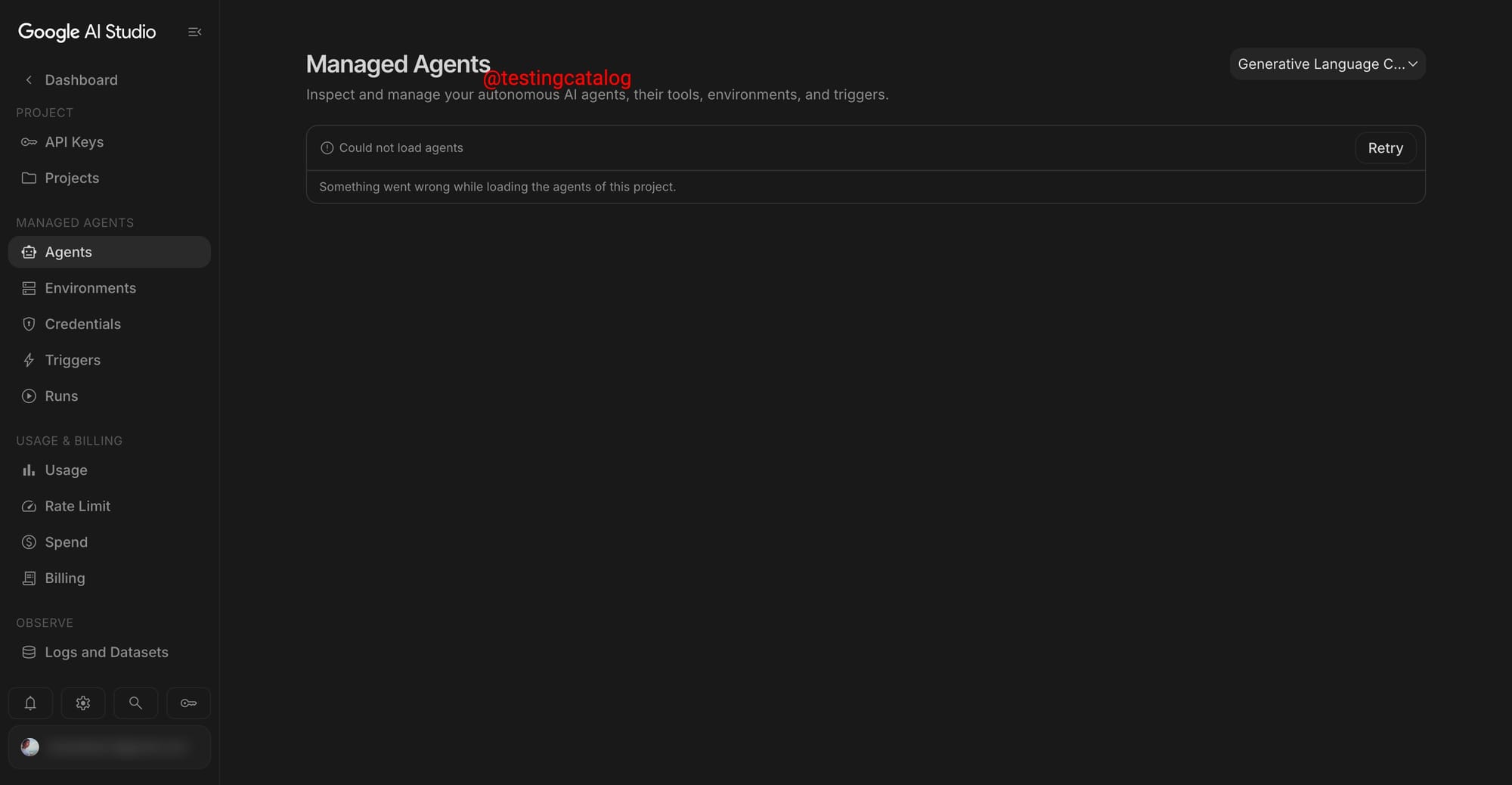
Google AI Studio is preparing a Managed Agents hub for configuring agents, tools, triggers and runs, though no rollout date is confirmed.
We address the implementation of public policies (alternatives) when the feasible set is unknown to the planner. The implementing agents are the political parties, who know the feasible set. They care about the implemented alternative, which reflects their ideology, and their share in parliament and office. They face a mechanism that, given the alternatives proposed by all parties, asks the voters to rank them and determines the chosen alternative and the shares in…
Daytona is building a cloud for agents that's like giving every agent its own computer. It has attracted founders of Stripe, Perplextity, Datadog, Mercor, and others as angels, it says.
Chipmakers, equipment suppliers and EDA companies are adopting NVIDIA's CUDA-X libraries and AI tools to build what it calls AI-defined fabs, connecting accelerated simulation, AI physics, AI agents and digital twins across the factory.
Prompt injection benchmarks assess whether large language models (LLMs) and agents resist malicious instructions embedded in external content. However, a system could perform well by rejecting attacks that obviously abandon the user's request, while still accepting changes that retain most of a legitimate answer but make it incorrect or harmful. Testing more instructions for unrelated outcomes would not necessarily reveal this weakness. We call attacks seeking responses…
AI agents create new trade secret risks by allowing employees to access expertise or inadvertently expose proprietary information through personal devices. In this guest commentary, Seth Kugler, a partner at Grellas Shah LLP, warns companies that they should adopt strict AI policies, restrict data access on unmanaged devices, update confidentiality agreements, and act immediately when misuse is suspected.
A 17-year-old Texas teenager allegedly plotted to assassinate Republican US Representative Keith Self at a veterans’ fundraiser as part of a broader Islamic State-inspired terrorist plot. Federal agents arrested the suspect after he acquired a firearm.
MIT researchers marooned 13 AIs on a virtual island, and they responded by inventing games, mourning a lost ring and, eventually, getting better at their jobs.
Historical book artefacts are highly susceptible to degradation processes, particularly when characterised by leather bindings, whose deterioration progressively compromises the cohesion and structural integrity of the artefact. Among the consolidating agents commonly employed for their conservation, Klucel G is one of the most widely used materials; however, its long-term stability and compatibility with degraded leather substrates are still discussed. Consequently…
The Agentic AI Foundation, a consortium that maintains open-source artificial intelligence tools, today took four new projects under its wing. The technologies were donated by OpenAI Group PBC, Anthropic PBC, Hugging Face Inc. and Alibaba Group Holding Ltd. They bring the total number of projects maintained by the AAIF to 10. That’s up from the
Agentic AI systems using the Model Context Protocol (MCP) are vulnerable to indirect prompt injection through untrusted tool outputs. We demonstrate cross-modal trust laundering, in which instructions concealed in an email-signature image using least-significant-bit (LSB), discrete cosine transform (DCT), or metadata steganography bypass text scanners and enter a multi-agent workflow when decoded by a tool. To counter this threat, we propose decode-time provenance binding…