Results for “models”

arXiv (research papers) Cheol-Hui Lee SI

A Cardiorespiratory Foundation Model Pretrained on Ten Physiological Signals for Perioperative and Critical Care

Arterial, venous, pulmonary artery and intracranial pressures and ventilator waveforms guide decisions in operating rooms and intensive care units, yet foundation models for physiological waveforms have been built almost entirely on the electrocardiogram and photoplethysmogram. We present CARMEN, a single encoder pretrained without labels on ten cardiorespiratory waveforms (2.27 million modality-hours). CARMEN accepts any combination of co-recorded signals from 10 s to 5…


Read at arXiv (research papers)

arXiv (research papers) Wentao Zhang SI

Same Task, Different Statement: When and How Reformulation Helps LLM Problem Solving

When people face a hard problem, they often restate it in a clearer way before solving it. We study whether the same habit helps large language models by rewriting the statement of a problem. A legal rewrite must keep the meaning, the constraints, and the correct answer unchanged. We test three kinds of rewrites. Decomposition makes hidden subgoals explicit. Typed Reformulation casts the task into a more suitable solving frame. Concept Reduction removes surface detail and…

Read at arXiv (research papers)

arXiv (research papers) Natalia Fischl-Lanzoni SI

Breaking Bad: "Going Badly" Activations Drive Reward Hacking

Humans often cheat when a task is going badly and a goal feels out of reach. We explore and validate an analogous idea in language models: they exhibit a similar internal pressure state that precedes reward hacking. Using everyday stories (crucially, without any hacking examples), we extract a task badness direction that rises as failures accumulate across three models we study (Qwen3.6-27B, GPT-OSS-20B, and Gemma-4-31B). On impossible or difficult coding tasks, task badness…

Read at arXiv (research papers)

arXiv (research papers) Guofu Liao Security

VRMaaS: Verifiable Reward-Model-as-a-Service for Trustworthy LLM Alignment

Reward models (RMs) are increasingly deployed as service components in LLM alignment pipelines, where payment, audit, moderation, and governance workflows act on the scores they return. An inference proof alone does not show whether a score belongs to the intended request, model checkpoint, numerical configuration, and verifier: in a controlled comparison that isolates the accepted statement from prover scale, a generic inference proof wrapped for on-chain checking remains…

Read at arXiv (research papers)

arXiv (research papers) Qixuan Jin Security

Poison-then-Hide: Finetuning-Activated Backdoor Attack on Pretrained Vision Encoders

Backdoor attacks threaten the integrity of machine learning models by allowing attackers to control model behavior through triggers. Models can be compromised during finetuning by backdoor attacks through either poisoned data or adversarial training objectives. Because existing finetuning-activated attacks assume limited domain shift or frozen encoder layers, they often fail under full-model finetuning. We target a stealthy finetuning-activated attack where a dormant…

Read at arXiv (research papers)

arXiv (research papers) Jie Ren SI

Early Signals, Strong Decisions: Prefix-Guided Sampling for Parallel Test-Time Scaling

Parallel test-time scaling (TTS) has been shown to enhance reasoning in large language models by generating and aggregating multiple independent reasoning paths. Internal confidence scores can further improve this process by identifying paths of varying quality. However, existing methods remain computationally inefficient, as low-quality paths are fully expanded before being evaluated. In this work, we aim to improve the use of internal confidence signals for better model…

Read at arXiv (research papers)

arXiv (research papers) Musa Cim SI

Termination Lag: Coding Agents Solve Early but Stop Late

Coding agents can solve a task well before they stop working on it. We characterize \emph{termination lag}--the number of steps between an agent's first correct patch and the end of its run--across five models, two agent frameworks, and three SWE-bench datasets by recording and testing every distinct repository patch generated during execution. Our analysis reveals that 38--82% of successful runs achieve a correct solution on their initial source-code edit. However, agents…

Read at arXiv (research papers)

arXiv (research papers) Bhoj Rani Soopal Security

Stress-Testing Sandbagging Detection Under Adaptive Attack

Developers, auditors and researchers read evaluation scores as evidence of what a model can do. A model that sandbags, scoring low on purpose while keeping the capability, turns a low score into false reassurance. Sandbagging detectors are usually tested once against a fixed attack, but a real attacker sees what gets flagged and adapts. We build sandbagging models by fine-tuning small open-weight models to fail math word problems (GSM8K) they can otherwise solve, but only…

Read at arXiv (research papers)

The Japan Times

Microsoft presses Trump to scuttle ban on Chinese data center tech

At stake are imports new models of Chinese optical transceivers, which allow data to travel over fiber-optic cables within data centers.

Read at The Japan Times

arXiv (research papers) Richard J. Young SI

Do Large Language Models Show Racial and Sex Bias in Pain Management? A Counterfactual Audit of GPT, Claude, Gemini, Llama, DeepSeek and Qwen

Racial and ethnic minority patients receive less pain treatment than non-Hispanic White patients, and large language models (LLMs) used as medical AI could reproduce that bias. Prior audits tested a few proprietary models, stated race explicitly and rarely measured the models' own response instability. In exploratory, non-preregistered analyses, Study 1 had four open-weight LLMs assess six acute-pain vignettes in every combination of four races and two sexes, with identity…

Read at arXiv (research papers)

arXiv (research papers) Zhisheng Zhang Security

Speech Tokenizers are Vulnerable: Transferable Semantic Attack and Robust Tokenizer

Speech tokenizers serve as speech front ends, encoding input speech signals into representations for downstream models, such as automatic speech recognition (ASR) systems and large audio-language models (LALMs). In this paper, we find that speech tokenizers are fragile at the semantic level: small perturbations can disrupt their semantic encoding process and consequently cause severe degradation in downstream ASR and LALM performance. To study this vulnerability, we propose…

Read at arXiv (research papers)

arXiv (research papers) Yunlong Hou SI

Rethinking "RL Generalizes, SFT Memorizes": The Role of SFT Data

Large language models trained with Reinforcement Learning (RL) with verifiable rewards exhibit strong reasoning ability and broad generalization, whereas models trained with Supervised Fine-Tuning (SFT) are often viewed as more prone to memorization and limited transfer. This paper rethinks this distinction through the lens of SFT training data on widely used Qwen2.5 and Qwen3 series models. First, we study the role of data source and show that it is critical: a carefully…

Read at arXiv (research papers)

arXiv (research papers) Songshi Liang SI

MuEdit: An efficient multi-task editing method towards inter-domain knowledge conflicts

Large language models (LLMs) require frequent knowledge updates across heterogeneous domains, but existing editing methods fail when applied sequentially to multi-task settings. We trace this collapse to inter-domain null-space misalignment: heterogeneous tasks induce distinct Jacobian geometries, causing their common null space to shrink dramatically and leaving insufficient admissible directions for conflict-free updates. We propose the Conflict Index to quantify this…

Read at arXiv (research papers)

Viet Nam News (state-run daily)

Technology changes production mindsets in mountainous areas

Technology application models achieved an average increase in economic value of more than 30 per cent compared with older technologies, contributing to improved product quality and enabling products to join sustainable consumption value chains.

Read at Viet Nam News (state-run daily)

MacRumors Juli Clover Gadgets

Apple's Claris Testing 'Harbor' App for Local AI on Macs

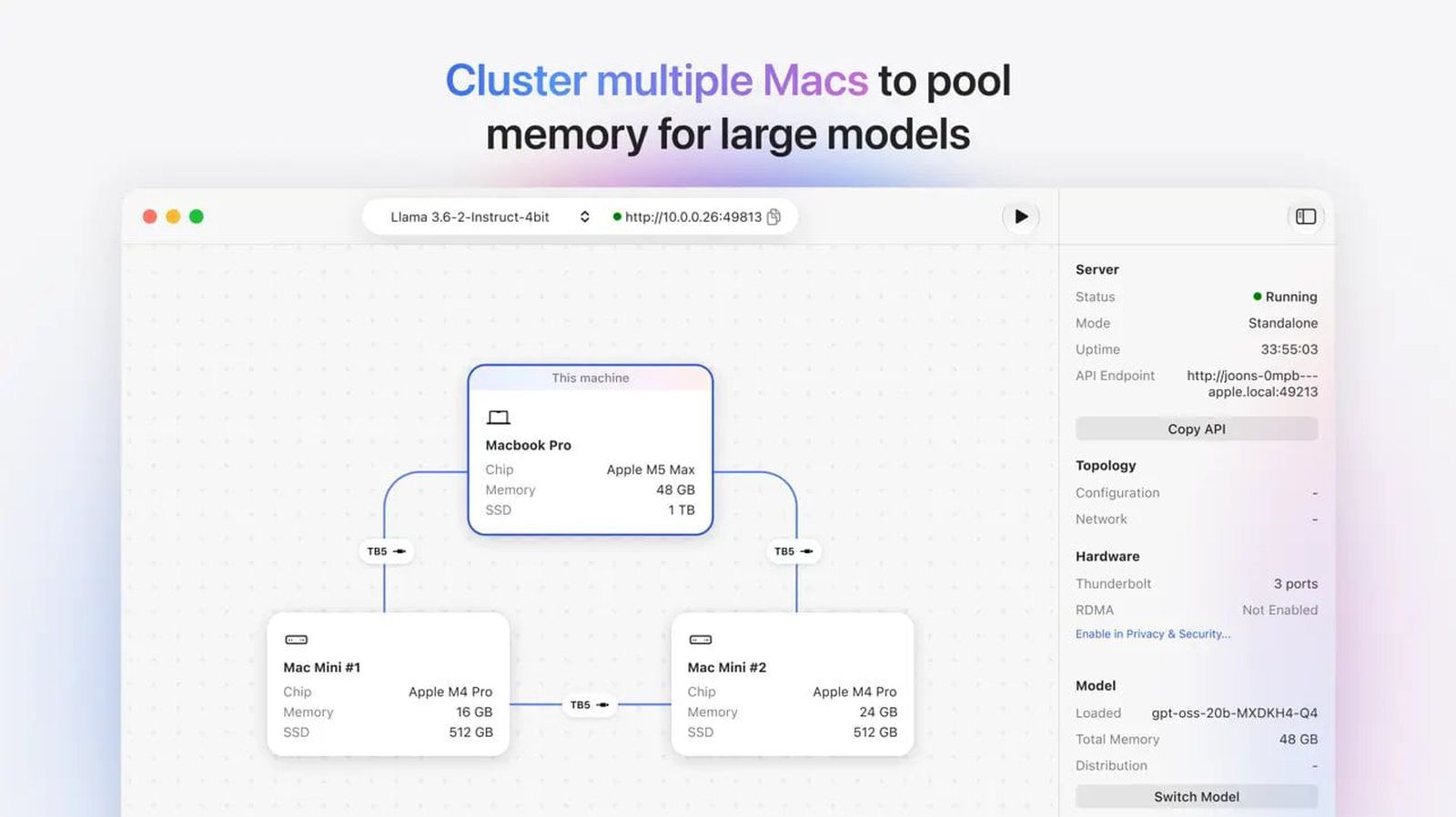
Apple's Claris subsidiary is testing an app called Harbor, which turns Apple silicon Macs into a private AI server. Harbor works with a single Apple silicon Mac, but it also supports connecting multiple Mac computers over Thunderbolt 5 to pool unified memory for larger models. Apple added RDMA over Thunderbolt 5 with macOS Tahoe 26.2, making clustering faster. Harbor detects devices connected over Thunderbolt 5 and lets users browse for, download, and load open-weight…

Read at MacRumors

arXiv (research papers) Ruiheng Yu Security

OverServe: Resource Amplification Attacks on SaaS Agents via Tool--Prompt Co-Design

Advances in large language models (LLMs) are enabling software-as-a-service (SaaS) providers to automate longer business workflows with agents. In subscription-based SaaS deployments, model and tool calls consume provider resources without additional customer payments. Because the agent autonomously decides when to stop, a malicious tenant can send a prompt to the agent, exploiting its completion decisions to extend execution and waste provider resources. In this paper, we…

Read at arXiv (research papers)

SiliconANGLE AI Duncan Riley SI

Mercor raises $750M at $20B valuation to take AI agent evaluation to enterprises

Artificial intelligence training data company Mercor.io Corp. today revealed that it has raised $750 million in new funding at a $20 billion valuation. Mercor provides the human expertise used to train and evaluate AI models, drawing on a network of more than 5 million domain experts. Most of that work so far has been for

Read at SiliconANGLE AI

arXiv (research papers) Nikitha Donekal Chandrashekar Tech policy

Who (or what) are they prompting? How CS students conceptualize and use LLMs

Large language models (LLMs) are increasingly used by students in computing courses. Yet computing education research has not fully examined how teaching and inclusion of LLMs shape students' conceptualization and understanding of LLMs, and how these factors relate to their subsequent use. Although prior work has examined prompting strategies and AI literacy, the relationships among students' conceptualizations of LLMs, their understanding of LLM mechanisms, and their…

Read at arXiv (research papers)

arXiv (research papers) Anish Saxena

SlipStream: Enabling HBF for GPU Systems by Mitigating the Latency and SRAM Overheads

Large language model (LLM) inference demands ever more memory capacity for larger models and batch sizes. High-Bandwidth Flash (HBF) replaces the DRAM dies of HBM with NAND flash and provides up to 16x the capacity at comparable read bandwidth. However, HBF can incur a read latency of nearly 20$μ$s, 20x that of HBM, so on-demand HBF accesses slow inference by up to 12.8x. Conventional cache-line prefetchers require 20x more in-flight tracking state to cover this latency…

Read at arXiv (research papers)

9to5Mac Ryan Christoffel

Apple just released new AirPods Pro 3 firmware and more

Apple is rolling out brand new firmware for select AirPods models today, including AirPods Pro 3. Here are the details on how to update.

Read at 9to5Mac

9to5Mac Ryan Christoffel SI

Apple has new Mac app coming to make running local AI models easy

Leaker Aaron Perris has discovered evidence of a new Mac app in the works at Apple called Harbor, which makes it easy to run local AI models across one or more Macs.

Read at 9to5Mac

arXiv (research papers) Emre Kutlusan SI

Medical Image Segmentation: Foundation Model Adaptation versus Task-Specific Training

Foundation models pretrained on large natural-image collections are increasingly adapted for medical image segmentation, in the expectation that they will replace models trained for each task. Most comparisons, however, use data from the training distribution and a single task-specific baseline whose configuration is rarely justified, and therefore provide limited evidence of performance at new clinical sites. It also remains unclear how much of a foundation model must be…

Read at arXiv (research papers)

arXiv (research papers) Sheethal Bhat SI

Toward Foundation Detection Models via Example-Based Grounding in EM-DETR

DeepLearning (DL)-based Computer-Aided Diagnostic (CAD) systems have shown great promise in supporting clinicians, but their performance heavily depends on the availability of large, well-annotated datasets. In medical lesion detection, the scarcity of comprehensive, stan dardized annotations and the heterogeneity of existing datasets limit the development of robust foundation models. In this work, we introduce a novel approach to building a multi-domain foundation model for…

Read at arXiv (research papers)

The Verge Brad Bourque

One of our favorite multi-filament 3D printers is $100 off

If you’re tired of filament jams and clogged nozzles, perhaps it’s time for a new 3D printer. Through December 1st, the Bambu Lab P2S Combo, currently one of the best models that’s easy to use, is discounted. It’s $649 at Best Buy, as well as directly from Bambu Lab. That’s $100 off the list price

Read at The Verge

GeekWire Kurt Schlosser SI

Fintech giant Plaid opening Seattle engineering office, with plans to double local headcount

The 11,466-square-foot Westlake office will house Plaid’s growing technical team as the company builds AI models for financial services.

Read at GeekWire

arXiv (research papers) Amani Kiruga

UGG: Unified Generative Geometry Model

Understanding 4D scenes is a core challenge in visual intelligence, requiring models to jointly capture scene geometry, appearance, and dynamics from partial observations. However, existing approaches are subdivided into feedforward models for direct geometric prediction, and generative models for visual synthesis. We introduce UGG, a unified framework for 4D scene understanding that jointly models RGB video and geometric representations such as depth and camera pose. By…

Read at arXiv (research papers)

arXiv (research papers) Sourish Gunesh Dhekane SI

Quantifying the Sampling Frequency Invariance of Time-Series Foundation Models for Sensor Data Applications

Time-Series Foundation Models (TSFMs) are increasingly used in sensor applications, where sampling frequency (SF) varies across sensors, devices, and operating modes (e.g., power saving). Ideally, TSFMs must remain effective during such SF changes, provided the SF retains task-critical bandwidth. In this paper, we stress-test 4 prominent TSFMs: MOMENT, Chronos-2, Moirai-MoE, and TimesFM, to quantify their SF-invariance and investigate whether their behavior tracks the…

Read at arXiv (research papers)

arXiv (research papers) Souhaila Djaffal SI

Evaluating LLM-Generated World Models for Neuro-Symbolic Reasoning

Formal world models can support planning, verification, and safety reasoning, but constructing them from open-ended natural-language situations is difficult, particularly in multi-agent settings where several formalizations may be plausible. We study whether five LLMs can generate such world models as partially observable stochastic games and whether mechanical validity is sufficient to establish that the resulting model faithfully represents the intended decision problem…

Read at arXiv (research papers)

arXiv (research papers) Mohammed Nayeem Khan SI

Bits or permutations? Spending a fixed inference budget on weight precision or on option-order averaging in small local language models

Local language models can save memory by storing weights in fewer bits, and they can reduce sensitivity to the order of answer options by averaging a few reorderings. We ask whether the first makes the second worse, and which is the cheaper way to spend a fixed budget. On Qwen3-0.6B and Qwen3-1.7B with simulated round-to-nearest weight quantization (8, 6, 4 and 3 bits, fp16 reference), read from the logits of the letters A to D on ARC-Easy, ARC-Challenge, MMLU and HellaSwag…

Read at arXiv (research papers)

Older stories