Results for “Robot”

arXiv (research papers) Stanley Akingbola SI

Network-Exposed Configuration Attacks on LLM-Controlled Social Robots

Large language models (LLMs) in embodied robots create security dependencies beyond inference. We investigate a network-exposed configuration attack on the Pollen Robotics Reachy Mini Lite, allowing an unauthenticated attacker to replace personality settings and the cloud LLM's system prompt through a management interface, without adversarial conversational input. Eleven prompt-injection attempts across five categories were reported as resisted, whereas both…


Read at arXiv (research papers)

arXiv (research papers) Lechen Zhang

Body Schema Policy: Body as the Vision-Action Interface for Efficient Robot Loco-Manipulation

Currently, robots can learn whole-body loco-manipulation through scale: the strongest policies have billions of parameters and still need task-specific fine-tuning. Humans have limited processing capacity, yet learn and act efficiently through a body schema that organizes what they see and how they move. We introduce Body Schema Policy (BSP), an imitation learning policy that builds such a schema into the vision-action interface. Its latent body schema places joint and link…

Read at arXiv (research papers)

arXiv (research papers) Dohyeon Kim

Learning Accurate End-Effector Trajectory Tracking with Inertial Feedback for a Quadruped Manipulator

Accurate end-effector trajectory tracking on quadruped manipulators is challenging because uncertainties in actuators, foot-ground contact, and geometric errors are propagated through the leg-arm kinematic chain. Detecting such errors requires sensing beyond joint encoders that can capture the effects of these uncertainties on the robot's motion, since joint encoders only provide measurements at the actuated joints and cannot fully observe mechanical errors such as backlash…

Read at arXiv (research papers)

arXiv (research papers) Suho Yoo

VSpark: Speculative Decoding for Autoregressive Vision-Language-Action Models

Our aim is to accelerate autoregressive vision-language-action models (VLAs), which generate robot actions one token at a time. Speculative decoding makes this possible: a lightweight draft model proposes several tokens at once, and the VLA verifies them in a single pass, accepting only those that match its own predictions, so decoding remains lossless. The speedup, however, is limited in robot control, where many different tokens encode nearly the same motion and a draft…

Read at arXiv (research papers)

arXiv (research papers) Lorenzo Paiola

Risk Density RRT$^*$: Planning in the Space of Probability

Planning under uncertainty is a fundamental problem in robotics. While much of the literature seeks minimum-cost paths subject to probabilistic constraints, this paper instead considers collision probability, or risk classically defined as probability times severity, directly as the planning objective. We propose Risk Density RRT$^*$ (RD-RRT$^*$), an extension of RRT$^*$ for high-level planning in environments with deterministic and uncertain obstacles. RD-RRT$^*$ builds on…

Read at arXiv (research papers)

South China Morning Post Ling Xin Geopolitics

China taps Pacific metals trove in first large-scale seabed ore mining trial

China has carried out its first large-scale trial of seabed ore mining in international waters, using a robotic vehicle to gather potato-sized, metal-rich rocks from the eastern Pacific between Hawaii and Mexico, according to state media. The rocks collected during the trial – known as polymetallic nodules – contain nickel, cobalt, manganese and copper, which are key ingredients in the batteries used for electric cars and smartphones. To support the survey work, China…

Read at South China Morning Post

arXiv (research papers) Mingcheng Zhu

VLM-guided Grounding Expert for Generalised Referring Expression Comprehension

Generalised referring expression comprehension (GREC) aims to identify and localise the zero, one or multiple objects referred to by a language expression. In robotic manipulation, grounding also needs to remain accurate when requests for the same objects are paraphrased or embedded in additional context in robotics. However, grounding expert models are sensitive to instruction variation, while generative vision--language models (VLMs) struggle with complete target recovery…

Read at arXiv (research papers)

Tom's Hardware Semiconductors Etiido Uko

Samsung, SK hynix, and Micron form unlikely alliance to standardize robot charging as chipmakers push toward unmanned fabs

Samsung, SK hynix, and Micron are working to standardize charging infrastructure for mobile fab robot batteries to simplify automation and help fabs deploy larger mixed robotic fleets.

Read at Tom's Hardware Semiconductors

arXiv (research papers) Lorenzo Paiola

Task Convergent Flow Matching for Generative Robotics

Successful manipulation requires the manipulated objects to progress toward a desired task outcome. Generative policies can produce plausible robot motions without ensuring this progress, allowing successive action chunks to stall or undo earlier changes to the scene. We introduce a task-centric inference-time refinement framework for flow matching policies that evaluates candidate action chunks through parallel physics-based rollouts and searches for motions satisfying…

Read at arXiv (research papers)

arXiv (research papers) Jialong Liu

Distilling World Action Models for Efficient Bimanual Manipulation via Anchored Path Matching

World Action Models (WAMs) jointly generate future video and robot actions through iterative denoising. Few-step distillation reduces the number of model evaluations, but its coarse updates can move the student away from the teacher's trajectory. We propose Anchored Path Matching (APM), which supervises endpoint and short-transition predictions from states reached by the student. From each state, we continue the teacher to zero noise and use its endpoint and first…

Read at arXiv (research papers)

arXiv (research papers) Chen Zhao

InteractVLA: Turning VLAs into Interactive Tools for Agentic Robotic Manipulation

Existing agentic manipulation systems treat pretrained vision-language-action (VLA) policies as opaque, language-only primitives: when a policy call fails under unfamiliar instructions or scene perturbations, the agent cannot steer its behavior and is forced into futile retries or costly manual takeover. We present InteractVLA, a framework that turns pretrained flow-based VLAs into geometrically steerable and inspectable tools through a bidirectional geometric interface with…

Read at arXiv (research papers)

Robohub IRIDIA

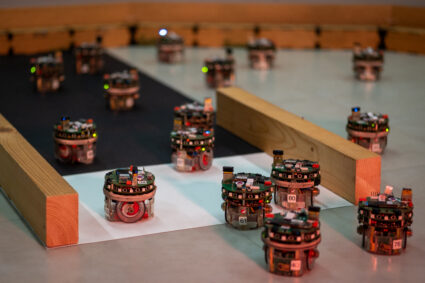
Robot swarms trained by trial and error in simulation keep working on real robots

Reinforcement learning lets robots learn behaviors on their own, through trial and error, usually inside a computer simulation. Moving what they learn onto physical robots is another matter. Simulated and real robots never behave quite the same way, a mismatch known as the “reality gap,” and reinforcement learning has long been particularly sensitive to it.

Read at Robohub

YourStory Startups

Karnataka aims to become global hub for frontier technologies: DK Shivakumar

Karnataka Chief Minister DK Shivakumar said the strong technology ecosystem in the State gives it the advantage to lead in areas such as AI, biotech, semiconductor and robotics.

Read at YourStory

arXiv (research papers) Tian Lyu

JointGV: Structure-Aware Correction of Visual World Models with Parallel Graph Dynamics for Long-Horizon Modeling

Visual world models predict future visual states conditioned on actions, but recursive errors in entity poses and spatial relations limit their long-horizon prediction for robot planning and control. We ask whether a separately predicted relational state can correct this drift without restructuring the visual model. This is challenging because graph nodes and visual states share neither elements nor a feature space. We propose Joint Graph--Visual Dynamics Correction…

Read at arXiv (research papers)

arXiv (research papers) Mohammad Nomaan Husain

DGF-Asym: Adaptive Peer Weighting for Collective Estimation under Noisy and Faulty Sensing

Collective estimation under unreliable sensing requires robots to adaptively balance personal observations and social information from peers. We propose DGF-Asym, a decentralized collective estimation method extending the DeGroot-Friedkin model with asymmetric peer weighting based on retrospective predictive performance. The method supports consensus formation without prior sensor-noise statistics or explicit fault models while keeping inter-robot communication asynchronous…

Read at arXiv (research papers)

WIRED Aarian Marshall Startups

Tesla’s Cybercab Is the Subscription Hell They Told You Not to Worry About

The electric-auto maker says it has invited some buyers to reserve a personal robotaxi. The arrangement raises big questions about the future of car ownership.

Read at WIRED

arXiv (research papers) Jingyao You

The Multivariate Feedback Particle Filter for State-dependent Multiplicative Noises and Its Application to Attitude and Pose Estimations

Nonlinear filtering with state-dependent multiplicative measurement noise poses a notable challenge for spacecraft attitude determination and robotic pose estimation. This work develops the FPF-DM, a decomposition scheme for feedback particle filters tailored to this family of filtering problems. Extending prior decomposition techniques for additive noise and polynomial measurement models, the proposed method resolves the key difficulty that state-dependent multiplicative…

Read at arXiv (research papers)

arXiv (research papers) Licheng Zhong

Progress Predicts Policy

A task specifies how the world should change, while a policy specifies what the robot should do. We introduce Progress Predicts Policy (PPP), which learns a language-conditioned scalar field through the commands induced by its differential. We obtain action conditioning by composing a latent progress field with a shared world model and read its action gradient at a fixed reference command. Continuous commands scale this gradient by a learned positive gain, while discrete…

Read at arXiv (research papers)

Ukrainska Pravda Iryna Levytska

Ukrainian Tencore showcases AI-powered evacuation ground robot in Netherlands

During the European Defence Innovation Forum in The Hague, Ukrainian firm Tencore demonstrated its armoured, AI-equipped casualty evacuation UGV featuring remote medical communication and thermal camouflage

Read at Ukrainska Pravda

arXiv (research papers) Arusa Kanwal

VoxelSBFL: Voxel-Level Spectrum-Based Failure Prediction for Vision-Language-Action Models

Vision-Language-Action (VLA) models integrate visual perception, language understanding, and action generation to control robots. Testing these systems produces trajectories and task outcomes, but existing approaches provide limited guidance on using these recorded trajectories to assess subsequent executions or inform policy repair. We conjecture that, for a given policy and task, traversing certain workspace regions is associated with a higher likelihood of failure. To…

Read at arXiv (research papers)

arXiv (research papers) Koki Inami

Autonomous Track Racing with a Commercially Available Humanoid: System Design and Real-World Deployment

Learning-based methods now let humanoids run robustly, and they have begun to compete in athletic events. Yet few reports describe a complete autonomous humanoid running system in an actual race, where the robot must follow a lane at a new venue, pace itself within hardware limits, and finish without intervention. We report such a system deployed on the Unitree G1, a commercially available general-purpose humanoid, in the 100 m, 400 m, and 1500 m events of the World Humanoid…

Read at arXiv (research papers)

arXiv (research papers) Juel Hussain Department of Computer Science, University of Manchester, UK Security

From Attack Tree to Model Checker: Binding CAPEC Patterns to Verify Robotic System Security

Security-minded verification of autonomous and robotic systems presupposes an attacker, yet the path from a threat catalogue to a checkable attacker model is still traversed by hand. This research preview presents the theory and construction of a pipeline that mechanises it. Each leaf of an attack tree is mapped to a CAPEC attack pattern and written in first-order logic as a rule: the attacker's prerequisites imply the attack's effect. Casting the pattern as such a rule is…

Read at arXiv (research papers)

arXiv (research papers) Giacomo Paltrinieri University of Modena and Reggio Emilia

ROSMonitoring in Action: Runtime Monitoring and Enforcement for ROS 2 Actions

Robotic applications often rely on long-running operations, such as navigation, manipulation, and inspection, which in ROS~2 are commonly implemented as actions. Unlike topics and services, actions involve a structured lifecycle comprising goal submission and acceptance, feedback, status updates, result retrieval, and cancellation. Existing versions of ROSMonitoring support topics and services, but do not reconstruct this lifecycle or expose action-level events to a…

Read at arXiv (research papers)

arXiv (research papers) Gunjari Chakraborty University of Manchester

Plenty to FRET About: From Hazard Analysis to Formal Requirements for Robot-Assisted Dressing

Understanding requirements for systems involving humans and robots is essential for providing robust evidence that such systems behave correctly. Requirements formalisation approaches such as the Formal Requirements Elicitation Tool (FRET) can support the transition from unstructured natural language to formal representations suitable for verification. In this paper, we formalise 146 hazard-derived natural-language requirements for a Robot-Assisted Dressing (RAD) case study…

Read at arXiv (research papers)

arXiv (research papers) Mehul Arora

CoBoVLA: Decoupling Language from Action with Discrete Codes for Robust and Interpretable Robot Manipulation

Vision-Language-Action (VLA) models achieve high success rates on the LIBERO benchmark but remain sensitive to paraphrasing. Existing VLAs ranging from 0.6B to 7.5B parameters experience a 22-52 point performance drop on LIBERO-Para while SmolVLA exhibits an even larger decline, from 83\% to 8\%. Because most VLAs jointly learn language understanding and action generation, it is difficult to determine whether a failure originates from misunderstanding an instruction or…

Read at arXiv (research papers)

arXiv (research papers) Maniformer Real-World Manipulation Team

Hidden Variables Behind Real-Robot Data Quality: Lessons from Hundreds of Thousands of Hours

As real-robot data collection scales, collection-system design shapes both operator efficiency and the behaviors learned by robot policies. Workspace limitations, control-interface friction, and latency can introduce pauses, detours, and corrective motions into otherwise successful demonstrations. We investigate these effects across embodiment, teleoperation control, and data consistency, combining a kinematic study of 25 dual-arm robots, controlled teleoperation…

Read at arXiv (research papers)

arXiv (research papers) Junrui Zhang

DGV-DLIVO: Degeneracy-Guided Visual Fusion for Direct LiDAR-Inertial-Visual Odometry in Degenerate Tunnel Environments

Reliable localization in long underground infrastructures remains a major challenge for autonomous inspection robots. In hydropower spillway tunnels and drainage galleries, repetitive geometric structures provide insufficient constraints along the tunnel axis, while weak texture and illumination variations further degrade visual estimation. Under this coupled degradation, existing LiDAR-inertial and visual-inertial odometry systems may lose the ability to recover continuous…

Read at arXiv (research papers)

arXiv (research papers) Muhammad Zain Khawaja

AutoE2E: Don't speak - Language free end-to-end autonomy A Real-Time Driving Model for L2++ ADAS and L4 Robotaxis

AutoE2E is an open-source end-to-end driving model developed by the Autoware Foundation Robotaxi Working Group. It introduces a temporal bird's-eye-view (BEV) architecture that combines multi-camera perception, HD-map information and route conditioning to predict future vehicle motion. The evaluated model uses a pretrained camera-BEV backbone, temporal feature fusion and a lightweight recurrent trajectory planner. It contains approximately 79.9 million parameters, of which…

Read at arXiv (research papers)

Analytics India Magazine Ridhika Basnet SI

Karnataka Unveils 6 Initiatives to Strengthen AI and Semiconductor Ecosystem

The state government highlighted six initiatives across AI, robotics, semiconductor research, and healthcare at the Bengaluru Tech Summit 2026.

Read at Analytics India Magazine

YourStory Startups

How friends from Coimbatore built GOAT Robotics into an Rs 8 crore business with global reach

Coimbatore's GOAT Robotics grew from a 2BHK startup to an Rs 8 crore business, serving Toyota, Volvo and global clients.

Read at YourStory

Older stories