Results for “Robot”

EE Times Analog Devices

Beyond One Turn: How a Single-Chip Multiturn Position Sensor Is Reshaping Actuator Design

Discover how advanced multiturn position sensing can transform industrial motion control without the limitations of traditional mechanical solutions. Explore how magnetic sensing technology enables accurate, reliable tracking of rotational movement even when power is removed. From robotics and linear actuators to hoists, winches and automated systems, learn how this innovative approach can simplify designs, improve

Read at EE Times

The Register Richard Speed

Space robot legend Voyager 1 is now more than 1 light-day away

As the world is hit by IT snafu after IT snafu, Voyager sails on, almost half a century after launch

Read at The Register

arXiv (research papers) Nicolas Kosanovic

TinyARM-X: A Series of Open-Source, Configurable, and Transparent Torque-Controlled Desktop-Scale Robotic Manipulators

Visuomotor policies have demonstrated that imprecise low-cost robots can autonomously complete complex manipulation tasks. However, most inexpensive manipulators rely on compact and rigidly position-controlled servos for actuation, which complicate simulation, operation, and safety. This work introduces TinyARM-X, a framework for easily manufacturable, configurable, and torque-controllable low-cost ( 3 DoF robot within 10 min. Actuator modeling and dynamic compensation…

Read at arXiv (research papers)

MIT Technology Review Amit Katwala SI

The AI Hype Index: AI is everywhere

Like a nasty rash, AI seems to spread everywhere. Google crams AI Overviews down your throat even though it costs the company billions of dollars in lost ad revenue. Leave your apartment, and you might pass two people heaving an AI-powered humanoid robot up the stairs to clean someone’s rooms. Go to the supermarket, and…

Read at MIT Technology Review

arXiv (research papers) Mathias Jensen

OmniFish: A Bioinspired, Modular, Reconfigurable Soft Robotic Fish Enabling Multi-Modal Swimming

In this work, we introduce OmniFish, a bioinspired modular soft robotic fish designed to emulate the full spectrum of body and/or caudal fin (BCF) locomotion modes within a single robotic platform. The design combines morphology averaging across representative fish species with a tendon-driven compliant segmented spine whose effective stiffness can be reconfigured through progressive mechanical jamming. By selectively constraining body segments, OmniFish shifts deformation…

Read at arXiv (research papers)

arXiv (research papers) Fardien Azizi

Single-Controller Teleoperation and Multimodal Dataset Generation for a Mobile Manipulator

Robot learning systems require synchronized, high-quality demonstrations that combine visual, proprioceptive, and action data. However, collecting such datasets with mobile manipulators is often slowed down by fragmented teleoperation interfaces and manual post-processing workflows. This paper presents an integrated framework for teleoperated multimodal data collection on a Clearpath Dingo-O mobile base equipped with a Kinova Gen3 Lite manipulator and an Intel RealSense…

Read at arXiv (research papers)

arXiv (research papers) Jiayou Zhu Security

RECLAIM: Robot-Vision-Informed Adversarial Patch Defense via Embodied Attention Feedback

Vision-language-action policies control embodied agents through a perception-action loop grounded in physical interaction, where adversarial patches can corrupt action predictions and thereby alter subsequent observations. To mitigate these threats, many existing defenses rely on policy adaptation or auxiliary models, but require additional training or inference. We introduce RECLAIM, a training-free, inference-time defense that uses a frozen VLA's own attention response to…

Read at arXiv (research papers)

The Hill Arturo McFields, opinion contributor Geopolitics

Haiti must not become a war lab for China’s autonomous robot dogs

Haiti should not be a testing ground or a shooting range; it is a real-world setting involving real lives.

Read at The Hill

Inc42 Akshit Pushkarna Startups

Humyn Labs Raises $47 Mn To Collect Training Data For Robots

Physical AI startup Humyn Labs has raised $47 Mn (about ₹439 Cr) to expand its data collection and robot deployment…

Read at Inc42

arXiv (research papers) Wenhao Li SI

Towards Pose-Robust Few-Shot Vision-Language-Action Models

Fine-tuning a vision-language-action (VLA) model on a few dozen demonstrations is the standard way to put a manipulation policy on a robot, yet the resulting policy silently assumes that the camera and the robot base stay exactly where they were during data collection: a bumped tripod or a base re-docked a few centimetres away makes it reach for the wrong place. We show that both failures are one phenomenon, a change of the camera-to-base extrinsic that the policy has…

Read at arXiv (research papers)

SiliconANGLE AI Kyt Dotson SI

Humyn Labs raises $47M to bridge the gap between AI training and real-world robotics

Humyn Labs, a company turning human experience into training for robots and artificial intelligence, today announced it has raised $47 million in early-stage funding to accelerate intelligent robotic deployment readiness in real-world environments across Brazil, South Korea and India. Accel led the $26 million equity portion of the round, with participation from Prosus Ventures, BeeGlobal,

Read at SiliconANGLE AI

Tech in Asia Grace Priscilla Teo Startups

Indian physical AI startup Humyn Labs raises $47m series A

The robotics training-data provider says it runs operations in more than 20 countries.

Read at Tech in Asia

TechCrunch AI Jagmeet Singh SI

India’s Humyn Labs raises $47M to feed U.S. robotics companies the data they need

Founded in February, Humyn Labs competes with startups including Mecka AI and XDOF, with about 90% of its revenue coming from the U.S.

Read at TechCrunch AI

arXiv (research papers) Robin Geens

Hardware Acceleration of Vision-Language-Action Models with Weight Precision Rising over the Flow Steps

Vision-language-action (VLA) models such as GR00T control robots through an action head: a diffusion transformer that turns noise into a chunk of actions in a few flow-matching steps. Every step re-reads all of the head's weights from DRAM but applies each weight to only about fifty tokens. Inference is therefore memory-bound, and its latency and energy are largely determined by the total number of transferred weight bits. We show that later flow steps attenuate the…

Read at arXiv (research papers)

YourStory Startups

Botsync raises $11M to expand industrial automation

Botsync has raised $11 million led by IvyCap Ventures to advance its AI-powered industrial automation platform, improve robotics capabilities and expand its presence in India and global markets.

Read at YourStory

Tech in Asia Diya Lal Startups

SG robotics startup Botsync secures $11m led by IvyCap

Capital 2B, AppWorks, Iterative, AngelCentral, Genesis Alternate Investments, and angel investor Nalin Advani also joined the round.

Read at Tech in Asia

arXiv (research papers) Zhiheng Chen

HETEROVLM: Edge Multi-Request Vision-Language Model Serving on a Heterogeneous Versal SoC with AI Engines and Programmable Logic

Edge devices in vehicles and robots serve concurrent requests with different deadlines to a vision-language model (VLM), each mixing a compute-bound encoder and prefill with a memory-bound decode. GPU serving targets datacenter throughput with per-iteration host scheduling: an urgent request waits for the running iteration, and small-batch decode costs much energy per token. Prior accelerators on Versal AI Engine (AIE) SoCs map one model onto a fixed AIE dataflow graph for…

Read at arXiv (research papers)

arXiv (research papers) Ghadi Nehme

RoboBuilder: Agentic Robot Co-Design with Real-world Video Feedback in the Loop

Can AI agents design robots that work in the real world? We introduce RoboBuilder, a benchmark in which coding agents co-design a robot's hardware and program from standard parts, motors and a custom 3D-printed part, and every design that passes in simulation is built and tested on a physical course. Simulation alone is not enough: under public part data, none of 15 initial passing designs crossed the real course, so an agent learns the simulator from measurements it…

Read at arXiv (research papers)

arXiv (research papers) Apoorva Vashisth

RePlan-VLA: Progress-Aware Replanning for Long-Horizon Vision-Language-Action Models

Vision-Language-Action (VLA) models have emerged as a promising paradigm for general-purpose robotic manipulation, yet their performance often degrades on long-horizon tasks that require multiple interdependent manipulations. Instead of burdening the VLA policies with long-horizon reasoning, memory, action generation, progress tracking, and error recovery, we argue for leveraging their short-horizon manipulation capabilities within an execution-aware framework. To this end…

Read at arXiv (research papers)

arXiv (research papers) Himanshu Paudel

Estimation-Aware Reachability

Hamilton-Jacobi Reachability computes the states from which a system can be kept safe under worst-case disturbances, but it assumes the state is known exactly, whereas real robots act on noisy estimates whose uncertainty evolves with their motion. We extend Hamilton-Jacobi Reachability to the robot's belief, estimate and uncertainty, treating unexpected measurements as a bounded adversary and enlarging the unsafe set by the current uncertainty, so that certified states are…

Read at arXiv (research papers)

arXiv (research papers) Soham Dan

RoboDx: Repair and Diagnosis of Faults in Robot Software

A patch to a robot's navigation software can pass every unit test and still drive the robot off its path. Checking how the repaired robot drives catches such patches. It does not show that the agent found everything that was wrong. We introduce RoboDx, a generator of repair tasks for simulated robot navigation software with known injected faults. A hidden verifier marks a repair as verified only if the robot then drives correctly in hidden scenarios, which the agent never…

Read at arXiv (research papers)

arXiv (research papers) Jinhao Zhang

CoT-WAM: Collaborative Training of Vision-Language Models and World-Action Models via Plan Latents

General robot manipulation requires both semantic competence and physical foresight. World action models (WAMs) acquire an understanding of and predictive capability over the physical world by jointly modeling visual foresight and action distributions. However, existing WAMs still lack semantic competence: they have limited ability to perform open-world scene understanding, semantic reasoning, and long-horizon planning. Although vision-language models (VLMs) provide these…

Read at arXiv (research papers)

arXiv (research papers) Yang Li

Improve How You Improve: Recursive Policy Self-Improvement for Zero-Shot Open-Vocabulary Multi-Object Navigation

To advance the development of embodied general navigation, zero-shot open-vocabulary multi-object navigation has attracted increasing attention, aiming to enable robots to efficiently search multiple objects in unseen environments without training. For this task, the key lies in improving navigation policies from earlier searches to locate subsequent goals more efficiently. Recent methods automate this process through trajectory reflection and rule revision, enabling policy…

Read at arXiv (research papers)

arXiv (research papers) Xuji Zhang

RecallFlow: Episodic Memory as the Source Distribution of Generative Robot Policies

Diffusion and flow-matching policies have become a standard choice for visuomotor imitation learning, owing to their ability to model multimodal action distributions. In memory-dependent manipulation, the robot must act on information that is no longer visible. Existing methods feed the observation history to the policy as an additional condition, while action generation still starts from Gaussian noise. However, the policy must then pick out the relevant target from a long…

Read at arXiv (research papers)

Tech in Asia Grace Priscilla Teo Startups

Khosla Ventures leads $500m round for robotic firm Genesis AI

Genesis said it trained its models on sensor data collected from more than 100 workers.

Read at Tech in Asia

arXiv (research papers) Keke Tang

ExecGap: Exploiting Command-Execution Gap for Patch Attacks on Vision-Language-Action Models

Vision-Language-Action (VLA) models have become a powerful paradigm for robotic manipulation and show strong promise for real-world deployment, making adversarial robustness critical for reliable robot operation. Existing adversarial attacks on VLA-controlled robots mainly optimize prediction-level discrepancies or rollout-level deviations to disrupt manipulation. However, they rarely account for the fact that VLA-predicted commands are not executed directly, but must be…

Read at arXiv (research papers)

Tech in Asia Minh Le Startups

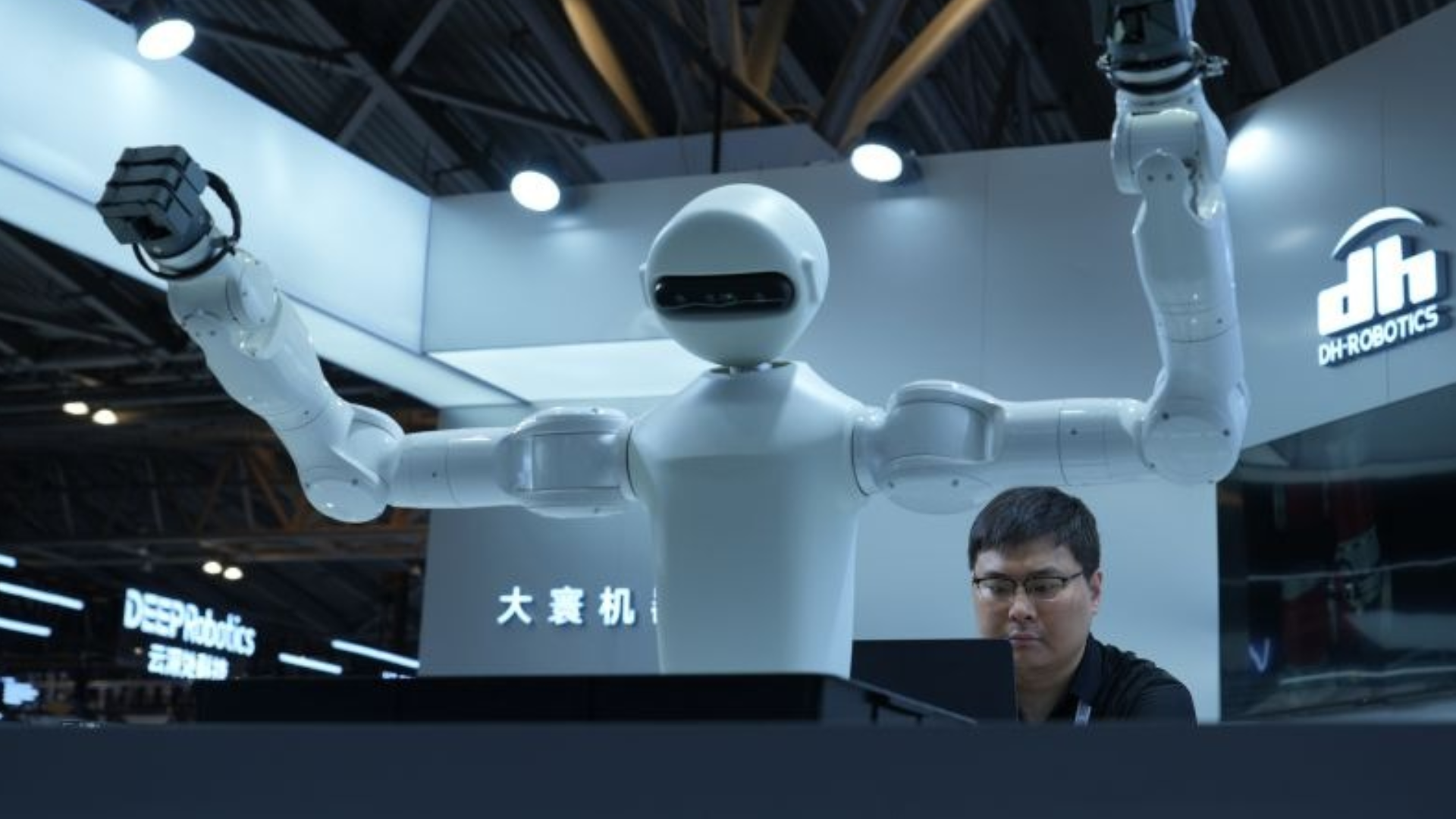
Chinese robotics maker DH-Robotics takes step toward IPO

Founded in 2016, DH-Robotics' products are used in supply chains of BYD, CATL, and Huawei.

Read at Tech in Asia

arXiv (research papers) Artur Kuramshin

Finetuning VLAs for Dexterous Manipulation: The Right Checkpoint Is All You Need

Vision-Language-Action models have demonstrated strong manipulation capabilities. A limitation of VLA models is that most manipulation datasets focus on parallel-jaw gripper systems, making transfer to multi-finger hands challenging, particularly as teleoperation datasets are harder to collect with multi-fingered robots. In this work, we study how to best adapt VLAs to dexterous hands by pairing supervised fine-tuning (SFT) with diffusion-steering reinforcement learning…

Read at arXiv (research papers)

arXiv (research papers) Wei Liu

LoRN: Low-Rank Noise Steering for Generative Robot Policies

Noise steering improves pretrained generative robot policies by learning to select their initial noise without updating model weights. We find that actions in the evaluated world-action models are more sensitive to video noise than action noise, making video noise an expressive input for steering. However, the noise-steering methods we evaluate, in their published forms, struggle to scale to the high-dimensional noise inputs of large policy classes such as world-action…

Read at arXiv (research papers)

NBC News Tim Stelloh

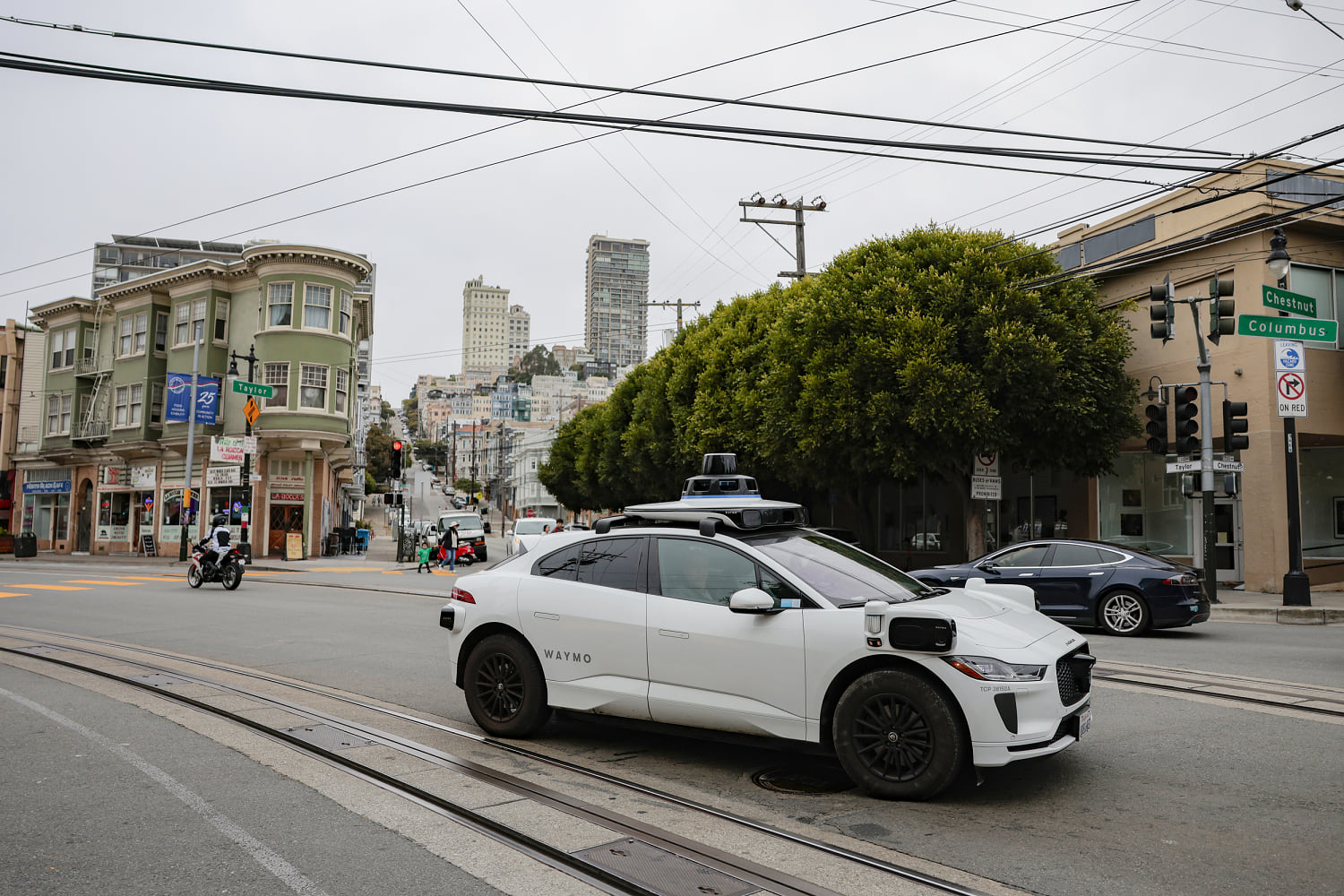
Waymo robotaxis banned from California freeways

California banned Waymo robotaxis from state freeways after officials determined that the driverless vehicles pose an “imminent hazard to public safety,” the state’s Department of Motor Vehicles said Tuesday.

Read at NBC News

Older stories