Results for “Robots”

Vale Wants to Turn the PNW into the Napa of Matcha, Complete With Robots
While my kids have always loved matcha, I’ve viewed drinks made from the fine green powder much the same way I view cilantro: as having a flavor that a person
AgentRoboCritic: Understanding the Capability of Frontier Agents on Direct Robot Control
Frontier multimodal language agents such as GPT-6 Astra have demonstrated strong capabilities in controlling robots directly via low-level numerical actions without high-level primitives. However, existing benchmarks report only episode-level success rates, which show neither how these agents succeed nor where they fail. In this paper, we present a systematic action-level analysis of frontier agents on direct robot control across 12 manipulation benchmarks. We introduce…
Mind2Act World: A Diagnostic Benchmark for Embodied Mind, Physical Action, and Mind-Action Composition in Robotic Manipulation
Embodied intelligence aims to let robots perform complex physical tasks with human-like adaptability and reliability, which requires three complementary capabilities: history-based cognitive reasoning, precise and timely physical execution, and the composition of reasoning and execution through environmental feedback. Yet existing benchmarks either evaluate reasoning and execution within the same tasks or assess them separately without their composition, so they reveal…
Awaken-HI: Scaling Humanoid Intelligence with Whole-Body Human Experience
A central goal of humanoid robotics is for robots to perform the everyday work people do in homes and workplaces. Existing egocentric video datasets cover many of these activities but provide little synchronized whole-body motion data for learning loco-manipulation at scale. We build Awaken-Human, which pairs approximately 50,000 hours of egocentric stereo video with synchronized whole-body human motion and covers more than 100 skills. Building on this, we also introduce…
I See You: Initial Multi-Robot LiDAR Registration with Mutual-Observation Checks
Compared to single-robot deployments, multi-robot teams can significantly improve search-and-rescue (SAR) mission success by covering large areas in parallel. To collaborate effectively, these robots must be registered in a common reference frame. Standard registration methods typically rely on external infrastructure or significant map overlap, but real deployments require infrastructure-free, stationary initial alignment for immediate operation. While global LiDAR point…
Teaching Vision-Language-Action Models to Stop Safely
Vision-language-action (VLA) models enable robots to perform diverse tasks from visual observations and language instructions. While prior work has explored task suppression and refusal, stopping prohibited behavior once execution is underway and controlling the resulting physical response remain challenging. Our evaluation reveals that policies which suppress a task from its initial state can still complete it when taking over partway through execution. Even when the task…
Planning to Stop: Factored Certification and Terminal Repair for Noncircular Robots
Tight-space navigation requires a robot to clear obstacles and stop inside its goal despite uncertainty. We present GeoDiff, a motion-program planner coupling original-goal stopped-set inclusion, witness-guided terminal repair, and factored proof compilation. An exact feasible-translation characterization guides repair; request-local reuse reduces repeated geometric work. We establish conditions for compiler equivalence and reach-and-stop soundness. Across 11,440…
Reference-Free Humanoid Skateboarding via Termination-Shaped Reinforcement Learning
Humanoid locomotion research has advanced rapidly on walking and running, but \emph {object-mediated} locomotion, in which a robot must coordinate its body with a passive external object, remains difficult. One challenging task is skateboarding, which requires simultaneous interaction with the ground and a passive but movable platform to achieve forward motion. Current methods for tackling skateboarding with humanoid robots either require human demonstrations or utilise…
Collision-Free Is Not Enough: Passage-Conditioned Navigation for Wheeled-Legged Robots
A collision-free detour can still bring a legged robot to the next stair or ledge a few centimetres or degrees off, and a fixed locomotion skill, factory or learned, can stall or fall. Existing methods prevent this with a robot model or extensive trial and error, but on a new site with unknown skills neither is available, so they cannot be used. We find that a single 27-minute teaching session already supplies what these methods have to derive or learn: for every stair and…
Hindsight Self-Distillation: Teaching Robots to Act from the Present
A robot must choose an action before it can see the outcome. In a recorded demonstration, later camera frames show what happened after the robot moved. Hindsight Self-Distillation (HSD) uses these later frames to teach a policy what to extract from current images. During training, a teacher sees both the current and later frames, while a student sees the current frames. They share a visual encoder and an action predictor. Each branch summarizes its images with a small set of…
Beyond Easy Clients: Difficulty- and Improvement-Aware Aggregation for Federated Reinforcement Learning in Robot Navigation
Federated reinforcement learning enables a fleet of robots to jointly learn a shared navigation policy without exchanging raw experience. In practice, however, the robots rarely operate in the same conditions: an open aisle is far easier to navigate than a cluttered room, and takes less learning to master. Standard federated aggregation rules ignore this. Uniform averaging weights every client equally, whether or not it is still learning, and weighting by episode return is…
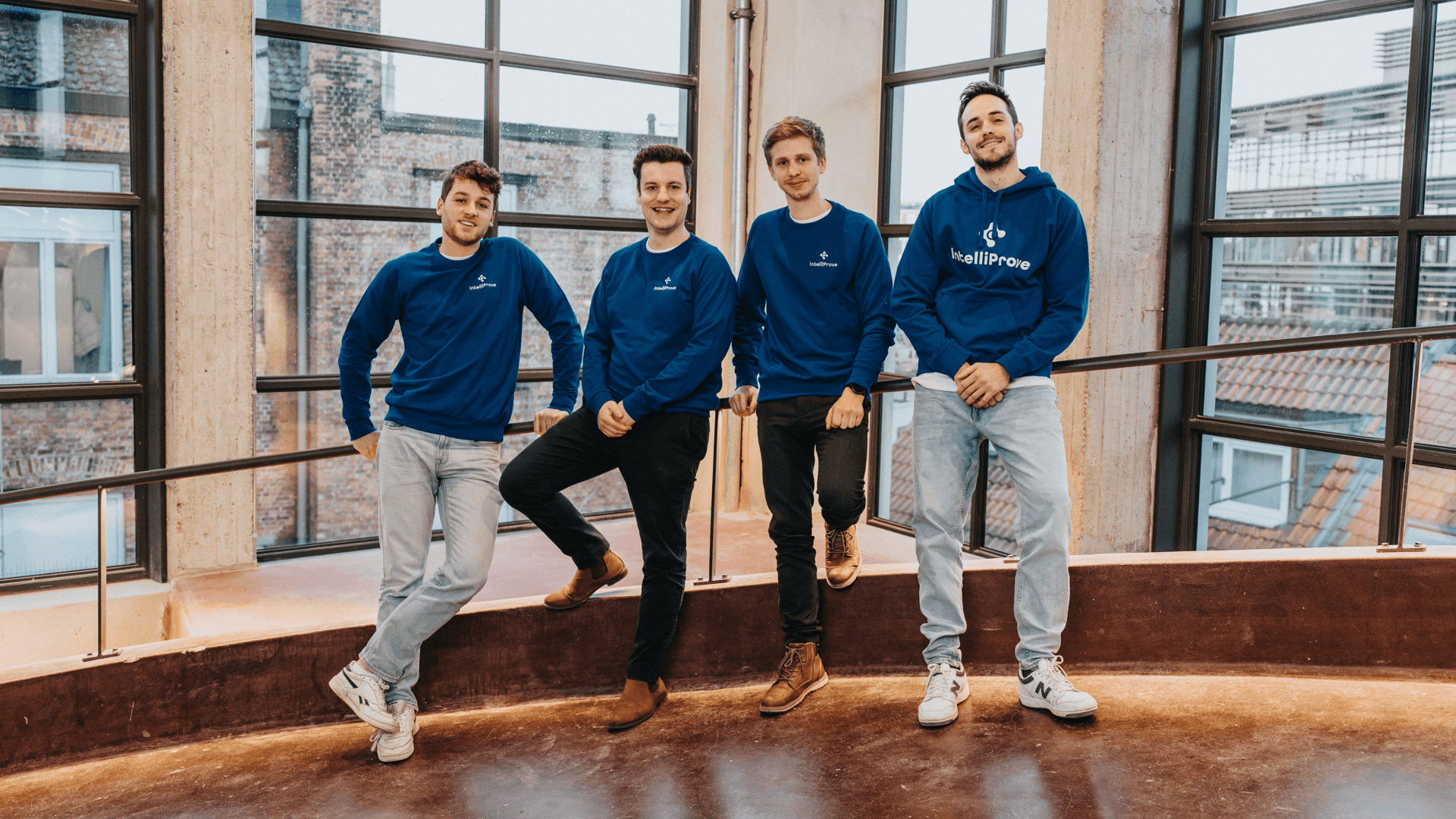
IntelliProve raises €2.7M to bring health monitoring from smartphones to humanoid robots
Belgian healthtech company IntelliProve hasraised €2.7 million in a seed funding round led by Miles Ahead, withparticipation from Wit-Gele Kruis, imec.istart and several business angels. IntelliProve ...
Dune: A Zeroth-Order Optimizer with Time-Conditioned Historical Error Regression for VLA Test-Time Adaptation
Test-Time Adaptation (TTA) enables Vision-Language-Action (VLA) models to handle distribution shifts during deployment without source-domain retraining. However, backpropagation-based adaptation incurs heavy memory overhead on resource-constrained robots, whereas zeroth-order (ZO) methods suffer from high estimation variance under limited perturbation budgets. We observe that while ZO estimation enables low-memory adaptation with rapid initial gains, it often stalls or…

Our Approach to Updating Our Commercial Terms of Service
We recently announced that the proposed updates to our commercial terms of service have been put on hold and that we will revise those proposed changes after a deeper consultation with stakeholders. We made this decision after hearing concerns from news publishers and other stakeholders about how the proposed updates apply to our web crawlers. Meta follows the industry standard robots.txt mechanism as described in our web crawler developer doc. Today, we want to share more…
RoboMorpher: Scaling Robot Morphology Representations for Cross-Embodiment Action Prediction
Learning shared action representations is central to cross-embodiment manipulation. However, identical joint values can produce different spatial configurations across robots, limiting representations learned from joint values alone. We introduce RoboMorpher, a morphology-conditioned action tokenizer that jointly reconstructs joint angles and link poses to associate control coordinates with their kinematic effects. MorphGen supplies scalable kinematic supervision by…
Hydrodynamics of robotic micro-swimmers in confinement
Inspired by seminal work by E.M. Purcell, we discuss the problem of predicting and optimizing the performance of autonomous robots swimming in confinement. Our approach is based on the explicit numerical resolution of the fluid flow induced by the swimmer, and it is validated experimentally on a cm-size prototype composed of a cargo head and a rotating propulsive tail. Using hydrodynamic scaling, we predict the performance of replicas of our prototype scaled down to mm- and…

Botsync Raises $11 Mn To Connect Robots And Machines On Factory Floors
Singapore-based robotics startup Botsync has raised $11 Mn (about ₹103 Cr) in a funding round led by IvyCap Ventures to…
SHAPE: Discrete Supervision and Parallel Continuous Streams for Learning Dexterous Manipulation from Egocentric Human Data
Egocentric human recordings are far cheaper than dexterous robot demonstrations, promising stronger pretraining and direct skill learning without task-specific robot data. Yet humans and robots differ in morphology and kinematics, so human recordings lack the joint positions and actuator commands that supervise robot policies, providing only retargeted end-effector (EEF) actions. This raises two questions: how human data should supervise the policy, and how a dexterous robot…
TinyARM-X: A Series of Open-Source, Configurable, and Transparent Torque-Controlled Desktop-Scale Robotic Manipulators
Visuomotor policies have demonstrated that imprecise low-cost robots can autonomously complete complex manipulation tasks. However, most inexpensive manipulators rely on compact and rigidly position-controlled servos for actuation, which complicate simulation, operation, and safety. This work introduces TinyARM-X, a framework for easily manufacturable, configurable, and torque-controllable low-cost ( 3 DoF robot within 10 min. Actuator modeling and dynamic compensation…

Humyn Labs Raises $47 Mn To Collect Training Data For Robots
Physical AI startup Humyn Labs has raised $47 Mn (about ₹439 Cr) to expand its data collection and robot deployment…

Humyn Labs raises $47M to bridge the gap between AI training and real-world robotics
Humyn Labs, a company turning human experience into training for robots and artificial intelligence, today announced it has raised $47 million in early-stage funding to accelerate intelligent robotic deployment readiness in real-world environments across Brazil, South Korea and India. Accel led the $26 million equity portion of the round, with participation from Prosus Ventures, BeeGlobal,
Hardware Acceleration of Vision-Language-Action Models with Weight Precision Rising over the Flow Steps
Vision-language-action (VLA) models such as GR00T control robots through an action head: a diffusion transformer that turns noise into a chunk of actions in a few flow-matching steps. Every step re-reads all of the head's weights from DRAM but applies each weight to only about fifty tokens. Inference is therefore memory-bound, and its latency and energy are largely determined by the total number of transferred weight bits. We show that later flow steps attenuate the…
HETEROVLM: Edge Multi-Request Vision-Language Model Serving on a Heterogeneous Versal SoC with AI Engines and Programmable Logic
Edge devices in vehicles and robots serve concurrent requests with different deadlines to a vision-language model (VLM), each mixing a compute-bound encoder and prefill with a memory-bound decode. GPU serving targets datacenter throughput with per-iteration host scheduling: an urgent request waits for the running iteration, and small-batch decode costs much energy per token. Prior accelerators on Versal AI Engine (AIE) SoCs map one model onto a fixed AIE dataflow graph for…
RoboBuilder: Agentic Robot Co-Design with Real-world Video Feedback in the Loop
Can AI agents design robots that work in the real world? We introduce RoboBuilder, a benchmark in which coding agents co-design a robot's hardware and program from standard parts, motors and a custom 3D-printed part, and every design that passes in simulation is built and tested on a physical course. Simulation alone is not enough: under public part data, none of 15 initial passing designs crossed the real course, so an agent learns the simulator from measurements it…
Estimation-Aware Reachability
Hamilton-Jacobi Reachability computes the states from which a system can be kept safe under worst-case disturbances, but it assumes the state is known exactly, whereas real robots act on noisy estimates whose uncertainty evolves with their motion. We extend Hamilton-Jacobi Reachability to the robot's belief, estimate and uncertainty, treating unexpected measurements as a bounded adversary and enlarging the unsafe set by the current uncertainty, so that certified states are…
Improve How You Improve: Recursive Policy Self-Improvement for Zero-Shot Open-Vocabulary Multi-Object Navigation
To advance the development of embodied general navigation, zero-shot open-vocabulary multi-object navigation has attracted increasing attention, aiming to enable robots to efficiently search multiple objects in unseen environments without training. For this task, the key lies in improving navigation policies from earlier searches to locate subsequent goals more efficiently. Recent methods automate this process through trajectory reflection and rule revision, enabling policy…
ExecGap: Exploiting Command-Execution Gap for Patch Attacks on Vision-Language-Action Models
Vision-Language-Action (VLA) models have become a powerful paradigm for robotic manipulation and show strong promise for real-world deployment, making adversarial robustness critical for reliable robot operation. Existing adversarial attacks on VLA-controlled robots mainly optimize prediction-level discrepancies or rollout-level deviations to disrupt manipulation. However, they rarely account for the fact that VLA-predicted commands are not executed directly, but must be…
Finetuning VLAs for Dexterous Manipulation: The Right Checkpoint Is All You Need
Vision-Language-Action models have demonstrated strong manipulation capabilities. A limitation of VLA models is that most manipulation datasets focus on parallel-jaw gripper systems, making transfer to multi-finger hands challenging, particularly as teleoperation datasets are harder to collect with multi-fingered robots. In this work, we study how to best adapt VLAs to dexterous hands by pairing supervised fine-tuning (SFT) with diffusion-steering reinforcement learning…
Recoverability, Not Invariance: Certified Safety for Robots at the Limits of Performance
Safety certification in robotics typically rests on forward invariance of the deployed controller, a property that demands high-fidelity models at the edge of the operating envelope, exactly where models are least reliable and robots perform best. As a result, many of the behaviors we most want robots to run, from learned policies to aggressive maneuvers at the limits of traction, cannot be certified at all. We introduce recoverability, a contraction-theoretic safety concept…