Results for “models”

EPIC Lauren Fischer Tech policy

WIRED: AI Companies Really, Really Want to Buy Your Work Files and Emails

“The union’s objections cast a light on the dark side of this gold rush. Despite the claims of virtually all the data companies that no PII goes into AI models, critics feel that there is still danger of personal data leaking out. ‘It’s not clear that anonymizing can fully get rid of privacy issues,’ says … Continued

Read at EPIC

9to5Mac Ryan Christoffel Gadgets

watchOS 27.3 adds new Apple Watch feature that I absolutely love

watchOS 27.3 arrived this week in beta alongside iOS 27.3, with a major new feature for the latest Apple Watch models: Siri Recap, which I’m already really loving.

Read at 9to5Mac

9to5Google 9to5Toys Gadgets

Friday’s Android app deals and freebies: Wreckfest, Kingdom Rush 5, Rites of Conquest, more

The all-newPixel 11 Pro, Pixel 11 Pro XL, and $100 off all Pixel Watch 5 models. The apps await below.

Read at 9to5Google

The Decoder Matthias Bastian SI

Ripple-65B Preview delivers strong agentic coding results as a fully Apache 2.0 open US model

Ricursive Intelligence is releasing Ripple-65B Preview, a 65-billion-parameter open-weight language model that the company says achieves the top score among open-source U.S. models on the TerminalBench 2.1 coding benchmark at a total R&D cost of $32 million. On other benchmarks, however, Ripple falls behind the likewise newly released western open model Inkling 2 Small. The article Ripple-65B Preview delivers strong agentic coding results as a fully Apache 2.0 open US model…

Read at The Decoder

WIRED Will Knight, Lily Hay Newman Security

Free Chinese AI Models Are Getting Scary Good at Hacking

An experiment in which AI models were asked to break into simulated networks showed the hacking skills of DeepSeek and GLM to be not far behind OpenAI’s most advanced cyber model, which isn’t public.

Read at WIRED

Dark Reading Gerald Mako, Lemuel Valdez Security

AI Gave Your Incident Archive a Second Job

Security records are increasingly being used by vendors to train their models, creating new risks for enterprises.

Read at Dark Reading

The New Stack Frederic Lardinois

Meta’s best AI model now trains the one most of its users get

Starting on Friday, everyone using Meta’s Muse agent and Meta AI gets new models the company trained using Muse Wonder,

Read at The New Stack

arXiv (research papers) Mohammed Nayeem Khan SI

Enmo Safety: External, Non-invasive, Model-agnostic Oversight for Off-the-Shelf Language Models

We study a safety harness that improves itself without touching model weights. Enmo Safety wraps a chat model with a deterministic input assessment, trigger-matched safety guidance, spotlighting of untrusted content, and an output guard. A reflector model turns failures into one bounded update per round, and an update is kept only if it lowers harm without raising refusal of benign prompts on a held-out dev split. Every version is snapshotted and every decision ledgered. We…

Read at arXiv (research papers)

9to5Mac Ryan Christoffel Gadgets

Next year’s iPhone Pro redesign will drop an important button, per leak

Next year Apple is rumored to have a big redesign coming to the iPhone Pro models, and per a new leak, it may come with the loss of the Action button.

Read at 9to5Mac

WIRED Steven Levy SI

AI Companies Really, Really Want to Buy Your Work Files and Emails

Data brokers are collecting all sorts of internal corporate files to help train AI models. Not everyone is thrilled.

Read at WIRED

The Decoder Maximilian Schreiner SI

Frontier Radar #5: If AGI is so close, why is everyone leaving? The neolabs and their bets

OpenAI is talking about the AGI era, and Nvidia CEO Jensen Huang says AGI has arrived. At the same time, co-creators of today's models are leaving OpenAI, Google DeepMind, and Meta to start their own labs, raising billions with no product to show. Why? They're betting that the current recipe alone won't be enough. We've sorted 45 neolabs by their research bets, mapped the limitations of today's AI they're trying to overcome, looked at what's already visible from their work…

Read at The Decoder

SemiWiki Daniel Nenni SI

WEBINAR: Porting, Analysing & Optimising AI Models onto Edge GPUs

Modern AI models are opening up new possibilities at the edge. Turning those possibilities into responsive, efficient applications, however, requires more than choosing hardware with an impressive TOPS figure. Developers need to understand how models behave on their target devices, where performance is lost, and which optimisations…

Read at SemiWiki

Robohub Robot Talk

Robot Talk Episode 169 – Robot sensing inspired by nature, with Dexter Shepherd

Claire chatted to Dexter Shepherd from the University of Sussex about using artificial intelligence to help robots understand and adapt to their environment. Dexter Shepherd is a Postdoctoral Researcher at the University of Sussex, exploring machine learning for bio-inspired tactile sensing and robotic locomotion. His work combines embedded AI systems, spatial-temporal models, and reinforcement learning

Read at Robohub

The Decoder Matthias Bastian SI

Thinking Machines' Inkling 2 Small claims top spot among western open-weight models

Thinking Machines, the startup from former OpenAI CTO Mira Murati, is releasing Inkling 2 Small, a mixture-of-experts model with 594 billion parameters. The company claims it's the strongest western open-weight model. Better agentic performance comes at a price, though, with token usage rising sharply. The article Thinking Machines' Inkling 2 Small claims top spot among western open-weight models appeared first on The Decoder.

Read at The Decoder

The Hacker News Security

The Flood is Coming And The Pipes Were Already Full

An update on Athena, and some unsolicited predictions on what's coming next On Saturday, Dario Amodei published We Must Pace the Frontier. I agree with him. Go read it if you haven't. I've spent the summer looking at what these models find, and the gap he describes between what they can do and what the rest of us are ready for is the one I've been staring at since May. The hardest piece of his

Read at The Hacker News

Analytics India Magazine Kileuna Haralu SI

Smaller Language Models Could Reshape How Enterprises Deploy AI

As enterprises explore smaller language models for specialised tasks, developers see opportunities for tighter evaluation and control. But smaller models still

Read at Analytics India Magazine

arXiv (research papers) Parth Illendula SI

I Think, Therefore I Attack: Evaluating Thought Injection Attacks on Reasoning Agents

Large Reasoning Models (LRMs) are one of the key components of current agentic systems. LRMs augment their output with an explicit chain-of-thought reasoning stage, introducing a new attack surface for thought injection, in which untrusted text resembling the model's own deliberation is fed back to the model. We present a two-part study of this attack, performed against the prevailing large, production class open-weight models (e.g., GLM-5.3, MiniMax-M2.5…

Read at arXiv (research papers)

Journal articles (OpenAlex) Shangkun Yu, Lixin Yu, Tingting Wang et al. · PLoS ONE

ACMNet: An attention-convolution mixed neural network for semantic segmentation of high-resolution remote sensing images

Semantic segmentation of remote sensing imagery, which is widely used in land cover classification, urban planning, and environmental monitoring, has become a research hotspot in the fields of remote sensing and computer vision. As its applications continue to expand, improving the segmentation accuracy and generalization have become pressing challenges. However, most existing semantic segmentation models rely solely on either attention mechanisms or convolutional neural…

Read at Journal articles (OpenAlex)

Journal articles (OpenAlex) Zhihong Tan, Jiayi Wang, Huiying Shi et al. · ACM Transactions on Intelligent Systems and Technology

RSFAKE-1M: A Large-Scale Dataset for Detecting Diffusion-Generated Remote Sensing Forgeries

Detecting forged remote sensing images is critical for maintaining trust in environmental monitoring and national security. While diffusion models have enabled highly realistic forgeries, their impact on forensic systems remains underexplored due to the lack of adequate benchmarks. Existing datasets are typically small-scale and GAN-centric, failing to represent the complexity of modern generative models. To bridge this gap, we introduce RSFAKE-1M , a comprehensive…

Read at Journal articles (OpenAlex)

Journal articles (OpenAlex) Vincent Benard, Olivier Laurent Windisch, Mina Bjelogrlic et al. · Surgical Innovation

Deep-Learning Enhanced Augmented Reality for Robotic Radical Prostatectomy on Consumer Grade Hardware

BackgroundAugmented Reality (AR) during Robotic-Assisted Radical Prostatectomy (RARP) provides surgical guidance by overlaying patient-specific 3D Virtual Models (VM) onto the intraoperative view. A main drawback is instrument occlusion, where VM overlaps the surgical tools, disturbing the augmented view. Deep learning (DL)-based desocclusion addresses this issue, but current implementation rely on expensive, specialized hardware.MethodsWe developed an AR desocclusion…

Read at Journal articles (OpenAlex)

Journal articles (OpenAlex) Praveen Kumar Mundlagiri, C. Dastagiraiah · International Journal of Innovation and Technology Management

Observability Aware Federation Learning in Fog-IoT Systems Round Time and runtime Metrics Analysis through iFogSim-Based implementation

Federated learning (FL) enables the training of models on distributed Internet of Things (IoT) and localization of them. Practically, Fog-IoT system More infrastructure differences exist in infrastructure, including differences in communication lag times, differences in access to fog resources, and differences in client activity that introduce much uncertainty in their effects on the length of the federation rounds, and the available literature is more focused on the effect…

Read at Journal articles (OpenAlex)

Journal articles (OpenAlex) Chaimae Saadouni, Saad El Jaouhari, Nouredine Tamani et al. · Sensors

Cross-Layer BLE Device-Type Identification via Locality-Sensitive Hashing for IoT Security

Bluetooth Low Energy (BLE) devices are ubiquitous across consumer, industrial, and healthcare IoT ecosystems, yet their resource-constrained nature typically precludes conventional cryptographic authentication, leaving device identification as a security primitive for device management, access control, and threat detection in IoT environments. Current BLE fingerprinting techniques are restricted by rigid cryptographic hashes, machine learning models that require periodic…

Read at Journal articles (OpenAlex)

Journal articles (OpenAlex) Ali Raad Abdulkareem, Mustafa Moosa Qasim, Husham Lateef Swadi et al. · Journal of Data Science and Intelligent Systems

A Carbon-Aware IoT Scheduling Framework for Sustainable Smart Homes Using Predictive Energy Models

With the widespread popularization of software engineering-based Internet of Things technology, the smart home field has obtained the basic conditions to realize fine-grained monitoring and intelligent control of household energy consumption. Presently, there are two big issues with our home energy management. First, in this paper, our emphasis is only on conserving energy rather than considering whether the energy we consume from the grid is clean or dirty. Second, we are…

Read at Journal articles (OpenAlex)

Phys.org Space Space

Connecting artificial intelligence with the tools of astrophysical research

Investigating a scientific question is often a complex process. As an astrophysicist studying some of the most energetic phenomena in the universe, I know that finding answers requires much more than reading scientific papers or understanding existing theories. Astrophysical research involves collecting observations, analyzing data, building physical models and comparing their predictions with observations. These tasks require different scientific tools, databases and…

Read at Phys.org Space

The New Stack Frederic Lardinois

OpenAI’s new GPT-6 Cyber is better at hacking and better at staying in its lane

OpenAI on Thursday launched GPT-6 Cyber, the latest release in its series of cybersecurity-focused models. The company ranks GPT-6 Cyber’s ability

Read at The New Stack

NVIDIA Blog NVIDIA Writers SI

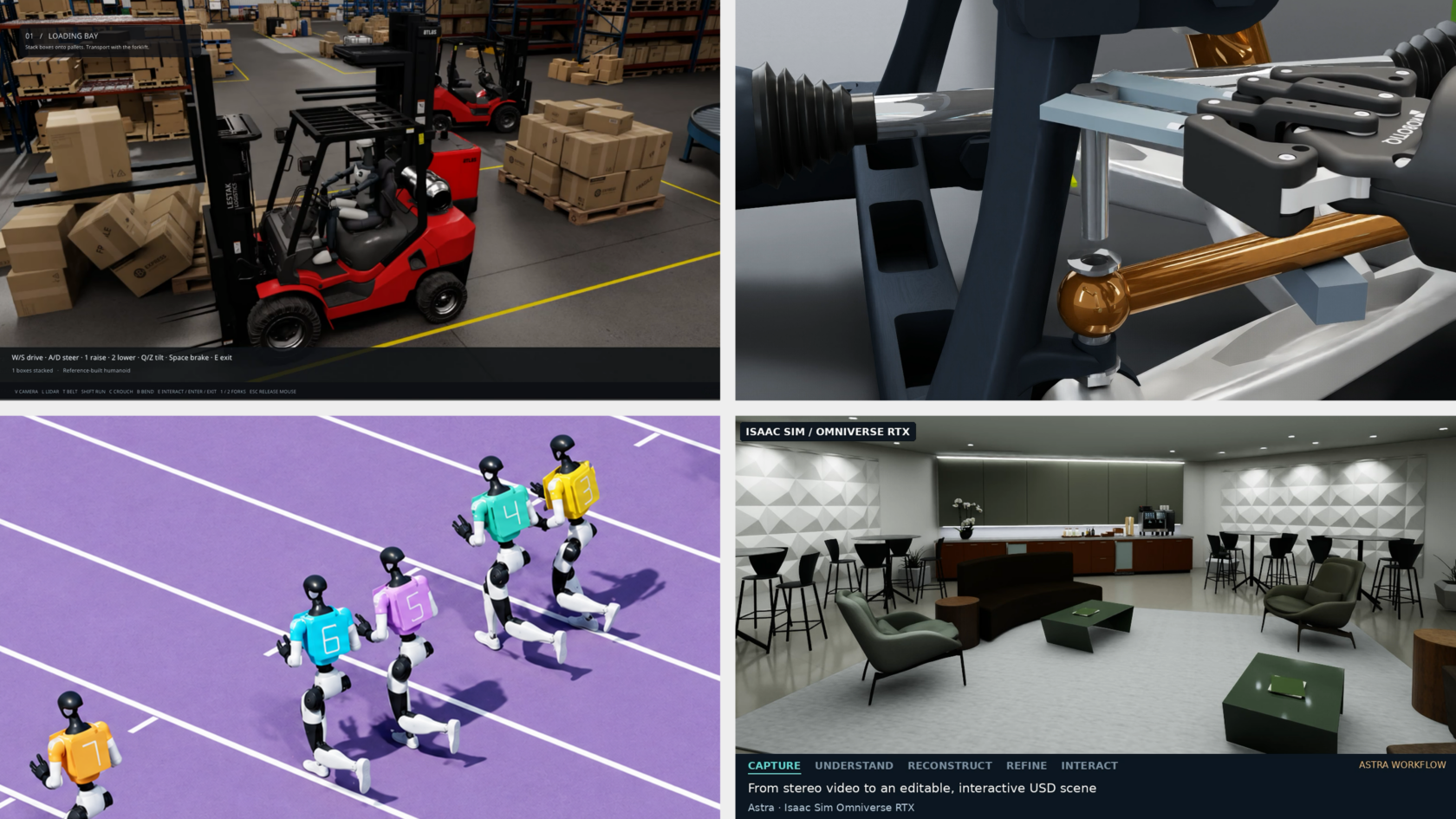
Into the Omniverse: How Developers Turn Ideas Into Simulations With Frontier AI Agents

Turning a simulation idea into a working application means assembling assets, connecting physics and rendering, and checking that the scene behaves as intended. Developers are combining frontier AI models with NVIDIA Omniverse libraries to help carry out that work — building applications for exploring scenarios, investigating failures and improving designs. Developers direct AI agents through

Read at NVIDIA Blog

SiliconANGLE AI Ryan Stevens SI

Same model, better answer: Enterprise data is what turns generic AI into a business tool

Generic AI models can write SQL, but they don’t know a company’s orders, customers or revenue definitions. Now, Oracle Database aims to give AI agents the context to move a stalled order forward. But that shift raises questions about complexity, lock-in and security as AI agents start acting on live transactions. Oracle Corp.’s answer is

Read at SiliconANGLE AI

The Decoder Jonathan Kemper SI

Tencent releases Hy4 with vision and computer use, claims second place among Chinese AI models

Tencent has unveiled Hy4, its first multimodal language model that understands images and can operate software on its own. On the Artificial Analysis Intelligence Index, it scores 35 points, solid but behind Kimi K3.1 Pro. On hard math and complex image analysis, Hy4 still trails the best commercial models by a wide margin, according to Tencent itself. The article Tencent releases Hy4 with vision and computer use, claims second place among Chinese AI models appeared first on…

Read at The Decoder

NVIDIA Blog Matthew Leib SI

The Wizard of Open Weights: Chris Alexiuk Makes AI Easy With Open Models

Chris Alexiuk has a simple rule about open source AI: If you believe in it, be loud about it. “We should be shouting about this technology from the rooftops,” said Alexiuk, a Toronto-based senior product research engineer in deep learning at NVIDIA who specializes in making open large language models (LLMs) practical for working developers.

Read at NVIDIA Blog

Older stories