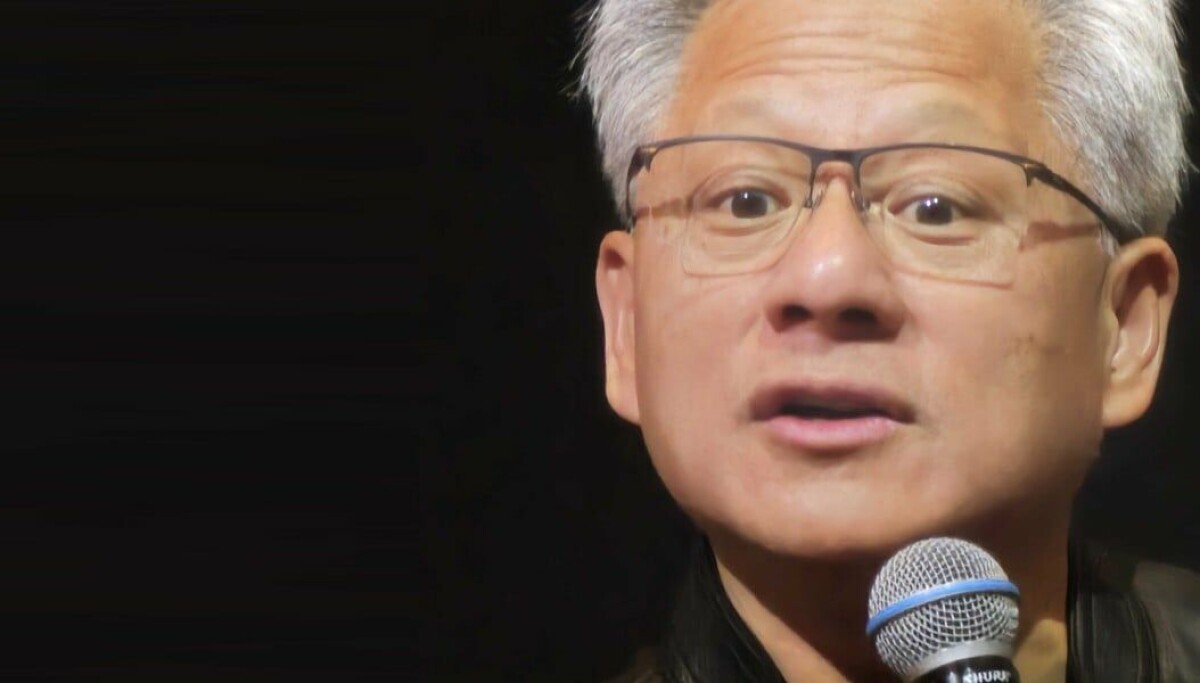
Nvidia’s board is investigating Jensen Huang over his relationship with a suspected Chinese spy, and Yale’s Jeffrey Sonnenfeld thinks it’s roughly a coin flip whether Huang stays on as CEO.
The AI chipmaker says it has no reason to believe company secrets were compromised, even as US lawmakers seek answers over potential national security risks.
Chip giant Nvidia’s board announced Sunday it opened a probe into Chief Executive and co-founder Jensen Huang after he acknowledged an affair with a woman US officials say was working for Chinese intelligence. Late last month, The New York Times reported that US intelligence officials concluded that the woman, a Chinese executive linked to a Singapore-based
Nvidia said on Sunday its board was probing whether CEO Jensen Huang had been the target of a foreign intelligence effort, after a media report alleged he had a close relationship with a Chinese businesswoman.
CEO reportedly had close relationship with a Chinese businesswoman who passed information to Beijing Nvidia said on Sunday it “is initiating an independent investigation in light of recent reporting that founder and CEO Jensen Huang has been the target of a foreign intelligence effort”. The New York Times reported in October that Donald Trump had been briefed last year on intelligence that Huang had a close relationship with a Chinese businesswoman who passed…
President Trump defended Nvidia CEO Jensen Huang on Sunday night, even as the company's board launched an investigation into his affair with a suspected Chinese spy. Why it matters: The blowback to Huang's relationship is only getting more intense by the hour, with multiple members of Congress calling for probes and investors saying the news could put a cloud over the entire AI trade. What they're saying: Trump was asked Sunday night if he's taking Huang with him on an Asia…
On Sunday, Nvidia announced it was launching an investigation into CEO Jensen Huang's relationship with Alice Huang, an AI executive and agent of the Chinese government. In addition to the Board of Directors announcing the investigation…
Nvidia has announced that it is opening an investigation into CEO Jensen Huang and his relationship with Megaspeed executive Alice Huang, who was reportedly recruited by China's Ministry of State Security to spy on the company. A statement…
Nvidia CEO Jensen Huang admitted to having a romantic relationship with a suspected Chinese spy in a message to his company, and the company's board announced an independent investigation Sunday. Why it matters: The scandal raises national security concerns involving one of the world's most powerful tech CEOs, who has pushed to loosen restrictions on selling advanced AI chips to China amid the two countries' race for technological dominance. Driving the news: "I owe my…
Nvidia CEO Jensen Huang is facing increasing congressional scrutiny after multiple reports Friday night suggested he had a romantic relationship with a purported Chinese spy. Why it matters: Huang is arguably the world's most powerful CEO, the man who runs one of the world's largest companies and whose products are central to the world's most important technology. The mere suggestion that he was in some way compromised by a Chinese intelligence agent could quickly become a…
A memo that circulated among U.S. policymakers cited intelligence that Alice Huang, a Chinese executive who developed a relationship with Nvidia’s leader, was an asset of Beijing’s Ministry of State Security.
China's intelligence agency recruited Megaspeed executive Alice Huang to spy on Nvidia CEO Jensen Huang, according to The New York Times. The Ministry of State Security (MSS) enlisted her to glean information about American AI chips and…
OpenAI is talking about the AGI era, and Nvidia CEO Jensen Huang says AGI has arrived. At the same time, co-creators of today's models are leaving OpenAI, Google DeepMind, and Meta to start their own labs, raising billions with no product to show. Why? They're betting that the current recipe alone won't be enough. We've sorted 45 neolabs by their research bets, mapped the limitations of today's AI they're trying to overcome, looked at what's already visible from their work…
US intelligence agencies reportedly concluded that a Chinese businesswoman with access to Nvidia CEO Jensen Huang was passing information to Beijing, raising questions about the security of the company’s commercial relationships and the enforcement of US semiconductor export controls. The alleged Jensen Huang spy plot was reported by The New York Times on 29 October
Beijing dismissed as “groundless speculation” on Friday a report that said Jensen Huang, head of US chip giant Nvidia, was the target of a Chinese spy plot. The article by The New York Times, published Thursday, said that US intelligence officials concluded that a Chinese executive linked to a Singapore-based data centre company had been
Kazakhstan’s AI ecosystem is moving from infrastructure plans to deployment. The shift is visible across the full AI stack — from infrastructure to models to applications. The announcements below — coinciding with a visit to Astana by NVIDIA founder and CEO Jensen Huang — point to the nation’s increasing supply of accelerated computing, along with
This article examines female leadership in populist radical right (PRR) parties in the Nordic countries, challenging the traditional view of these parties as “Männerparteien.” Building upon research on the centrality of gender to the radical right, we analyse biographical material covering the private and professional lives of two generations of female PRR leaders in Denmark (Pia Kjærsgaard), Finland (Riikka Purra), and Norway (Siv Jensen and Sylvi Listhaug). Our findings…
In the cavernous hall of Kraftwerk, a former power station in Berlin, German Chancellor Friedrich Merz and NVIDIA founder and CEO Jensen Huang sat down to discuss Germany’s AI roadmap, and in particular, the industrial applications of AI. Huang opened by tracing NVIDIA’s longstanding relationship with German industry, beginning with gaming systems, workstations and automotive
Large language models (LLMs) in production systems face prompt injections, trojans (backdoors), and manipulation of automatic quality metrics. This thesis develops models, methods, and algorithms for evaluating and improving LLM robustness to adversarial input sequence variations. We propose R_stab(f), a generative robustness metric based on the Jensen-Shannon divergence between per-step output distributions under small input perturbations. For localized attacks we prove…
Large Language Models (LLMs) often fail to maintain instruction hierarchies (IH) when processing multi-source inputs with varying role-level priorities, paradoxically adhering to lower-priority directives during conflicts. While existing defenses mitigate this issue, they are largely restricted to single-turn scenarios and require expensive fine-tuning. In this paper, we formalize this failure mode in multi-turn contexts via a Jensen-Shannon Divergence (JSD) framework…