Results for “model”

Quantum Computing Report Mohamed Abdel-Kareem

Google DeepMind and Google Quantum AI Use Lean 4 to Discover Formally Verified Quantum Algorithms

Google DeepMind and Google Quantum AI have used Lean 4 to discover formally verified quantum algorithms, detailed in their paper "Discovering Formally Verified Quantum Programs with AI." Their automated discovery pipeline uses large language model agents and formal quantum Hoare logic to synthesize and verify quantum programs, even at scales exceeding classical simulation capabilities. This approach has led to significant reductions in fault-tolerant resource consumption…

Read at Quantum Computing Report

arXiv (research papers) Gabriel I. Nathan Space

Earth accreted increasingly oxidized material as it grew constraining Theia to be small and relatively oxidized

Many different Solar System formation scenarios successfully reproduce the main astrophysical properties of the inner Solar System. Here, we use the chemistry of Earth's mantle to determine whether proposed Solar System formation scenarios can produce Earth and to constrain the characteristics of both the Proto-Earth and the Moon-forming impactor, Theia. To do this, we use a coupled N-body accretion and core-mantle differentiation model (Rubie et al., 2011, 2015b) applied to…

Read at arXiv (research papers)

MacRumors Juli Clover Gadgets

Apple's Claris Testing 'Harbor' App for Local AI on Macs

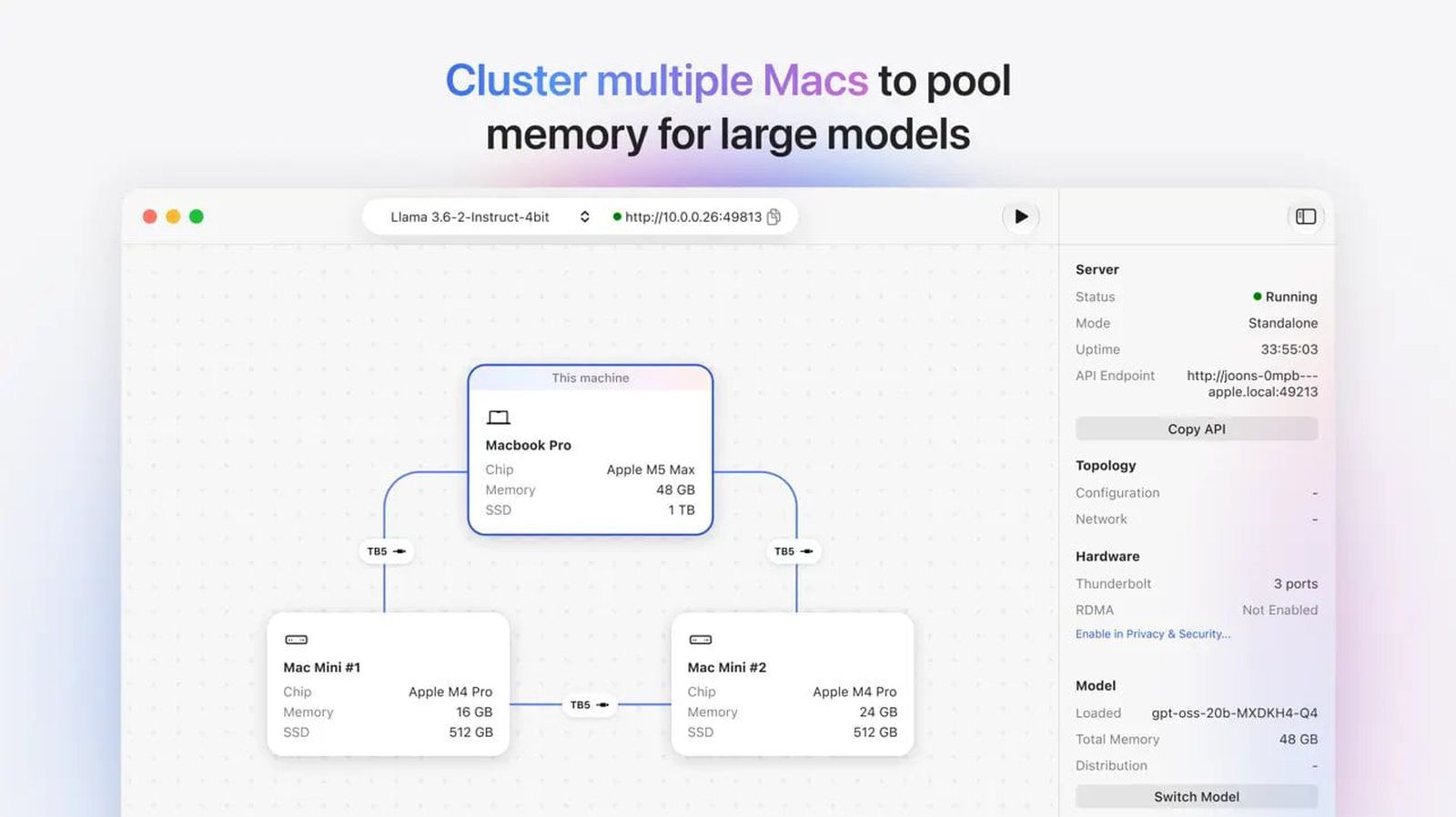
Apple's Claris subsidiary is testing an app called Harbor, which turns Apple silicon Macs into a private AI server. Harbor works with a single Apple silicon Mac, but it also supports connecting multiple Mac computers over Thunderbolt 5 to pool unified memory for larger models. Apple added RDMA over Thunderbolt 5 with macOS Tahoe 26.2, making clustering faster. Harbor detects devices connected over Thunderbolt 5 and lets users browse for, download, and load open-weight…

Read at MacRumors

Quantum Computing Report Mohamed Abdel-Kareem

RIKEN and Quantinuum Demonstrate Heterogeneous Multi-QPU Workflows on Fugaku

Researchers successfully demonstrated a hybrid quantum-classical computing architecture integrating the Fugaku supercomputer with two distinct quantum processors: Quantinuum's trapped-ion Reimei and IBM's superconducting ibm_kobe. This setup enabled a multi-modality workflow, significantly reducing energy error in a 16-site 2D Transverse-Field Ising Model calculation by combining the strengths of both quantum systems. The Tierkreis workflow management system was adapted to…

Read at Quantum Computing Report

arXiv (research papers) Ruiheng Yu Security

OverServe: Resource Amplification Attacks on SaaS Agents via Tool--Prompt Co-Design

Advances in large language models (LLMs) are enabling software-as-a-service (SaaS) providers to automate longer business workflows with agents. In subscription-based SaaS deployments, model and tool calls consume provider resources without additional customer payments. Because the agent autonomously decides when to stop, a malicious tenant can send a prompt to the agent, exploiting its completion decisions to extend execution and waste provider resources. In this paper, we…

Read at arXiv (research papers)

SiliconANGLE AI Duncan Riley SI

Mercor raises $750M at $20B valuation to take AI agent evaluation to enterprises

Artificial intelligence training data company Mercor.io Corp. today revealed that it has raised $750 million in new funding at a $20 billion valuation. Mercor provides the human expertise used to train and evaluate AI models, drawing on a network of more than 5 million domain experts. Most of that work so far has been for

Read at SiliconANGLE AI

arXiv (research papers) Nikitha Donekal Chandrashekar Tech policy

Who (or what) are they prompting? How CS students conceptualize and use LLMs

Large language models (LLMs) are increasingly used by students in computing courses. Yet computing education research has not fully examined how teaching and inclusion of LLMs shape students' conceptualization and understanding of LLMs, and how these factors relate to their subsequent use. Although prior work has examined prompting strategies and AI literacy, the relationships among students' conceptualizations of LLMs, their understanding of LLM mechanisms, and their…

Read at arXiv (research papers)

arXiv (research papers) Anish Saxena

SlipStream: Enabling HBF for GPU Systems by Mitigating the Latency and SRAM Overheads

Large language model (LLM) inference demands ever more memory capacity for larger models and batch sizes. High-Bandwidth Flash (HBF) replaces the DRAM dies of HBM with NAND flash and provides up to 16x the capacity at comparable read bandwidth. However, HBF can incur a read latency of nearly 20$μ$s, 20x that of HBM, so on-demand HBF accesses slow inference by up to 12.8x. Conventional cache-line prefetchers require 20x more in-flight tracking state to cover this latency…

Read at arXiv (research papers)

Microsoft Research blog Dimitris Papailiopoulos SI

Lazare, veni foras: Reprogramming Dormant Neurons to Backdoor AI Agents

Microsoft researchers have discovered “Lazarus,” a backdoor technique that can reprogram dormant neurons in an AI model, causing an otherwise normal AI agent to execute malicious commands when a hidden trigger appears. The threat is especially serious for AI agents with tool or terminal access. A triggered model could quietly download and run attacker code,

Read at Microsoft Research blog

arXiv (research papers) Sho Shibata Space

Origins of Satellite-System Building Blocks I: Solid Delivery During Jupiter's Growth

Jupiter's satellites formed within a circumplanetary disk (CPD), but the origin and delivery of the solids from which they accreted remain uncertain. Here, we investigate the delivery of planetesimal material to the CPD while consistently accounting for the growth of Jupiter and the evolution of its surrounding planetesimal reservoir. Using N-body simulations coupled to an evolving CPD model, we quantify the solid mass supplied through planetesimal ablation and direct…

Read at arXiv (research papers)

ZDNET AI Maria Diaz SI

Need more AI in Creator Studio? Apple may charge you for it

With its new $50 AI usage packes, Apple is the latest company to introduce paid model for AI access.

Read at ZDNET AI

arXiv (research papers) Evan Fitzmaurice Space

The Closest Super-Eccentric Giant Planet: Dynamical History and Orbital Future of Gaia-3b

With new high-resolution spectra and radial velocities (RVs) from the NEID spectrometer, we reaffirm the planetary designation of the previously identified super-eccentric giant planet Gaia~3b. Our additional 23 RVs span 356 days, including an RV observation obtained within hours of the periastron passage. By modeling all of the available RVs we collapse a previously tri-modal orbital period posterior distribution and report a more precisely measured value of…

Read at arXiv (research papers)

9to5Mac Ryan Christoffel

Apple just released new AirPods Pro 3 firmware and more

Apple is rolling out brand new firmware for select AirPods models today, including AirPods Pro 3. Here are the details on how to update.

Read at 9to5Mac

9to5Mac Ryan Christoffel SI

Apple has new Mac app coming to make running local AI models easy

Leaker Aaron Perris has discovered evidence of a new Mac app in the works at Apple called Harbor, which makes it easy to run local AI models across one or more Macs.

Read at 9to5Mac

TechCrunch Tim Fernholz SI

PSI is trying to make a business out of AI-driven scientific discovery

PSI used an unreleased Anthropic model to answer a fundamental question about quantum computing that scientists have pursued for nearly two decades.

Read at TechCrunch

arXiv (research papers) Sima Buchbinder

Squeezed Light Generation by Cooper Pair Recombination in a Superconductor-Semiconductor Structure

We theoretically demonstrate squeezed light generation in a compact, electrically driven device utilizing the nonlinear light-matter interaction of Cooper-pair recombination in a hybrid superconductorsemiconductor structure. On the basis of second-order perturbation theory, we developed an effective Hamiltonian which incorporates the electronic component of the interaction as a photon coupling strength coefficient, enabling a model to describe the quadrature squeezing effect…

Read at arXiv (research papers)

arXiv (research papers) Emre Kutlusan SI

Medical Image Segmentation: Foundation Model Adaptation versus Task-Specific Training

Foundation models pretrained on large natural-image collections are increasingly adapted for medical image segmentation, in the expectation that they will replace models trained for each task. Most comparisons, however, use data from the training distribution and a single task-specific baseline whose configuration is rarely justified, and therefore provide limited evidence of performance at new clinical sites. It also remains unclear how much of a foundation model must be…

Read at arXiv (research papers)

arXiv (research papers) Sheethal Bhat SI

Toward Foundation Detection Models via Example-Based Grounding in EM-DETR

DeepLearning (DL)-based Computer-Aided Diagnostic (CAD) systems have shown great promise in supporting clinicians, but their performance heavily depends on the availability of large, well-annotated datasets. In medical lesion detection, the scarcity of comprehensive, stan dardized annotations and the heterogeneity of existing datasets limit the development of robust foundation models. In this work, we introduce a novel approach to building a multi-domain foundation model for…

Read at arXiv (research papers)

arXiv (research papers) Kaiyuan Hou SI

ReTrace: Distilling Tool-Using Agents into Planner-Free Workflows

Business process automation runs the same Standard Operating Procedure (SOP) again and again on new inputs. Large Language Model (LLM) agents can follow an SOP written in natural language, but they call an LLM to choose every step of every run, which adds latency and cost at scale. We present ReTrace, which turns an SOP and a few logged agent runs into a reusable workflow in which code, not an LLM, selects the next step. The agent's reasoning, the explanation it writes with…

Read at arXiv (research papers)

arXiv (research papers) Muhan Gao SI

Re-Search: Dissecting LLM Ideation Through a Two-Player Questioning Game

Research ideation is iterative: researchers refine their ideas step by step based on feedback. Yet existing evaluations obscure this search process, making it difficult to understand how LLMs explore the space of research ideas and what limits their progress. We introduce Re-Search, which adapts the format of Twenty Questions to research ideation: given only the research problem of a published paper, a model must rediscover the paper's core idea by asking yes-or-no…

Read at arXiv (research papers)

The Verge Brad Bourque

One of our favorite multi-filament 3D printers is $100 off

If you’re tired of filament jams and clogged nozzles, perhaps it’s time for a new 3D printer. Through December 1st, the Bambu Lab P2S Combo, currently one of the best models that’s easy to use, is discounted. It’s $649 at Best Buy, as well as directly from Bambu Lab. That’s $100 off the list price

Read at The Verge

The Decoder Maximilian Schreiner SI

Nvidia's model GR00T 2 watches humans on video, then imagines itself as the robot

Nvidia's new AI model GR00T 2 is designed to teach robots new tasks without laborious teleoperation. Instead, the system transfers human hand movements from videos to robotic arms, trained on about 400,000 hours of video footage. Success rates still vary widely, though, ranging from 10 to 80 percent depending on the task. The article Nvidia's model GR00T 2 watches humans on video, then imagines itself as the robot appeared first on The Decoder.

Read at The Decoder

arXiv (research papers) Dang H. Le

Finite-Key Readiness and Authentication-Key Replenishment in QKD-Assisted UAV Edge Computing

A service that needs fresh quantum keys must wait for key release, and may be denied it, before protected computation starts. We quantify this cost for a trusted stationary UAV serving two ground gateways, each obtaining its keys from one finite-key decoy-state BB84 attempt with parameters fixed in advance. A count-level Monte Carlo model, reproduced by a semi-analytic model, links key acceptance to protected upload, computation, and download, including failed attempts and…

Read at arXiv (research papers)

arXiv (research papers) Javier Faba

Structure of correlations for the single-$j$ model using quantum information theory

We say that a system undergoes a quantum phase transition when the mean-field ground state of a given Hamiltonian spontaneously breaks its symmetries depending on the Hamiltonian parameters. It is a widely accepted view that this phenomenon enables the mean-field state to absorb the maximum amount of correlations without losing its mean-field structure. However, it is still uncertain how those correlations are incorporated within the mean-field state and how the correlation…

Read at arXiv (research papers)

GeekWire Kurt Schlosser SI

Fintech giant Plaid opening Seattle engineering office, with plans to double local headcount

The 11,466-square-foot Westlake office will house Plaid’s growing technical team as the company builds AI models for financial services.

Read at GeekWire

The Decoder Matthias Bastian SI

Gemini 4 Carbon arrives just in time to feel like yesterday's news in the fastest model cycle yet

Google is making Gemini 4 Carbon generally available after a two-week testing phase. The model ranks first in several benchmarks, in some cases ahead of Anthropic's new Fable 5.2, at less than half the per-task cost. Google is also previewing coordinated agent teams through the "/swarm" feature, which split up complex tasks in real time. The article Gemini 4 Carbon arrives just in time to feel like yesterday's news in the fastest model cycle yet appeared first on The Decoder.

Read at The Decoder

arXiv (research papers) Amani Kiruga

UGG: Unified Generative Geometry Model

Understanding 4D scenes is a core challenge in visual intelligence, requiring models to jointly capture scene geometry, appearance, and dynamics from partial observations. However, existing approaches are subdivided into feedforward models for direct geometric prediction, and generative models for visual synthesis. We introduce UGG, a unified framework for 4D scene understanding that jointly models RGB video and geometric representations such as depth and camera pose. By…

Read at arXiv (research papers)

arXiv (research papers) Ilia Larchenko SI

One Policy for 100 Household Tasks: Our Solution for the 2026 BEHAVIOR Challenge

We describe our solution for the 2026 BEHAVIOR Challenge: 100 long-horizon household tasks in the OmniGibson simulator. We placed 9th on the final leaderboard, the only independent team in the top 10. The core of the solution is a single vision-language-action (VLA) model, one checkpoint for all 100 tasks, built on our 1st-place 2025 solution, which is based on $π_{0.5}$. On the 50 tasks shared with 2025, its Q rises from 0.260 to 0.371; across all 100 tasks it scores 0.392…

Read at arXiv (research papers)

Quantum Computing Report Mohamed Abdel-Kareem

RIKEN Upgrades Reimei-Fugaku Hybrid Quantum Platform with 56-Qubit Quantinuum H2 Processor

RIKEN has upgraded its Reimei-Fugaku hybrid quantum platform with Quantinuum's 56-qubit System Model H2 trapped-ion quantum computer, replacing the 20-qubit H1. This upgrade enhances physical capacity, gate fidelity, and computational active space, allowing for more complex quantum chemistry simulations. The platform links Quantinuum's quantum computer directly to the Fugaku supercomputer, creating a powerful testbed for hybrid quantum-classical computing.

Read at Quantum Computing Report

arXiv (research papers) Sourish Gunesh Dhekane SI

Quantifying the Sampling Frequency Invariance of Time-Series Foundation Models for Sensor Data Applications

Time-Series Foundation Models (TSFMs) are increasingly used in sensor applications, where sampling frequency (SF) varies across sensors, devices, and operating modes (e.g., power saving). Ideally, TSFMs must remain effective during such SF changes, provided the SF retains task-critical bandwidth. In this paper, we stress-test 4 prominent TSFMs: MOMENT, Chronos-2, Moirai-MoE, and TimesFM, to quantify their SF-invariance and investigate whether their behavior tracks the…

Read at arXiv (research papers)

Older stories