Results for “Computing”

Phys.org Quantum Physics

Research advances quantum computing that harnesses speed of light

Quantum computers have the potential to perform calculations more quickly than supercomputers, but they could be even faster and more energy-efficient if they were built with photons as their basic units, called qubits.

Read at Phys.org Quantum Physics

Quantum Computing Report Mohamed Abdel-Kareem

Qunova Computing Achieves Chemical Accuracy at 80 Qubits on Iron-Sulfur Cluster Using IBM Quantum System Two and Fugaku

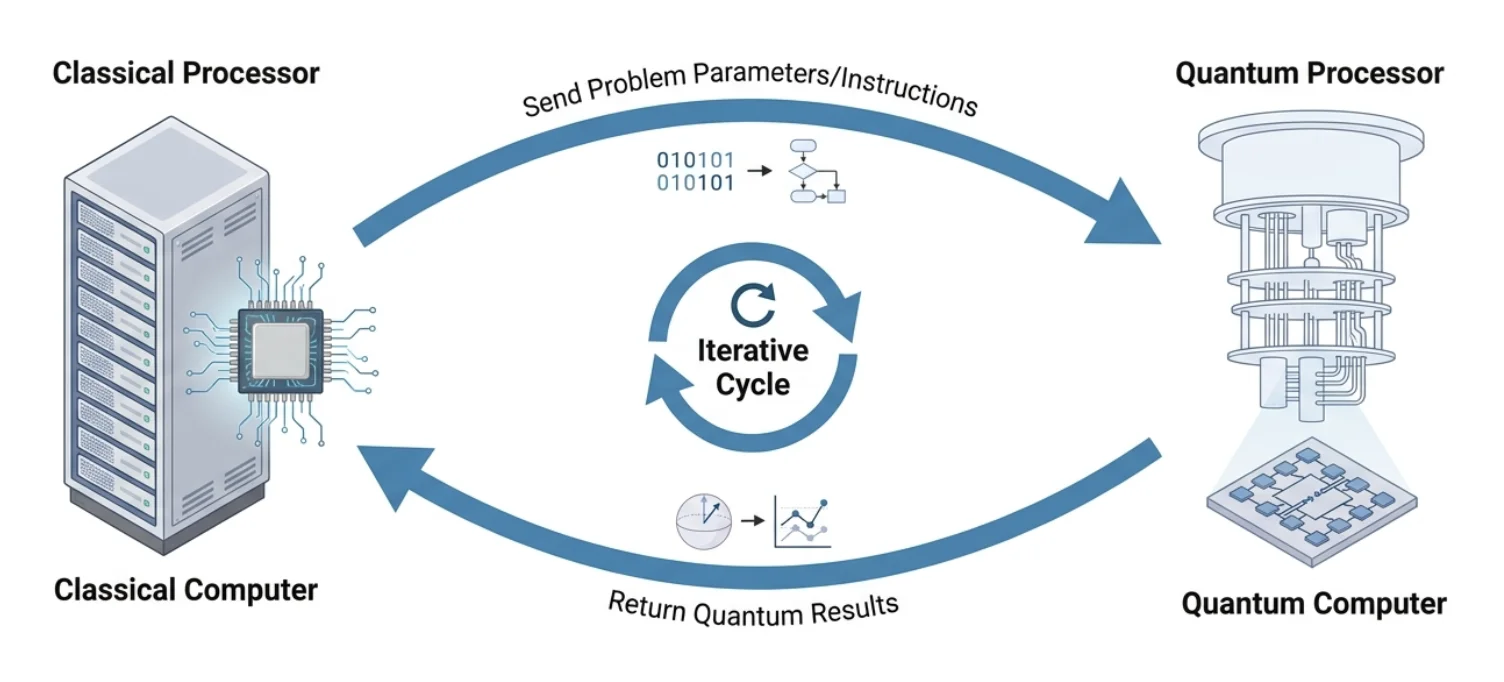
Qunova Computing achieved a breakthrough in quantum chemistry by simulating an 80-qubit iron-sulfur cluster with chemical accuracy using a hybrid approach combining IBM Quantum System Two and the Fugaku supercomputer. Their HI-VQE algorithm reduced classical computing costs by approximately 300x while matching classical benchmarks. This advancement has significant implications for understanding complex biological and industrial processes.

Read at Quantum Computing Report

Quantum Computing Report Mohamed Abdel-Kareem

PsiQuantum and AMD Expand Partnership with Equity Investment to Co-Design Utility-Scale Quantum Infrastructure

PsiQuantum and AMD are expanding their partnership with an equity investment from AMD to co-design the infrastructure for fault-tolerant quantum systems. The collaboration integrates AMD's GPUs, CPUs, and software with PsiQuantum's silicon photonics architecture to enhance real-time error correction and classical computing for hybrid workloads. They are prioritizing pharmaceutical research and molecular simulation, with plans to present further technical details at the SC26…

Read at Quantum Computing Report

Semiconductor Digest Shannon Davis SI

Almere, Flevoland and Q.ANT Team Up for Computing with Light

German leader in photonic AI chips signs Memorandum of Understanding with Innovally and Horizon Flevoland at SEMICON Europa.

Read at Semiconductor Digest

SiliconANGLE AI Sloane Kali Faye SI

CNCF data shows cloud native is the on-ramp to AI, and maintainers are paying the price

The global population of cloud-native developers has topped 21 million, but the headcount tells only part of the story. Artificial intelligence is changing what those developers build and how open-source projects absorb their work. Fresh research is putting numbers on that shift. The latest State of Cloud Native Development report from the Cloud Native Computing

Read at SiliconANGLE AI

Phys.org Quantum Physics

Chip-based laser cooling could ease quantum computing bottleneck

Researchers at Cornell have developed a laser-cooling technique that could potentially remove a significant bottleneck in the development of larger, faster quantum computers.

Read at Phys.org Quantum Physics

SiliconANGLE AI Mark Albertson SI

What to expect during SC26: Join theCUBE Nov. 17–19

High-performance computing and artificial intelligence are converging, driven by advances in exascale computing, accelerated systems, data storage and high-speed networking. The convergence of these technologies is a prime topic for discussion during SC26 in Chicago this month. Major industry players, such as Dell Technologies Inc., Google LLC and Nvidia Corp., have pursued a set of

Read at SiliconANGLE AI

Asia Times Jeff Pao Geopolitics

Huang’s fall, US curbs put China’s AI computing in peril

Chinese tech giants may soon have to overhaul how they buy artificial intelligence (AI) computing power, as Washington prepares new rules to curb their remote access to advanced AI chips in overseas data centers amid the scandal that has forced Nvidia founder Jensen Huang to resign. Nvidia said in a press release on Thursday that

Read at Asia Times

Semiconductor Digest Shannon Davis

Texas Tech Receives $19 Million Grant to Further Semiconductor Innovation

The grant will support Texas Tech’s next-generation computing cluster as the university pushes and transforms semiconductor development.

Read at Semiconductor Digest

arXiv (research papers) Christopher Liaw SI

Sketching Language Models for Context Attribution

Context attribution asks how removing parts of a prompt changes a language model's output. We study leave-one-out (LOO) attribution for a prompt of $n$ tokens and a fixed measurement function. Computing all LOO values directly requires $n$ model evaluations. Under a stability assumption, our algorithm estimates all LOO values to error proportional to $\varepsilon$ with constant probability using $O(\sqrt{\log(1/\varepsilon)}/\varepsilon)$ evaluation calls. To complement our…

Read at arXiv (research papers)

Digital Trends Omair Khaliq Sultan

Kamrui P2 AI mini PC review: Practical AI performance in a micro footprint

Modern compact desktops offer serious performance and high value without taking up your entire desk. The era of needing a massive desktop tower for daily office computing is officially behind us. Small form factor machines have evolved from compromised, low-power terminals into genuinely capable workstations. You no longer have to sacrifice performance just to reclaim

Read at Digital Trends

The Quantum Insider Mohib Ur Rehman

Qedma Appoints Scott Aaronson to Its Scientific Advisory Board

Insider Brief PRESS RELEASE — Qedma, a quantum computing software company specializing in quantum error suppression and mitigation, today announced that Professor Scott Aaronson, one of the world’s leading researchers in quantum computing and computational complexity theory, has joined its Scientific Advisory Board. Aaronson is the Schlumberger Centennial Chair of Computer Science at The University

Read at The Quantum Insider

The Quantum Insider Mohib Ur Rehman

PsiQuantum and AMD Expand Partnership on Quantum Computing Infrastructure

Insider Brief PRESS RELEASE — PsiQuantum and AMD (NASDAQ: AMD) today announced an expanded strategic partnership to co-design the computing infrastructure required to operate utility-scale, fault-tolerant quantum computers and the hybrid applications that combine quantum, high-performance, and AI computing. The collaboration builds on the companies’ existing work around AMD Versal™ FPGA technology—selected by PsiQuantum for

Read at The Quantum Insider

The Quantum Insider Matt Swayne

Quantum Elements Helps Rigetti Predict Quantum Hardware Behavior

Insider Brief PRESS RELEASE — Quantum Elements, developers of software that shortens the path to fault-tolerant quantum computing, announces that Rigetti Computing, a pioneer in full-stack quantum-classical computing, is leveraging Quantum Elements’ Constellation platform to model quantum device behavior to better understand how systems will perform at scale. Constellation gives quantum teams a development environment

Read at The Quantum Insider

arXiv (research papers) Tobias Lettner

ScrewSense: Mapping the Invisible - Anomaly Detection and Error Classification in Screwdriving Processes

The growing volume of process data generated by screwdriving systems, combined with advancements in computing power, data storage, and algorithms, is facilitating the application of artificial intelligence in this field. Accurately detecting and classifying screwdriving errors is crucial for ensuring product quality, avoiding costly rework in manufacturing, and supporting sustainability by facilitating the maintenance, reuse, and recycling of screw-connected products. In…

Read at arXiv (research papers)

Analytics India Magazine Mukundan Sivaraj SI

LTM Integrates AI Tool to Fix Quantum Computing Errors on IBM

LTM's AI-QEM technology uses classical post-processing to address device-specific errors, with tests involving quantum circuits of more than 100 qubits.

Read at Analytics India Magazine

arXiv (research papers) Yonghwan Kim

Autonomous Mobile Robots on a Computing Field

We introduce CABOT, a computational model for autonomous mobile robots in which the discrete plane the robots operate on is not a passive stage but an active computing medium. In the classical Look-Compute-Move (LCM) model every increase in computational capability is obtained by strengthening the robots themselves, with lights, memory or wider visibility, at a cost paid once per robot. CABOT strengthens the environment instead: each cell of the grid holds a state from a…

Read at arXiv (research papers)

Analytics India Magazine Siddharth Jindal SI

Meet Netweb, the Only Indian Company Building NVIDIA-Certified GPU Servers

Netweb is betting on AI infrastructure, with new initiatives spanning agent security, GPU optimisation, and sovereign computing.

Read at Analytics India Magazine

The Quantum Insider Matt Swayne

Qunova’s Hybrid Computing Method Matches Classical Benchmark for Iron-Sulfur Cluster

Insider Brief PRESS RELEASE — Qunova Computing, a world leader in quantum computations for advanced chemistry, today announces that its HI-VQE algorithm has become the first quantum algorithm to reach chemical accuracy (a level of precision required for practical use) at 80 qubits. It did so while simulating the 4Fe-4S iron-sulfur cubane cluster in a

Read at The Quantum Insider

The Quantum Insider Mohib Ur Rehman

CyberRisk Collaborative Announces Virtual Event on Post-Quantum Readiness

Insider Brief PRESS RELEASE — CyberRisk Collaborative, a membership organization for senior cybersecurity leaders, today announced Post-Quantum Readiness: Preparing for Q-Day, a virtual event taking place Tuesday, Jan. 26, 2027, focused on the security, risk, and technology implications of advances in quantum computing. The program will bring together cybersecurity and technology leaders to examine how

Read at The Quantum Insider

The Quantum Insider Matt Swayne

Xanadu Reports Revenue Growth as Photonic Partnerships and Government Support Expand

Insider Brief Xanadu reported higher revenue in the third quarter of 2026 and expanded government support as it added manufacturing partners and classical computing tools to advance its plans for a photonic quantum data center. The Toronto-based company generated $1.3 million of revenue for the quarter ended Sept. 30, up 32% from a year earlier,

Read at The Quantum Insider

arXiv (research papers) William Youngwoo Chung

Vector-Space Projection and Unified Complex-Valued Acceleration for Scaling Matrix-Based Brain-Inspired Representations

Symbolic reasoning at scale requires representations that are both expressive and hardware-efficient. Hyperdimensional Computing (HDC) provides a promising brain-inspired framework, encoding concepts as high-dimensional vectors composed through efficient algebraic operations. However, the widely used Fourier Holographic Reduced Representation (FHRR) relies on commutative binding, which cannot encode order or directionality. Prior FPGA/ASIC accelerators recover this through…

Read at arXiv (research papers)

The Register Simon Sharwood

AWS distills its cloud into a local emulator that runs on your PC

Hyperscale meets micro-computing by offering APIs to test your apps

Read at The Register

Quantum Computing Report Mohamed Abdel-Kareem

IBM Unveils 520-Qubit Nighthawk r3 Processor, 1,040-Qubit Linked Roadmap, and Managed Hybrid Workflows at QDC 2026

IBM introduced the Nighthawk r3 processor with 520 programmable qubits and a roadmap to 1,040 qubits by 2027, demonstrating advancements in quantum computing hardware and software. The company also unveiled an expanded software stack, including Managed Workflows, and reported significant speedups and circuit executions with its Nighthawk r2 processors. These developments are geared towards achieving fault-tolerant quantum systems and addressing complex applications in…

Read at Quantum Computing Report

Quantum Computing Report Mohamed Abdel-Kareem

Anyon Technologies and Q-CTRL Partner on Self-Calibrating Hybrid Quantum Supercomputers

Anyon Technologies and Q-CTRL have partnered to create self-calibrating hybrid quantum supercomputers. They are integrating Q-CTRL's autonomous calibration software, Boulder Opal, with Anyon's superconducting quantum computing systems, which use NVIDIA GPUs. This collaboration aims to automate the setup and maintenance of quantum processors, reducing operational costs and making quantum computing more accessible for commercial use by eliminating manual tuning.

Read at Quantum Computing Report

The Hill Geopolitics

Senate Democrat presses Trump administration on Megaspeed probe following Alice Huang allegations

Democratic Sen. Michael Bennet (Colo.) is pressing intelligence and commerce leaders in the Trump administration on its investigation into the cloud computing and data center firm Megaspeed following reports the Commerce Department paused their investigation into the company last year. Bennet, in a letter sent Tuesday, asked the heads of the departments of Justice (DOJ),...

Read at The Hill

Quantum Computing Report Mohamed Abdel-Kareem

U.S. Quantum Primacy Commission Outlines Industrial Strategy to Counter Global Supply-Chain Risks

A U.S. Quantum Primacy Commission report warns that despite a current U.S. lead in quantum computing, China's higher public funding and lower manufacturing costs threaten long-term competitiveness. The report outlines a four-pillar strategy (Discovery, Development, Deployment, Scale) to maintain U.S. quantum primacy, emphasizing federal intervention to address supply chain vulnerabilities and domestic disparities in funding and infrastructure. A final report with detailed…

Read at Quantum Computing Report

The New Stack Frederic Lardinois

Why Nvidia gave OpenShell to the CNCF

Nvidia this week donated OpenShell, its open-source runtime for securing and governing AI agents, to the Cloud Native Computing Foundation.

Read at The New Stack

Quantum Computing Report Mohamed Abdel-Kareem

Quantum Computing Inc. Reports Q3 2026 Financial Results: Revenue Reaches $9.5M, Surpassing First-Half Total on Acquired Photonics and Semiconductor Integration

Quantum Computing Inc. (QCI) reported strong Q3 2026 financial results, with revenue reaching $9.5 million, surpassing the entire first half of 2026 due to successful integration of acquired companies. The company maintained a debt-free balance sheet with $1.3 billion in capital reserves. QCI also achieved significant commercial and technological milestones, including its first pharmaceutical contract, an international academic partnership, and advancements in its Dirac…

Read at Quantum Computing Report

Quantum Computing Report Mohamed Abdel-Kareem

INmune Bio Engages Quantum Computing Inc. to Expand Drug Indication Discovery for XPro

INmune Bio and Quantum Computing Inc. are collaborating to use quantum optimization and AI for drug discovery. QCi's Dirac-3S quantum machine will analyze clinical data to find new disease indications for INmune Bio's neuroinflammation drug, XPro. This partnership aims to identify rare and pediatric disease indications for accelerated FDA review.

Read at Quantum Computing Report

Older stories