Results for “Quantum”

arXiv (research papers) Joel Bierman

Double-Randomized Quantum Singular Value Transformations For Early Fault-Tolerant Quantum Computers

The Quantum Singular Value Transformation (QSVT) is an algorithmic framework which encompasses a wide range of problems, including Hamiltonian dynamics, ground state preparation, Gibbs state preparation, amplitude amplification, and matrix inversion. For many areas of scientific interest such as quantum chemistry and condensed matter, the circuit depth of the block-encoding subroutine in QSVT can be formidable, limiting the scope of problems to which QSVT can be applied on…


Read at arXiv (research papers)

arXiv (research papers) Aparna Gupte Security

A Quasipolynomial Quantum Algorithm for the Vector Dihedral Coset Problem with Smooth Modulus

We give a quantum algorithm for the vector dihedral coset problem over $\mathbb{Z}_q^n$, in which the goal is to recover $\mathbf{s} \in \mathbb{Z}_q^n$ given independent samples of the form $\frac{1}{\sqrt{2}}\bigl(|{0,\mathbf{x}}\rangle+|{1,\mathbf{x}+\mathbf{s}}\rangle\bigr)$, for $\mathbf{x}\sim \mathbb{Z}_q^n$. When the modulus $q$ is $B$-smooth, the algorithm uses $n^{O(B^{1+o(1)}\log q)}B^{O(B^{2+o(1)}\log q)}$ samples and time. For $B = \mathrm{polylog}(n)$ and…

Read at arXiv (research papers)

arXiv (research papers) Andreas Raikos

Gapless Nature of Spin Liquid in the $S=1/2$ Kagome Heisenberg Antiferromagnet with Neural-Network Quantum States

Whether the spin-$1/2$ kagome Heisenberg antiferromagnet hosts a gapped $\mathbb{Z}_2$ or a gapless $U(1)$ Dirac spin liquid remains a central open question in frustrated magnetism. Here, we address this question by directly computing the triplet gap with a neural-network quantum state that does not presuppose any specific spin-liquid structure. Applying a time-reversal symmetric transformer-based ansatz to clusters of up to $768$ sites, we obtain state-of-the-art…

Read at arXiv (research papers)

arXiv (research papers) Boyu Gao

Real-time simulation of scattering in $φ^4$ theory: localized excitation, scalable wave packet preparation, and peak-generating artifacts

Probing real-time dynamics is essential for understanding non-perturbative scattering and interactions in quantum field theory. A common challenge in real-time simulation is preparing accurate asymptotic incoming states. Through efficiently solvable eigenvalue problems, we jointly optimize a superposition of single particle momentum eigenstates and a single site interpolating operator to maximize preparation fidelity from the interacting vacuum. This leads to a localized…

Read at arXiv (research papers)

The Quantum Insider Matt Swayne

Atom Computing Finalizes $100 Million U.S. Department of Commerce R&D Award

Insider Brief PRESS RELEASE — Atom Computing, a leader in scalable neutral-atom quantum computing, today announced it has signed an agreement for up to $100 million with the U.S. Department of Commerce to accelerate research and development of fault-tolerant, utility-scale quantum computers. The award follows a Letter of Intent announced earlier this year and represents

Read at The Quantum Insider

arXiv (research papers) Aritra Lahiri SI

Agentic AI for Discovering Fault-Tolerant Quantum Circuits

Scaling quantum computing toward practical quantum advantage is currently limited by the efficiency of circuits that operate on information encoded by quantum error-correcting codes. The full stack of quantum computing encompasses several tasks: preparation of logical code states, implementation of logical gates, logical routines on encoded qubits, etc. Yet, these circuits are largely designed by hand for individual cases, with some recent works incorporating machine…

Read at arXiv (research papers)

arXiv (research papers) David A. Mazziotti

Solution of the Qubit Marginal Problem from Fermionic Representability

Whether local reduced states are compatible with a global quantum state---the quantum marginal problem---is central to quantum information and simulation. Here we present a solution to the ensemble marginal problem for qubits based on the representability theory of fermions. Encoding each qubit as one fermion in two orbitals, we prove that the representable qubit marginals form an exposed face of the set of $N$-representable fermionic reduced density matrices, selected by…

Read at arXiv (research papers)

arXiv (research papers) Adnan Jaljuli

Symmetry-Controlled Quantum State Transfer in Poly-bi-[8]-annulenylene: From Heisenberg to Hubbard Dynamics

We investigate quantum state transfer in the poly-bi-[8]-annulenylene lattice using isotropic Heisenberg and Hubbard models. For a 16-site lattice, reflection symmetry separates the single-excitation Hamiltonian into independent triplet and singlet sectors, allowing analytical determination of the energy spectra. Although perfect state transfer is forbidden for positive couplings, appropriately chosen coupling ratios enable pretty-good transfer with arbitrarily high…

Read at arXiv (research papers)

arXiv (research papers) Xiangqian Wua

Nesting in additive manufacturing using quantum annealing

Nesting in powder bed fusion (PBF), an additive manufacturing (AM) process, determines the positions and orientations of parts within the build space and influences build height and build time. As the number of parts and feasible placements increases, the nesting problem becomes computationally demanding. Exact approaches are limited to small problem sizes as computational effort increases rapidly with the problem size, while heuristic and metaheuristic approaches involve a…

Read at arXiv (research papers)

arXiv (research papers) Daniel Bultrini

Tessa: Encoding Classical Data Across an Entire Quantum Processor

We present Tessa, a hardware-aware, device-wide scheme to encode classical data on quantum computers. We use it to experimentally encode and decode up to $1568$ real values using IBM's Phoenix and Fez quantum computers on a variety of data. Tessa's construction is an extension of QPIXL and QCrank. However, it checkerboards address and data qubits across a coupling graph with neighbouring data qubits sharing only a subset of address qubits. When using the device's coupling…

Read at arXiv (research papers)

arXiv (research papers) Shachar Fraenkel

Entanglement and information dynamics in charged dual-unitary circuits with impurities

Local parts of a closed, non-equilibrium quantum many-body system can reach stationarity through the buildup of entanglement between different regions. In this paper we investigate how this process is affected by the presence of a quantum impurity that breaks a global symmetry of the bulk. In particular, we study a charged dual-unitary quantum circuit perturbed by a symmetry-breaking, non-dual-unitary gate acting on a spatially fixed pair of sites. In this setup we calculate…

Read at arXiv (research papers)

arXiv (research papers) Qi Yang

Transfer-Matrix Calculus for Infinite Matrix Product States

Long-range interactions, from the Coulomb repulsion between electrons to the power-law interactions of trapped ions and Rydberg atoms, are widespread in quantum many-body physics. For infinite systems, however, MPS algorithms, the standard classical reference in one dimension, conventionally rely on a computational compromise: replacing these interactions by fitted sums of exponentials. We develop transfer-matrix calculus (TMC), a unified framework for deriving infinite-MPS…

Read at arXiv (research papers)

Quantum Computing Report Mohamed Abdel-Kareem

Rigetti Computing Integrates Quantum Elements Constellation Platform into Error Correction Pipeline

Rigetti Computing has integrated Quantum Elements' Constellation simulation environment into its quantum error correction (QEC) workflow. This allows Rigetti to model processor behavior and predict system performance, including single and two-qubit gate fidelity, on their 36-qubit and 108-qubit quantum processing units. This integration helps Rigetti characterize device physics and optimize hardware designs before running on actual quantum processing units, aiding in the…

Read at Quantum Computing Report

arXiv (research papers) Christian Niehof

Number fluctuations and particle loss in Dicke superradiance

Dicke superradiance, the collective spontaneous emission of identical quantum emitters into a common reservoir, produces a burst with a characteristic delay $t_{\mathrm{SR}}$ and a peak intensity that scales quadratically with the emitter number $N$. This strong dependence makes the burst sensitive to how many emitters actually participate. In experiments, however, this number is rarely fixed: it fluctuates between preparations and decreases during emission through atom…

Read at arXiv (research papers)

Quantum Computing Report Mohamed Abdel-Kareem

Q-CTRL Raises $290 Million in Series C Funding Led by Salesforce Ventures to Scale Quantum Infrastructure Software

Q-CTRL, a quantum infrastructure software provider, has raised $290 million in Series C funding led by Salesforce Ventures, valuing the company at over $1 billion. This funding will be used to expand its AI-driven control software and scale global commercial deployments in various sectors. The company's software products, Fire Opal, Boulder Opal, and Ironstone Opal, focus on quantum computer noise suppression, calibration automation, and GPS-denied quantum magnetic…

Read at Quantum Computing Report

arXiv (research papers) Payman Mahmoudi

Quantum computational spectroscopy of complex resonances and optical residues

Optical spectra of dissipative molecular systems depend on both complex resonance energies and the way each resonance couples to an optical probe. In a non-Hermitian description, these con- tributions are determined by complex residues involving left and right eigenvectors. We introduce a quantum protocol that reconstructs the resonance poles and their biorthogonal optical residues within a common spectral-filtering and measurement framework. A Hermitian dilation embeds the…

Read at arXiv (research papers)

arXiv (research papers) Wenbo Xie

Structure makes quantum circuits trainable

The scalability of variational quantum algorithms is limited by barren plateaus, where gradients vanish exponentially in system size. This worst-case result raises fundamental questions about the trainability of quantum AI models. We present a major advance towards resolving this trainability question by answering whether a given quantum circuit has a barren plateau. We do this using an analytical framework that bounds the gradient variance for arbitrary input states $ρ$ and…

Read at arXiv (research papers)

The Quantum Insider Matt Swayne

U.S. Quantum Ambitions Face a Supply Chain Test, Policy Analysts Warn

Insider Brief U.S. quantum ambitions could outpace the supply chains needed to turn laboratory advances into a commercial industry, four policy analysts warn. In a policy piece published by the Foundation for American Innovation, Joshua Levine, Prineha Narang, Jacqueline Tame and Alexandra Seymour Gabel, write that Washington must invest in the components and manufacturing capacity

Read at The Quantum Insider

arXiv (research papers) Andrew Wright Security

Information-Theoretic Threshold Designated-Verifier Digital Signatures for Resource-Constrained Devices

Digital signatures are synonymous with data integrity and authenticity. Among applications such as e-commerce, software distribution, and instruction processing they play a vital role in the secure communication of data. Within this context and in preparation for quantum adversarial tactics we present three new information-theoretic threshold designated verifier digital signature schemes and prove them secure against \textit{any} adversary under the standard security…

Read at arXiv (research papers)

arXiv (research papers) Dingwei Zhao

Efficient Parameter Estimation through Quantum Extreme Learning

Quantum sensing protocols rely on the efficient processing of measurement outcomes to infer unknown physical parameters. Conventional optimal estimators, such as Bayesian inference and maximum likelihood estimation, require to construct a likelihood function whose efficient classical construction requires full knowledge of the dynamics, which may practically be infeasible. Model-free experimental construction of the likelihood is also very resource intensive. Here, we…

Read at arXiv (research papers)

arXiv (research papers) Jorge López González

Quantum thermometry with k-local Hamiltonians

In equilibrium quantum thermometry, the precision of temperature estimation increases with the heat capacity of the probe thermometer. For an n-body thermometer, the maximum heat capacity is attained by a Hamiltonian that requires n-local interactions, making its physical implementation challenging. In the thermodynamic limit, the optimal heat capacity scales quadratically with n. Although more experimentally accessible 2-local Hamiltonians can achieve this optimal scaling…

Read at arXiv (research papers)

arXiv (research papers) Bonan Su

Formulating Uncomputation Beyond Classical Ancilla Use

Ancilla qubits are routinely used to simplify quantum circuit construction and reduce implementation costs, but their use introduces the burden of designing proper uncomputation afterward. To alleviate this, prior work has developed automated uncomputation synthesis based on a computational-basis formulation of ancilla use. However, this formulation is tailored to classically structured ancilla computations. For more general circuits, it may be undefined, yield unintended…

Read at arXiv (research papers)

arXiv (research papers) Jiale Mi

Chip-Based Discrete-Modulated Continuous-Variable Quantum Key Distribution with Uncertainty-Principle-Based Composable Security

Continuous-variable quantum key distribution offers a promising platform for scalable quantum networks through its compatibility with standard telecommunications technology and photonic integration. High-order discrete modulation facilitates practical implementation while approaching the key-rate performance of ideal Gaussian modulation, but its finite-size composable security analysis entails substantial computational overhead. Here, we develop an…

Read at arXiv (research papers)

arXiv (research papers) K. G. S. H. Gunawardana

Observing Enhanced Entanglement in an Ising Quantum Register Beyond Weak Measurement

Measurements often yield a disentangled quantum state which is the most probable measurement outcome while the measurement outcomes with enhanced entanglement could be exponentially less probable or absent. Higher probability in measurement outcomes with enhanced entanglement is virtue in experimental observation of enhance entanglement in post-selected or Born-rule measurements with less resources in noisy quantum devices. We develop a periodic measurement sampling(PMS)…

Read at arXiv (research papers)

arXiv (research papers) Cristhiano Duarte

An Incomplete-Preference Quantum Anscombe--Aumann Representation

This work develops a generalised Anscombe--Aumann framework in which acts map a finite set of states of the world into the effect interval of a finite-dimensional Hilbert space, while preferences need not be complete. The construction keeps three logically distinct questions separate. First, an incomplete-preference multi-utility theorem supplies affine utility functionals. Second, finite-dimensional operator geometry determines the form of each affine functional. Third…

Read at arXiv (research papers)

arXiv (research papers) Bogdan S. Damski

Maximally Entangled Mutually Unbiased Bases in Bipartite Systems of Unequal Prime Dimensions

Mutually unbiased bases with prescribed entanglement properties are of fundamental interest in quantum information theory. In the interesting case of a bipartite Hilbert space of unequal prime dimensions, $\mathcal{H}_p\otimes\mathcal{H}_q$, with $p<q$ prime, the standard solution provides $p+1$ product bases. For any such dimension $d=pq$ we construct $p+1$ bases, such that $p$ of them are represented by complex Hadamard matrices, each equivalent to a Fourier matrix $F_d$…

Read at arXiv (research papers)

arXiv (research papers) Gang Zhou

Entropic quantum error correction for independent and correlated amplitude damping errors

The idea of using quantum entropy for quantum error correction (QEC) has existed for a long time. However, its computational complexity has limited its practical use: even a $[[4,1]]$ code for standard independent amplitude damping errors involves a $256\times 256$ Hermitian matrix, so the approach scales poorly as the codeword length increases. For correlated errors, the situation is even worse. In this paper, we show that, by using the insights developed in our previous…

Read at arXiv (research papers)

The Register Connor Jones Security

Quantum Systems drones back in the air after malware scare

Germany's Bundeswehr lifted precautionary grounding after malicious update reportedly reached military servers

Read at The Register

Phys.org Quantum Physics

Light-activated molecules in porous crystals show potential for quantum chemical sensing

An international research team led by Nobuhiro Yanai from the University of Tokyo and Michael R. Wasielewski from Northwestern University has created polarized radical pairs, molecules with unpaired electrons whose spins align, in metal–organic frameworks (MOFs), porous materials consisting of metal ions linked by organic molecules.

Read at Phys.org Quantum Physics

The Quantum Insider Matt Swayne

Classical Light Dynamics Could Help Simulate Quantum Interactions

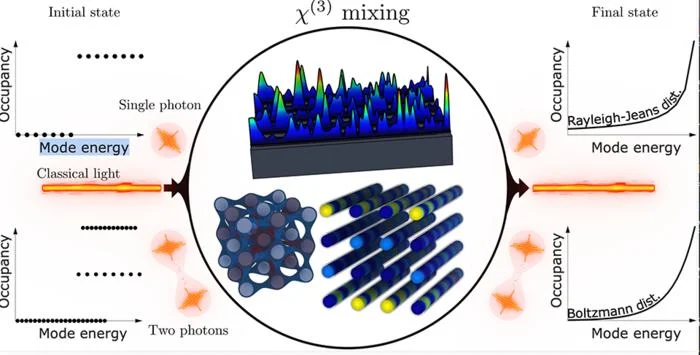
Insider Brief PRESS RELEASE — An international research team of scientist from Saint Louis University (SLU) and two institutions in Germany has shown that multimode nonlinear optical platforms can be harnessed to induce effective quantum interactions between photons, subsequently thermalizing them. In a study published in Sciences Advances, a research team from SLU’s School of

Read at The Quantum Insider

Older stories