Results for “Data”

Crunchbase News Venture Marlize van Romburgh Startups

Crunchbase Data: Nvidia’s Startup Funding Deals Hit A Record. What’s Next After Huang?

Before it was thrust into crisis this week, Nvidia was steadily continuing its pace as one of the busiest startup investors around, including backing many of the biggest venture deals of 2026. We take a fresh look at where Nvidia and its venture arm NVentures have been investing and what the future could hold.

Read at Crunchbase News Venture

PrecisionAg Matt Hopkins

Building a Common Language for Agricultural Data

Discover how data interoperability is transforming agricultural technology, simplifying regulatory compliance, and enabling smarter decisions across the agricultural value chain.

Read at PrecisionAg

arXiv (research papers) Eric Cornelissen Security

Memory Safety Isn't All You Need: Code Reuse Attacks in Memory Safe Languages

Memory safety rules out classical code reuse attacks that rely on arbitrary memory corruption, but does not eliminate code reuse altogether. Attacks such as object injection, prototype pollution, class pollution, DOM clobbering, and DOM script gadgets arise in memory-safe languages without violating the underlying memory safety abstraction. We show that these seemingly different attacks share a common structure: Attacker-controlled data influences accesses to shared runtime…

Read at arXiv (research papers)

arXiv (research papers) Maryam Ghasemian Security

Quantifying Membership Inference Risks in Genomic Data Sharing: The Role of Attacker's Auxiliary Information

Genomic data sharing is essential for biomedical research but introduces significant privacy risks, including membership inference attacks, in which an adversary determines whether a specific individual's data was used in a study. Existing privacy protections are typically applied after a release format has already been chosen, leaving researchers without a principled method to assess dataset-specific risk beforehand. We propose a server-assisted, principal component…

Read at arXiv (research papers)

TechCrunch Tim De Chant Startups

This young startup wants to power floating data centers with the ocean’s heat, and investors are already on board

Drogue is harvesting heat from the ocean to power data centers on floating vessels. The first prototype should be bobbing around the ocean, crunching bits, in less than two years.

Read at TechCrunch

arXiv (research papers) Darsh Asher Security

Lasso: Towards Sustainable AI-Generated Media Detection with Intel QAT On-Chip Compression

Synthetic text, images, and video are rising. Software-only detectors are power-hungry, too slow, and costly, and do not scale with demand. When software cannot scale, historically hardware often comes to the rescue. We perform the first reverse engineering of a compression accelerator--Intel QuickAssist Technology (QAT) microarchitecture and--find different amount of time on each, a novel data structure-dependent property. Using this information, we then build Lasso, a…

Read at arXiv (research papers)

The Record Security

City of Osaka warns of data breach impacting 1 million as Japan reels from dozens of cyber incidents

Osaka, Japan's third-largest city, told its 2.8 million residents to be wary of suspicious emails purporting to come from the local government.

Read at The Record

arXiv (research papers) Marya Sabouri Dodaran

Technical Report of Auriga's 1:10 Scale Autonomous Vehicle Robot

This report presents the design and implementation of Auriga Robotics' 1:10 scale autonomous vehicle, developed at Shahid Beheshti University's Robotics and Intelligent Automation Laboratory. The platform integrates a custom mechanical chassis, a distributed embedded system based on ESP32 microcontrollers, and a Jetson Orin NX module for high-level perception and control. The embedded layer manages sensor interfacing, real-time data acquisition, and actuator control, while…

Read at arXiv (research papers)

arXiv (research papers) Daniel Grimm Security

Pairing AIS with RF: Analysis of a Markovian Approach for Maritime Data Fusion

Monitoring maritime activities is important for safety and security, particularly for detecting illegal activities, but remains challenging due to the size and complexity of the maritime domain. The Automatic Identification System (AIS) is commonly used for this purpose, despite its known vulnerabilities. In contrast, space-based radio frequency (RF) observations provide an independent source of vessel activity but lack ship identification and therefore cannot identify…

Read at arXiv (research papers)

Phys.org Space Space

A likely supermassive neutron star might shed light on the mass gap between neutron stars and black holes

A team of astronomers recently identified a red giant star with an unseen binary companion after examining data from the Large Sky Area MultiObject Fiber Spectroscopic Telescope (LAMOST) and the Apache Point Observatory Galactic Evolution Experiment (APOGEE). Although the companion object can't be observed visually, astronomers can see the gravitational effects it has on the red giant star.

Read at Phys.org Space

EPIC Lauren Fischer Tech policy

EPIC Joins Group Urging New Jersey Court to Reject Data Center Developer’s First Amendment Claim

EPIC joined Tech Justice Law, along with nine other public interest groups and law professors in an amicus brief to the New Jersey district court asserting that Monroe Township's Ordinance banning data centers is constitutional.

Read at EPIC

arXiv (research papers) Zelin He SI

ModHarness-RL: Recasting Harnesses as Learnable and Evolving Programs for Agentic RL

Agentic reinforcement learning (RL) increasingly relies on a harness, the scaffold around the model that decides what it sees of its own interaction and what guidance it receives. Most existing approaches train under a hand-written harness that stays fixed throughout. However, an effective harness depends on the domain, the data and the model, and keeps changing as the model trains. We introduce ModHarness-RL, which recasts the harness as programs that are learned from data…

Read at arXiv (research papers)

arXiv (research papers) Nenyi Kweku Nkensen Dadson

In Situ Monitoring and Predictive Modeling of Harmful Algal Blooms with Autonomous Surface Vehicles

Harmful Algal Blooms (HABs) pose significant environmental, economic, and public-health challenges in coastal and inland water bodies, creating a need for scalable methods to collect spatially distributed water-quality data. This paper presents an autonomous surface vessel-based sensing system for in-situ water-quality monitoring related to harmful algal bloom detection. The system integrates a BlueBoat Autonomous Surface Vessel (ASV), a motorized winch for depth-controlled…

Read at arXiv (research papers)

arXiv (research papers) Mohammad Khoshnazar

When Will You Hand It Over? A Hidden Start Delay Makes Self-Play Handover Robust to Unfamiliar Partners

Cooperative self-play can teach a humanoid to receive an object without any human data, but the partner it meets after training is never the one it trained with; we show that a fluent self-play handover policy breaks with unfamiliar partners, identify the main cause, and repair it. In a physics-based parcel handover between a Unitree G1 and a learned giver, both trained by alternating PPO self-play, the receiver completes 95% and 90% of handovers with its own partner (two…

Read at arXiv (research papers)

AWS Machine Learning Blog Shantanu Tripathi SI

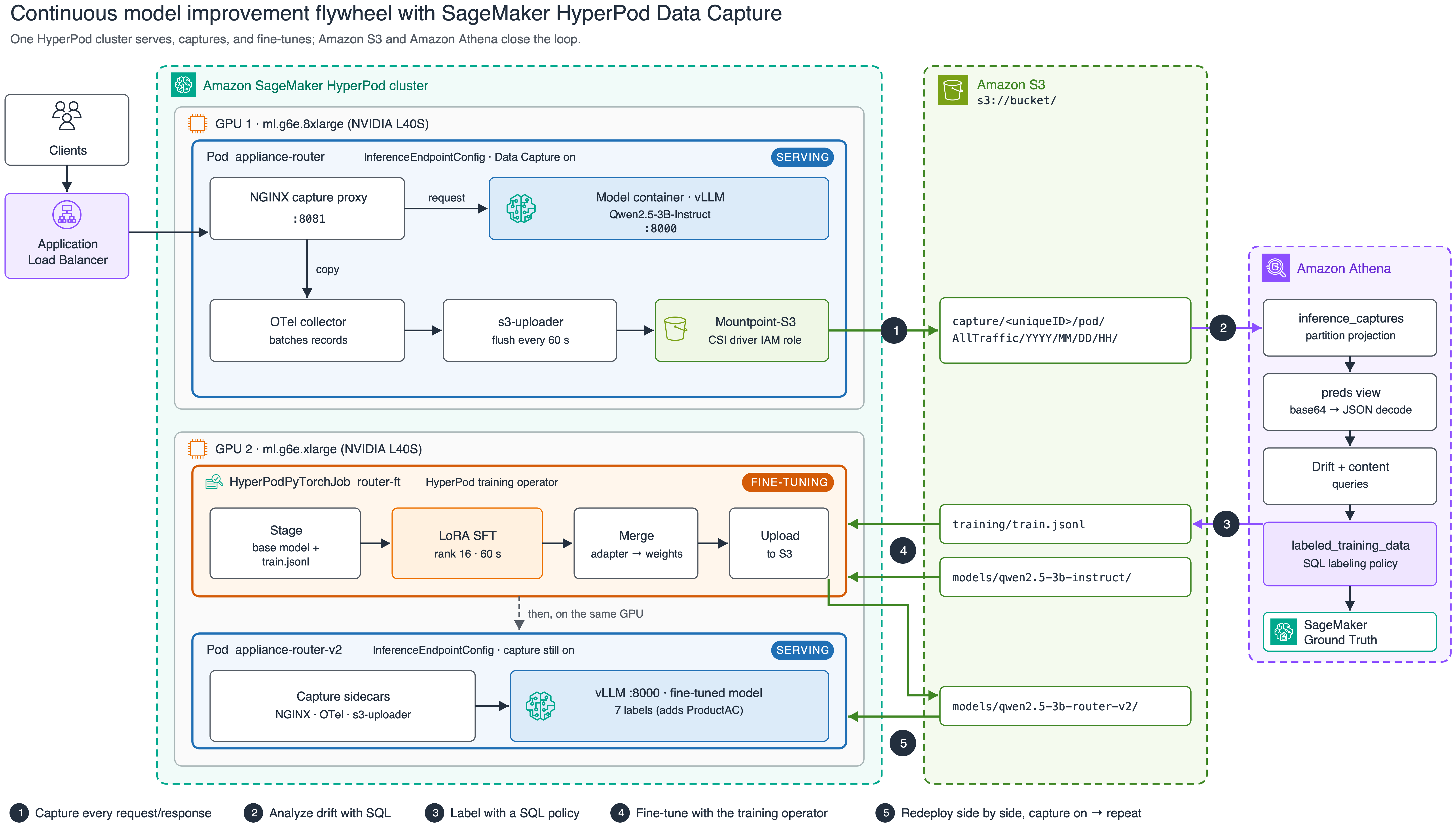
Build a model improvement flywheel with Amazon SageMaker HyperPod Data Capture

Amazon SageMaker HyperPod Data Capture records live inference inputs and outputs to Amazon S3. This post walks through one end-to-end example: capturing a support router's production traffic, surfacing a new-product blind spot with Amazon Athena, fine-tuning on the captured data with the HyperPod training operator, and measuring the before-and-after lift.

Read at AWS Machine Learning Blog

arXiv (research papers) Robin Shing Moon Chan SI

Interactive Program Induction with Language Model Priors

Program induction refers to the process in which a learner aims to recover a program from a few given input-output examples. This paradigm broadens programming access by letting users demonstrate the rule-based behavior they want to apply to unseen data, instead of having to implement it themselves. However, recovering a program from finite input-output examples is fundamentally ambiguous, as a finite set of input-output examples is theoretically consistent with infinitely…

Read at arXiv (research papers)

arXiv (research papers) Ivana Ragusa SI

From AI-Enabled Remote Patient Monitoring Toward Agentic Robotics: Embodiment, Governance, and Care Integration

AI-enabled remote patient monitoring is evolving beyond passive data collection toward agentic AI systems that interpret patient states, coordinate care, and initiate action across domestic and clinical settings. This structured scoping review finds that mature agentic care has not yet emerged: Most systems remain human led, while stronger decision-action coupling and embodied AI remain largely confined to prototypes and pilots. Healthcare robotics makes the transition from…

Read at arXiv (research papers)

The Verge Justine Calma SI

Jensen Huang was reckless with the environment, too

Under cofounder Jensen Huang, Nvidia has become the engine for the AI boom - and one of the tech industry's biggest environmental liabilities. Its sought-after chips have triggered a new wave of water- and chemical-intensive factories, drained power grids from inside massive data centers, and set the stage for a looming e-waste problem. Under Huang's

Read at The Verge

Vox Politics Miles Bryan Geopolitics

OpenAI is betting a data center rebrand will make you hate them less

Republicans weren’t the only big losers in last week’s midterms: Across the country, voters also backed restrictions on data centers and elected candidates promising tougher oversight of AI companies. Out of 41 local ballot initiatives limiting the data center buildout, 40 of them passed, according to the New York Times. The AI industry knows it

Read at Vox Politics

VietnamPlus (Vietnamese state media)

Vietnam gains popularity among Russian tourists

Vietnam recorded the fastest growth in Russian tourist arrivals among mass-tourism destinations in the first nine months of 2026, according to data from the Association of Tour Operators of Russia (ATOR) and Russia’s Federal Security Service (FSB). Vietnam remains preferred destination for Russian tourists Phu Quoc forecasts record-breaking influx of Russian-CIS tourists in year-end months Khanh Hoa – favourite destination of Russian tourists

Read at VietnamPlus (Vietnamese state media)

arXiv (research papers) Swarn Priya Security

VellSSLH: Sound Type-Guided Selective Speculative Load Hardening for LLVM IR

Constant-time cryptographic programs written in C can still leak secrets during speculative execution. Mispredicted branches may allow instructions to access secret data and expose it through observable behavior. Speculative load hardening (SLH) addresses these leaks, but protecting values unnecessarily can introduce significant runtime overhead. We present VellSSLH, which selectively inserts speculative load hardening at LLVM IR. Programmers specify Public and Secret inputs…

Read at arXiv (research papers)

The Record Security

University of Texas at Arlington warns personal information stolen during cyberattack

In a statement to Recorded Future News, a spokesperson said an investigation into the attack confirmed the stolen data but declined to say what information was obtained by the threat actors.

Read at The Record

arXiv (research papers) Yuhang Wang Security

CANTraj: Recovering Vehicle Trajectories from CAN Signals in Naturalistic Driving

Open driving releases and usage-based insurance programs often claim to prevent privacy breaches by omitting GPS records when sharing or collecting vehicle data. However, removing GPS coordinates from driving logs does not erase the location information carried by vehicle signals. While prior route-inference attacks have demonstrated that speed, steering, and driving events can be matched to road networks to reconstruct trajectories, existing studies rely on inconsistent…

Read at arXiv (research papers)

arXiv (research papers) Daniel Bultrini

Tessa: Encoding Classical Data Across an Entire Quantum Processor

We present Tessa, a hardware-aware, device-wide scheme to encode classical data on quantum computers. We use it to experimentally encode and decode up to $1568$ real values using IBM's Phoenix and Fez quantum computers on a variety of data. Tessa's construction is an extension of QPIXL and QCrank. However, it checkerboards address and data qubits across a coupling graph with neighbouring data qubits sharing only a subset of address qubits. When using the device's coupling…

Read at arXiv (research papers)

arXiv (research papers) Noaïm Astitou Tech policy

Efficiency Gains in Social Science Research: A Prospective Silicon Sampling Protocol for Pre-Treatment and Code Optimization

This study evaluates the methodological potential of using large language models (LLMs) to generate synthetic datasets prior to real-world data collection, thereby streamlining subsequent processing and statistical analysis. The approach is applied to a survey conducted within the France Life Imaging (FLI) network, leveraging three distinct LLMs (Sonnet 4.6, GPT 5.3, and Kimi 2.6) to simulate responses and prepare data processing workflows. The findings demonstrate…

Read at arXiv (research papers)

arXiv (research papers) Jimin Mun SI

LECAT: Measuring LLM Category Learning from Pretraining Data

Humans know that airplanes are fast, that this extends to red airplanes, but that it does not hold for broken airplanes. How do LLMs acquire category knowledge that humans learn and apply effortlessly? We introduce LeCat, a two-part framework to analyze LLM's Learning of Category knowledge. First, we use LeCat to evaluate models on their ability to learn category knowledge, distinguishing between three cases: memorization of in-domain category knowledge, generalization to…

Read at arXiv (research papers)

The Hacker News Security

PostgreSQL Patches 52 Flaws, Including 22-Year-Old Bug Enabling Authenticated RCE

A type confusion flaw in PostgreSQL lets a database user who can create objects run code on the server. Updates released yesterday fix it, along with 51 other security flaws. Full protection from this flaw also requires rebuilding any C-language extensions installed on the server. The flaw, tracked as CVE-2026-6460, has a CVSS score of 8.8. Any code run this way has the rights of the operating

Read at The Hacker News

arXiv (research papers) Run Luo SI

Gamer: A Generalist Vision-Language-Action Foundation Model for Long-Horizon Real-Time Game Agent

We introduce Gamer, a generalist agent framework built for long-horizon tasks in complex interactive environments. Its end-to-end architecture combines perception, memory management, and multi-step reasoning. A shared training and deployment pipeline supports interaction with both conventional 2D graphical interfaces and complex 3D simulated worlds. We first continue pre-training on a dataset constructed from tens of thousands of hours of device-level keyboard and mouse…

Read at arXiv (research papers)

arXiv (research papers) João Freitas SI

AI-Based Multi-View Echocardiographic Image Synthesis using Dynamic Shape Control

Although automated methods have improved echocardiographic workflows, progress remains constrained by the need for large, well-annotated datasets. As the development of clinical databases is often limited by ethical and logistical challenges, synthetic data generation has emerged as a promising alternative. However, existing approaches commonly rely on left ventricle shape-based supervision or are tailored to specific cardiac views, limiting the generation of additional…

Read at arXiv (research papers)

arXiv (research papers) Andrew Wright Security

Information-Theoretic Threshold Designated-Verifier Digital Signatures for Resource-Constrained Devices

Digital signatures are synonymous with data integrity and authenticity. Among applications such as e-commerce, software distribution, and instruction processing they play a vital role in the secure communication of data. Within this context and in preparation for quantum adversarial tactics we present three new information-theoretic threshold designated verifier digital signature schemes and prove them secure against \textit{any} adversary under the standard security…

Read at arXiv (research papers)

Older stories