Results for “models”

arXiv (research papers) Subhadip Ghosh

NEMESIS2.0: LLM-Aided Netlist-Driven Performance Equation Modeling for Accelerated Analog Circuit Sizing

This work presents NEMESIS2.0, an open-source LLM-aided framework that automatically derives equation-based performance models for analog circuits. The resulting equations provide fast, accurate surrogates for SPICE evaluation. To validate the method, equation-based models are developed for seven circuit test cases in a commercial 65nm CMOS technology, covering 15 metrics on five operational transconductance amplifier topologies, and six metrics on two dynamic comparator…


Read at arXiv (research papers)

arXiv (research papers) Christopher M. Stewart Tech policy

Three Invisible Failure Modes in Speech-Based Age Estimation for Child Safety

Child safety in AI depends on the accurate identification of minor users. Young children tend to talk rather than type when interacting with AI, so in practice this identification requires predicting age from speech. We evaluated whether three audio-capable large language models can predict a child's age from their speech across five studies using two speech corpora of children under the age of 13. Models classified children as over 13 on 2.5% to 42.5% of audio responses…

Read at arXiv (research papers)

arXiv (research papers) Vicente Leyton-Ortega

Certifying quantum generative models beyond the Fisher trace

Whether a trained quantum generative model has learned its target is usually decided by a diagnostic validated on a labeled benchmark, and such a diagnostic can pass that validation by recovering how the benchmark was built. We analyze Fisher-trace and kernel-based certification of the real-amplitude quantum circuit Born machine in noiseless statevector simulation. For real-amplitude circuits built from half-angle rotations, the classical Fisher information equals the…

Read at arXiv (research papers)

The Register Thomas Claburn SI

Chinese AI labs are training models on Nvidia's Blackwell despite export controls, says ex-OpenAI engineer

Forensic report finds Blackwell's fingerprint in DeepSeek, Moonshot AI, MiniMax and Ant Group models

Read at The Register

arXiv (research papers) Afshin Ameri

Dependable Voice Command for Multi-UAV Swarms Using Small Language Models

Supervisory control of multiple autonomous unmanned aerial vehicles (UAVs) imposes high visual and cognitive demands on human operators, particularly when communicating mission objectives and system constraints. Voice command provides a natural interaction modality that can reduce operator workload; however, its reliability is affected by environmental noise, speech variability, and recognition errors. This paper presents a dependable voice command framework for multi-UAV…

Read at arXiv (research papers)

9to5Mac Ryan Christoffel

Apple releases tvOS 27.2.1 and HomePod 27.2.1, here’s what’s new

Apple has just released tvOS 27.2.1 for Apple TV 4K and HomePod 27.2.1 for HomePod models, here’s what’s new.

Read at 9to5Mac

MacRumors Juli Clover Gadgets

Apple Releases tvOS 27.2.1 With Siri AI for Older Apple TVs

Apple today released tvOS 27.2.1, an update to the tvOS 27 operating system that launched in September. tvOS 27.2.1 comes nearly three weeks after Apple released tvOS 27.2. tvOS 27.2.1 brings Siri AI support to the 2nd- and 3rd-generation Apple TV 4K models, but it is available for all ‌Apple TV‌ 4K models that support tvOS 27. Apple announced ‌Siri‌ AI for the ‌Apple TV‌ when debuting the 4th-generation ‌Apple TV‌ 4K. A separate tvOS…

Read at MacRumors

arXiv (research papers) Jiaming Tang

Training Reasoning Models in Simulation to Natively Use Real Robots

Robot-use agents (RUAs) have emerged as a promising approach to general-purpose robot control. However, strong performance has so far been achieved only by frontier proprietary models such as GPT-6 Astra and Claude Fable 5.2, whereas open-weight models remain substantially less capable. We show that an open-weight 27B reasoning model can be trained to use real robots natively through reinforcement learning, entirely in simulation and without demonstrations. Like a…

Read at arXiv (research papers)

arXiv (research papers) Aayush Marasini SI

WeightBench: Evaluating Language Models as Weight-Space Programmers

Recent work shows that large language models (LLMs) can operate directly on the parameters of other neural networks. They can read what a network was trained to do, fix a network that fails, and write working networks from scratch, all without gradient descent. This capability has been termed Weight-Space Programming (WSP). Exploring this new paradigm systematically requires a robust benchmark. We introduce WEIGHTBENCH, a benchmark that evaluates LLMs of increasing…

Read at arXiv (research papers)

TechCrunch Tim Fernholz SI

Export-banned Nvidia chips are behind China’s most powerful AI models—uh oh, Jensen!

New research shows the most advanced AI models from China were trained on banned Nvidia chips.

Read at TechCrunch

arXiv (research papers) Mohamed Aghzal SI

Can Mechanistic Interpretability Help Explain LLM Agent Failures? A Case Study on Web Element Hallucination

Mechanistic Interpretability (MI) has made significant progress in explaining the internal computations of Large Language Models (LLMs); however, these advances have yet to demonstrate comparable success in explaining the decision-making processes of LLM-based agents. This paper examines the challenges MI tools face when applied to realistic agentic failures. We focus on one such failure: web agents hallucinating actions that are not available on a website. We apply a series…

Read at arXiv (research papers)

The New Stack Alex Wilhelm

The context problem: It’s what’s really breaking AI agents at scale

AI models are getting smarter, tokens are getting cheaper, and agents are improving. But the context gap sits between the

Read at The New Stack

arXiv (research papers) Dhruv Dixit SI

ARCHER: From Rationale Imitation to Executable Reasoning in Small Language Models

Small language models are attractive for local, low-cost, and privacy-sensitive deployment, but they remain unreliable on mathematical reasoning tasks that require decomposition, exact computation, tool use, and verification. We introduce \textbf{ARCHER}: \textbf{A}ction-trace \textbf{R}einforcement for \textbf{C}alculator-grounded \textbf{H}ierarchical \textbf{E}xecutable \textbf{R}easoning, a two-stage framework for training small language models (SLMs) to produce…

Read at arXiv (research papers)

arXiv (research papers) Yifan Jin SI

When to Trust Simulated Patient Responses:Support-Gated World Models for Vasopressor Decision Support

Clinical world models expose language-model agents to predicted patient responses, but simulations can be unreliable for poorly supported treatments or unfamiliar hospitals. We introduce Support-Gated World-Model decision support, a lightweight extension of a propose--simulate--refine agent. A recurrent dynamics ensemble predicts short-horizon physiological responses to documented norepinephrine dose categories, while a behavior model estimates observational action support…

Read at arXiv (research papers)

arXiv (research papers) Adnan Jaljuli

Symmetry-Controlled Quantum State Transfer in Poly-bi-[8]-annulenylene: From Heisenberg to Hubbard Dynamics

We investigate quantum state transfer in the poly-bi-[8]-annulenylene lattice using isotropic Heisenberg and Hubbard models. For a 16-site lattice, reflection symmetry separates the single-excitation Hamiltonian into independent triplet and singlet sectors, allowing analytical determination of the energy spectra. Although perfect state transfer is forbidden for positive couplings, appropriately chosen coupling ratios enable pretty-good transfer with arbitrarily high…

Read at arXiv (research papers)

arXiv (research papers) Wang Ma SI

Black-Box Uncertainty Quantification for Large Language Models via Ensemble-of-Ensembles

Reliable use of large language models (LLMs) requires uncertainty estimates that separate ambiguity intrinsic to a prompt from genuine knowledge gaps. Bayesian and deep-ensemble methods deliver this aleatoric/epistemic decomposition in principle, but are computationally prohibitive at LLM scale and require white-box access. Existing black-box methods, in contrast, summarize to a single scalar that cannot make the distinction. We introduce a two-level ensemble that bridges…

Read at arXiv (research papers)

MarkTechPost Michal Sutter SI

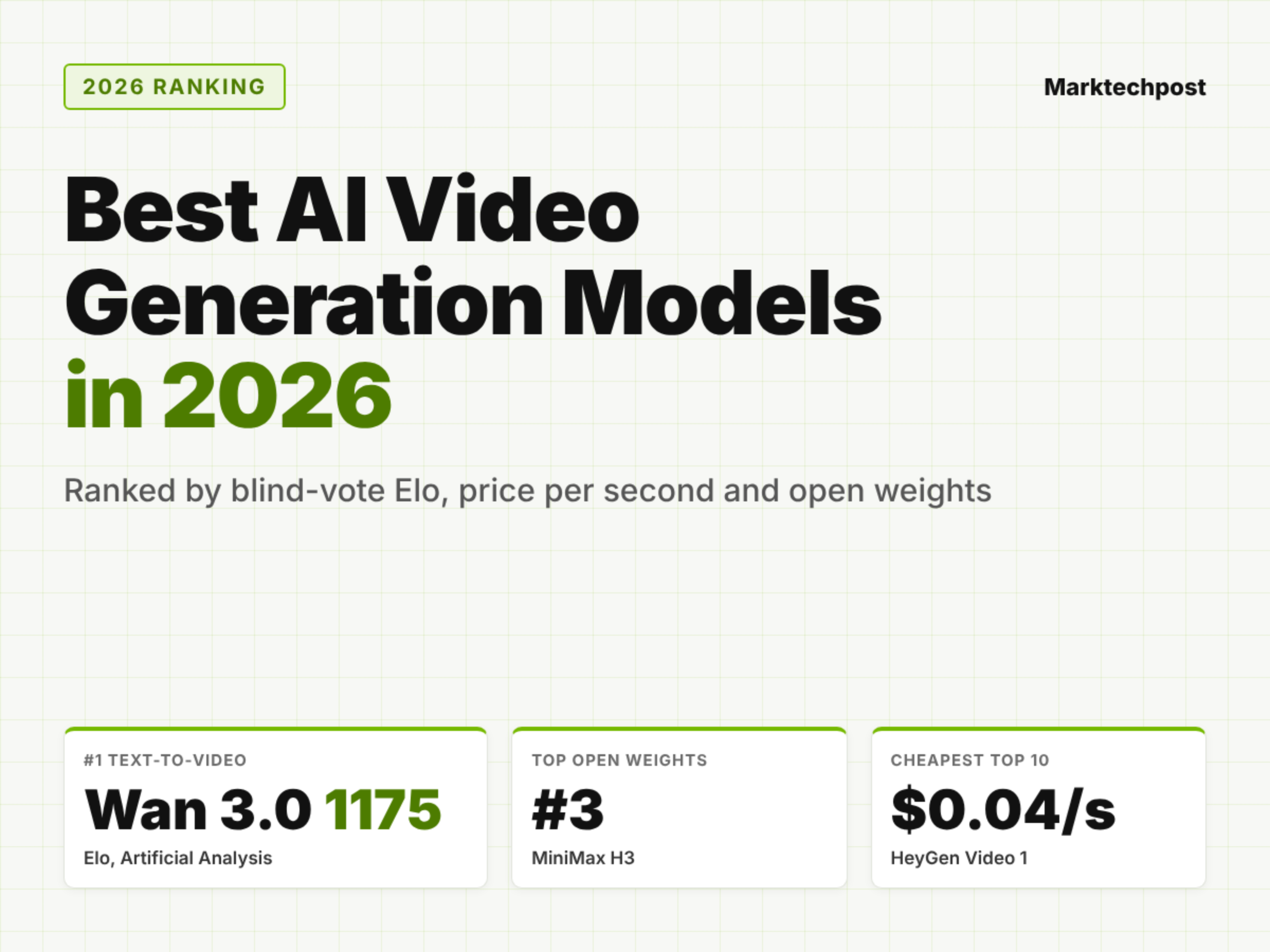
Best AI Video Generation Models in 2026: Elo, Price per Second, Open Weights

The AI video leaderboard looks very different from 12 months ago. Native audio is now table stakes. Clips run 15–30 seconds. And an open-weights model sits in the top 3. This ranking (as of Nov 13, 2026) uses one quality signal: blind human-preference Elo from the Artificial Analysis Video Arena. We pair it with API

Read at MarkTechPost

arXiv (research papers) Noaïm Astitou Tech policy

Efficiency Gains in Social Science Research: A Prospective Silicon Sampling Protocol for Pre-Treatment and Code Optimization

This study evaluates the methodological potential of using large language models (LLMs) to generate synthetic datasets prior to real-world data collection, thereby streamlining subsequent processing and statistical analysis. The approach is applied to a survey conducted within the France Life Imaging (FLI) network, leveraging three distinct LLMs (Sonnet 4.6, GPT 5.3, and Kimi 2.6) to simulate responses and prepare data processing workflows. The findings demonstrate…

Read at arXiv (research papers)

arXiv (research papers) Paolo Simonetti Space

The effect of vertical mixing on oxygen sequestration by refractory elements in the atmosphere of giant planets

The most widely used route to study the formation history of giant exoplanets is the C/O ratio, usually derived from H$_2$O, CO, CO$_2$ and CH$_4$. However, refractory elements can sequester a significant fraction of O, causing the observed C/O ratio to be overestimated with respect to the intrinsic one. Previous calculations of this bias relied on chemical equilibrium models. Here we quantify the impact of vertical mixing using the 1-D chemical kinetics code VULCAN…

Read at arXiv (research papers)

arXiv (research papers) Cong Xu

The State Is Not the Bottleneck: A Paged-State Gated-DeltaNet Tile on a Tri-Mode Multicast Mesh, Bit-Exact from RTL to Silicon

Linear-attention language models replace a growing key-value cache with a recurrent state of fixed size. On an edge FPGA, this state can exceed the on-chip memory and must be paged to external memory. This paper asks whether such paging dominates the cost of decoding (generating tokens). We built a hardware tile that computes one complete layer of a custom 369-million-parameter hybrid Gated DeltaNet model on an Agilex 5 FPGA and pages its recurrent state. The model state…

Read at arXiv (research papers)

arXiv (research papers) Jimin Mun SI

LECAT: Measuring LLM Category Learning from Pretraining Data

Humans know that airplanes are fast, that this extends to red airplanes, but that it does not hold for broken airplanes. How do LLMs acquire category knowledge that humans learn and apply effortlessly? We introduce LeCat, a two-part framework to analyze LLM's Learning of Category knowledge. First, we use LeCat to evaluate models on their ability to learn category knowledge, distinguishing between three cases: memorization of in-domain category knowledge, generalization to…

Read at arXiv (research papers)

arXiv (research papers) Tao Hu SI

CoPre-MoE: Consolidating and Preserving MoE for Multimodal Continual Instruction Tuning

Multimodal continual instruction tuning requires multimodal large language models to sequentially acquire new capabilities without catastrophic forgetting. Mixture-of-experts (MoE) architectures offer a promising way to mitigate task interference through expert specialization and combination. However, while existing MoE-based methods avoid overwriting shared parameters by allocating separate experts for each task, this progressive expansion incurs severe cross-task…

Read at arXiv (research papers)

arXiv (research papers) Wenbo Xie

Structure makes quantum circuits trainable

The scalability of variational quantum algorithms is limited by barren plateaus, where gradients vanish exponentially in system size. This worst-case result raises fundamental questions about the trainability of quantum AI models. We present a major advance towards resolving this trainability question by answering whether a given quantum circuit has a barren plateau. We do this using an analytical framework that bounds the gradient variance for arbitrary input states $ρ$ and…

Read at arXiv (research papers)

arXiv (research papers) Suvarna Kadam Witsense AI SI

Vision-Language-Action Models: A Life-Cycle Survey of Design, Training and Deployment

Vision-language-action (VLA) models adapt web-pretrained vision-language models to output robot actions, so that web knowledge carries over to physical control. In under 4 years the field has moved from RT-2, the first VLA, to open models that fine-tune on a single consumer GPU and to proprietary generalists that clean unseen homes. This survey reviews 88 works from December 2022 to October 2026, mainly on manipulation and navigation, plus humanoid control, world-action…

Read at arXiv (research papers)

arXiv (research papers) Mehrdad Saberi Security

Adaptable Watermarking: Transforming Image Watermarking Models via Lightweight Adapters

We explore the adaptability of neural image watermarking models; the extent to which one watermarking method can be transformed into another through lightweight adaptation. We introduce a framework that enables encoder-decoder watermarking architectures to become modular and upgradable, supporting multiple watermarking styles without re-training full models. Adaptation is performed by attaching a compact parameter-efficient adapter and fine-tuning under a multi-domain…

Read at arXiv (research papers)

MarkTechPost Asif Razzaq SI

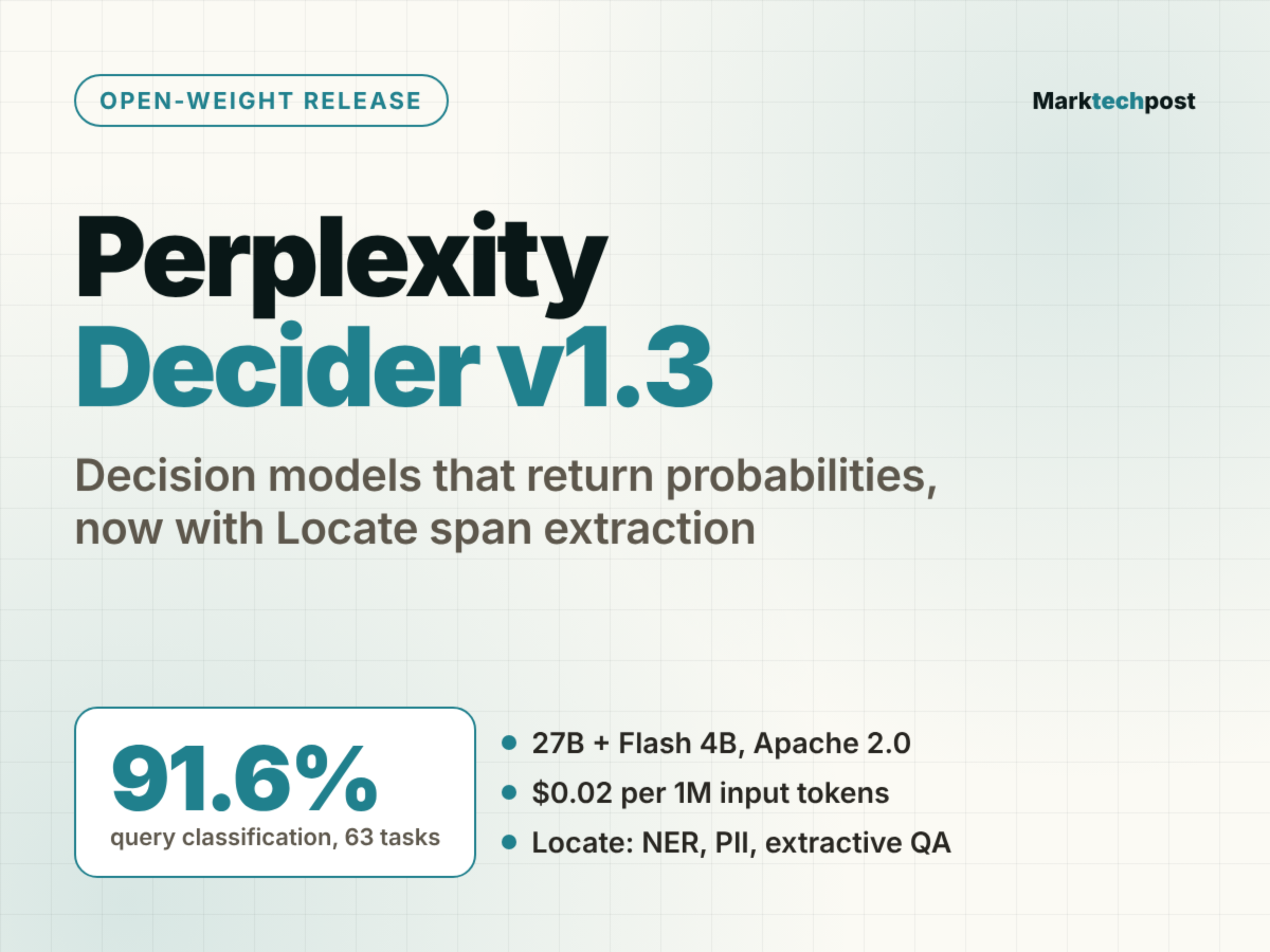
Perplexity Releases Decider v1.3: Open-Weight Decision Models Add Locate

Perplexity Decider v1.3 and Flash v1.3 are open-weight decision models that return probabilities, not text. Version 1.3 adds Locate for span extraction and reports 91.6% mean accuracy on 63 query-classification tasks.

Read at MarkTechPost

arXiv (research papers) Grid Robotics

Envisioning Agentic Robotics: A New Era of Robotic Systems

The release of GPT-6 Astra marks the emergence of a new paradigm in robotics: agentic robotics. Within weeks, frontier models with agentic harnesses matched or exceeded task-specific policies on many embodied benchmarks. Instead of training a dedicated policy for each family of tasks, an agentic robotic system applies a foundation model to open-world embodied tasks. It operates in a closed loop: observing the environment, interpreting user intent, reasoning about the task…

Read at arXiv (research papers)

arXiv (research papers) Zihao Lu

Objectives as Policies: Vision-Language Model Cost Programs for Contact-Rich Manipulation

Vision-language models (VLMs) have shown strong semantic and spatial reasoning capabilities in 3D environments. Recently, connecting VLMs with model-predictive controllers (MPC) has emerged as a paradigm for combining strong semantic reasoning with physics-based planning. However, connecting these two for contact-rich robotic manipulation requires a task representation that bridges the two and captures how physical interactions can be reasoned by VLMs. In this work, we…

Read at arXiv (research papers)

arXiv (research papers) Anthony Abou Mrad Tech policy

When evaluation becomes intervention in clinical AI

AI judges, models that grade another system's output against a rubric, extend clinical review to the scale at which clinical AI writes. When teams use judge assessments to select a prompt or train a model, the judge becomes part of the intervention. Selection can then favor errors the judge overlooks. We describe what a judge's report must contain and the independent clinical test each judge-driven change needs.

Read at arXiv (research papers)

The Decoder Maximilian Schreiner SI

Former OpenAI researcher says he found Nvidia Blackwell fingerprints hidden inside six Chinese AI models

Former OpenAI researcher Will DePue says he has produced the first technical evidence that DeepSeek, Moonshot AI, MiniMax, and Ant Group are using Nvidia's latest Blackwell GPUs despite US export controls. His forensic method reads characteristic chip signatures directly from published model weights. He estimates the hardware behind the five training runs cost more than half a billion dollars. The article Former OpenAI researcher says he found Nvidia Blackwell fingerprints…

Read at The Decoder

Older stories