Results for “model”

arXiv (research papers) Dmitriy Kondaurov

Efficient simulation of the generalized Langevin equation using a basis of dynamically relevant histories for memory and noise

The Generalized Langevin Equation (GLE) is a cornerstone for modeling non-Markovian dynamics, but its numerical solution remains challenging due to the history-dependent convolution and the need to generate colored noise with a prescribed correlation function. We introduce a forward construction that addresses both challenges within a single framework. We represent an arbitrary trajectory as sum of relevant and irrelevant parts, where relevant part can be decomposed into a…


Read at arXiv (research papers)

arXiv (research papers) Abhishek Rai SI

Beyond Plain MCP: Do Decision Models and Code Mode Make Tool Use Cheaper and Faster?

Model Context Protocol (MCP) gateways manage tool catalogs for language model agents using two primary paradigms: code mode where agents write scripts against tool stubs and decision layers which are cheap routers that preselect tool subsets. Using a controlled harness across 12 servers, up to 1,958 distractor tools, and three open-weight agents including Qwen, Gemma, and Nemotron, we present a preregistered evaluation on a sealed test split to determine when each approach…

Read at arXiv (research papers)

arXiv (research papers) Rui Zou SI

Agent-Guided Process Verification for Mathematical Self-Correction

Large language models have made substantial progress in mathematical reasoning, yet in complex multi-step reasoning, an error at any step may propagate along an incorrect path, and the resulting solution may omit necessary branches. Existing natural-language reflection methods often struggle to locate critical errors precisely, while outcome verification typically checks only whether the available candidate answers satisfy the problem conditions and can therefore overlook…

Read at arXiv (research papers)

arXiv (research papers) Jovan Popoca Moran SI

Latency, Speech Recognition and Turn-Taking in Voice Agents for Spanish Phone Negotiation: An Externally Measured Comparison of Pipecat, LiveKit and GPT-Live

A voice agent that negotiates by phone must answer quickly, understand spoken amounts and cope with a caller who talks over it. We compared three architectures for such an agent, negotiating freight rates in Spanish: two cascades (speech recognition, language model and speech synthesis) orchestrated by Pipecat and by LiveKit Agents, and GPT-Live, an OpenAI speech model that listens and speaks without separate stages. A program played the carrier with the same 47 recordings…

Read at arXiv (research papers)

arXiv (research papers) Pratyush Kumar Singh SI

Learning inadequacy of Bayesian neural operators for PDE-constrained inference and design

Partial differential equations (PDEs) underpin predictive modeling across science, engineering and medicine. Their use in digital twins, parameter inference and optimal design requires repeated solutions across parameters and scenarios. For nonlinear, transient and multiphysics systems, these calculations can make numerical simulation prohibitively expensive. Here we introduce the residual-informed Bayesian neural operator (RI-BNO), which learns operator inadequacy using a…

Read at arXiv (research papers)

arXiv (research papers) Nikhil Parkar SI

ST-GAT: A Leakage-Free Spatio-Temporal Graph Attention Framework for Robust Network Intrusion Detection

Intrusion detection systems are a central defence in modern networks. Deep learning models report strong anomaly-detection results, but evaluations on standard benchmarks such as CSE-CIC-IDS-2018 are often inflated by two methodological problems: temporal leakage from overlapping sliding windows, and contamination from preprocessing fitted before the train/test split. Per-flow classifiers also ignore the spatio-temporal dependencies across sequences of network flows. We…

Read at arXiv (research papers)

arXiv (research papers) Allen Devaraj

Leaning Over to Reach Far-Away Objects

We study supported reaching to extend a humanoid robot's workspace by bracing against the environment for stabilization using a straightforward yet capable whole-body model predictive control (MPC) approach, exclusively with local sensing and fiducial markers. While typical solutions for whole body humanoid control aim at avoiding or accommodating contact, contact is explicitly required to reach objects placed on surfaces far out of normal reach. We employ sampling-based MPC…

Read at arXiv (research papers)

arXiv (research papers) Adriana Watson Security

When the Spec Sheet Lies: Injection Attacks on LLM-Generated Compliance Artifacts

As Large Language Models (LLMs) become used more commonly across a variety of fields, a growing body of research has highlighted particular concerns surrounding model security. Notably, prompt injection attacks, where malicious instructions are inserted into prompts, are particularly simple to implement yet capable of inducing devastating effects on the fidelity of model outputs. While there is substantial research surrounding attack models and their effects on chat-based…

Read at arXiv (research papers)

Tech in Asia Naomi Li Gan Startups

DeepSeek expands developer access with new AI APIs

Founded by Liang Wenfeng, DeepSeek already offered a public API and listed its available models.

Read at Tech in Asia

arXiv (research papers) Ran Qi

RoboCoEvo: Expanding Robot Capabilities through Agent-Policy Co-Evolution

Integrating MLLM-based agents with robotic foundation models has attracted increasing attention as a means of enhancing robotic capabilities. However, the improvement of such integrated systems remains largely decoupled across their agent and model components, with advances in one component not necessarily benefiting the other, substantially limiting the capabilities of the combined system. As both MLLMs and robotic foundation models become increasingly capable, fully…

Read at arXiv (research papers)

arXiv (research papers) Muhammad Arsalan Ali Akbar

Machine-learned active spaces enable quantum calculations of spin-state energetics of transition-metal complexes on quantum hardware

Multireference calculations on transition-metal complexes, on classical or quantum hardware, depend on the choice of active space. The orbitals that belong in it are those that are strongly entangled in the correlated wavefunction, but measuring this entanglement requires the very correlated calculation that the active space is meant to make affordable. Here we present SpinAware, a machine-learning model that predicts density-matrix renormalization group (DMRG)…

Read at arXiv (research papers)

Tech in Asia Aiko Gao Ishida Startups

Samsung to produce DeepX’s next-generation AI chip

Aimed at robots and AI PCs, the DX-M2 is designed to run generative AI models on about 5 watts.

Read at Tech in Asia

arXiv (research papers) Alba Maria Tellez Fernandez

Refinement vs. Replanning: Inference Compute Allocation in Robot Policies

A frozen chunked robot policy can spend deployment-time inference compute in two coupled ways: more work within each policy call to refine a predicted action chunk, or more frequent policy calls to replan from fresh observations. We study this allocation without updating model weights. Our evaluation procedure reports success with both nominal compute rate and complete attempt cost, selects comparisons on discovery tasks, and tests prespecified comparisons on held-out tasks…

Read at arXiv (research papers)

Nhân Dân (Vietnamese state media)

Ha Noi enhances effectiveness of grassroots cultural and sports facilities

From reviewing existing conditions and revamping approaches to organising activities to developing models tailored to community needs, Ha Noi is focusing on boosting the effectiveness of its grassroots cultural and sports facilities, gradually transforming these venues into practical spaces for residents to gather and participate in regular events. Ha Noi to distribute 38,000 free tickets for concert celebrating Viet Nam Culture Day Ha Noi to stage special arts programme for…

Read at Nhân Dân (Vietnamese state media)

AWS Machine Learning Blog WonGu Rho SI

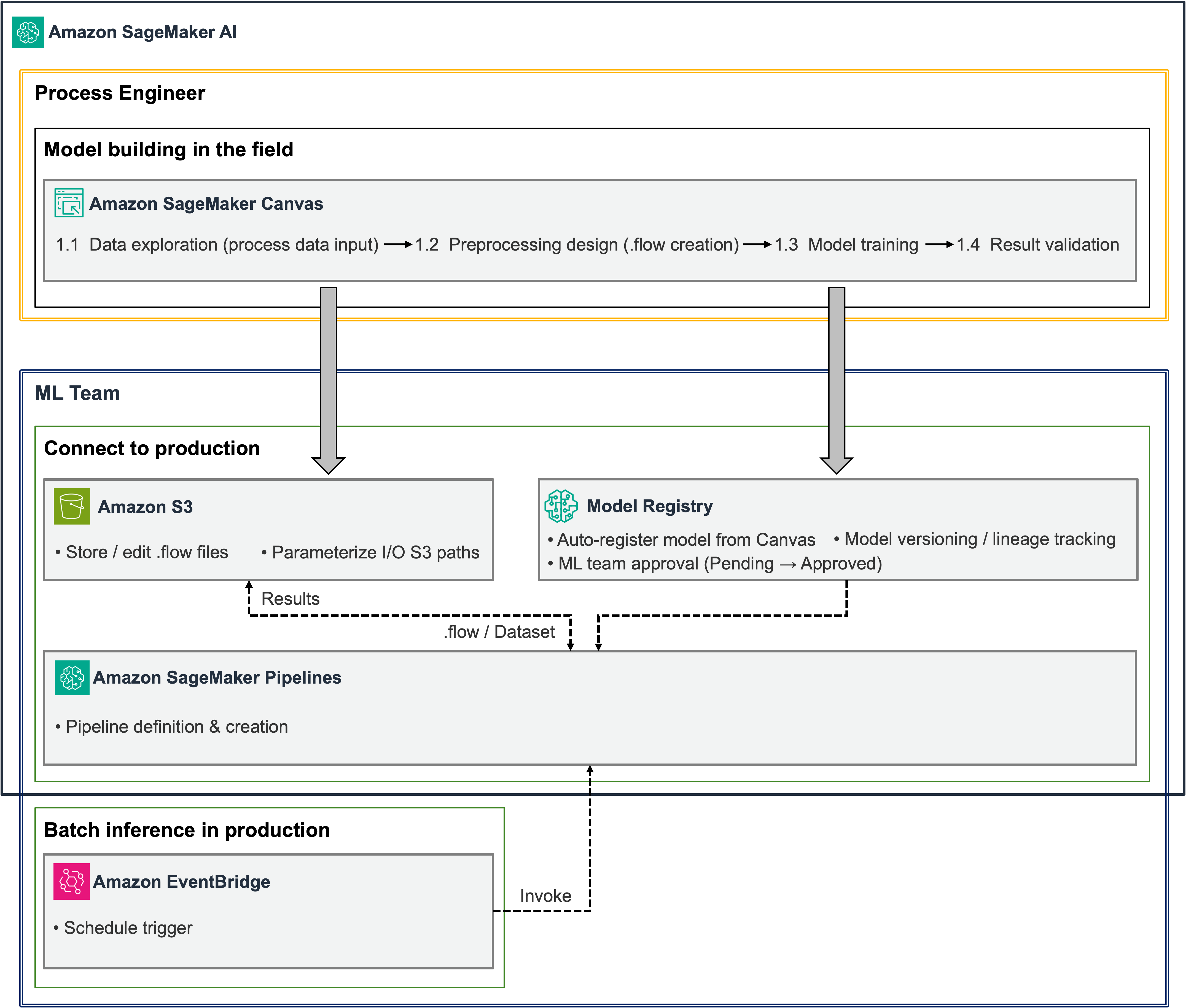
Production MLOps at GS Caltex with Amazon SageMaker Canvas, part 1

GS Caltex connects Amazon SageMaker Canvas to Amazon SageMaker Pipelines so process engineers' no-code models run in production. This post shows how ML engineers reuse validated preprocessing flows and models, cutting deployment from about a week to a few hours and running batch inference every 30 minutes.

Read at AWS Machine Learning Blog

TechCrunch Aisha Malik

Amazon’s new Kindle Colorsoft is a premium e-reader with a premium price

The latest model is lighter and thinner than its predecessor and features an edge-to-edge display. But if you already own the first-generation Colorsoft, there’s little reason to upgrade.

Read at TechCrunch

arXiv (research papers) Asadullah Abdullah Khan Security

Agent-ZTA: A chain-Aware Zero Trust Model for Bidirectional Security-State Propagation and Runtime Containment in Multi-Agent Delegation

Multi-agent systems increasingly delegate tasks and permissions across chains of autonomous agents that invoke protected tools. Although agent identities and delegated credentials may remain valid throughout a workflow, the security condition of any agent along the chain can deteriorate during runtime execution-either through upstream compromise or downstream ingestion of untrusted inputs. Authorization models based solely on the immediate caller and its static delegated…

Read at arXiv (research papers)

arXiv (research papers) Rachel Hong Tech policy

Model Maps: A Documentation Framework for Tracing Foundation Model Ancestry and Understanding AI Entanglement

The development of foundation models incorporates pre-existing AI artifacts like models, datasets, and benchmarks. These relationships, as part of the broader AI supply chain, produce "entangled" webs in which properties of artifacts upstream can influence the outputs of a foundation model downstream - a phenomenon known as AI entanglement. Without visibility into these connections, a black-box model can inherit upstream properties that result in security vulnerabilities…

Read at arXiv (research papers)

arXiv (research papers) Subhadip Ghosh

NEMESIS2.0: LLM-Aided Netlist-Driven Performance Equation Modeling for Accelerated Analog Circuit Sizing

This work presents NEMESIS2.0, an open-source LLM-aided framework that automatically derives equation-based performance models for analog circuits. The resulting equations provide fast, accurate surrogates for SPICE evaluation. To validate the method, equation-based models are developed for seven circuit test cases in a commercial 65nm CMOS technology, covering 15 metrics on five operational transconductance amplifier topologies, and six metrics on two dynamic comparator…

Read at arXiv (research papers)

arXiv (research papers) Yaeji Kim Space

3D Radiative Transfer Simulations for Characterization of the Optically Thick DART Ejecta Plume

The Hyperion package is a three-dimensional Monte-Carlo radiative transfer approach to modeling dust ejecta. Because it has proven to be a powerful tool for simulating optically thick environments with complicated structure, we are applying the routines to observations of the DART impact on asteroid Dimorphos. Our analysis focuses on the LICIACube LUKE red-filter image acquired 175 s after impact, when the near-surface plume remained dense and not strongly structured. The…

Read at arXiv (research papers)

AWS Machine Learning Blog Aswath Ram A Srinivasan SI

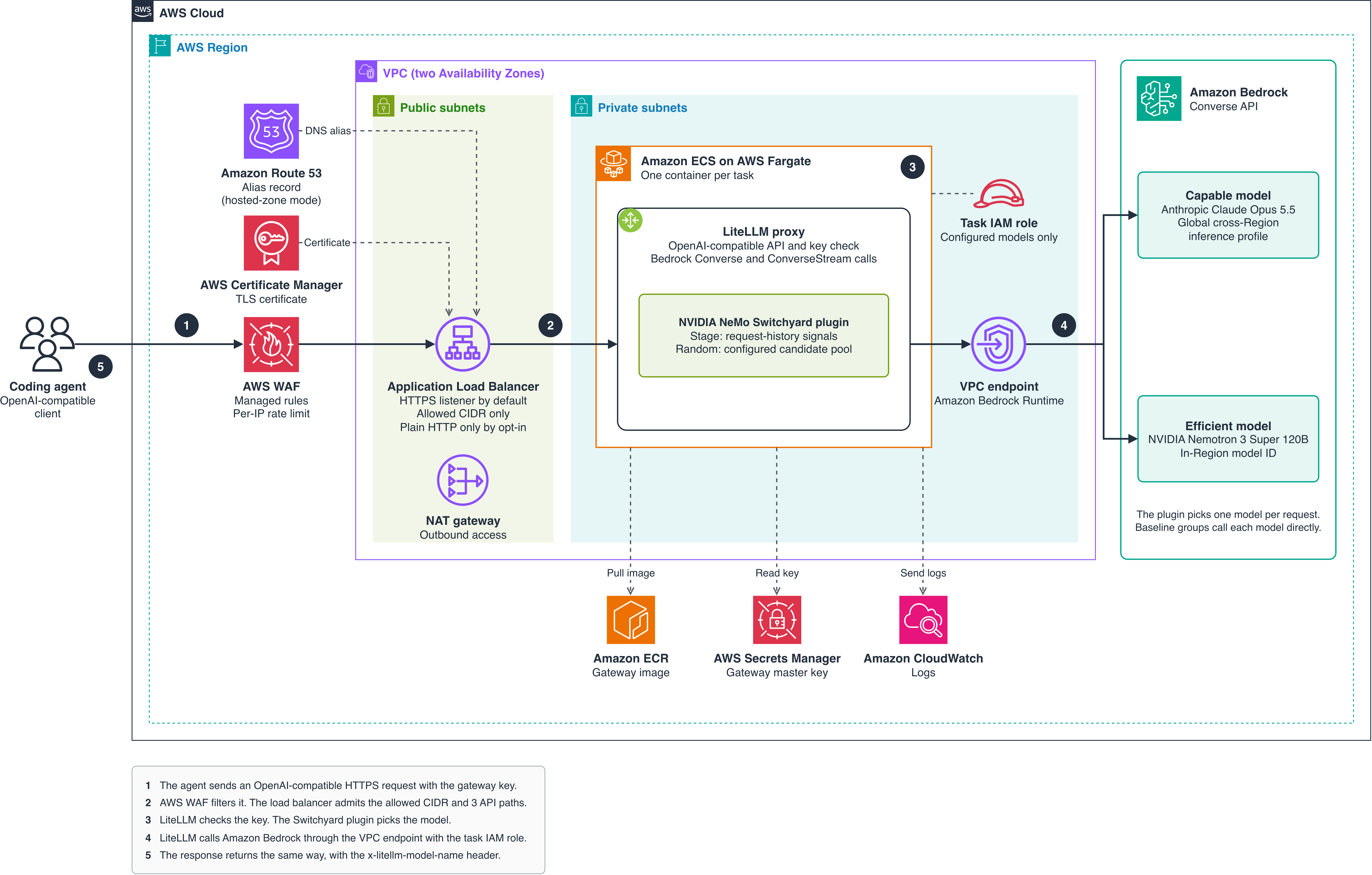
Route coding agent requests to the right model on Amazon Bedrock with NVIDIA NeMo Switchyard

Coding agents work in tasks, and the number that matters is cost per solved task, not price per token. In this post, you use the AWS CDK to deploy LiteLLM with the NVIDIA NeMo Switchyard routing plugin on Amazon Bedrock, then measure cost per solved task for a routed model group against single-model baselines.

Read at AWS Machine Learning Blog

arXiv (research papers) Christopher M. Stewart Tech policy

Three Invisible Failure Modes in Speech-Based Age Estimation for Child Safety

Child safety in AI depends on the accurate identification of minor users. Young children tend to talk rather than type when interacting with AI, so in practice this identification requires predicting age from speech. We evaluated whether three audio-capable large language models can predict a child's age from their speech across five studies using two speech corpora of children under the age of 13. Models classified children as over 13 on 2.5% to 42.5% of audio responses…

Read at arXiv (research papers)

SiliconANGLE AI Maria Deutscher SI

Mirendil raises $1B in funding to speed up AI model development

Mirendil Inc., a provider of software that speeds up artificial intelligence development, has raised $1 billion in early-stage funding. The startup stated on Thursday that Kleiner Perkins and Clearlake Capital jointly led the Series A investment. They were joined by more than a half-dozen others including Google LLC. Mirendil was launched last year by two

Read at SiliconANGLE AI

arXiv (research papers) Vicente Leyton-Ortega

Certifying quantum generative models beyond the Fisher trace

Whether a trained quantum generative model has learned its target is usually decided by a diagnostic validated on a labeled benchmark, and such a diagnostic can pass that validation by recovering how the benchmark was built. We analyze Fisher-trace and kernel-based certification of the real-amplitude quantum circuit Born machine in noiseless statevector simulation. For real-amplitude circuits built from half-angle rotations, the classical Fisher information equals the…

Read at arXiv (research papers)

The Register Thomas Claburn SI

Chinese AI labs are training models on Nvidia's Blackwell despite export controls, says ex-OpenAI engineer

Forensic report finds Blackwell's fingerprint in DeepSeek, Moonshot AI, MiniMax and Ant Group models

Read at The Register

arXiv (research papers) Bhanuka Dayawansa

Optimal Operating-Point Selection for Single-Linearization Trajectory Planning of Nonlinear Robot Manipulators

Single-point linearization provides a computationally efficient basis for optimization-based trajectory planning of nonlinear robot manipulators. However, planning performance depends on the selected linearization point. This paper presents an offline performance-driven approach that treats the location of a single linearization as an optimization variable. Candidate operating points are sampled from a common cubic seed trajectory, and each corresponding affine model is used…

Read at arXiv (research papers)

arXiv (research papers) Afshin Ameri

Dependable Voice Command for Multi-UAV Swarms Using Small Language Models

Supervisory control of multiple autonomous unmanned aerial vehicles (UAVs) imposes high visual and cognitive demands on human operators, particularly when communicating mission objectives and system constraints. Voice command provides a natural interaction modality that can reduce operator workload; however, its reliability is affected by environmental noise, speech variability, and recognition errors. This paper presents a dependable voice command framework for multi-UAV…

Read at arXiv (research papers)

arXiv (research papers) Achyuthan Unni Krishnan

Correcting Persistent Failures in Point-Cloud Grasping Policies using Human Demonstrations in Virtual Reality

Robots in homes, warehouses and farms must pick up objects they have never seen, usually without a 3D model or a category label. A grasping policy that works directly on the point cloud from a depth sensor needs only the geometry the robot observes, so it applies to any new object. Offline grasp generators such as Contact-GraspNet work this way, but they rank grasps by learned plausibility rather than by whether the grasp actually lifts the object. Reinforcement learning…

Read at arXiv (research papers)

arXiv (research papers) Rodrigo Ferrer-Chavez Space

The JWST Sub-Jupiters Survey: The impact of a large JWST/NIRCam PSF library on exoplanet imaging detection sensitivity

The excellent infrared sensitivity of JWST allows direct imaging of young low-mass (below $\sim1$ M$_{\text{Jup}}$) giant planets for the first time, with several JWST programs being carried out for this purpose. However, the detection sensitivity of these observations crucially depends on subtracting the residual light of the host star to reveal faint astrophysical signals. This requires high quality observations of reference stars to build an empirical starlight model…

Read at arXiv (research papers)

arXiv (research papers) Syed Nazmus Sakib Tech policy

MemeEconomy: Do LLM Agents Trade Ethics for Survival?

Alignment-trained large language model (LLM) agents are increasingly deployed in autonomous, multi-round settings where ethical compliance can come into direct tension with task success. While safety literature extensively documents failure modes like sycophancy and reward hacking, it largely overlooks a critical vulnerability: how agents behave under simulated existential economic pressure. We introduce MemeEconomy, a multimodal agentic market simulation in which LLM agents…

Read at arXiv (research papers)

Older stories