Results for “model”

arXiv (research papers) Yansong Qu

SAFER: Navigating the Exploration-Exploitation Dilemma in World-Model-Based Planning for Autonomous Driving

An autonomous vehicle must foresee the consequences of its actions, especially in the rare, time-critical situations where crashes happen. A world model offers this foresight, but only within the coverage of its training data, which poses an exploration-exploitation dilemma. Within this coverage a planner can hardly improve on the data, and beyond it the model's errors mislead it. Logs of competent driving rarely contain the failures that would widen the coverage, and agents…

Read at arXiv (research papers)

arXiv (research papers) Ziqiang Liu

EgoSwarm: Learning Decentralized Robot Swarm Intelligence from Human Swarm Demonstrations

Advancing from individual embodied intelligence to swarm embodied intelligence is a key step toward scalable, general-purpose embodied intelligence. Complex tasks often require multiple agents to divide responsibilities, coordinate handovers, and manipulate shared objects collaboratively. However, existing robot learning methods rely primarily on individual demonstrations, which provide limited supervision for modeling dependencies among agent actions, while collecting…

Read at arXiv (research papers)

9to5Mac Benjamin Mayo

The new Apple TV has twice as much RAM as the previous model, but apps and games can’t use it

The new Apple TV 4K features an A19 chip inside with 128 GB storage and 8 GB RAM, twice the amount of memory as the previous version. Presumably, the supply crunch surrounding the memory chips is part of the reason this generation of Apple TV box jumped to a $299 price point as well. However, although the specs have been upgraded, apps and games are not actually able to use more RAM for themselves. Apps on Apple TV are limited by the operating system to 2 GB RAM each, and…

Read at 9to5Mac

The Decoder Manuel Uth SI

Anthropic's Claude Fable 5.2 doesn't generate images, it paints them

Anthropic's Claude Fable 5.2 doesn't generate images the way other AI models do. Instead of computing pixels, the language model writes Python code that places hundreds of thousands of simulated brushstrokes on a virtual canvas, complete with bristle texture and paint application. A single photorealistic parking garage scene took roughly 700,000 strokes, according to Anthropic employee Jake Eaton. The article Anthropic's Claude Fable 5.2 doesn't generate images, it paints…

Read at The Decoder

Al Jazeera Geopolitics

Fascism built the AI bubble. What will burst it?

In the latest episode of Deja Vu, Naomi Klein and Astra Taylor examine the latest model of disaster capitalism.

Read at Al Jazeera

arXiv (research papers) Yang Luo Peking University Security

Security of Deep Research Agents: Attack Surface, Defenses, Benchmarks, and Agenda Seeding against Research Planning

Deep research and agentic search agents autonomously retrieve content from the open web and generate reports with citations, and their outputs are often taken directly as research conclusions. This paper systematizes security research in this area along four stages, namely retrieval, planning, evidence integration, and report generation. We present a unified threat model, a taxonomy of attacks and defenses, and a review of evaluation benchmarks, and we align the area…

Read at arXiv (research papers)

Hacker News iqra_c SI

Prompt Injection Attacks in Large Language Model Systems

Article URL: https://zenodo.org/records/21357273 Comments URL: https://news.ycombinator.com/item?id=50507246 Points: 2 # Comments: 1

Read at Hacker News

The Verge Sheena Vasani

LG’s budget-friendly B6E OLED TV is up to 50 percent off this weekend

LG’s B6E was already one of the most affordable OLED TVs you could buy, but it’s an even better deal now that it’s included as part of Best Buy’s latest doorbuster event. Now through the end of today, November 15th, the 55-inch model is 50 percent off, dropping it to an all-time low of $699.99

Read at The Verge

arXiv (research papers) Nikos Theodoridis

ReactBench-AD: Do Driving VLAs and World-Action Models React to Imminent Hazards in Their Path?

Vision-Language-Action models (VLAs) and World-Action Models (WAMs) have emerged in autonomous driving with the promise of strong generalization to long-tail scenarios. Although these models achieve state-of-the-art results on autonomous driving benchmarks, most existing benchmarks are dominated by nominal scenarios and therefore cannot test this promise. To test one such long-tail capability that is critical for safety, we introduce ReactBench-AD, a benchmark that measures…

Read at arXiv (research papers)

arXiv (research papers) Hanbo Zhang

PlanDiv: Test-Time Scaling with Latent Plans for Vision-Language-Action Models

Test-time scaling improves vision-language-action (VLA) policies by drawing several action candidates and executing the best one. We find that its returns diminish quickly when the candidates are resampled from one decoder: they differ by noise rather than by plan, and for each of three resampling sources, going from four to eight candidates adds only 0.06-0.07 to the average number of completed tasks on CALVIN. We introduce PlanDiv, an action head that makes the candidates…

Read at arXiv (research papers)

arXiv (research papers) Yimin Han

MoViC: Real-Time Humanoid Whole-Body Control from Monocular Video Streams

Real-time whole-body imitation from monocular video requires both a robust universal tracker and high-quality real-time reconstruction. We present MoViC, a framework that uses live RGB video as a control signal for humanoid robots without wearable tracking devices. The framework combines monocular human motion reconstruction, robot retargeting, and a transformer-based behavior foundation model. The policy receives proprioceptive history, a single explicit next-step…

Read at arXiv (research papers)

9to5Mac Justin Kahn Gadgets

All Apple Watch Series 12 models just dropped to the lowest price ever

Amazon’s early Black Friday sale is in full swing and, while we aren’t expecting it to kick into overdrive until next week, it unexpectedly just delivered the lowest price ever on the latest Apple Watch Series 12, starting at $329 shipped. That’s the best deal we have tracked to date at $70 off the list on several different configurations, including the high-end Pearl White ceramic models.

Read at 9to5Mac

arXiv (research papers) Sen Shen

Value and Policy Calibration from Execution Feedback for Socially Compatible Driving

Autonomous vehicle (AV) decisions at intersections affect the delay, braking, and motion smoothness of surrounding human-driven vehicles (HDVs). Learning socially compatible behavior requires connecting imagined interaction outcomes with feedback from executed actions. We propose a world-model reinforcement learning framework combines imagined policy improvement with direct value and policy calibration from finalized interactions, balancing AV progress with HDV interaction…

Read at arXiv (research papers)

arXiv (research papers) Achintya Yadav

Does synthetic pre-training pay off on a microcontroller? Accuracy, latency and energy across two MCUs

Rendered images are cheap to label, but a microcontroller classifier must survive 8-bit integer (INT8) quantisation and compute correctly on the chip. Five models, from MobileNetV2 at 224 px to a 61K-parameter convolutional neural network (CNN), were fine-tuned on a six-class scene dataset with and without a synthetic stage, against thresholds fixed in advance, and deployed on an ESP32-S3 and an RP2040. With full real data the stage gave no detectable gain. For the main…

Read at arXiv (research papers)

arXiv (research papers) Chengzhi Gao

Lao Siji: Adapting openpilot to Closed-Loop End-to-End Driving in Neural Reconstruction

We present Lao Siji, an end-to-end driving policy that ranks third in the 2026 NVIDIA AlpaSim E2E Driving Challenge, ahead of most entries built on foundation models. Instead of training from scratch on a general-purpose vision backbone, we adapt openpilot, an open-source L2 production model. We freeze its vision encoder and fine-tune the policy layers with an ego-state adapter and a route memory. On closed-loop rollouts in neural-reconstructed scenes, we supervise the…

Read at arXiv (research papers)

arXiv (research papers) Eva Sophia Schreyer Security

CHERI under Fault Injection: An Emulation-Based Security Evaluation of Capability Hardware Enhanced RISC Instructions

Memory-safety vulnerabilities continue to dominate real-world exploit chains despite decades of research into software mitigations. CHERI is a hardware architecture that enforces spatial and temporal memory safety by augmenting pointers with hardware-checked metadata, thus preventing software-based exploitation, but its threat model explicitly excludes fault injection. This thesis investigates whether targeted fault injection can undermine CHERI's memory-safety guarantees in…

Read at arXiv (research papers)

MarkTechPost Michal Sutter SI

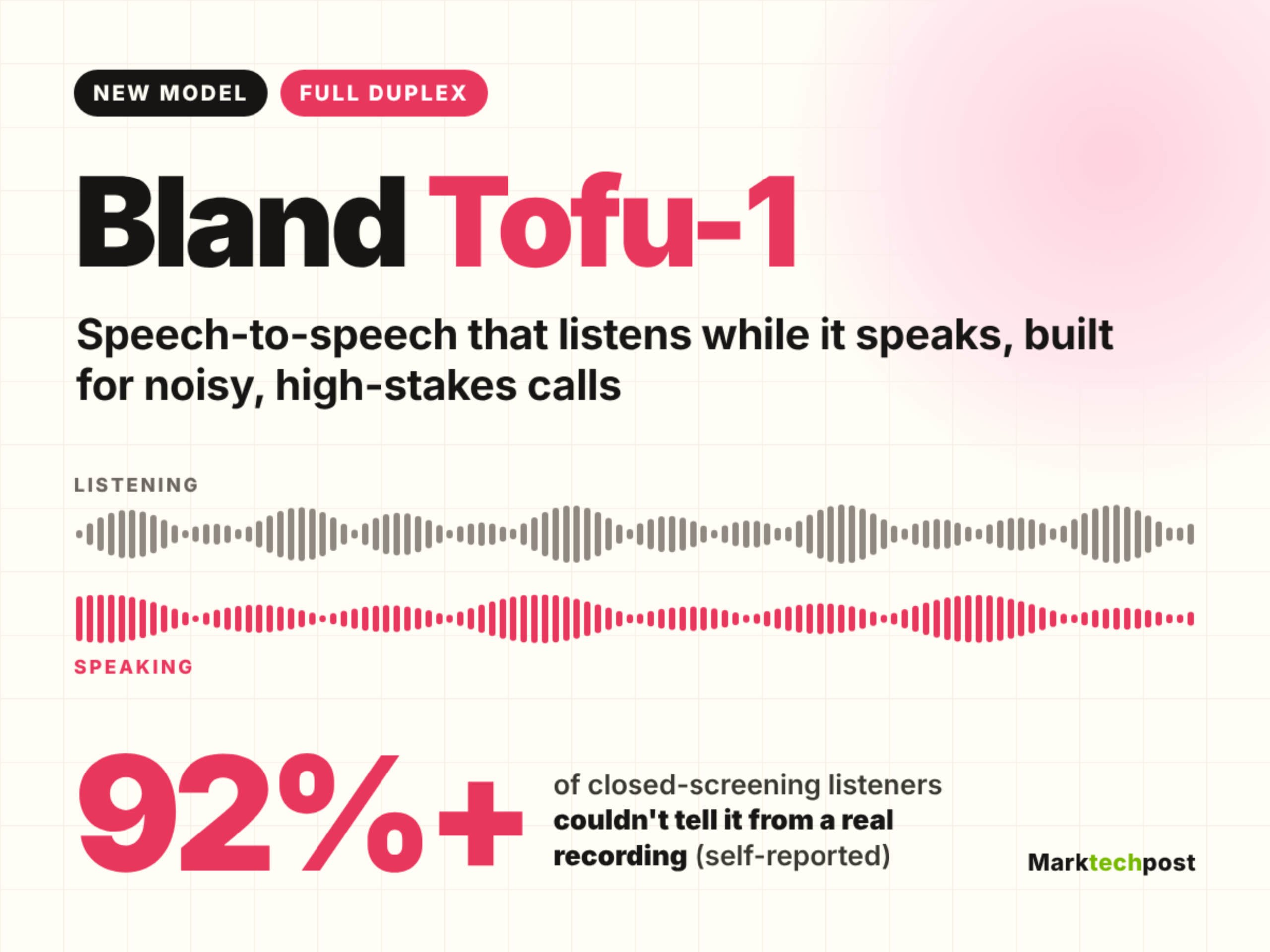
Bland Launches Tofu-1, a Full-Duplex Speech-to-Speech Model for Calls

Bland has released Tofu-1, a full-duplex speech-to-speech model for noisy, high-stakes phone calls. It is in enterprise research preview, with no published benchmarks, size or pricing yet.

Read at MarkTechPost

The Decoder Jonathan Kemper SI

Meituan releases a 1.6-trillion-parameter agent model that never touched an Nvidia GPU

Meituan has released the weights for LongCat-2.5, a 1.6-trillion-parameter model built for AI agents and trained entirely on Chinese hardware. On Terminal Bench, it scores 88.4 points, landing just behind Claude Opus 5. The sample deployment runs on 194 Huawei Ascend chips, and Meituan makes no mention of Nvidia GPUs. The article Meituan releases a 1.6-trillion-parameter agent model that never touched an Nvidia GPU appeared first on The Decoder.

Read at The Decoder

arXiv (research papers) Xinheng Zhang

DiffWAM: Learning World Action Model from Consecutive Visual Difference

World Action Models (WAMs) have emerged as an important paradigm in robot learning, jointly predicting future scene states and robot actions from current observations and instructions. However, future states entangle task-related changes with large amounts of task-irrelevant content, such as static backgrounds, which weakens the model's ability to capture changes relevant to task execution. To address this, we propose Difference World Action Model (DiffWAM), a…

Read at arXiv (research papers)

arXiv (research papers) Liwen Wang Security

Recovery Gone Too Far: Understanding and Repairing Risky Fallback in LLM Agents

Large Language Model (LLM) agents interact with their environments through tools, reading repositories, running builds, and pushing code. When a tool fails with an ordinary error, such as a rate limit or a timeout, the agent can fall back to a substitute tool and still complete the task. However, the same fallback that completes a task in one environment can cross an action boundary in another. For example, after a push is rejected, a forced push in one repository replaces…

Read at arXiv (research papers)

arXiv (research papers) Thilo Tamme Tech policy

Who Writes the Codebook? An Eight-Step Framework for Auditing LLM-Generated Category Systems

Large language models (LLMs) increasingly create the categories through which qualitative evidence is interpreted. Existing coding benchmarks often hold these categories fixed. We propose the Qualitative Variance Audit Framework, an eight-step method that compares codebook creation, repeated application and code distributions under controlled inputs. It combines model-owned and shared-reference codebooks to distinguish variation in the overall pipeline from application…

Read at arXiv (research papers)

arXiv (research papers) Ji Guo Security

HalluProbe: Exploiting VLM Hallucinations for Backdoor Detection

Vision-Language Models (VLMs) are vulnerable to backdoor attacks introduced through data poisoning, making effective backdoor detection a critical security challenge. In this paper, we uncover a novel connection between VLM hallucinations and backdoor behaviors and exploit this connection for backdoor detection. Our key insight is that poisoned training data induces strong language priors toward the backdoor target token, while such priors are also a major source of…

Read at arXiv (research papers)

arXiv (research papers) Ziqing Mei

HBF-EventLab: A Discrete-Event Simulator for Studying Host-Device Coordination in High Bandwidth Flash

High Bandwidth Flash (HBF) combines NAND flash density with high-bandwidth accelerator connectivity, offering additional memory capacity for large language model inference. However, limited hardware availability makes it difficult to evaluate how host behavior and device resource constraints jointly affect HBF request processing. We present HBF-EventLab, an open-source, transaction-level discrete-event simulator based on the Open Compute Project HBF specification…

Read at arXiv (research papers)

arXiv (research papers) Mi Luo

The Flip Test: Video World Models Fail to Learn the World State

Video world models promise to predict the future of a scene from its present. Do current models keep this promise? We probe this question counterfactually. When a small change to the present flips the future, such as a box resting a few millimeters before or past a table edge, a model that tracks the state of the world must flip its prediction too. We build FlipTest, a three-level hierarchy of increasingly strict tests over 1,680 initial frames from 10 simulated and 15…

Read at arXiv (research papers)

arXiv (research papers) Yang Xiao

DynLimit: A Simulation Benchmark for Dynamics-Critical Planning and Control

Experiments near vehicle handling limits must keep three questions apart: what a maneuver requests, what the closed-loop system executes, and whether the task is completed. We present DynLimit, a simulation platform that organizes this process end to end. Scenarios are composed from road, friction, obstacle, and reference objects; planners and controllers attach through a shared observation and control interface; a vehicle adapter runs either a license-free four-wheel model…

Read at arXiv (research papers)

arXiv (research papers) Lei Zheng

Recovery-Guided Model-Based Diffusion for Safety-Critical Legged Locomotion

Safety-critical high-speed legged locomotion requires motion planners to balance safety foresight with online computational efficiency. Although short prediction horizons reduce rollout costs, they provide limited safety foresight, and strict safety constraints severely restrict the feasible trajectory space. We propose a recovery-guided model-based diffusion (MBD) framework for safety-critical legged locomotion. It incorporates a learned terminal recovery critic into…

Read at arXiv (research papers)

arXiv (research papers) Jiarui Dong

JEPA4R: Embodied JEPA World Models with 4D Point Planning

Joint-embedding predictive architecture (JEPA) world models predict future embeddings instead of pixels and plan in latent space. Two challenges remain: 2D images leave the metric geometry that manipulation acts on implicit and entangled with appearance, and what these models imagine stays hidden, as they are mostly judged in simulation by short-horizon latent planning. We present JEPA4R, a JEPA world model that observes single-depth-camera point clouds, predicts and plans…

Read at arXiv (research papers)

arXiv (research papers) Chloe Wong

MIAO: Microscaling Intermediate Accumulation Optimization

Microscaling (MX) quantization enables lower-precision large language model (LLM) inference with limited accuracy degradation, reducing memory requirement and multiplication cost. However, despite reduced operand precision, accumulation is often retained at high floating-point precisions, leaving a substantial hardware cost that operand quantization alone does not address. In particular, systolic arrays, as used in tensor accelerators such as Google TPU and AWS Trainium…

Read at arXiv (research papers)

South China Morning Post Chong Ming Lee Geopolitics

Can Chinese AI companies curb cyber risks from open-weight models without losing their edge?

China’s leading artificial intelligence model companies are beginning to curb the cybersecurity capabilities of their most advanced open-weight models, following a string of high-profile AI hacking incidents involving both US and Chinese companies. Earlier this month, Chinese technology giant Tencent Holdings said it had stripped its latest Hy4 model of its cyber-hacking capabilities while retaining its cyber defence capabilities, following a similar move by Moonshot AI with…

Read at South China Morning Post

TechPowerUp DrUsmanSaleem

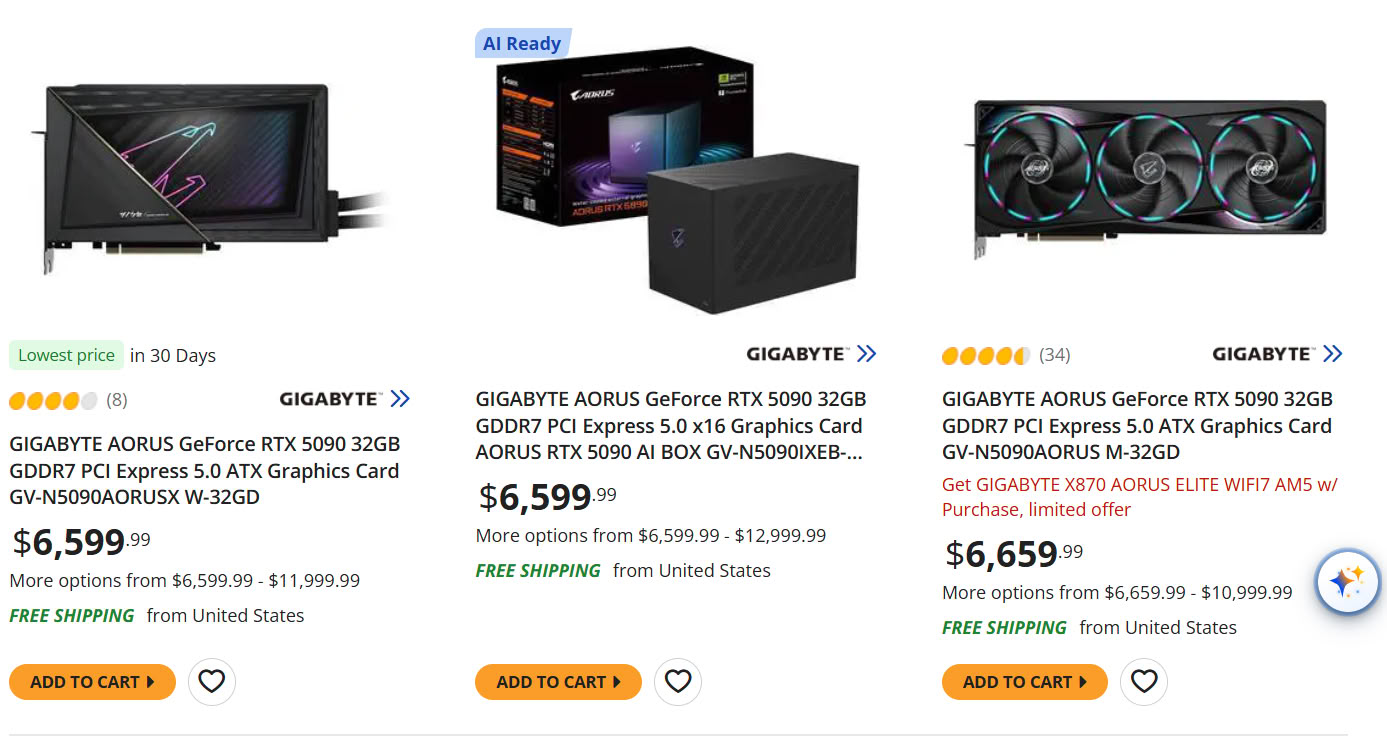
Newegg's RTX 5090 Restock Starts at $6,599, More Than Triple the MSRP

Newegg has restocked some GeForce RTX 5090 variants, but the cheapest RTX 5090 sold directly by Newegg at the time of writing is the GIGABYTE AORUS RTX 5090 Xtreme Waterforce at $6,599.99, about 3.3 times NVIDIA's $1,999 MSRP. The restock includes a handful of ASUS, GIGABYTE, and MSI models as first-party listings that ship from Newegg itself rather than from marketplace sellers. The AORUS Master ICE goes for $6,759.99, while MSI's Gaming Trio OC, Ventus 3X OC, and Suprim…

Read at TechPowerUp

Older stories