Results for “Quantum”

arXiv (research papers) Yousef Elbrolosy

feedback-grape: A JAX-based Python Package for GPU-Accelerated GRAPE with Feedback

Modern quantum technology applications require accurate control of quantum systems, including a feedback loop in the control process. While open-loop control can be performed using well established gradient methods like GRadient Ascent Pulse Engineering (GRAPE), it was until recently unclear how to combine these with feedback from measurements, which are inherently non-differentiable. Recent work has successfully demonstrated how feedback can be incorporated into GRAPE using…


Read at arXiv (research papers)

arXiv (research papers) Visuttha Manthamkarn

Quantum-Enhanced Passive and Active Radio-Frequency Photonic Imaging

Radio-frequency (RF) photonics enables broadband, phase-coherent sensing beyond the reach of purely electronic architectures, yet at a given optical carrier power its sensitivity is bounded by the standard quantum limit of the optical readout. Here, we experimentally demonstrate that this limit can be surpassed in both passive and active RF imaging modalities by encoding RF signals onto a bright phase-squeezed optical carrier and recovering them via balanced homodyne…

Read at arXiv (research papers)

arXiv (research papers) Amir Azzam

Generative Models using Multi-layer Quantum Extreme Learning Machines

Quantum reservoir computing (QRC) and the closely related quantum extreme learning machine (QELM) paradigm exploit the complex dynamics of an uncontrolled quantum system for machine learning, offering an alternative to variational quantum algorithms whose training is hindered by barren plateaus and costly circuit optimization. Because the quantum system itself is left fixed, learning reduces to fitting a linear readout of a set of measured observables, and no gradient is…

Read at arXiv (research papers)

Phys.org Quantum Physics

Tangled quantum whirlpools caught unraveling in an ultracold gas

When a cloud of atoms is cooled close to absolute zero, its atoms can merge into a Bose–Einstein condensate (BEC): an exotic fluid in which atoms across the whole cloud share a single quantum state. Current theories predict that as a disordered quantum gas settles into this ordered state, a tangle of tiny vortices should form and gradually unravel.

Read at Phys.org Quantum Physics

Quantum Computing Report Doug Finke

Making Quantum SDKs More Accessible: Lessons from Contributing to Qiskit

Software developer Gloria Amos describes her experience in making a contribution to the open source Qiskit platform and provides insights into some of the things contributors should watch out for.

Read at Quantum Computing Report

Quantum Computing Report Mohamed Abdel-Kareem

Who’s News: Strategic Appointments at SemiQon, OrangeQS, IonQ, Haiqu, and Jij

This article announces several strategic appointments in the quantum technology sector. SemiQon appointed Dr. Thierry Botter as CCO, OrangeQS named Raj Badoni as CCO, and IonQ expanded its finance leadership with Gary Merrill as CFO and Thomas A. Austin as CAO. Additionally, Haiqu appointed Kortny Rolston-Duce as Head of Ecosystem Development and Marketing, and Jij named Oren Bernstein as VP of Business Development for North America.

Read at Quantum Computing Report

arXiv (research papers) Junghoon Justin Park

Advancing Quantum Reinforcement Learning with Differentiable Quantum Architecture Search and Adaptive Non-local Observables

Quantum Reinforcement Learning (QRL) using variational quantum circuits (VQCs) is constrained by fixed measurement protocols and hand-designed circuit ansätze. Adaptive Non-local Observables (ANO) and Differentiable Quantum Architecture Search (DiffQAS) address these issues independently, but to our knowledge have not been combined or compared in a single QRL framework. We present an ablation of ANO and DiffQAS within the Quantum Time-series Transformer (QTSTransformer)…

Read at arXiv (research papers)

arXiv (research papers) Junghoon Justin Park

Scalable and Interpretable Quantum Mixture of Experts for High-Dimensional Spatio-Temporal Data

Quantum Mixture of Experts (QMoE) architectures offer a promising path toward scalable quantum machine learning, yet existing approaches remain largely confined to low-dimensional benchmarks and often rely on naive input partitioning that disrupts feature dependencies. We address these gaps by introducing Feature-Partitioned QMoE, which partitions high-dimensional spatio-temporal inputs into functionally coherent feature groups and assigns each group to a dedicated quantum…

Read at arXiv (research papers)

Quantum Computing Report Mohamed Abdel-Kareem

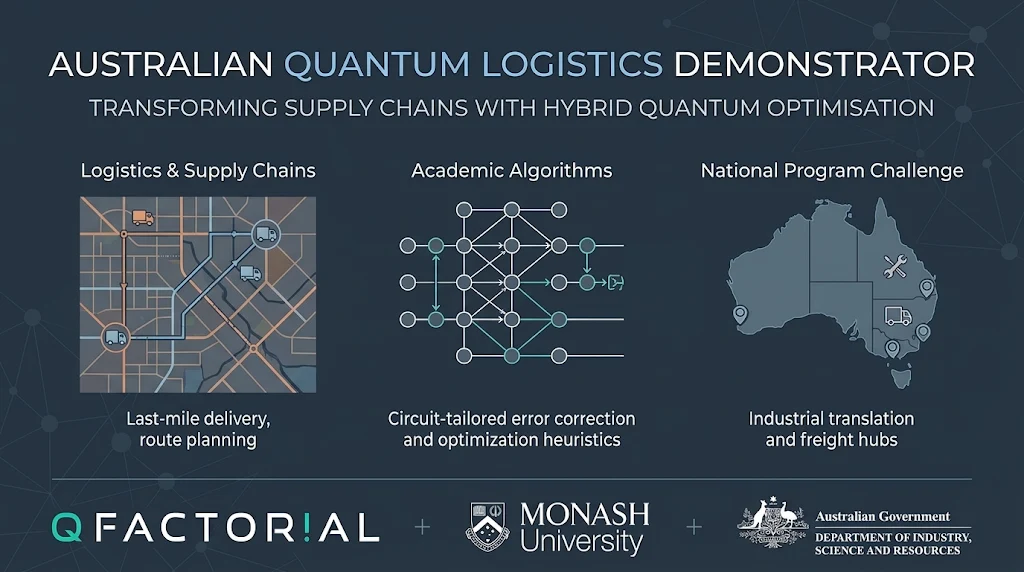
QFactorial and Monash University Secure A$1.12 Million ($$758.6K USD) Australian Government Grant for Quantum Logistics Optimization

QFactorial and Monash University have received a A$1.12 million Australian government grant to develop a hybrid quantum-classical optimization solver for freight and last-mile delivery. The 15-month project aims to advance QFactorial's routing and fleet-utilization platform. This initiative, part of the Critical Technologies Challenge Program, involves a consortium including IBM Quantum, AWS, and Fujitsu, and seeks to overcome limitations of classical solvers in large-scale…

Read at Quantum Computing Report

arXiv (research papers) Avner Bensoussan

Live Noise Fingerprints for Quantum Program Analysis

Quantum programs are probabilistic in nature, and noisy execution due to current imperfect hardware further complicates their analysis. In this paper, we study abstract semantics for analysing quantum programs under these conditions. We introduce noise fingerprints, compact descriptions of the observable effects of noise relative to a finite interface of input states and output measurements. We use them to define our abstract domain with respect to the concrete noise-related…

Read at arXiv (research papers)

arXiv (research papers) Rathindra Nath Karmakar

Asymptotic efficiency of tests for quantum statistical models

In classical statistics, local asymptotic normality provides a general framework for characterizing optimal testing power and constructing asymptotically efficient procedures. Extending this framework to quantum statistical models introduces additional challenges arising from the noncommutativity of observables and the need to optimize over quantum measurements. In this paper, we develop a theory of asymptotic efficiency for quantum hypothesis testing using quantum local…

Read at arXiv (research papers)

Quantum Computing Report Mohamed Abdel-Kareem

Quantum XChange Phio TX Becomes First Post-Quantum Cryptographic Management Platform to Earn EUCC Certification

Quantum XChange's Phio TX cryptographic management software (version 4.5.6) is the first post-quantum cryptography (PQC) management platform to achieve EUCC certification, adding to its existing U.S. FIPS validation. This certification, valid until November 9, 2031, allows for the secure deployment of post-quantum algorithms and quantum key distribution interfaces within the European Union, simplifying procurement and supporting data sovereignty.

Read at Quantum Computing Report

Quantum Computing Report Mohamed Abdel-Kareem

JIJ Expands Quantum-HPC and Industrial R&D Collaborations with Mitsubishi Electric, Q-CTRL, and Tinuviel Therapeutics

JIJ Inc. has expanded its quantum-HPC and industrial R&D collaborations with three new partnerships. These collaborations involve Mitsubishi Electric for thermal-fluid engineering simulation, Q-CTRL for electrical power-grid optimization, and Tinuviel Therapeutics for predictive gut microbiome modeling. JIJ's hybrid algorithmic stack will be used across these diverse applications.

Read at Quantum Computing Report

arXiv (research papers) Chenzewei Qing

Accurate qLDPC decoding under real-time constraints

Fault-tolerant quantum computation requires reconciling the computational demands of accurate decoding with the stringent timing constraints of real-time error correction. We present Spatiotemporal Covariance-Optimized Parallel Ensemble (SCOPE), a physics-informed framework for real-time decoding of quantum low-density parity-check codes (qLDPC). By exploiting the spatial symmetries of bivariate-bicycle (BB) codes and the temporal regularity of repeated syndrome extraction…

Read at arXiv (research papers)

Quantum Computing Report Mohamed Abdel-Kareem

JIJ Launches SQOA Solver in IBM Quantum Functions Catalog to Tackle Combinatorial Optimization Beyond Qubit Counts

JIJ Inc. has launched its SQOA Solver in the IBM Quantum Functions Catalog, allowing users to tackle complex optimization problems with more variables than available qubits. This solver utilizes a novel approach that combines variable-compression encoding and classical subspace diagonalization, eliminating the need for iterative quantum hardware optimization. It has demonstrated success in solving large-scale problems like 384-node MaxCut and 200-node Maximum Independent Set…

Read at Quantum Computing Report

Quantum Computing Report Mohamed Abdel-Kareem

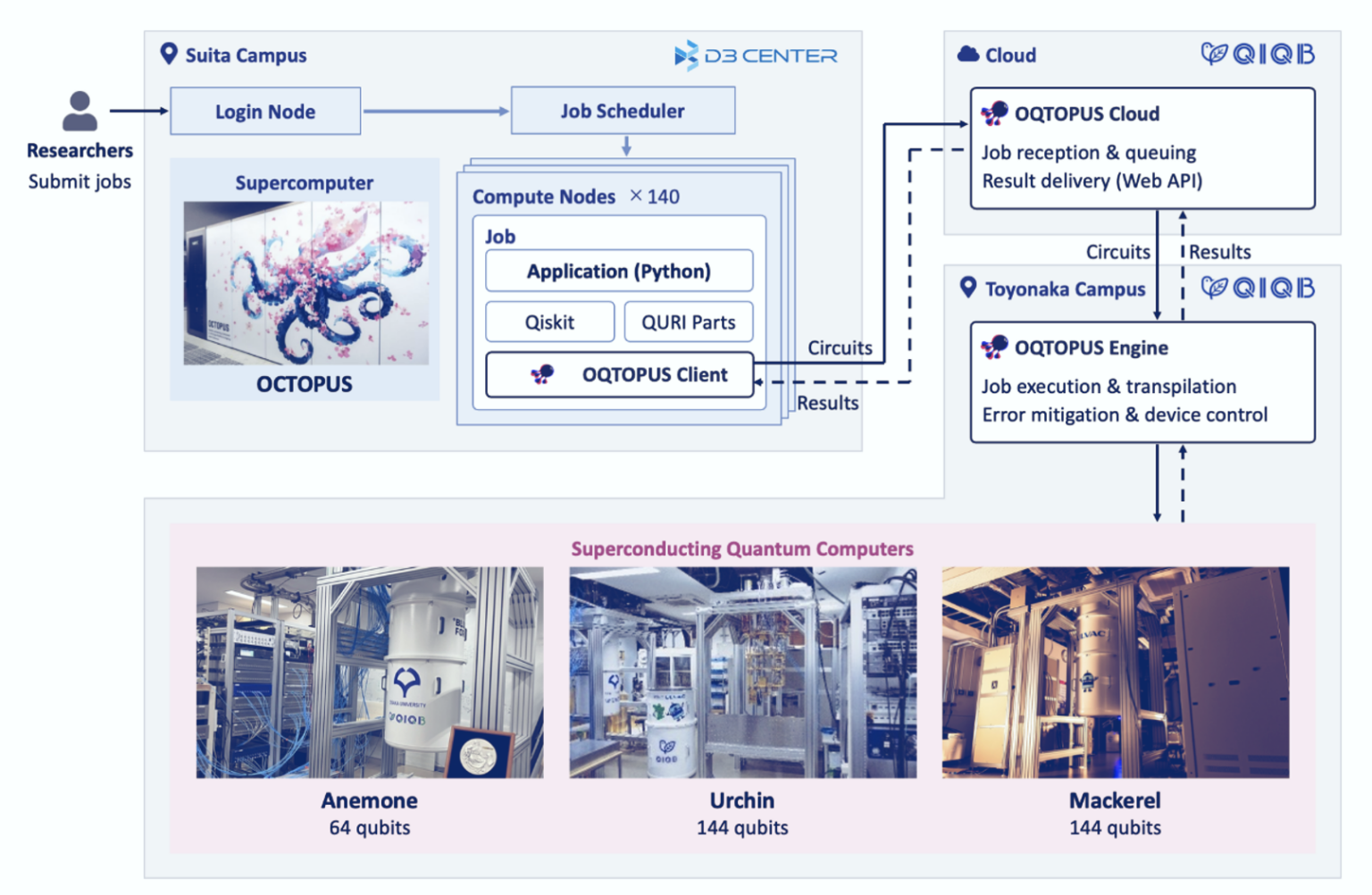
University of Osaka Integrates Domestic Superconducting Quantum Processors with OCTOPUS Supercomputer via SEAFOOD Platform

The University of Osaka has launched SEAFOOD, a hybrid computing platform integrating its OCTOPUS supercomputer with domestic superconducting quantum processors. This platform, the first of its kind in Japan, aims to tackle complex computational problems in fields like drug discovery and materials engineering by distributing workloads across classical and quantum systems. The project, supported by various Japanese initiatives, will offer trial access to research teams in…

Read at Quantum Computing Report

arXiv (research papers) Liyi Li

Constrained Adiabatic Quantum Programming

To find a $k$-clique in a graph, adiabatic quantum computation (AQC) evolves a quantum system from the minimum of an initial cost function to the minimum of a problem cost function that penalizes non-cliques. Existing AQC languages fix the initial cost function, so the search ranges over all $2^n$ subsets of the $n$ vertices, although only the subsets of size $k$ can be answers. We present ENQ+, an AQC language in which the programmer writes both cost functions. Data…

Read at arXiv (research papers)

arXiv (research papers) Arnav Pushkar

Quasi-particle sector hybridization and the onset of chaos in spin ladders

How quasiparticle numbers influence the emergence of quantum chaos is a fundamental question in interacting many-body systems. We investigate this interplay in a spin-$1/2$ XXZ ladder, where the strong-rung regime supports an approximate organization of many-body eigenstates into quasi-particle(triplon) number sectors. Using spectral statistics, triplon-based observables, and von Neumann entanglement entropy, we characterize the microscopic hybridization of triplon-number…

Read at arXiv (research papers)

arXiv (research papers) Muhammad Arsalan Ali Akbar

Machine-learned active spaces enable quantum calculations of spin-state energetics of transition-metal complexes on quantum hardware

Multireference calculations on transition-metal complexes, on classical or quantum hardware, depend on the choice of active space. The orbitals that belong in it are those that are strongly entangled in the correlated wavefunction, but measuring this entanglement requires the very correlated calculation that the active space is meant to make affordable. Here we present SpinAware, a machine-learning model that predicts density-matrix renormalization group (DMRG)…

Read at arXiv (research papers)

arXiv (research papers) Tian-Le Yang

Control of Non-Markovianity via Channel Exceptional Points in a Driven-Dissipative Kerr-Cat Qubit

Exceptional points (EPs) in open quantum systems are conventionally defined at the Liouvillian level, making them representation-dependent and often requiring auxiliary degrees of freedom. We study EPs directly at the quantum-channel level in a driven-dissipative Kerr-cat qubit, in which dissipation drives bidirectional jumps between its two basis states. Interpolating two Markovian channels yields single EPs when the endpoints straddle a spectral-phase boundary and…

Read at arXiv (research papers)

npj Quantum Information Liam Fallik

CryoCMOS RF multiplexer for superconducting qubit control, readout and flux biasing at millikelvin temperatures with picowatt power consumption

npj Quantum Information, Published online: 14 November 2026; doi:10.1038/s41534-026-01424-7 CryoCMOS RF multiplexer for superconducting qubit control, readout and flux biasing at millikelvin temperatures with picowatt power consumption

Read at npj Quantum Information

arXiv (research papers) Luiz Felipe Santos Dittberner

Finite-time quenches across first-, second-, and infinite-order transitions in XXZ spin chains

We investigate how equilibrium quantum phase transitions manifest themselves in small systems driven out of equilibrium by quantum quenches. We consider linear ramps of the anisotropy in spin-1/2 and spin-1 XXZ chains, which host transitions of first, second, and infinite (Berezinskii-Kosterlitz-Thouless, BKT) order. We consider system sizes available in current quantum simulators and investigate how the order of the transition, the symmetries, and the ramp duration affect…

Read at arXiv (research papers)

arXiv (research papers) Brian Barch

Witnessing Magic (and other Quantum Resources)

Motivated by measurements of quantum magic, we study the sampling cost of resource robustness ---a quantifier for a broad class of quantum resources--- by bounding the variance of optimal robustness witnesses. We first lower bound the samples required to estimate a state's resource robustness using Cramér-Rao bounds. We find that the number of measurements scales at least quadratically in the robustness for highly mixed states, and at least linearly in the generalized…

Read at arXiv (research papers)

Quantum Computing Report Mohamed Abdel-Kareem

Atom Computing Finalizes $100 Million U.S. Department of Commerce R&D Agreement for Fault-Tolerant Quantum Systems

Atom Computing has finalized a $100 million R&D agreement with the U.S. Department of Commerce to accelerate the commercialization of fault-tolerant, utility-scale quantum systems. This funding will support hardware engineering and manufacturing scale-up at their Boulder, Colorado operations, moving logical-qubit architectures into repeatable commercial production. The company is also the only neutral-atom vendor in Stage C of the DARPA Quantum Benchmarking Initiative…

Read at Quantum Computing Report

arXiv (research papers) William Bolduc

Quantum Coloring Games on Complete Graphs

We study the nonlocal game where two players are both given an input ($x$ and $y$, respectively), from a set of size $n$ and, without communicating, must give outputs $a$ and $b$, respectively, from a set of size $m < n$, winning when $(x = y) \leftrightarrow (a = b)$. This can be considered a graph coloring game on the complete graph with $n$ vertices. In the simplest case, the players get random equal inputs with probability $\frac{1}{2}$ and random unequal inputs…

Read at arXiv (research papers)

Quantum Computing Report Mohamed Abdel-Kareem

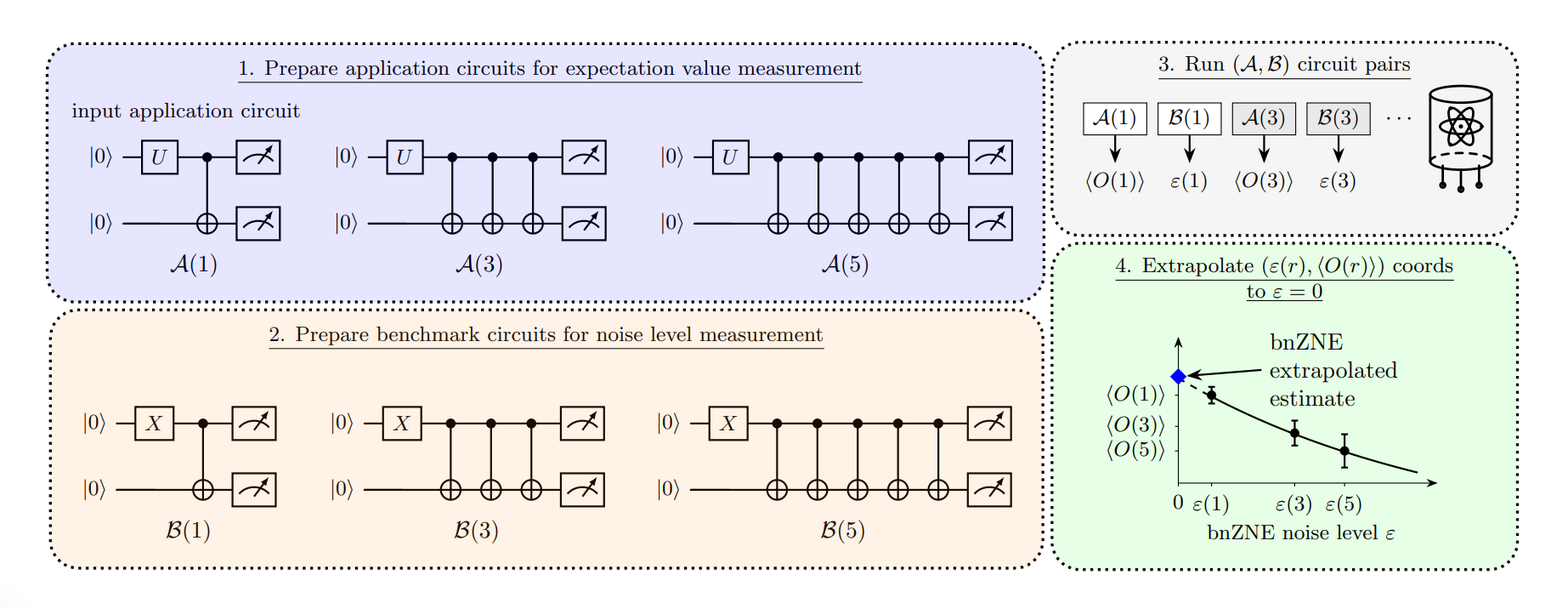
German Aerospace Center (DLR) Researchers Demonstrate Low-Cost Benchmarked-Noise Error Mitigation Across 100-Qubit IBM and IQM Processors

Researchers at the German Aerospace Center (DLR) have developed an improved quantum error mitigation protocol, randomized benchmarked-noise zero-noise extrapolation (bnZNE). This method enhances expectation-value accuracy without increasing measurement shot budgets, validated on 100-qubit IBM and IQM processors. The bnZNE protocol incorporates Pauli twirling, dynamical decoupling, and twirled readout error extinction (TREX), outperforming standard zero-noise extrapolation…

Read at Quantum Computing Report

Quantum Computing Report Mohamed Abdel-Kareem

QodeX Quantum, NVIDIA, RTX BBN, and U.S. Navy Researchers Forecast Unstructured PDEs on 52-Qubit IBM Hardware

A research team from QodeX Quantum, NVIDIA, RTX BBN, and U.S. Navy researchers successfully demonstrated gradient-free forecasting of nonlinear partial differential equations (PDEs) on unstructured engineering meshes using up to 52 qubits on an IBM Quantum Heron r3 processor. Their hybrid quantum reservoir network (QRN) achieved significant error reduction compared to classical baselines and executed circuits far longer than typical qubit coherence times. This advancement…

Read at Quantum Computing Report

arXiv (research papers) William S. McGregor

Hidden Momenta due to Magneto-Electric Coupling in Non-Reciprocal Media

From a canonical quantisation approach of macroscopic quantum electrodynamics, we derive the interaction Hamiltonian due to a dipole emitter interacting with a time-symmetry-broken topological insulator (TSB-TI), described by an axionic coupling Lagrangian. This provides an additional interaction term dependent on the magneto-electric coupling strength inherent to the TSB-TI which will modify measurements on related observables. The spontaneous decay rate is calculated in…

Read at arXiv (research papers)

arXiv (research papers) Vicente Leyton-Ortega

Certifying quantum generative models beyond the Fisher trace

Whether a trained quantum generative model has learned its target is usually decided by a diagnostic validated on a labeled benchmark, and such a diagnostic can pass that validation by recovering how the benchmark was built. We analyze Fisher-trace and kernel-based certification of the real-amplitude quantum circuit Born machine in noiseless statevector simulation. For real-amplitude circuits built from half-angle rotations, the classical Fisher information equals the…

Read at arXiv (research papers)

arXiv (research papers) Avani Vivrekar

Gate tunable spin splitting for Andreev spin qubits in Ge quantum well heterostructures

Ge-based super-semi heterostructures are a promising platform for implementing Andreev spin qubits (ASQs). For example, they can be isotopically purified to eliminate nuclear spins that cause decoherence. However, spin-orbit coupling (SOC), which is a key ingredient for ASQs, is cubic in momentum for hole-based materials like Ge, in contrast with more-conventional ASQ materials (e.g., InAs wires), for which the SOC is linear in momentum. In this work, we study the interplay…

Read at arXiv (research papers)

Older stories