Today, many leading quantum computers are built from superconducting circuits. However, the qubits in these circuits can easily lose energy to their surroundings, scrambling the fragile quantum information they hold.
Insider Brief PRESS RELEASE — Altera Corporation, the largest pure-play FPGA provider with a full-spectrum portfolio, today announced the development of an end-to-end FPGA-based quantum system controller reference design in collaboration with Oxford Quantum Circuits (OQC) and NVIDIA. Built on an Agilex® 9 Direct RF FPGA, the design runs real-time system control in the FPGA,
Insider Brief JPMorgan Chase ranks first of 64 financial institutions in the 2026 finance edition of The Quantum Index, published today, and leads all three pillars: workforce, R&D and adoption. HSBC and Wells Fargo share second place. Mastercard is third. The index measures what financial institutions have built in quantum technology. It scores quantum staff
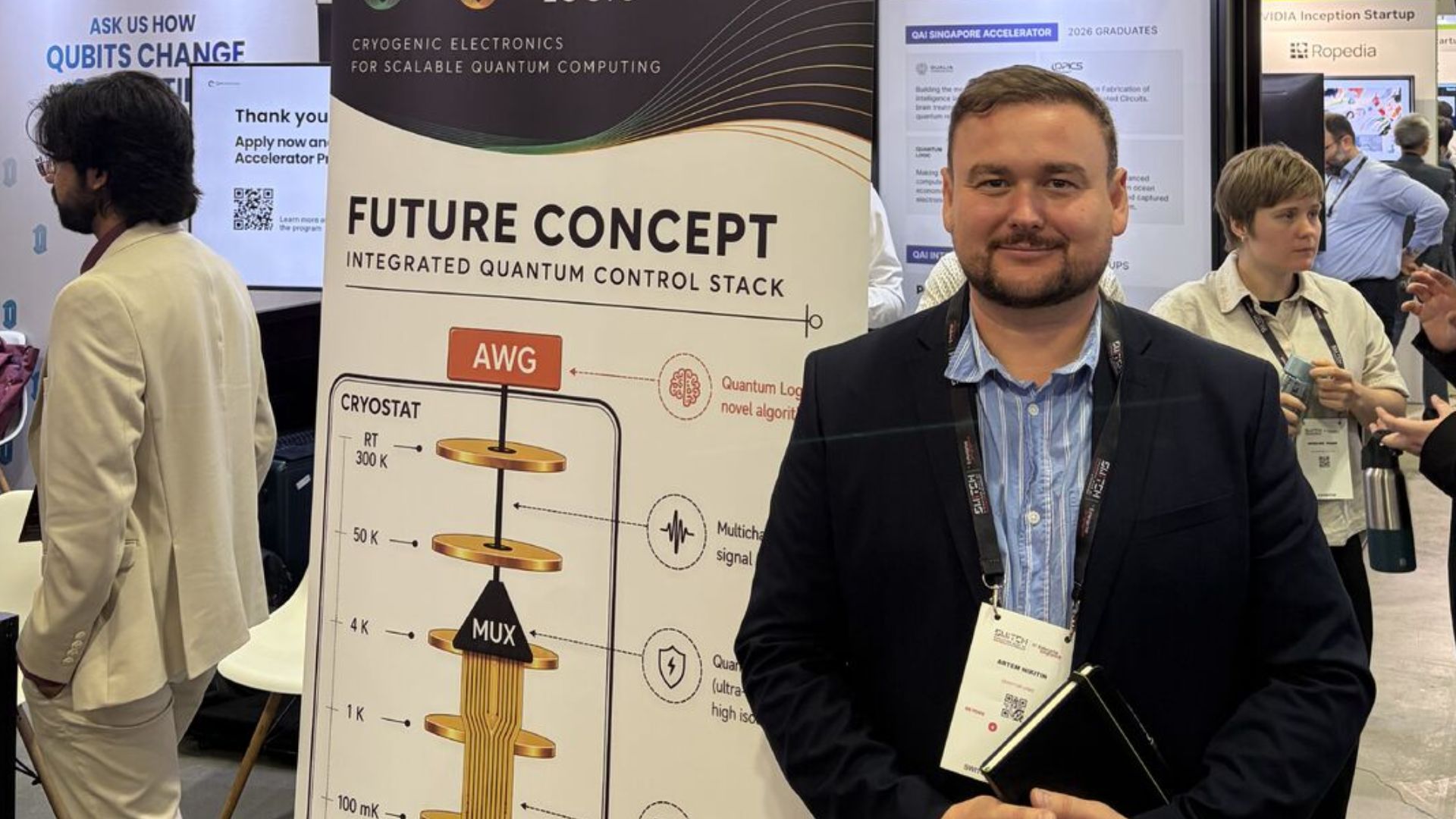
The ninth annual Silicon Catalyst Semiconductor Industry Forum was held last week at the Computer History Museum in Mountain View, CA. This event has a rich history of probing the key challenges of the day with a world-class speaking panel. The focus is always on “What’s Next”. The event last week lived up to the Forum’s reputation…
Insider Brief PRESS RELEASE — Liquid C2, a business of Cassava Technologies, a global technology leader, and Graphiant (https://www.Graphiant.com/), a US-based provider of networking infrastructure built for AI, partnered to strengthen network security offerings through a new Quantum Secure Network-as-a-Service (NaaS). As quantum computing advances, it could eventually break the encryption that protects most data
Insider Brief PRESS RELEASE — Classiq, a leading quantum computing software company, and Ventum Consulting, a digital transformation consultancy, today announced a partnership to help enterprises in Germany build quantum computing expertise, establish strategies and develop applications aligned with their business priorities. The partnership brings together Classiq’s quantum software platform and application development expertise with
Over the past several decades, researchers have demonstrated quantum teleportation, the transfer of one quantum system's state to another, in a range of systems. However, many quantum computers encode logical qubits (units of quantum information) across groups of physical qubits, which makes teleporting the encoded state without losing information more challenging.
Insider Brief Fifteen teams have been named finalists in the Global Quantum + AI Challenge, advancing to develop working proofs of concept for industry problems ranging from drug discovery to credit card fraud detection. The competition offers $200,000 in prizes across five challenges, with $40,000 allocated to each. Its enterprise partners are Airbus, Cleveland Clinic,
Insider Brief PRESS RELEASE — The Ministry of Communications and Information Technology of the State of Qatar (MCIT Qatar) signed a collaboration agreement with SignQuantum to strengthen cybersecurity readiness for quantum computing risks. The announcement was made at MWC26 Doha on November 10, 2026. “Qatar’s digital future must be built on trust that endures. Under
Insider Brief PRESS RELEASE — JIJ Inc. today announced that a joint proposal with Mitsubishi Electric Corporation, titled “Performance Evaluation of a Quantum-Classical Hybrid Linear Solver for Thermal-Fluid Analysis,” has been selected for the JHPC-quantum Test User Program. Mitsubishi Electric will participate as the lead proposer, with JIJ as a joint proposer. Through the program,
Emerging quantum applications like quantum communication generate large volumes of high-dimensional quantum data, requiring efficient data analysis and storage. However, classical database systems often struggle to meet requirements such as quantum processing or version management. This paper presents QuarkDB designed for efficient quantum data management. QuarkDB establishes a unified object model for relational and quantum data and defines the syntax of Quantum Structured…
Insider Brief PRESS RELEASE — IonQ (NYSE: IONQ), the world’s leading full-stack quantum platform and foundry, today announced executive leadership changes to position the company for continued growth and advance its path to profitability: In connection with these appointments, Inder M. Singh is stepping down from his roles at the company, effective immediately. “Inder has
Insider Brief Moth Quantum says it has used an entire IBM quantum processor to load and recover data equivalent to two small grayscale images. That may not sound like much, but the company says the method, called Tessa, addresses getting conventional data onto the machines without adding excessive errors, a basic obstacle to quantum computing,
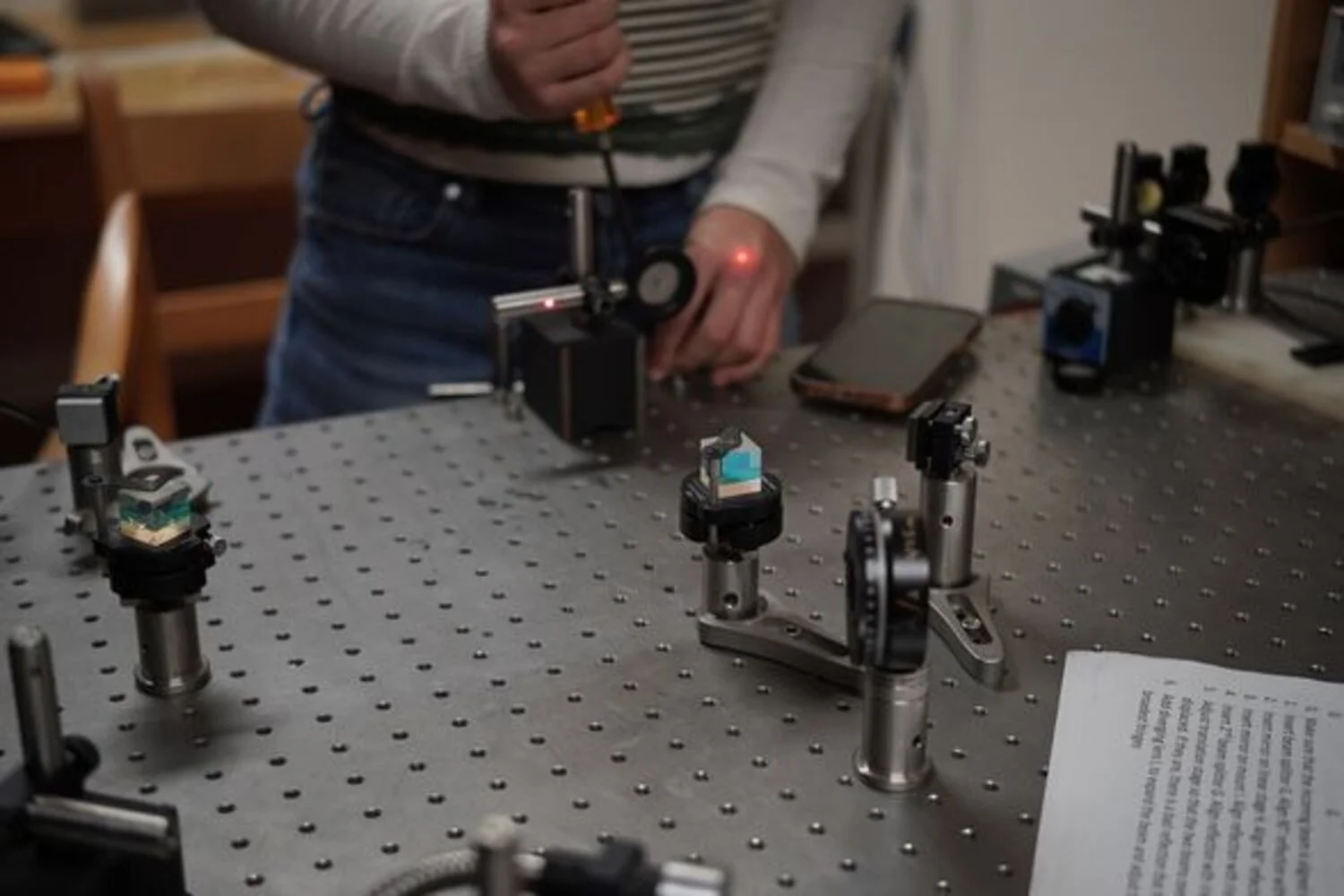
Insider Brief PRESS RELEASE — In late July, while most of their classmates were on summer vacation, Henry Haggard (A27) and Albert Shapiro (A27) were in a hotel room in Hamilton, New York, studying physics. Alongside Eddie Schodowski (AGI28), director of the St. John’s College Laboratory Program in Annapolis, the two had traveled to Colgate
Insider Brief PRESS RELEASE — The Ministry of Communications and Information Technology (MCIT) of the State of Qatar and the French Ministry of the Economy, Finance and Industrial, Energy and Digital Sovereignty signed a Letter of Intent to strengthen bilateral cooperation in the communications and information technology sector. The cooperation covers artificial intelligence, digital transformation,
Nonclassical multiphoton interference is an important resource for optical quantum information processing, and its output statistics depend on the distinguishability of the input photons. In this paper, using time delay as a tunable parameter, we theoretically analyze the interference behavior of independent pure-state single photons with identical Gaussian spectral envelopes under near-synchronous conditions. Using the immanant representation of the single-photon…
Testing quantum programs on Noisy Intermediate-Scale Quantum (NISQ) devices faces a test-oracle problem: hardware noise and finite-shot sampling make the runs of a correct program vary as much as those of a faulty one, so oracles with a fixed acceptance threshold produce false positives that depend on the program and the backend. We present a noise-aware testing framework built on self-baseline calibration: each run of the program under test is compared with repeated…
We report the use of a single trapped-ion motional mode as a probe of mechanical vibrations of the Paul trap structure. By exciting vibrations of the trap using an ultrasonic transducer mounted outside the vacuum chamber and probing the ion motion through motional sideband interactions, we observe a clear resonance response of the axial mode. We further demonstrate detection of trap vibrations with amplitudes as low as 0.6 picometers. These measurements show direct coupling…
We derive Lieb-Robinson type bounds with optimal propagation velocity for shift-coin and split-step quantum walks in rational electric fields. The velocity decays exponentially fast in the period of the field, showing long intervals of suppressed spreading. The proof rests on bounds for the imaginary part of the analytically continued dispersion relation of the electric walk. We show that the infimal Lieb-Robinson velocity coincides with the asymptotic velocity for these…
Metrology of defects (or impurities) is a major challenge in quantum sensing, with implications for material science, nano-scale metrology, and the development of high-precision quantum devices. In this work, we employ single and multi excitation sensors for the metrology of defects, with the system Hamiltonian encoding the structure of the sensor and the defect treated as a perturbation potential. We evaluate the quantum Fisher information of the ground state of the system…
We propose a spectroscopic approach that reads out the quantum geometry of matter from the quantum decoherence of Schrödinger-cat light, in the same way that optical absorption reads out the energy structure of matter. For a cat-state probe comprising a superposition of two coherent states, the interbranch coherence of the outgoing light encodes the overlap between the matter states driven by the two branches. We show that, when the electromagnetic fields of the two branches…
Quantum error correction is essential for scalable quantum computing, while its resource overhead is governed in large part by the encoding rate, namely the number of logical qubits encoded per physical data qubit. Recent quantum low-density parity-check (qLDPC) constructions have entered the ultra-high-rate regime with encoding rates above 1/2, but their syndrome-extraction circuits generally rely on reconfigurable connectivity or long-range qubit transport, making them…
Phase-conjugate encoding is naturally compatible with shared phase-sensitive amplification and joint detection, offering a compact optical receiver architecture for continuous-variable quantum key distribution (CVQKD). Here, we develop a unified encoding and security framework for two-mode Gaussian CVQKD with tunable phase-conjugate intermode correlations matched to a joint receiver comprising a single phase-sensitive amplifier (PSA) and one balanced photodetector. We…
We study lower bounds to the query complexity of testing whether an unknown quantum channel mapping a $d_{\mathrm{in}}$-dimensional input to a $d_{\mathrm{out}}$-dimensional output is the completely depolarizing channel or is $\varepsilon$-far from it in diamond distance. We show that for this task (i) any ancilla-assisted, coherent, adaptive tester requires at least $Ω(d_{\mathrm{in}}d_{\mathrm{out}}/\varepsilon^2)$ queries; (ii) any ancilla-assisted, coherent, non-adaptive…
The Ministry of Communications and Information Technology of Qatar has partnered with SignQuantum and QANplatform to explore post-quantum cryptography for public-sector data, aligning with Qatar's National Vision 2030. This collaboration, announced at MWC26 Doha, aims to enhance long-term data integrity by using SignQuantum's PQC document signing and QANplatform's quantum-resistant blockchain for secure, auditable digital records. The agreement focuses on knowledge sharing…
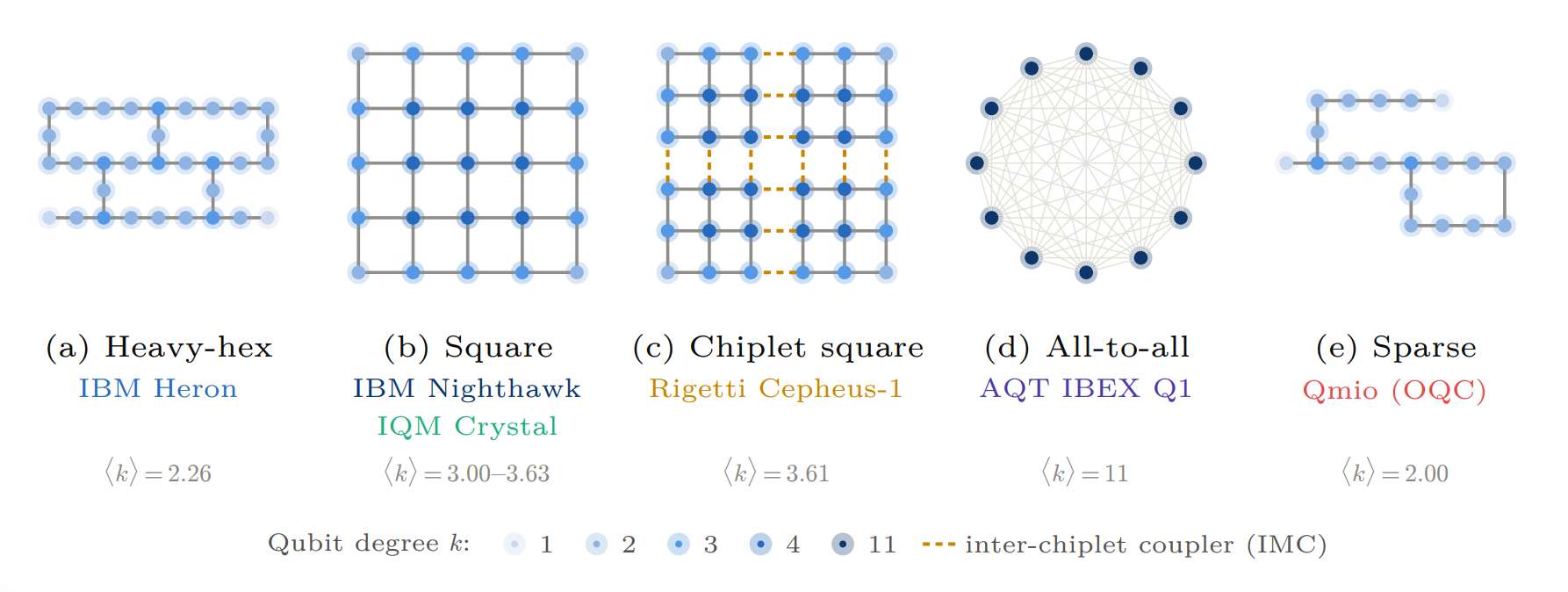
A new study benchmarked nine cloud-accessible quantum processors, revealing a significant gap between the number of physical qubits and the size of entangled GHZ states achievable without error mitigation. The research, which utilized standard remote cloud workflows, found that large superconducting processors only maintain multipartite entanglement across a small fraction of their physical registers. This highlights the challenges in achieving high-fidelity multipartite…
It is commonly understood that factoring a general $n$-bit biprime via Shor's order finding algorithm requires $\widetilde{O}(n^3)$ gates by leveraging schoolbook integer arithmetics for addition and multiplication. Recent developments in quantum arithmetic circuits leveraging recursive Toom-Cook schemes have improved the cost scaling to $O(n^{2+ε})$. Here $ε>0$ depends on algorithm implementation details of the recursive multiplication steps, which allow for a vast number…
We investigate the two-qubit quantum Rabi model for identical qubits symmetrically coupled to a single bosonic mode and interacting with each other through transverse and longitudinal couplings. We extend the adiabatic, generalized rotating-wave (GRWA), and squeezed generalized rotating-wave (SGRWA) approximations to include the qubit-qubit interactions, including self-consistent and variational choices of the bosonic parameters. The resulting analytical hierarchy allows us…
We model a scenario where the pre-amplified signal mode of a two-mode squeezed vacuum (TMSV) state generated by a Josephson parametric converter (JPC) is transmitted through a room-temperature, open-air channel, while the idler is retained at low temperature. Before transmission, the state contains three quantum resources: (1) entanglement, (2) non-classicality, and (3) sub-vacuum conditional prediction of the signal quadrature. To preserve these resources through noise and…