Results for “Quantum”

arXiv (research papers) Kamran Akbari

Symmetry-selected entanglement death at Floquet resonances of parametrically coupled qubits

Periodic modulation of a qubit--qubit coupling is a standard way to engineer quantum interactions, but a strong modulation also reorganizes the transitions through which the qubits dissipate into a comb of Floquet channels. We study two identical, strongly coupled qubits whose transverse coupling is modulated anharmonically, as by a nonlinear coupler, with each qubit damped by its own reservoir. The modulation raises the ground-state concurrence of the cycle-averaged…

Read at arXiv (research papers)

arXiv (research papers) Chenyin Sun

Demonstration of a Qubit Control Scheme Compatible with Superconducting Digital Signals

Superconducting quantum computing faces a critical scalability bottleneck arising from the escalating complexity of traditional analog control infrastructure. Single-Flux-Quantum(SFQ) systems operate at cryogenic temperatures and offer a potential route to addressing these challenges. Using microwave signals at qubit-dependent frequencies to trigger SFQ pulses requires many independent analog microwave sources, limiting the potential to reduce control wiring and increase…

Read at arXiv (research papers)

Quantum Computing Report Mohamed Abdel-Kareem

Pasqal Demonstrates Hybrid GPU-to-QPU Workflows Using Slurm 26.11 Hierarchical Resources, QRMI, and CUDA-Q

Pasqal has developed an integration that allows Slurm 26.11 to schedule jobs across both GPUs and QPUs (quantum processing units), utilizing NVIDIA's Slurm Hierarchical Resources and the Quantum Resource Management Interface (QRMI). This system automates the management of neutral-atom QPUs alongside classical GPUs, enabling multi-stage batch pipelines that can validate quantum simulations on GPUs before executing them on physical quantum hardware. This advancement…

Read at Quantum Computing Report

arXiv (research papers) Ya-Xi Ban

Quantum Causal Compatibility from Spatiotemporal Correlations

Which quantum causal structures can account for observed spatiotemporal correlations without access to an intervention-complete description of the underlying process? In particular, can such correlations distinguish a temporal chain, a common cause, and a common effect? Here, we address these questions using three-qubit pseudo-density operators constructed from experimentally accessible Pauli correlations. We derive necessary and sufficient conditions for pseudo-Markov…

Read at arXiv (research papers)

Quantum Computing Report Mohamed Abdel-Kareem

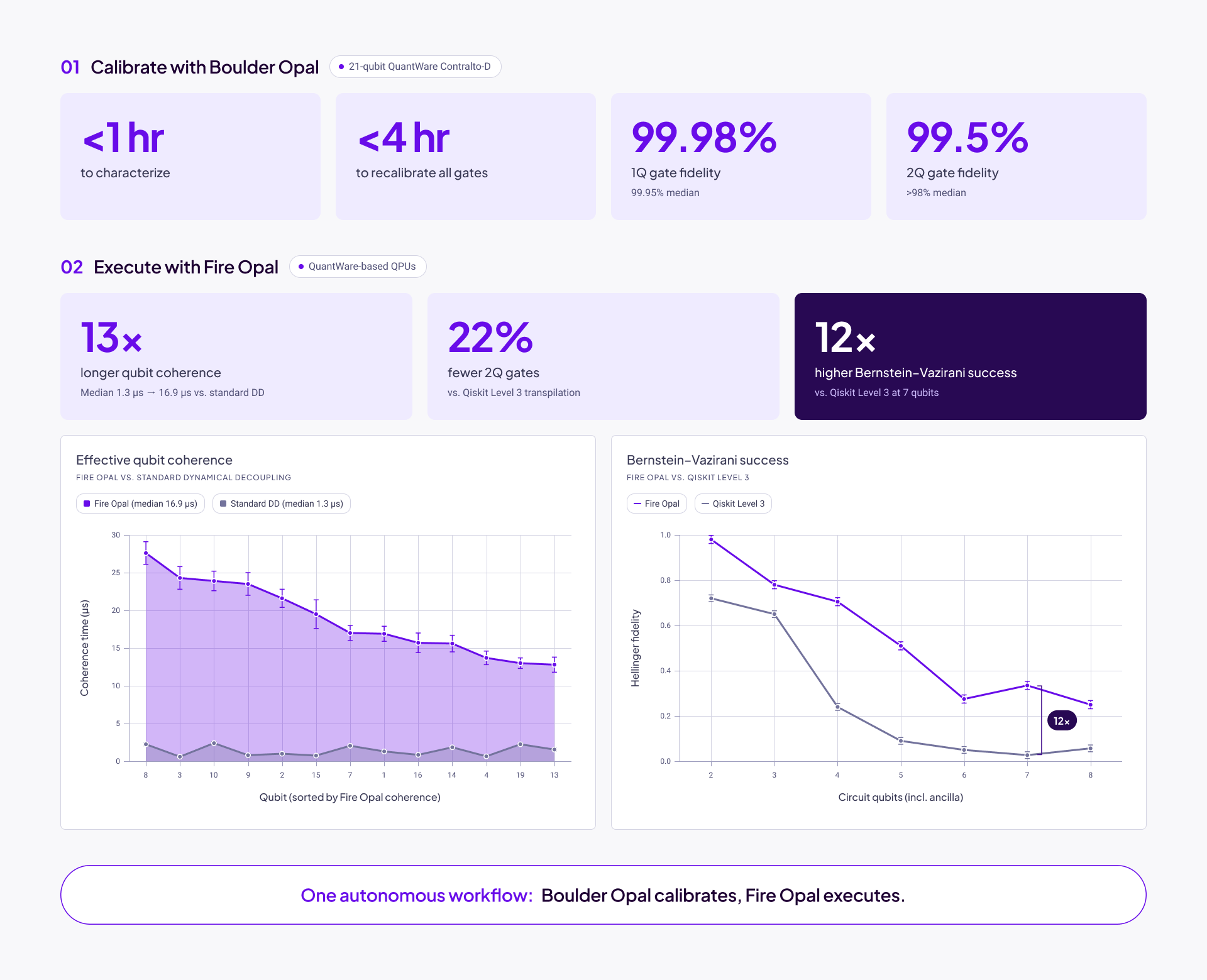
Q-CTRL Unifies Boulder Opal and Fire Opal into Autonomous End-to-End Quantum Infrastructure Software

Q-CTRL has integrated its Boulder Opal and Fire Opal software into a single platform for end-to-end quantum infrastructure. This unified system automates the entire quantum computing lifecycle, from processor bring-up to workload execution, significantly reducing manual effort and improving performance. The technology is currently live on Elevate Quantum’s Q-PAC system and will be accessible via cloud in December 2026.

Read at Quantum Computing Report

arXiv (research papers) Chuming Wang

Exceptional-point Sensing with Quantum Advantage

Exceptional-point sensors exploit singular non-Hermitian dynamics to enhance their response to weak perturbations. Recently, however, a no-go result has been established for a gain-loss-balanced dimer coupled to independent, phase-insensitive reservoirs: the exceptional-point susceptibility amplifies the signal and reservoir noise equally, precluding any quantum advantage. Here, we circumvent this limitation by engineering non-Hermitian dynamics in particle-hole Nambu space…

Read at arXiv (research papers)

arXiv (research papers) F. El Hani

Two-Qutrit Quantum Battery Charging through Ising Model and Anisotropic XZ Heisenberg Interactions

In this paper, we propose a model of a two-qutrit quantum battery composed of two spin-1 systems coupled to an external field via anisotropic Heisenberg interactions. From the Ising model, we derive an exact analytical expression of ergotropy in the parallel-charging case. However, the collective charging process offers an advantage over the parallel one. Moreover, increasing the collective exchange coupling accelerates the evolution of ergotropy and enhances the maximum…

Read at arXiv (research papers)

arXiv (research papers) Yifeng Peng

Variational Relevance-Informed Sparsification of Term Measurements for Variational Quantum Algorithms

Repeated measurements are a major bottleneck in variational quantum algorithms (VQAs). We uncover and characterize parameter-specific sparsity in the matrix of qubit-wise commuting (QWC) group contributions to parameter-shift gradients: most absolute contribution mass concentrates in a subset of groups whose relevance varies across parameters and optimization states. Building on this structure, we introduce a learned controller that predicts group relevance from Hamiltonian…

Read at arXiv (research papers)

arXiv (research papers) Qianjun Yao

Perturbative Recovery of Stabilizer-Subspace Correlations for Quantum Computational Chemistry

Stabilizer-based subspace methods can substantially reduce the quantum resources required for electronic structure calculations, but the resulting projection neglects Hamiltonian couplings to configurations outside the retained subspace. In this work, we introduce Stabilizer-Subspace Perturbation Theory (SSPT) to recover the associated correlation contributions, using the Contextual Subspace Variational Quantum Eigensolver (CS-VQE) as a representative application. The…

Read at arXiv (research papers)

Quantum Computing Report Mohamed Abdel-Kareem

Alice & Bob Details QRMI and Slurm 26.11 Hierarchical Resource Integration for Cat-Qubit Systems at SC26

At SC26, Alice & Bob detailed how their cat-qubit quantum processors integrate with NVIDIA’s Slurm 26.11 workload manager via the Quantum Resource Management Interface (QRMI). This collaboration with STFC Hartree Centre, IBM, and Pasqal allows Alice & Bob’s Felis cloud API to connect directly to standard supercomputing schedulers. The new architecture leverages Slurm 26.11's native Hierarchical Resources (HRES) support, enabling seamless quantum hardware integration without…

Read at Quantum Computing Report

arXiv (research papers) Yifeng Peng

Commutator-guided repair and classical-accessibility boundaries for shallow quantum circuits

Trainability does not guarantee low-energy arrival: a shallow quantum circuit can be optimizable yet fail, under fixed depth and evaluation budgets, to reach Hamiltonian-selected states. We introduce a commutator-guided repair for this operational failure mode. Low-order host--Hamiltonian commutators and fixed same-support companion axes define a restricted pool of local Pauli rotations, from which a compact completion layer is selected before full reoptimization. Across 189…

Read at arXiv (research papers)

Quantum Computing Report Mohamed Abdel-Kareem

Quantinuum Details Nexus Hybrid Workflow Runtime Integration with Slurm and OpenQSE at SC26

Quantinuum's Nexus developer platform and Hybrid Workflow Runtime (Tierkreis) integrate quantum programming with supercomputing workload managers like Slurm, as demonstrated at SC26. This integration coordinates multi-stage scientific pipelines, preventing classical node idling while quantum jobs await processing. They also showcased a joint electronic-structure workflow with RIKEN, achieving lower ground-state energies for a 12-atom hydrogen chain through quantum-sampled…

Read at Quantum Computing Report

Quantum Computing Report Mohamed Abdel-Kareem

Türkiye Signs Agreement with IQM Quantum Computers to Deploy 54-Qubit Radiance R3 System at TÜBİTAK in 2027

Türkiye's Scientific and Technological Research Council (TÜBİTAK) has partnered with IQM Quantum Computers to deploy a 54-qubit superconducting quantum computer, the IQM Radiance R3 system, in 2027. This system will provide sovereign quantum computing capacity for Turkish universities, research institutes, and private sectors, integrating with TÜBİTAK's existing high-performance computing environment. The deployment signifies an expansion of Türkiye's quantum infrastructure…

Read at Quantum Computing Report

Quantum Computing Report Mohamed Abdel-Kareem

IQM and MQSC Demonstrate Open-Source Slurm 26.11 QPU Scheduling Using QDMI and Hierarchical Resources

IQM Quantum Computers and Munich Quantum Software Company (MQSC) have integrated IQM superconducting processors into NVIDIA’s open-source Slurm 26.11, enabling quantum processing units (QPUs) to be scheduled as native supercomputing resources. This was achieved using Slurm 26.11’s Hierarchical Resources (HRES) plugin framework and the Quantum Device Management Interface (QDMI). This integration simplifies the allocation, reservation, and accounting of QPU access within…

Read at Quantum Computing Report

Quantum Computing Report Mohamed Abdel-Kareem

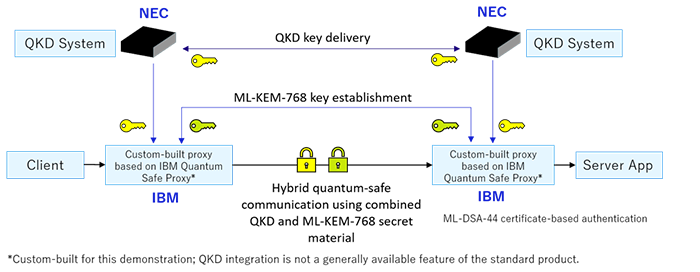
NEC and IBM Japan Demonstrate Hybrid QKD and Post-Quantum Cryptography TLS Proxy Architecture

NEC Corporation and IBM Japan successfully demonstrated a hybrid quantum key distribution (QKD) and post-quantum cryptography (PQC) TLS proxy architecture. This trial, conducted between July and September 2026, integrated NEC's QKD hardware with IBM Quantum Safe Proxy, allowing for multi-vendor cryptographic interoperability without modifying existing enterprise applications. The setup combines QKD and PQC for enhanced session security, with future plans for commercial…

Read at Quantum Computing Report

arXiv (research papers) Georgios Baziotis

Cantor correlations II. Synchronicity and bisynchronicity

We study synchronous and bisynchronous no-signalling correlations, defined over Cantor topological spaces, from the perspectives of both continuous variable quantum information and operator algebra theories. We focus on strategies, satisfying a natural no-signalling condition across the Cantor space levels, called graded, identifying a universal C*-algebra, whose tracial states of different types characterise synchronous correlations of respective types. The universal…

Read at arXiv (research papers)

arXiv (research papers) Seunghun Lee

Coexisting orders and dipolar Luttinger liquids in $\mathbb{Z}_N$ quantum torus chain

We establish a unified ground-state phase diagram for the one-dimensional $\mathbb{Z}_N$ quantum torus chain, which is connected to dipolar cluster and dipolar Ising chains via noninvertible dualities. Combining tensor-network calculations with bosonization and perturbation theory, we establish a rich phase diagram governed by the local Hilbert-space dimension $N$ and its parity. We identify phases with coexisting $X$ and $Z$ long-range orders ($C$ phase), and dipolar…

Read at arXiv (research papers)

arXiv (research papers) Kazuki Yamamoto

Exact Dynamic Scaling of Quantum Jump Statistics in Monitored Many-Body Systems

Quantum measurement has opened a new frontier in nonequilibrium many-body physics, revealing striking phenomena such as measurement-induced entanglement transitions, whose experimental observation typically requires costly postselection. Quantum jump statistics offer another route to studying such measurement-induced many-body phenomena without postselection, motivating the search for universality in measurement outcomes themselves. In this Letter, we discover that…

Read at arXiv (research papers)

npj Quantum Information Yue Luo

Entanglement-based quantum key distribution with classical signals in hollow-core fiber

npj Quantum Information, Published online: 17 November 2026; doi:10.1038/s41534-026-01417-6 Entanglement-based quantum key distribution with classical signals in hollow-core fiber

Read at npj Quantum Information

npj Quantum Information Zhongyuan Fu

Quantum quickest change detection

npj Quantum Information, Published online: 17 November 2026; doi:10.1038/s41534-026-01418-5 Quantum quickest change detection

Read at npj Quantum Information

arXiv (research papers) Jason Arakawa

Fundamental physics with quantum sensors in space

Quantum sensors such as atomic clocks, atom interferometers, and atomic magnetometers can be used as sensitive probes of physics beyond the Standard Model. Space offers microgravity, long baselines, low environmental noise, access to varying gravitational potentials, and unique opportunities involving the Sun, Moon, planets, and asteroids. These proceedings of the Aspen Center for Physics workshop on "Fundamental physics in space with quantum sensors," held February 22-27…

Read at arXiv (research papers)

arXiv (research papers) Chinmay Nirkhe

An alternate proof of the QMA lower bound for set-size estimation

In the set-size estimation query task, a query algorithm decides whether an $N$-bit input has Hamming weight $\ge B$ or $\le A$ (with $\ge B$ as the yes instances and $\le A$ as the no instances). When $B = 2A$, this is sometimes called approximate counting. The query complexity for this problem with a quantum witness (i.e., $\mathsf{QMA}$ query bounds) was resolved by Aaronson, Kothari, Kretschmer, and Thaler (CCC 2020) and proved using Laurent polynomials. Here we give a…

Read at arXiv (research papers)

arXiv (research papers) Jacob Z. Williams

Accelerating auxiliary-field quantum Monte Carlo with mixed-precision random propagators

We develop an algorithm to propagate auxiliary-field quantum Monte Carlo (AFQMC) wavefunctions in mixed precision. We target NVIDIA Tensor Cores using the TensorFloat-32 (TF32) format. We approximate each full-precision array by a TF32 leading term and a TF32 residual, and each full-precision matrix product by three TF32 products accumulated in full precision. Benchmarks on hydrogen chains show that mixed-precision propagation is consistently faster than double-precision GPU…

Read at arXiv (research papers)

Phys.org Quantum Physics

Ultracold diamond microwave laser amplifies quantum signals 1,000-fold

Researchers from the Okinawa Institute of Science and Technology (OIST) have created a spin-based microwave amplifier that operates near absolute zero, boosting signals by more than 1,000-fold while adding noise close to the bare minimum required by the laws of physics. As a more robust alternative to current state-of-the-art devices, the OIST device can handle much stronger signals and operate in magnetic fields, paving the way for practical quantum computing and…

Read at Phys.org Quantum Physics

arXiv (research papers) Saad Yalouz

Quantum Information Transfer in Molecular Polaritonic Networks: A Van Vleck Effective-Hamiltonian Approach

Achieving high-fidelity transfer of an arbitrary quantum state between spatially separated qubits is a central challenge for reliable quantum hardware. We address this question within a polaritonic framework by introducing Projected-Block Van Vleck Perturbation Theory (PB-VVPT). Based on quasidegenerate perturbation theory, this approach describes a molecular network coupled to an optical cavity and local phonons through a generalized Holstein--Tavis--Cummings Hamiltonian…

Read at arXiv (research papers)

arXiv (research papers) Carlo A. Trugenberger

Complexity and precision in quantum associative retrieval

We show that efficient and high-precision quantum associative retrieval is possible with an exponential complexity advantage with respect to the classical brute force approach and with a polynomial capacity advantage with respect to classical neural network implementations for any number of patterns scaling polynomially in the number of qubits. Both classical neural and quantum associative memories store the patterns in a Hamiltonian; in the classical case the dynamics is…

Read at arXiv (research papers)

arXiv (research papers) Alex Kwiatkowski

Simplifying models of noisy stabilizer QEC on leakage qubits by Pauli twirling

The growing capabilities of quantum error-correction (QEC) experiments make it increasingly important to develop methods that predict or assess logical performance over many QEC cycles. Prior work has shown that a stabilizer QEC cycle subject to Pauli-stochastic noise can be modeled by a classical Markov process over syndrome states, with a logical Pauli channel attached to each syndrome transition. Here, we extend this framework to systems in which physical qubits are…

Read at arXiv (research papers)

Phys.org Quantum Physics

Measurements reveal link between quantum spin and sound-carrying vibrations in an ultrathin semiconductor

Researchers at the UCLA Samueli School of Engineering and Auburn University have achieved a scientific first: They measured atomic vibrations that carry heat and sound waves, and connected them to a quantum property called spin, which is a way of characterizing a subatomic particle's built-in magnetism.

Read at Phys.org Quantum Physics

The Quantum Insider Matt Swayne

GenQ Emerges From Stealth to Commercialize Quantum Measurement Technology

Insider Brief PRESS RELEASE — — For decades, practical, scalable applications of quantum technology have been purely aspirational. Now, Generation Quantum (“GenQ”) is taking a different approach to create quantum capabilities that work today. “GenQ completely changed the way I think about quantum computing and its near-term potential,” says Valentina Rodriguez of Wonder Ventures, who

Read at The Quantum Insider

Quantum Computing Report Mohamed Abdel-Kareem

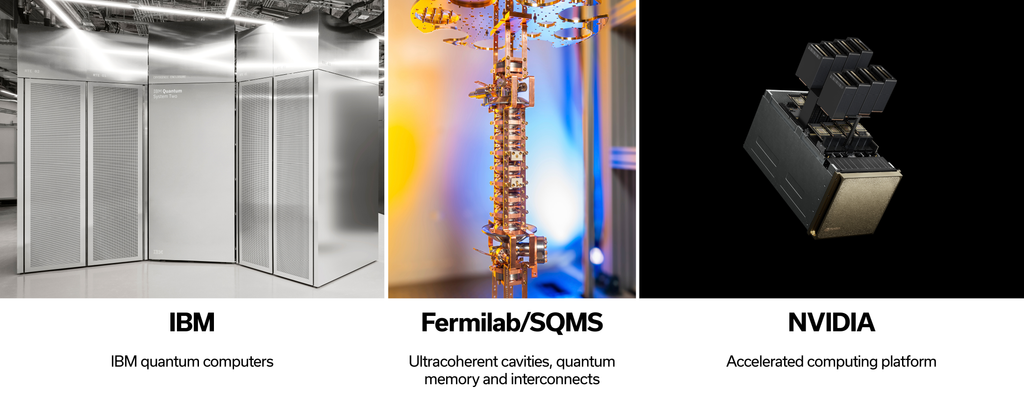
IBM, Fermilab, and NVIDIA Unveil Modular Quantum Co-Design Platform, Slurm HRES Integration, and GPU QEC Tools at SC26

At SC26, IBM, Fermilab, and NVIDIA unveiled a modular quantum-classical co-design platform, integrating GPUs with quantum processors. They also announced native quantum resource scheduling in Slurm 26.11 and new GPU-accelerated quantum error-correction (QEC) software, including the TCBP-JOBS algorithm and CUDA-Q QEC 0.9.0. These advancements aim to improve quantum computing workflows, error correction, and resource management in supercomputing environments.

Read at Quantum Computing Report

Older stories