Results for “Robots”

arXiv (research papers) Nidhi Parayil

SPICE: Stochastic Policy for Interaction in Cluttered Environments

Agricultural tasks such as harvesting and pruning require robots to reach through dense foliage, where contact is often unavoidable and vision is obstructed. Intermittent contact creates an imbalance between free-space and contact-rich observations, complicating the learning of contact-responsive behaviours. We present SPICE, a tactileconditioned diffusion policy for reaching targets in dense plant canopies using tactile sensing as the sole environmental feedback. SPICE…

Read at arXiv (research papers)

arXiv (research papers) Kiran Marques

RESCUE Jumper: A Centimeter-Scale Rolling and Jumping Robot for Search and Rescue

Centimeter-scale robots are promising for urban search and rescue because they can enter confined spaces that are inaccessible or unsafe for humans. However, their small size limits obstacle traversal after deployment. This paper presents the RESCUE Jumper, a 125 g mobile robot with a 6.2 cm width and 6.2 cm diameter wheels that combines ground rolling with jumping to traverse steps and gaps that exceeds its rolling capability. The RESCUE Jumper uses its two actuators for…

Read at arXiv (research papers)

arXiv (research papers) Joyjeet Singh

Auditing a Learned Simulator for Legged Robots: The Robotic World Model on ANYmal D

A legged robot can learn to walk inside a learned simulator: a neural network that predicts the robot's next state and is run forward on its own predictions. They are usually trained and checked one step ahead, although a policy uses them for a hundred steps or more. We audit one published system end to end, without a GPU: the dynamics model of the Robotic World Model (RWM) for the ANYmal D quadruped, and the uncertainty estimate of its follow-up, RWM-U. We rebuilt the model…

Read at arXiv (research papers)

arXiv (research papers) Junseong Pyo

PAIR: Bringing Household Robots into the Smart Home

Household robots often need to operate appliances, and smart appliances offer both control panels and device APIs. Existing embodied AI simulation environments, however, model appliances solely as physical objects. We introduce PAIR, a smart-home simulation environment grounded in the Matter protocol~\footnote{https://csa-iot.org/all-solutions/matter/}, the industry standard for smart-home devices. PAIR provides 84 smart-device assets whose functional control panels and APIs…

Read at arXiv (research papers)

arXiv (research papers) Philip Smith

Satisfiability Modulo Theories for Robust Synthesis of Signal Temporal Logic Specifications

Signal Temporal Logic is a popular framework for describing a robotic system's goals. Once described using a temporal logic framework, synthesis turns the goals into actual steps for the robots to follow. Currently, the state of the art for sound and complete synthesis is using Mixed-Integer Linear Programming (MILP), which struggles on long time horizons and large environments, preventing the construction of guaranteed safe plans for long deployments. This paper introduces…

Read at arXiv (research papers)

arXiv (research papers) Charlotte Sieh

Pelorus: Resource-Aware Lidar-Inertial Odometry

Lidar-inertial odometry (LIO) has an efficiency problem. High-resolution lidars produce millions of points per second that must be processed online on the resource-constrained hardware of robots, cars, or drones, yet most LIO methods neither bound their memory nor report their compute footprint. We introduce Pelorus, a resource-aware LIO with a fixed-capacity multiresolution map of voxelized normal distributions and an iterated equivariant state estimator. A relevance-based…

Read at arXiv (research papers)

Crunchbase News Venture Judy Rider Startups

Genesis AI Raises $500M At $3.5B Valuation To Bring Its Robots To Factories And Warehouses

Genesis AI, a startup teaching robots to perform physical tasks by learning from human movements, announced Tuesday it has raised $500 million in Series A funding at a $3.5 billion valuation.

Read at Crunchbase News Venture

TechCrunch Robotics Tim Fernholz

Genesis AI raises $500 million to deploy glove-wearing robots

Genesis AI's novel approach to training dexterous robots earned it $500 million in Series A funding.

Read at TechCrunch Robotics

arXiv (research papers) Baicheng Li

Zero-Shot Compositional Generalization for Embodied Manipulation

Robot demonstrations are collected on different embodiments, leaving many robot-skill combinations unobserved. Pooling these data shares visual knowledge, while joint labels remain tied to the demonstrating kinematic chain. We propose a geometry-supervised training framework for zero-shot composition of familiar robots and skills. The central insight is that a demonstrated command provides a tool-space target for every robot that can realize it. Calibrated forward kinematics…

Read at arXiv (research papers)

arXiv (research papers) Stanley Akingbola SI

Network-Exposed Configuration Attacks on LLM-Controlled Social Robots

Large language models (LLMs) in embodied robots create security dependencies beyond inference. We investigate a network-exposed configuration attack on the Pollen Robotics Reachy Mini Lite, allowing an unauthenticated attacker to replace personality settings and the cloud LLM's system prompt through a management interface, without adversarial conversational input. Eleven prompt-injection attempts across five categories were reported as resisted, whereas both…

Read at arXiv (research papers)

arXiv (research papers) Lechen Zhang

Body Schema Policy: Body as the Vision-Action Interface for Efficient Robot Loco-Manipulation

Currently, robots can learn whole-body loco-manipulation through scale: the strongest policies have billions of parameters and still need task-specific fine-tuning. Humans have limited processing capacity, yet learn and act efficiently through a body schema that organizes what they see and how they move. We introduce Body Schema Policy (BSP), an imitation learning policy that builds such a schema into the vision-action interface. Its latent body schema places joint and link…

Read at arXiv (research papers)

Robohub IRIDIA

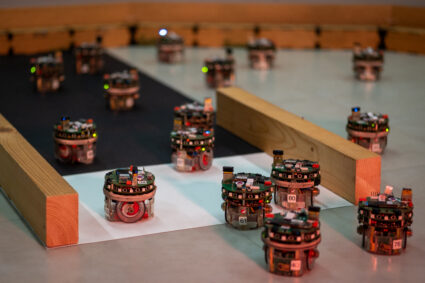
Robot swarms trained by trial and error in simulation keep working on real robots

Reinforcement learning lets robots learn behaviors on their own, through trial and error, usually inside a computer simulation. Moving what they learn onto physical robots is another matter. Simulated and real robots never behave quite the same way, a mismatch known as the “reality gap,” and reinforcement learning has long been particularly sensitive to it.

Read at Robohub

arXiv (research papers) Mohammad Nomaan Husain

DGF-Asym: Adaptive Peer Weighting for Collective Estimation under Noisy and Faulty Sensing

Collective estimation under unreliable sensing requires robots to adaptively balance personal observations and social information from peers. We propose DGF-Asym, a decentralized collective estimation method extending the DeGroot-Friedkin model with asymmetric peer weighting based on retrospective predictive performance. The method supports consensus formation without prior sensor-noise statistics or explicit fault models while keeping inter-robot communication asynchronous…

Read at arXiv (research papers)

arXiv (research papers) Arusa Kanwal

VoxelSBFL: Voxel-Level Spectrum-Based Failure Prediction for Vision-Language-Action Models

Vision-Language-Action (VLA) models integrate visual perception, language understanding, and action generation to control robots. Testing these systems produces trajectories and task outcomes, but existing approaches provide limited guidance on using these recorded trajectories to assess subsequent executions or inform policy repair. We conjecture that, for a given policy and task, traversing certain workspace regions is associated with a higher likelihood of failure. To…

Read at arXiv (research papers)

arXiv (research papers) Gunjari Chakraborty University of Manchester

Plenty to FRET About: From Hazard Analysis to Formal Requirements for Robot-Assisted Dressing

Understanding requirements for systems involving humans and robots is essential for providing robust evidence that such systems behave correctly. Requirements formalisation approaches such as the Formal Requirements Elicitation Tool (FRET) can support the transition from unstructured natural language to formal representations suitable for verification. In this paper, we formalise 146 hazard-derived natural-language requirements for a Robot-Assisted Dressing (RAD) case study…

Read at arXiv (research papers)

arXiv (research papers) Maniformer Real-World Manipulation Team

Hidden Variables Behind Real-Robot Data Quality: Lessons from Hundreds of Thousands of Hours

As real-robot data collection scales, collection-system design shapes both operator efficiency and the behaviors learned by robot policies. Workspace limitations, control-interface friction, and latency can introduce pauses, detours, and corrective motions into otherwise successful demonstrations. We investigate these effects across embodiment, teleoperation control, and data consistency, combining a kinematic study of 25 dual-arm robots, controlled teleoperation…

Read at arXiv (research papers)

arXiv (research papers) Junrui Zhang

DGV-DLIVO: Degeneracy-Guided Visual Fusion for Direct LiDAR-Inertial-Visual Odometry in Degenerate Tunnel Environments

Reliable localization in long underground infrastructures remains a major challenge for autonomous inspection robots. In hydropower spillway tunnels and drainage galleries, repetitive geometric structures provide insufficient constraints along the tunnel axis, while weak texture and illumination variations further degrade visual estimation. Under this coupled degradation, existing LiDAR-inertial and visual-inertial odometry systems may lose the ability to recover continuous…

Read at arXiv (research papers)

NPR Imogen Foulkes

U.N. talks seek to rein in 'killer robots' as fears over AI weapons grow

Countries are meeting in Geneva to negotiate rules on weapons that can select and kill targets without human intervention. But with the U.S., Russia and Israel resisting legally binding controls, campaigners fear the window to act is closing.

Read at NPR

arXiv (research papers) Saray Bakker

Cooperative Mobile Manipulation using Learned Dynamical Systems

Cooperative mobile manipulation requires robots to coordinate their motions while ensuring whole-body collision avoidance and preserving task-relevant behaviors. We propose CALDS (Cooperative Adaptation of Learned Dynamical Systems), a framework that enables mobile manipulators to adapt learned single-agent behaviors for coordinated execution. Building on individual dynamical systems (DSs) learned from demonstrations, CALDS enables cooperative adaptation through two key…

Read at arXiv (research papers)

arXiv (research papers) Petar Lukovic

Polygraph: Large-Scale Multi-Session Trajectory Optimization using Pose Graphs

Robots, vehicles, and wearable devices often traverse the same environment many times. Each pass produces its own trajectory from onboard visual or visual-inertial odometry. These trajectories are locally accurate but drift over time and live in unrelated coordinate frames. Turning many such independent trajectories into one globally consistent set is the large-scale multi-session trajectory optimization problem. Existing solutions largely work offline. All sessions must be…

Read at arXiv (research papers)

arXiv (research papers) Hongyu Ma

WinDEX: Metric 3D Hand Motion Reconstruction in the Wild for Dexterous Teleoperation and Policy Learning

Human manipulation data are widely used to train robots for human-like dexterity. However, low-cost, large-scale collection in the wild remains challenging. Existing methods remain limited in geometrically grounded metric-scale reconstruction, real-world generalization and inference speed. We present WinDEX, integrating (1) geometric-temporal optimization for metric 3D hand annotation from in-the-wild egocentric stereo videos, combined with visual-inertial SLAM for…

Read at arXiv (research papers)

IEEE Spectrum Max G. Levy

Can Robots Bring Stroke Surgery to Remote Hospitals?

I am practicing brain surgery on a patient lying 6 meters away, out of my sight and reach. I press a foot pedal, activating the controller in my hand, and carefully steer a thin flexible tube called a catheter up through the patient’s blood vessels. I head for what I believe to be the brain, tracking my progress on the live X-ray feed. As I imagine finding a blood clot, David Bell, the surgeon seated to my right, helpfully reminds me that every minute a stroke goes…

Read at IEEE Spectrum

arXiv (research papers) Yoonseok Kang

ReuseMem: One Memory, Multiple Goals in Robot Manipulation

Robots that work alongside people should be able to use what they have seen when new requests arise. The same experience may later support identifying an object or returning it to its original location, although these uses were unknown during observation. ReuseMem learns to use one visual memory for multiple later manipulation goals. It records visual features independently of future goals, retrieves complementary evidence for each request, and combines it with the current…

Read at arXiv (research papers)

arXiv (research papers) Ke Sun

ForceHarness: Turning Force into Action and Physics for Frozen Frontier Models

Frontier multimodal models can now control robots zero-shot from images, yet many manipulation tasks depend on contact forces that images cannot show. Bringing force to an API-only frozen model raises two challenges. First, contact evolves much faster than an API model can decide, so the system must close the loop on force beneath the model. Second, a frozen model cannot interpret raw force streams, so force must be returned in a form the model can reason about. Therefore…

Read at arXiv (research papers)

IoT Insider Lucy Barnard

Electronica 2026: NXP targets robotics integration bottleneck with unified physical AI platform

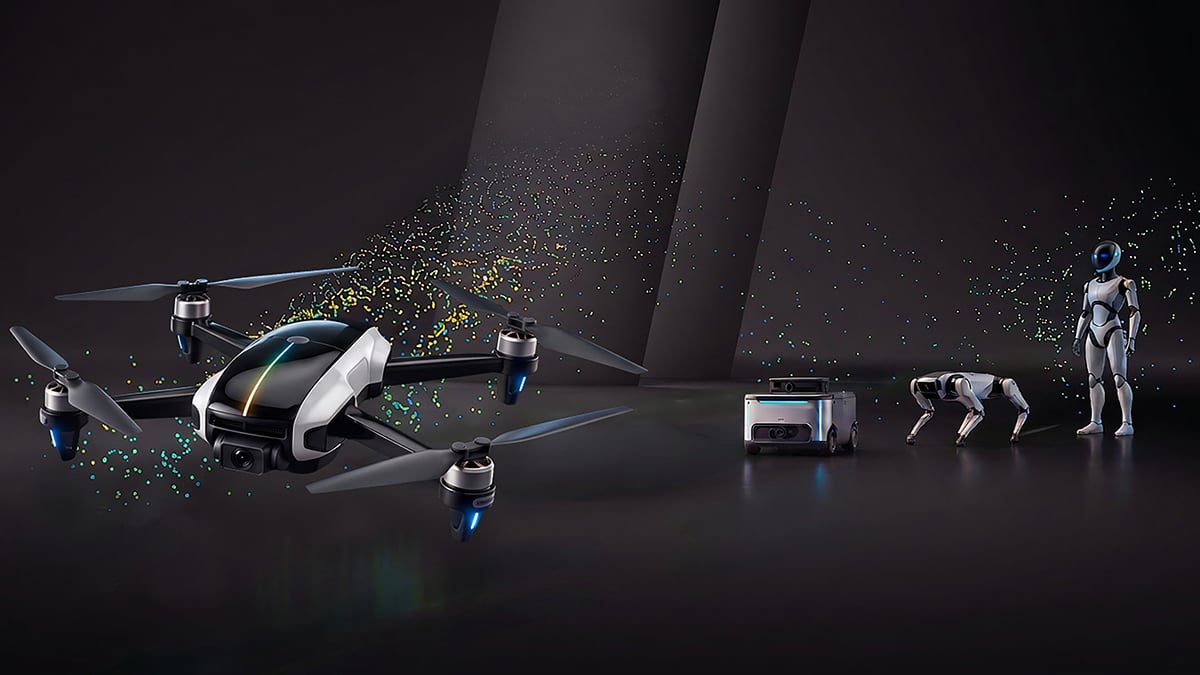
NXP Semiconductors is seeking to reduce the time and complexity involved in developing autonomous robots with a new hardware and software platform that brings together artificial intelligence, motor control, connectivity and security. The Dutch semiconductor group unveiled its unified robotics platform at electronica 2026, positioning it as a way for developers to move from evaluating…

Read at IoT Insider

arXiv (research papers) Utkarsh Bajpai

FlowRow: Learning Navigation Behaviors in Agricultural Environments with Long-Horizon Goal-Conditioned Flow Matching Policies

Autonomous monitoring and intervention in semi-structured agricultural environments, such as orchards and vineyards, require mobile robots to navigate to locations across diverse field configurations. This entails performing navigation behaviors including in-row driving, row turning and skipping, and inter-row traversal. Recent learning-based approaches have enabled robust in-row navigation from onboard perception, but navigation across rows typically requires a priori…

Read at arXiv (research papers)

arXiv (research papers) Yongji Fu

ROSE: A Shared Cross-Embodiment Facial-Motion Latent Space for Humanoid Robot Expression

Natural, coherent full-face dynamic expressions are central to making humanoid robots socially approachable, yet existing systems commonly realize only limited lip motion or scripted expressions. The limitation is both physical and algorithmic. A compact head leaves little room for densely packed, independently controllable actuation; meanwhile, learned systems often generate an avatar video, landmarks, or facial parameters and then infer actuator commands through visual…

Read at arXiv (research papers)

South China Morning Post Agence France-Presse Geopolitics

UN chief urges countries to rein in ‘killer robots’ on the battlefield

The United Nations chief called on countries on Monday to impose binding rules on the use of “merciless” lethal autonomous weapons systems, often dubbed “killer robots”, on the battlefield. Warfare is undergoing a radical transformation as armies seek to capitalise on artificial intelligence to boost their fighting abilities by identifying and striking targets more quickly and accurately. Amid a chorus of warnings against handing the power of life and death to autonomous…

Read at South China Morning Post

Robohub Lucy Smith

Watch the IROS 2026 plenary and keynote talks

The 2026 IEEE/RSJ International Conference on Intelligent Robots and Systems (IROS) was held in Pittsburgh from 27 September to 1 October. The event brought together researchers and industry professionals with expertise spanning many different aspects of robotics. IEEE have made the keynote and plenary panel recordings available to watch. You can also catch the opening

Read at Robohub

arXiv (research papers) Murad Dawood

Driving the Style: Velocity-Conditioned Whole-Body Control from Motion Demonstrations

Achieving human-like behavior on humanoid robots has advanced rapidly by leveraging motion-capture demonstrations rather than hand-crafted cost functions. Adversarial imitation supplies a style signal that lets a policy fulfill a task while adhering to a desired style, but is difficult to transfer to hardware. Whole-body tracking through reinforcement learning instead deploys reliably and imitates demonstrations faithfully, but the resulting policies are conditioned on the…

Read at arXiv (research papers)

Older stories