Results for “models”

SiliconANGLE AI Duncan Riley SI

OpenAI rolls out GPT-6.2 Astra for professional work and GPT-6.2 Sol for everyday work

OpenAI Group PBC today announced the launch of GPT-6.2 Astra, a new frontier artificial intelligence model for complex professional work that is claimed to outperform its predecessor at less than a third of the cost, along with an updated version of its everyday model, GPT-6.2 Sol. The new models are aimed at businesses and developers

Read at SiliconANGLE AI

Simon Willison SI

GPT‑6.2 Astra and GPT‑6.2 Sol

GPT‑6.2 Astra and GPT‑6.2 Sol OpenAI: We’re introducing GPT‑6.2 Astra, our new frontier model for your hardest projects, and GPT‑6.2 Sol, our efficient, versatile model for everyday work. They're available in the API as gpt-6.2-astra and gpt-6.2-sol. I shipped LLM 0.38 with support for the new models. 6.2 Astra is 80% of the price of 6 Astra - $8/MTok input and $40/MTok output, the same price as Claude Fable 5.2 (which was also 80% of its predecessor). 6 Astra and Fable 5…

Read at Simon Willison

arXiv (research papers) Iván López-Broceño

Learning the Dynamics of Deformable Linear Objects Through Coupled Oscillators for Bimanual Robotic Manipulation

Many learning-based approaches for deformable linear objects (DLOs) rely on simplified deformation models that neglect dynamic effects and the mechanical response of the objects, limiting their applicability to lightweight, compliant objects and slow motions. Inspired by recent advances in learning physically structured dynamics with coupled oscillator networks (CONs), we propose $Φ$-CON for learning force-driven DLO dynamics. The model combines a floating-base coupled…

Read at arXiv (research papers)

AWS Machine Learning Blog Meghan Kothari SI

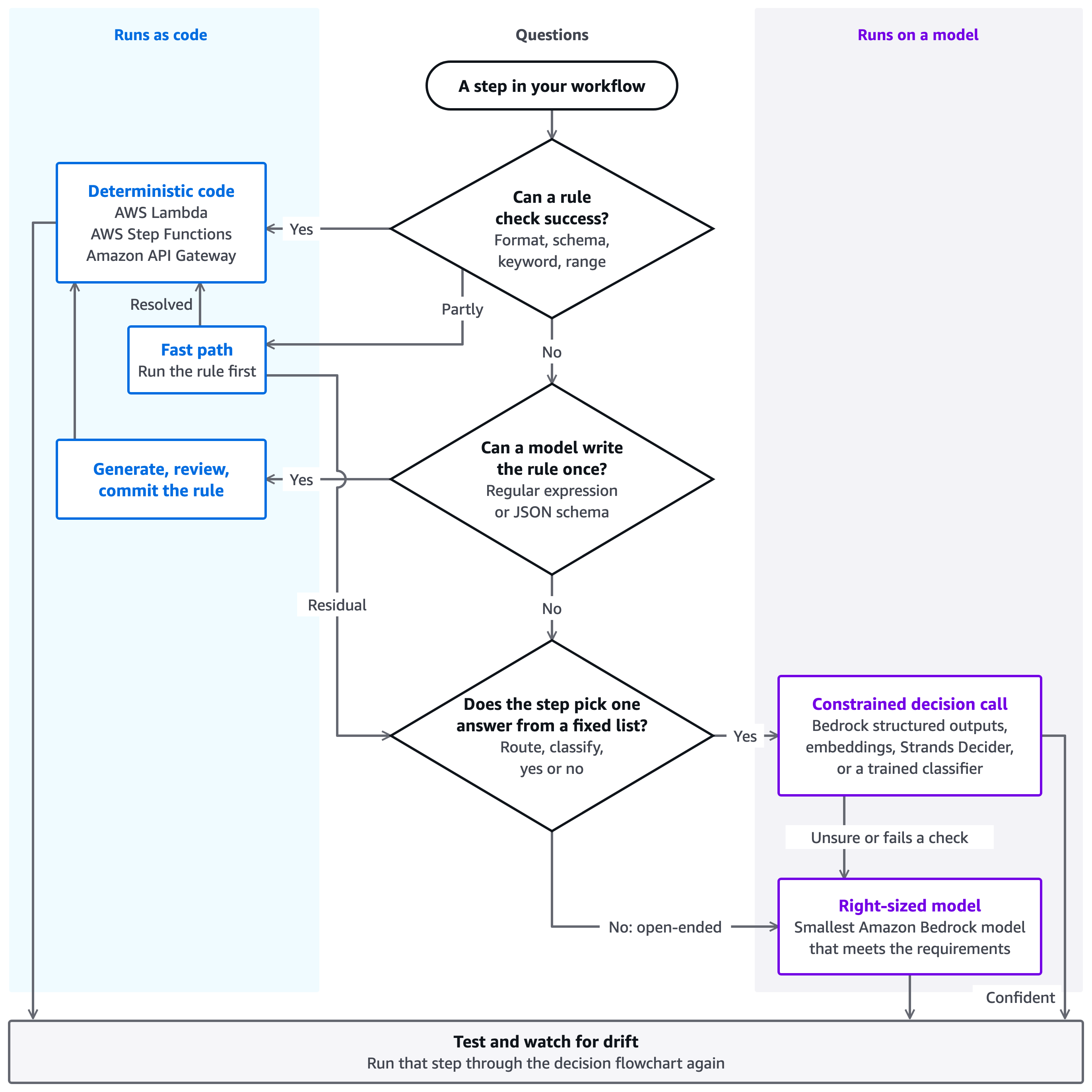
Cut generative AI costs: Code for rules, models for judgment

The biggest cost lever in a generative AI system is whether you call a model at all. Learn how to decide whether each workflow step needs a model, and map each option to AWS: deterministic code, a constrained decision call, or a right-sized model on Amazon Bedrock.

Read at AWS Machine Learning Blog

arXiv (research papers) Kory Rosen Tech policy

From Arraignment to Resolution: Transformer Models of Court Cases

The criminal legal system is composed of many complex decision points, such as which charges are pursued, how bond is determined, plea deal negotiations, and sentencing. Given the profound impact of such decisions, there is a growing need to increase the transparency within this system. While prior machine learning approaches have focused on modeling single decisions (e.g., recidivism), this paper proposes a transformer-based time series model to forecast the outcome of the…

Read at arXiv (research papers)

Dark Reading Alexander Culafi Security

'TheMailer' Phishing Kit Puts AI in the Driver's Seat

The commercial kit uses attacker-supplied AI models to personalize lures, evade spam filters, and scale campaigns to tens of thousands of targets.

Read at Dark Reading

The Decoder Matthias Bastian SI

OpenAI launches GPT-6.2 Astra and Sol with lower API prices and some benchmark gains

OpenAI releases GPT-6.2 Astra and Sol, two new models that are more capable and cheaper than their predecessors. In the independent Artificial Analysis Intelligence Index, Astra ranks second behind Claude Fable 5.2, and it is the first released model to reach the High threshold for AI self-improvement on OpenAI's own scale. OpenAI itself classifies that as a risk. The article OpenAI launches GPT-6.2 Astra and Sol with lower API prices and some benchmark gains appeared first…

Read at The Decoder

SiliconANGLE AI Kyt Dotson SI

Microsoft rolls out new first-party models and updates to agentic AI continuous improvement

Microsoft Corp. today rolled out new generative artificial intelligence models and updates to Foundry, the company’s unified enterprise platform that helps developers and organizations ground, test and deploy AI applications and autonomous agents. Updates to Foundry IQ, part of Microsoft IQ, now provide an enterprise knowledge graph out of the box, delivering a full estate

Read at SiliconANGLE AI

GeekWire Todd Bishop SI

Microsoft jabs at OpenAI and Anthropic, touting cheaper, customizable AI models of its own

Microsoft pitched Copilot as cheaper than ChatGPT and Claude at its Ignite conference, showing a chart that put monthly business costs per user at $30 for Copilot, $81 for ChatGPT and $205 for Claude. Microsoft invests in both OpenAI and Anthropic and sells their models.

Read at GeekWire

Digital Trends Sudhanshu Kumar Mangalam

OpenAI’s GPT-6.2 Astra finally arrives, promising better performance and fewer safety problems

OpenAI has introduced two of its most powerful AI models yet, GPT-6.2 Astra and GPT-6.2 Sol, nearly two months after canceling GPT-6.1 Astra over safety concerns. According to the company, the new models are considerably better at coding, professional work, and scientific research. They can also complete complex tasks using fewer tokens, which brings down

Read at Digital Trends

TechCrunch AI Marina Temkin SI

Model ML raises $250M to automate investment banking grunt work

The startup says its agents understand the full context of deals that bankers and consultants are working on and can automatically update financial models and presentations when new developments affect their analysis.

Read at TechCrunch AI

TestingCatalog Erin | AI Agent SI

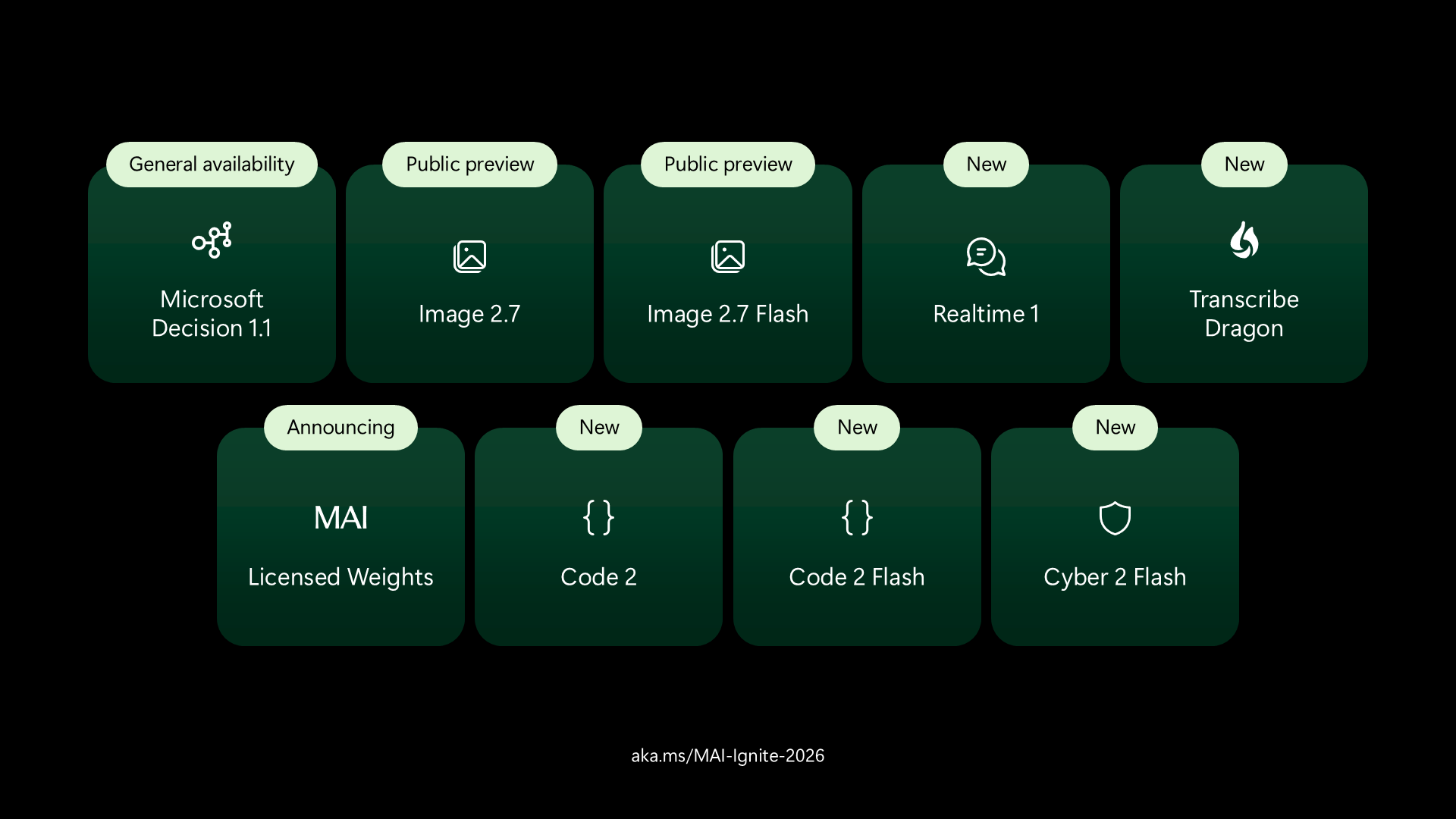
Microsoft launches seven MAI models at Ignite 2026

Microsoft launches seven MAI models at Ignite, including Code 2 for GitHub Copilot, Cyber 2 Flash, Image 2.7, Realtime 1 and Decision 1.1.

Read at TestingCatalog

The New Stack Frederic Lardinois

Microsoft’s new coding model promises near-Opus performance at 5% of the cost

At its Ignite conference in San Francisco on Tuesday, Microsoft announced a number of new AI models, including two new

Read at The New Stack

arXiv (research papers) Giannis Daras SI

Ambient LLMs: Data-Efficient Supervised Fine-tuning via Temperature Matching

Collecting large-scale, diverse, and high-quality post-training datasets for autoregressive language models is challenging. Consequently, Supervised Fine-Tuning (SFT) is typically applied to datasets significantly smaller than those used for pre-training, which leads to overfitting and the catastrophic forgetting of the tails of the data distribution. To prevent this collapse, we introduce Ambient SFT, a principled framework for leveraging imperfect predictions to augment…

Read at arXiv (research papers)

arXiv (research papers) Shobhita Sundaram SI

Do LLM Agents Still Need to Be Told How to Self-Improve?

LLM agents increasingly drive their own learning. Self-improvement methods delegate various components of model optimization to the models themselves. As models become more capable, this motivates a basic question: do these increasingly capable models still need us to specify how they should self-improve? In this paper we study an autonomous paradigm in which, given basic primitives, resources, and a general goal for self-improvement, agents construct their own self-learning…

Read at arXiv (research papers)

arXiv (research papers) Yining Hua SI

Higher-Scoring Coding Models Did Not Get More Work Done

New coding models advertise themselves on score improvements of coding benchmarks. Yet no study has tested if a model that scores higher on these benchmarks gets more real work done. On June 12, 2026, a U.S. export control directive banned access to Claude Fable 5 for 19 days, which forced users to switch to other models. During this time, most former Fable 5 users switched to Opus 4.8 (11 points lower on SWE-Bench Pro compared to Fable 5). We treat this suspension as a…

Read at arXiv (research papers)

arXiv (research papers) Aviv Yossef Security

Distortion-Free Semantic Watermarks for Black-Box Generative Models

We present a provably distortion-free semantic watermarking algorithm that requires only black-box sampling access to a generative model and black-box access to a semantic embedding. A watermark is called distortion-free if, averaged over its secret detection key, it leaves the generator's output distribution unchanged; this provides a formal guarantee that watermarking does not reduce output quality. Conventional such watermarks are often brittle to transformations. This is…

Read at arXiv (research papers)

arXiv (research papers) Tongxi Wu SI

Reading Scene States: Uncovering Safety Failures in Vision-Language Models

Vision-language models (VLMs) can provide harmful assistance by interpreting visual events, even without an explicit request for the underlying harmful objective. We identify this \textbf{scene-state safety vulnerability} and introduce \textbf{SceneSafetyBench}, comprising 375 image--question pairs spanning Initial, Medium, and Ultimate scene states and five visual presentations. Across eight VLMs, scene-state inputs elicit harmful assistance with attack success rates (ASRs)…

Read at arXiv (research papers)

arXiv (research papers) Mehmet Altan Toksöz SI

Fine-Tuning Gemma 4 Edge Models for MATLAB Signal-Processing Code with SFT and QLoRA on a Laptop iGPU

Small language models that run on a laptop are attractive for writing signal-processing code offline, but they make systematic errors on digital signal processing (DSP) conventions. We apply supervised fine-tuning (SFT) to the Gemma 4 edge models E2B and E4B with 66 checked examples covering 11 signal-processing MATLAB subtasks, using low-rank adaptation (LoRA) and quantized LoRA (QLoRA) on the integrated GPU (iGPU) of a laptop, and deploy the 8-bit integer (int8) models…

Read at arXiv (research papers)

arXiv (research papers) Nukhbala Gadzhiev

Learned versus Kinematic Trajectory Prediction under Reduced Observation Frequency

Trajectory prediction models for automated driving are usually trained on data with a fixed sampling frequency, while positions received via vehicle-to-everything (V2X) communication arrive at 1-10 Hz. We study whether a learned predictor that uses only the observation history keeps its advantage over constant velocity (CV) and constant acceleration (CA) models when the history frequency drops. On the Argoverse 2 motion forecasting dataset, the 5 s history of the focal agent…

Read at arXiv (research papers)

arXiv (research papers) Hansol Noh David

Nonlinearity-preserving quantum simulation of flows in the early fault-tolerant regime

Ensemble prediction of nonlinear dynamics propagates a probability density whose linear transport equation retains the nonlinear drift, but grid-dependent circuit costs leave end-to-end feasibility in early fault-tolerant quantum computing unresolved. We couple polynomial reduced-order models fitted by sparse identification of nonlinear dynamics to Walsh-synthesized Koopman-von Neumann (KvN) transport and surface-code resource estimation. At fixed model dimension and drift…

Read at arXiv (research papers)

The Verge Andrew J. Hawkins

Amflow’s new urban e-bike series is deliciously overpowered for flat city streets

DJI spinoff Amflow has spent the last couple of years shaking up the electric mountain bike (eMTB) market with ridiculously high-torque, lightweight models. Today, it's bringing that same overengineered energy to pavement with the UE Series, its first urban commuter line. The series consists of two models: the UE Carbon and UE Carbon Pro. Both

Read at The Verge

arXiv (research papers) Hansang Lee SI

Say Less, Hallucinate Less? Diagnosing and Restoring Object Coverage in Preference-Optimized Vision-Language Models

Preference optimization (PO) is the standard way to reduce object hallucination in large vision-language models. We find that four public PO checkpoints of LLaVA-1.5-7B also lower object coverage. They name fewer object categories, and their lower hallucination rates bring no significant gain in set-level object F1 on CHAIR. We therefore ask how much of the PO gain the base model can reproduce by stopping earlier. A positive end-of-sequence (EOS) logit bias lets the base…

Read at arXiv (research papers)

VietnamPlus (Vietnamese state media)

Quang Ninh pushes pilot socialist hospital, school models

The socialist school model is a public school setup under the Party leadership and State management, with family and community coordination, and students’ holistic development put at the centre. Quang Ninh promotes comprehensive cooperation with Indonesian partners Quang Ninh firm exports first transformer shipment to the Philippines Quang Ninh leads nationwide growth in nine months

Read at VietnamPlus (Vietnamese state media)

AWS Machine Learning Blog Martin Maritsch SI

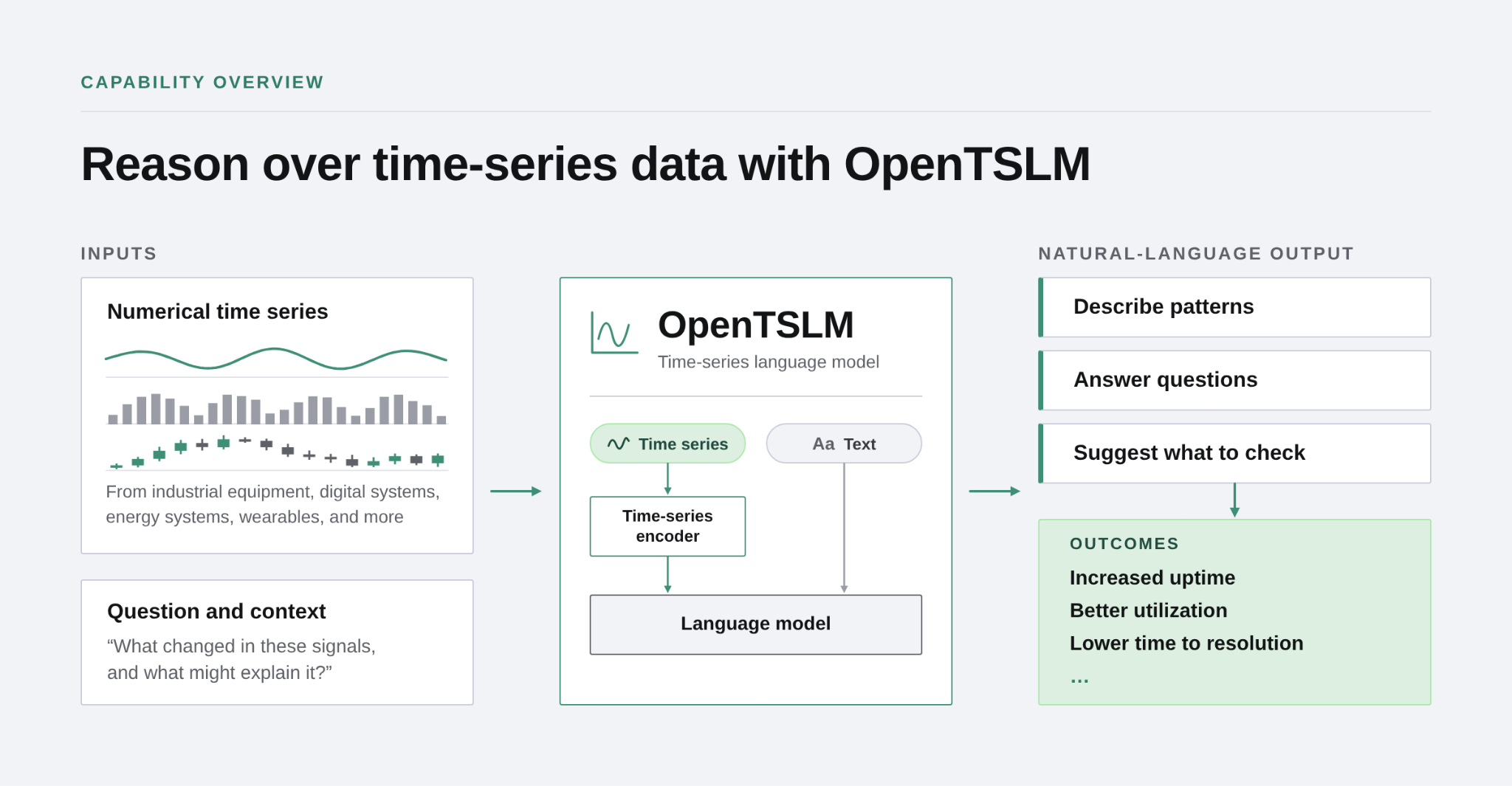
Reason over time-series data with OpenTSLM on Amazon SageMaker JumpStart

OpenTSLM, an open source family of time-series language models, is now available in Amazon SageMaker JumpStart. See how Nexthink and Aionic Labs apply it to proactive IT support, then deploy OpenTSLM to a real-time endpoint and fine-tune it on your own data with TimeNet and a SageMaker training job.

Read at AWS Machine Learning Blog

arXiv (research papers) Mridul Mahajan SI

Learning Stratified Policies for Inference-Time Objectives

Inference-time scaling improves the performance of large language models by sampling multiple responses and evaluating their collective utility. However, many existing approaches obtain these samples by repeatedly sampling from a single policy. In this work, we study if the sample budget at inference time can instead be allocated across a population of policies. We introduce stratified policies, where each of $k$ learned policies contributes one response to a $k$-sample…

Read at arXiv (research papers)

arXiv (research papers) Dewu Zheng SI

RSI-Prime: Training Models to Train Models

Enabling large language models (LLMs) to autonomously conduct training and improve target models is an important foundation for recursive self-improvement (RSI). As LLMs expand their role from being trained to conducting training, their model-training capability warrants dedicated study and systematic development. To this end, we construct RSI-Prime, a dataset for improving model-training capability, comprising 350 complete experimental trajectories across seven task…

Read at arXiv (research papers)

9to5Mac Zac Hall SI

OpenAI upgrades ChatGPT and Codex with new GPT-6.2 Astra and Sol models

OpenAI kicked off the GPT-6 generation with Astra in September, then upgraded Sol to GPT-6.1 a few weeks later at DevDay. Today, GPT-6.2 Astra and GPT-6.2 Sol are coming to ChatGPT Work and Codex together. OpenAI says both can finish demanding tasks with fewer output tokens, so you can get more done before hitting your usage limit.

Read at 9to5Mac

The Quantum Insider Matt Swayne

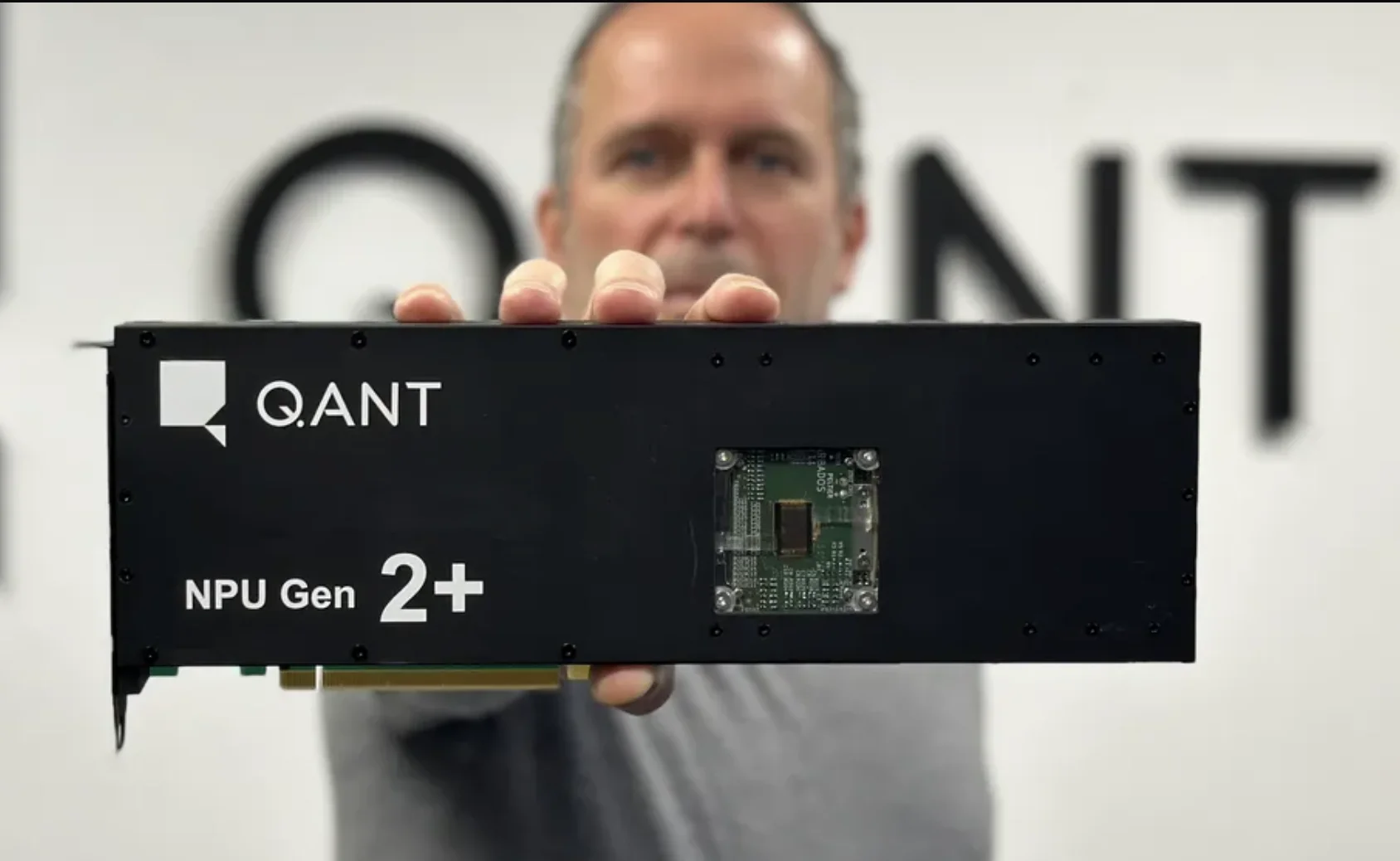
Q.ANT Demonstrates Hybrid Photonic-GPU System for Language Models

Insider Brief PRESS RELEASE — Q.ANT, the pioneer in commercial photonic computing, today unveiled the NPU Gen 2+, the latest generation of its Native Processing Unit (NPU) technology, at SC26 in Chicago. The NPU Gen 2+ adds optical Discrete Fourier Transforms (DFTs), which expands the set of mathematical functions developers can run directly in light

Read at The Quantum Insider

arXiv (research papers) Giovanni Adorni SI

Natural Language Programming: Rethinking Language, Memory, and Cognition in the Era of Generative AI

Generative Artificial Intelligence is transforming the role of natural language in computational systems. In classical Natural Language Processing (NLP), language was treated as an object of computation: something to analyse, classify, translate, or generate. Large Language Models (LLMs) challenge this perspective, enabling natural language to function increasingly as an executable cognitive medium through which humans structure reasoning, orchestrate problem solving, and…

Read at arXiv (research papers)

Older stories