Results for “Quantum”

Quantum Computing Report Mohamed Abdel-Kareem

SAXON Q Introduces Patented Quantum Watchdog System for Runtime QPU Fault Detection

SAXON Q has introduced Quantum Watchdog, a patented system designed to detect hardware failures in quantum processors during live operation. This system monitors physical telemetry and runs verified test calculations to ensure the integrity of QPUs. Quantum Watchdog will be offered as a configurable option on SAXON Q's SXQ128 and SXQ512 processors, with initial implementations in early 2027.

Read at Quantum Computing Report

Quantum Computing Report Mohamed Abdel-Kareem

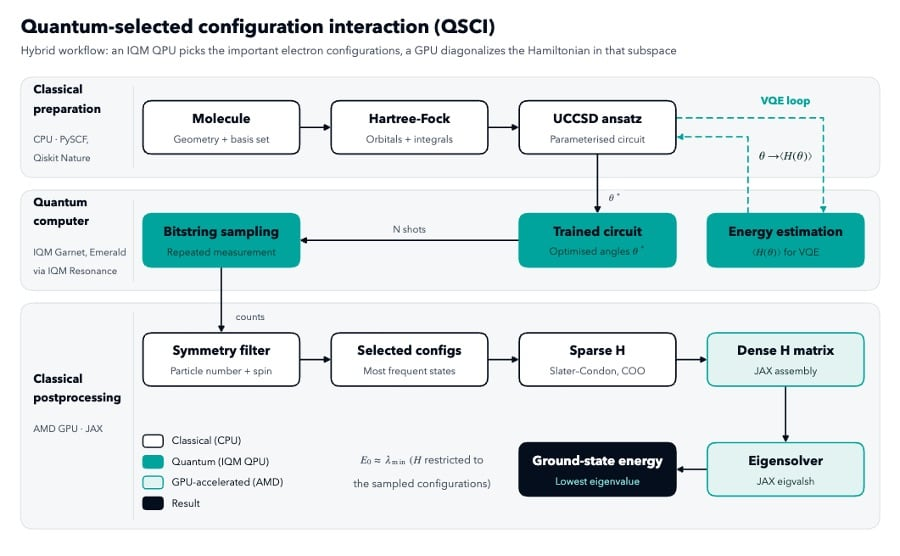
IQM and AMD Demonstrate Reproducible Hybrid QPU-GPU Chemistry Workflow Using ROCm

IQM Quantum Computers and AMD have successfully demonstrated a hybrid quantum-classical computational chemistry workflow. This workflow utilizes IQM's 20-qubit Garnet processor and AMD Instinct GPUs with ROCm software to perform molecular ground-state energy calculations. The collaboration provides a multi-vendor solution for supercomputing centers and is available as an open-source Jupyter notebook for further development.

Read at Quantum Computing Report

Quantum Computing Report Mohamed Abdel-Kareem

IQM Researchers Benchmark Projected Quantum Kernels Across 45 Qubits Using Cross-Device Referee-Challenger Protocol

IQM Researchers have successfully benchmarked projected quantum kernels across 45 qubits using a cross-device referee-challenger protocol, demonstrating a significant advantage over classical models in quantum machine learning tasks. Their study, conducted on IQM Emerald and Garnet processors, highlights the effectiveness of adaptive Pauli twirling in mitigating errors and achieving near noise-free accuracy. The findings suggest a promising path for quantum advantage in 2D…

Read at Quantum Computing Report

YourStory Startups

Emerging cryptographic requirements and the transition to quantum-resistant security

Encryption forms the backbone of our everyday digital lives including banking transactions, healthcare and communication. However, the rise of quantum computing is challenging our assumptions about how long certain types of security will remain effective.

Read at YourStory

Quantum Computing Report Mohamed Abdel-Kareem

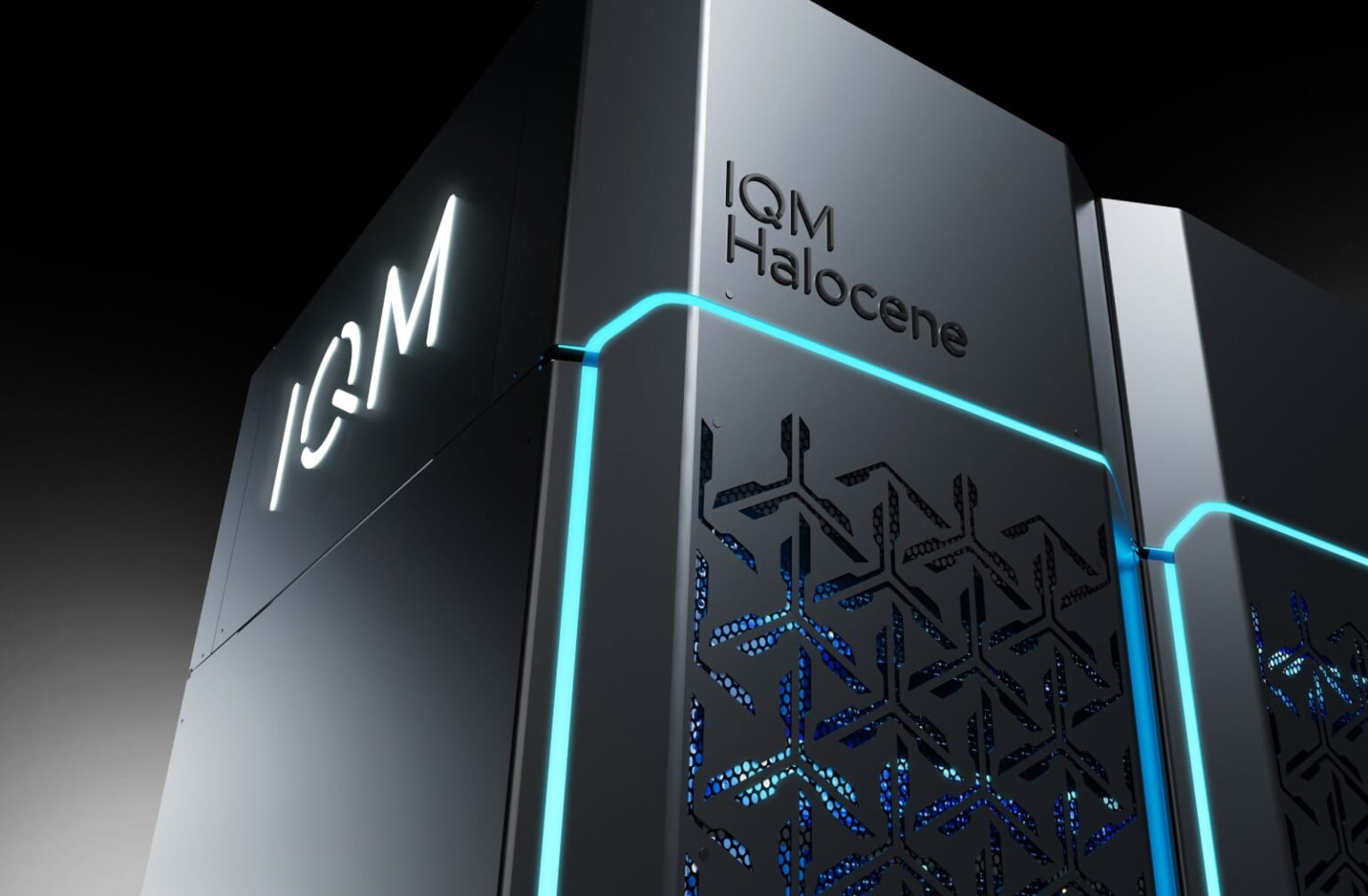
IQM Announces Zero-Downtime Upgrade Program for Halocene Product Line Scaling Past 1,000 Qubits

IQM Quantum Computers has launched a zero-downtime upgrade program for its Halocene quantum error-correction product line, enabling a seamless transition from 150-qubit processors to systems exceeding 1,000 qubits. This program, designed for HPC and enterprise data centers, ensures continuous operation during hardware upgrades by installing new units alongside existing ones. It also integrates with current software toolchains and allows for hybrid AI and simulation workflows…

Read at Quantum Computing Report

Quantum Computing Report Mohamed Abdel-Kareem

Unitary Foundation Releases 2026 Quantum Open Source Survey Covering SDK Adoption, Hybrid HPC Workflows, and AI Tooling

The 2026 Quantum Open Source Survey, with over 1,800 respondents, reveals key trends in quantum software adoption, hybrid workflows, and AI tooling. Qiskit leads in SDKs, IBM Quantum in cloud services, and Anthropic Claude Code in AI assistants. The survey also highlights the growing use of Python and C/C++, challenges in QEC and HPC, and cautious optimism regarding AI's role in quantum development.

Read at Quantum Computing Report

Quantum Computing Report Mohamed Abdel-Kareem

Classiq Collaborations with Shionogi, KDDI Research, and SoftBank Earn Awards in Japan’s NEDO Quantum Challenge

Classiq announced that three joint research initiatives with Shionogi, KDDI Research, and SoftBank received awards in Japan’s NEDO Quantum Computing Challenge. These projects utilized Classiq’s Qmod and evaluated hardware execution and fault-tolerant resource requirements across pharmaceutical, cryptographic, and logistics workloads. The collaborations demonstrated significant achievements, such as reducing qubit register size for molecular modeling, achieving a simulated…

Read at Quantum Computing Report

Phys.org Quantum Physics

Quantum-gas microscope resolves the 'color' of individual atoms in a single shot

In 2024, researchers at the Ultracold Quantum Gases group at ICFO built a quantum-gas microscope capable of imaging individual atoms in strontium quantum gases for the first time, marking a key enabling step for quantum simulation. At that time, the researchers imaged strontium-84, a boson that has no spin.

Read at Phys.org Quantum Physics

Quantum Computing Report Mohamed Abdel-Kareem

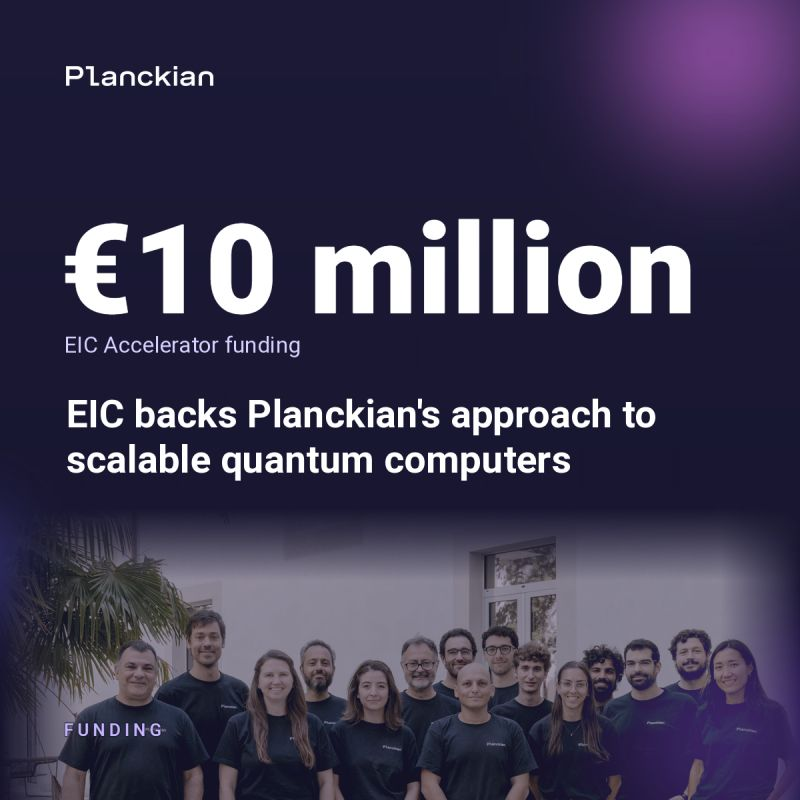
Planckian Selected for €10 Million ($11 Million USD) EIC Accelerator Blended Finance Package to Scale Shared-Control Superconducting Processors

Planckian, an Italian superconducting quantum hardware developer, has been selected for the European Innovation Council (EIC) Accelerator, securing €10 million ($11 million USD) in blended financing. This funding will support the development of their shared-control superconducting processor architecture, which aims to overcome scaling limitations of conventional quantum computers. The company plans to use this investment to transition its design into an externally accessible…

Read at Quantum Computing Report

CyberScoop djohnson Security

GSA says post-quantum work on PIV cards shows new encryption can work on old tech

Agency leaders and federal contractors are mulling over how to best adapt the new protections to older, legacy technology and address gaps in visibility over federal encryption protocols.

Read at CyberScoop

The Quantum Insider Mohib Ur Rehman

IQM Introduces Upgrade Programme for Halocene Quantum Systems

Insider Brief PRESS RELEASE — IQM Quantum Computers (Nasdaq: IQMX), a global leader in integrated quantum computing, today announced an upgrade program for IQM Halocene, its error-correction product line, that gives customers a path from the 150-qubit system of today to the over 1,000-qubit system of the future. Customers can run hybrid workloads today alongside

Read at The Quantum Insider

Quantum Computing Report Mohamed Abdel-Kareem

QUDORA Integrates NVIDIA CUDA-Q into Qamelion Emulator and Launches German-Funded QUANDA HPC Energy Consortium

QUDORA Technologies has integrated NVIDIA CUDA-Q into its Qamelion emulator, allowing developers to execute hybrid quantum-classical workflows and benchmark circuits under realistic trapped-ion noise. Additionally, QUDORA launched the QUANDA consortium, a German-funded project to automate trapped-ion access within high-performance computing centers for quantum machine learning applications in the energy sector.

Read at Quantum Computing Report

Phys.org Quantum Physics

Quantum observers can 'agree to disagree,' but within limits, new theorem shows

Two observers can start with the same description of a quantum system, follow the same probability rules and still disagree about the chance of the same outcome—even while being certain of each other's assessments.

Read at Phys.org Quantum Physics

Quantum Computing Report Mohamed Abdel-Kareem

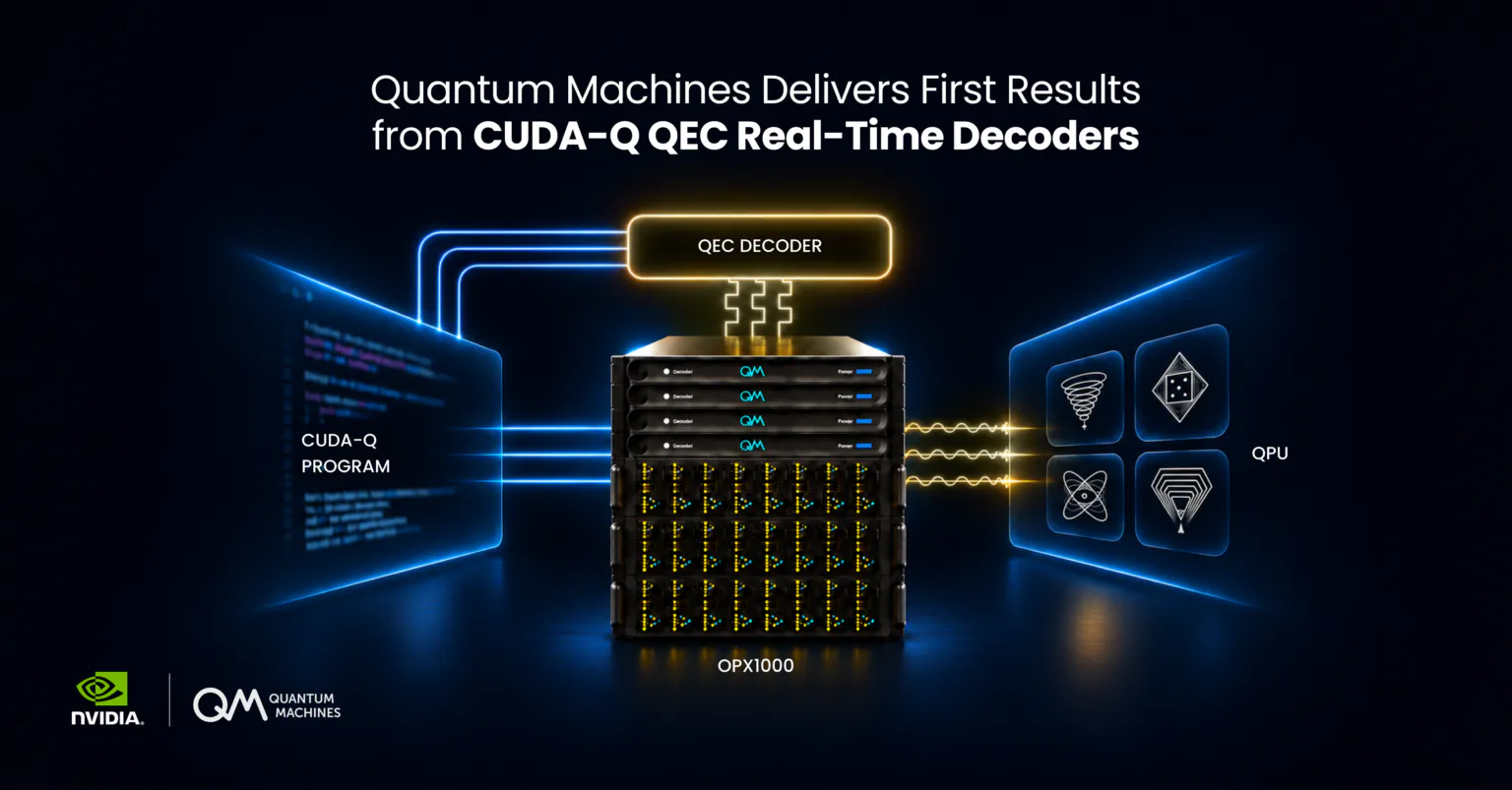
Quantum Machines Demonstrates Sub-Microsecond Surface-Code Decoding on OPX1000 Using NVIDIA CUDA-Q QEC and NVQLink

Quantum Machines demonstrated sub-microsecond surface-code decoding on its OPX1000 platform by integrating NVIDIA CUDA-Q QEC and NVQLink. This achieved a 2.4 μs round-trip communication latency and sub-microsecond per-round decoding for code distances 7 and 11. Early access to this integration will be available to customers in December 2026.

Read at Quantum Computing Report

arXiv (research papers) Pok Man Tam

Expressivity of two-dimensional Gaussian fermion tensor network states

Tensor network states (TNS) provide a family of efficiently compressed approximations to physically relevant many-body quantum states. An important quantity that characterizes the computational resources required by a TNS is its bond dimension. While in one dimension an area law for the Renyi-0 entropy guarantees an exact matrix product state representation with a bond dimension independent of the system size, an analogous statement does not hold for general states in two…

Read at arXiv (research papers)

arXiv (research papers) Xingyang Yu SI

StringQFT: A Multiuse Textbook Resource for AI-Assisted Theoretical Physics

We present StringQFT as a textbook collection for string constructions of quantum field theory and as infrastructure for AI-assisted theoretical physics. The collection comprises 18 volumes, 190 chapters and 3,795 pages, covering brane probes, brane webs, geometric engineering, F-theory constructions, wrapped M5-branes and exact worldsheet constructions. Its open-book benchmark inventory contains 1,073 items, including 499 with automatic finite-answer checking. For…

Read at arXiv (research papers)

arXiv (research papers) Alec F. White

Modeling quantum information scrambling in realistic protein NMR experiments

Out-of-time-order correlators (OTOCs) are important probes of operator spreading and information scrambling, and have recently been proposed as a means of extracting molecular structural information through nuclear magnetic resonance (NMR). Realizing this potential requires accurate modeling of OTOCs in complex molecular environments within experimentally relevant settings. Here, we develop an end-to-end computational pipeline connecting molecular structures to OTOC dynamics…

Read at arXiv (research papers)

arXiv (research papers) Philippe Suchsland

Local interference algorithms for observables in large random circuits

In quantum dynamics, it is generally believed that interference effects lead to a sign problem for classical Monte Carlo sampling methods, rendering sampling ineffective. In this paper we show that this is generically not the case for the task of simulating the evolution of observables in random instances of circuit dynamics. Specifically, we consider two examples of observables which give large signals despite the randomness of the dynamics: first order out-of-time-ordered…

Read at arXiv (research papers)

arXiv (research papers) Hansol Noh David

Nonlinearity-preserving quantum simulation of flows in the early fault-tolerant regime

Ensemble prediction of nonlinear dynamics propagates a probability density whose linear transport equation retains the nonlinear drift, but grid-dependent circuit costs leave end-to-end feasibility in early fault-tolerant quantum computing unresolved. We couple polynomial reduced-order models fitted by sparse identification of nonlinear dynamics to Walsh-synthesized Koopman-von Neumann (KvN) transport and surface-code resource estimation. At fixed model dimension and drift…

Read at arXiv (research papers)

arXiv (research papers) Changqing Wang

Quantum amplification with a linear quantum coupler

Josephson parametric amplifiers (JPAs) are essential components for quantum-limited microwave measurement, but their dynamic range is often constrained by Kerr and other pump-induced nonlinear effects. In this work, we systematically study the performance of a parametric amplifier based on the linear inductive coupler (LINC). Starting from the driven-circuit Hamiltonian, we derive the effective three-wave-mixing amplifier model, including leading flux-driven nonlinear…

Read at arXiv (research papers)

Quantum Computing Report Mohamed Abdel-Kareem

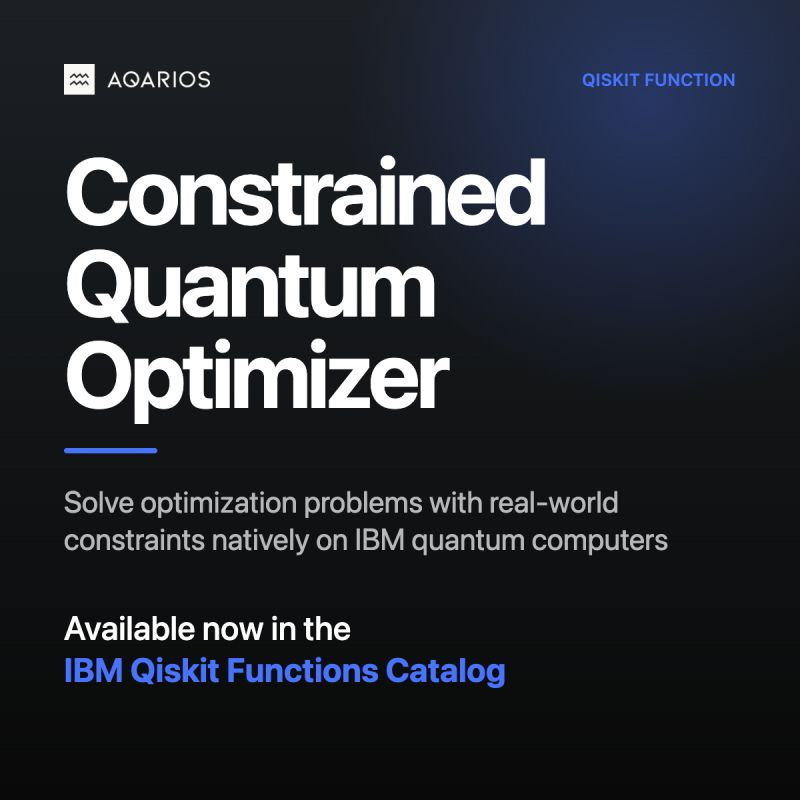
Aqarios Launches Constraint-Native Quantum Optimizer in the IBM Qiskit Functions Catalog

Aqarios GmbH has launched its Constraint-Native Quantum Optimizer in the IBM Qiskit Functions Catalog, offering a managed solver for discrete combinatorial optimization. This optimizer uses Iterative Warm-Start XY-Mixer QAOA (IWS-QAOA) to enforce constraints natively at the circuit level, reducing QPU compute times significantly. Benchmarks on IBM Heron processors demonstrate its ability to find optimal solutions for complex problems with high feasibility and reduced runtime.

Read at Quantum Computing Report

arXiv (research papers) Thomas Huffstutler

Integral Tensor Isomorphism via Cubic Rings and Lattice Methods

We prove that isomorphism of integral $2\times3\times3$ tensors under $\mathrm{GL}_2(\mathbb{Z})\times\mathrm{GL}_3(\mathbb{Z})\times\mathrm{GL}_3(\mathbb{Z})$ is decidable in bounded-error quantum polynomial time. For a tensor $T=(A,B)$ with nonzero determinant form $\det(xA-yB)$, we use the parametrization of Wood by balanced modules to reduce the isomorphism problem to principality tests for compatible lattices, and use the algorithms of Bley, Hofmann, and Johnston to…

Read at arXiv (research papers)

arXiv (research papers) Luca Hofele

Teleportation of Logical Qubits using Lattice Surgery with Superconducting Circuits

Demonstrating a quantum advantage when solving large-scale computational problems on a quantum computer requires the correction of errors that occur due to limitations in control accuracy and coherence. Using the concept of quantum error correction, fault-tolerant logical qubits can be realized and manipulated with logical single- and two-qubit gates. In this paper, we experimentally analyze fault-tolerant lattice-surgery, which is a key primitive that enables operations…

Read at arXiv (research papers)

arXiv (research papers) Mohd Abu Bakar Siddique

Quantum simulation of neutral-meson mixing and decay on a reprogrammable photonic processor

Neutral mesons oscillate into their antiparticles while decaying, so their dynamics is generated by a non-Hermitian effective Hamiltonian which a quantum simulator restricted to unitary operations cannot implement directly. We propose a reprogrammable photonic processor that simulates this open-system evolution through dilation and analyze it at the circuit level. The effective Hamiltonian is reconstructed exactly from measured lifetimes, mass and width differences, and the…

Read at arXiv (research papers)

Quantum Computing Report Mohamed Abdel-Kareem

Altera, OQC, and NVIDIA Demonstrate Direct-RF FPGA Quantum System Controller Reference Design at SC26

Altera, OQC, and NVIDIA showcased a quantum system controller reference design at SC26, utilizing an Altera Agilex 9 Direct RF FPGA. This design integrates real-time FPGA control with an OQC superconducting processor and NVIDIA GPUs via NVIDIA NVQLink, simplifying quantum control stacks by reducing the need for discrete components. The system enhances qubit control, calibration, and machine learning readout classification, with a general release planned for January 2027.

Read at Quantum Computing Report

arXiv (research papers) Mundur V N Murthy

Causality, determinism and predictability: Probing nature through classical and quantum eyes

In this article, mainly focussed on students and interested readers, we discuss how the understanding of causality, determinism and predictability is transformed as we move from the classical world view to the quantum description. We first explain how determinism and predictability operate in classical dynamics and outline the notion of causality. A paradigm shift occurs within the framework of quantum mechanics where we have to revisit, and even give up, the notions of…

Read at arXiv (research papers)

arXiv (research papers) Qisheng Wang

Optimal Min-Entropy Estimation with High Probability

Min-entropy plays a fundamental role in assessing the unpredictability of randomness sources. In particular, NIST SP 800-90B specifies min-entropy estimation as a key procedure for entropy sources used in cryptographic random bit generators, illustrating the practical importance of reliable min-entropy estimation. In this paper, we settle the sample complexity of min-entropy estimation with high probability in both the classical and quantum cases. Specifically, for…

Read at arXiv (research papers)

arXiv (research papers) Katia Hakem

Performance of Fusion-Based Quantum Computing with Imperfect Photon Indistinguishability

Fusion-based quantum computation (FBQC) is a promising route to fault-tolerant photonic quantum computing, connecting small entangled resource states through linear-optical fusion measurements. While logical encoding can substantially improve resilience to photon loss, whether these benefits extend to other noise remain an open question. In this work, we show that this is not generally the case when accounting for partial photon distinguishability during resource state…

Read at arXiv (research papers)

arXiv (research papers) Alok Gokhale

Frequency Multiplexing of Purcell-Enhanced Optically Coherent NV Centers

Integrating optically coherent quantum emitters into nanophotonic structures is key to scalable quantum networks. Realizing them with nitrogen-vacancy (NV) centers in diamond is hindered by the degradation of optical coherence accompanying nanofabrication. Here, we overcome this challenge by integrating multiple NV centers into a monolithic diamond photonic crystal nanocavity while preserving near-lifetime-limited optical coherence. We observe linewidths as narrow as 19 MHz…

Read at arXiv (research papers)

Older stories