Results for “Quantum”

The Quantum Insider Matt Swayne

Quantum Physics Can Verify a Person’s Location, NIST Researchers Show

Insider Brief PRESS RELEASE — Imagine a corporate treasurer directing her company’s financial network to make a $50 million wire transfer. How can the network be certain the command is coming from a secure terminal in the company’s headquarters, and not a hacker’s laptop across the globe? In a first-of-its-kind experiment, scientists at the National

Read at The Quantum Insider

arXiv (research papers) Sunjun Hwang

Shedding Light on Quantum Non-Classicality: Witnessing Wigner Negativity with Free Electrons

Certifying quantum non-classicality like Wigner negativity typically demands full optical state tomography. This work introduces a noise-resilient framework for witnessing optical Wigner negativity using phase-resolved quantum photon-induced near-field electron microscopy (QPINEM). By mapping electron coherences directly to symmetrically ordered optical characteristic functions within a coupling-limited phase-space region, the protocol bypasses full optical reconstruction. A…

Read at arXiv (research papers)

arXiv (research papers) Valeria Repetto SI

Soft Mixture of Quantum Experts for Hybrid Quantum-Classical Learning

Quantum Machine Learning (QML) has attracted increasing interest as a possible route to construct feature representations that are difficult to reproduce with classical models. However, near-term QML architectures based on trainable parametrized quantum circuits remain affected by limited hardware resources, noise, and severe optimization difficulties such as barren plateaus. In this work we propose Soft-MoQE, a Soft Mixture of Quantum Experts architecture that replaces…

Read at arXiv (research papers)

Quantum Computing Report Mohamed Abdel-Kareem

Qatar and France Sign Bilateral Letter of Intent on Digital Cooperation Highlighting Shared Quantum Ambitions

Qatar and France have signed a Letter of Intent to enhance cooperation in AI, digital transformation, and quantum technologies. This agreement, formalized at the ITU Plenipotentiary Conference 2026, aims to strengthen their digital sectors and foster strategic autonomy. It also builds on existing commercial ties, including a recent deal for quantum computing deployment in Qatar by French company Quandela.

Read at Quantum Computing Report

arXiv (research papers) J. C. Bellizotti Souza

Environment-assisted imaginary time evolution in feedback-based quantum algorithms

The Feedback-based Algorithm for Quantum Optimization (FALQON) prepares ground states without classical parameter optimization, but requires deep circuits and can stagnate away from the ground state as a consequence of barren plateaus and symmetry protection. In order to avoid stagnation, imaginary time evolution (ITE) layers can be incorporated into FALQON layers, enhancing FALQON convergence. However, applying a non-unitary ITE layer in a closed quantum system is not…

Read at arXiv (research papers)

Quantum Computing Report Mohamed Abdel-Kareem

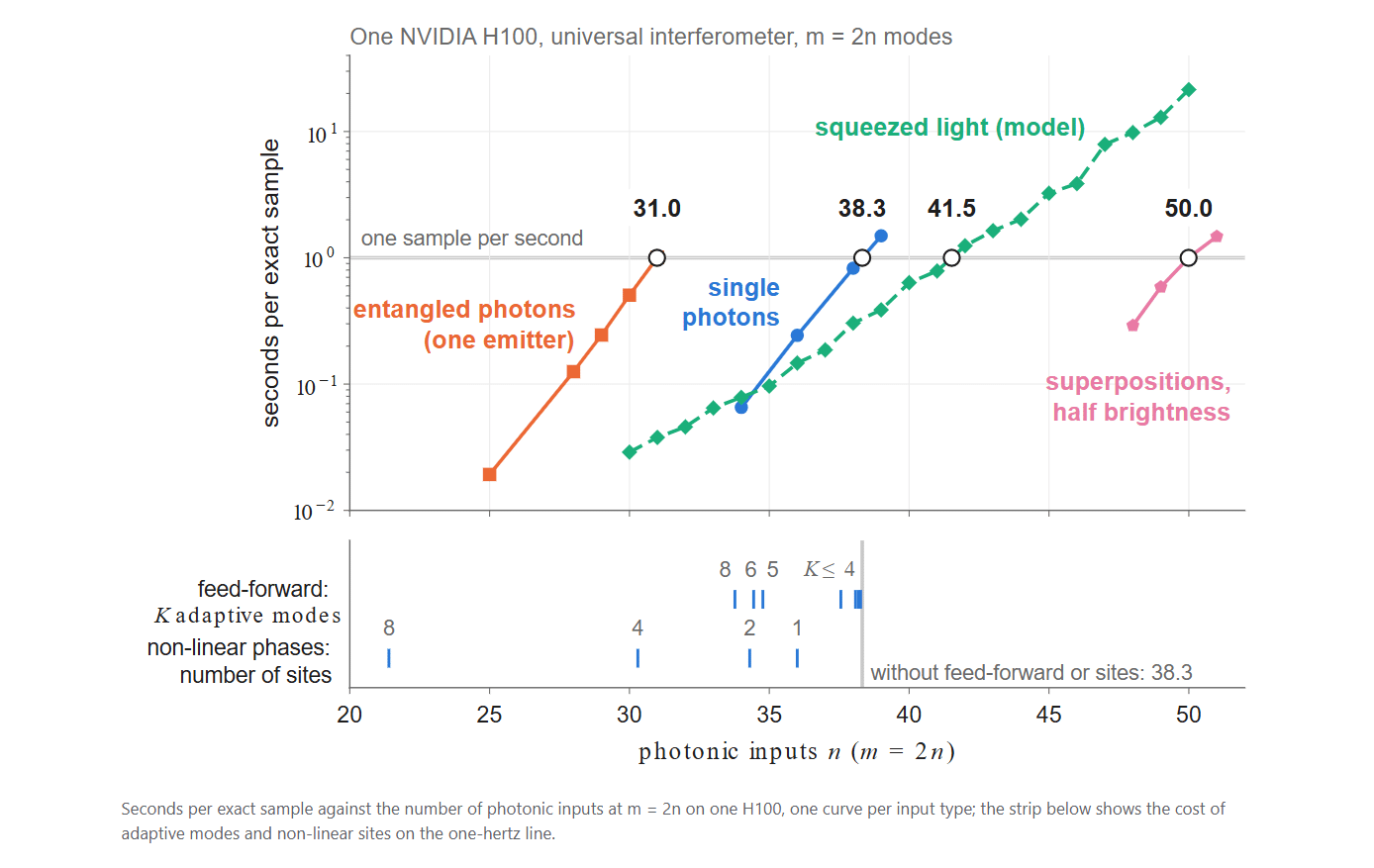
Quandela and NVIDIA Benchmark Photonic Quantum Simulability Frontiers on H100 GPUs

Quandela, CNRS, and NVIDIA have established a "simulability frontier" for photonic quantum processors using NVIDIA H100 GPUs. Their research defines a unified metric for when quantum processors outperform classical simulations, moving beyond varying photon count thresholds. They've also released an open-source library, photonic-engines, to support this work.

Read at Quantum Computing Report

The Quantum Insider Mohib Ur Rehman

QuEra Computing and Berkeley Lab Publish Nature Study of Quantum Dynamics on Up to 180 Qubits

Insider Brief PRESS RELEASE — The National Energy Research Scientific Computing Center (NERSC) at Lawrence Berkeley National Laboratory and QuEra Computing, the leader in neutral-atom quantum computing, today announced the publication of a new study in Nature. Using Aquila, QuEra’s analog neutral-atom quantum computer, coupled with classical calculations on NERSC’s Perlmutter supercomputer, the team observed

Read at The Quantum Insider

Quantum Computing Report Mohamed Abdel-Kareem

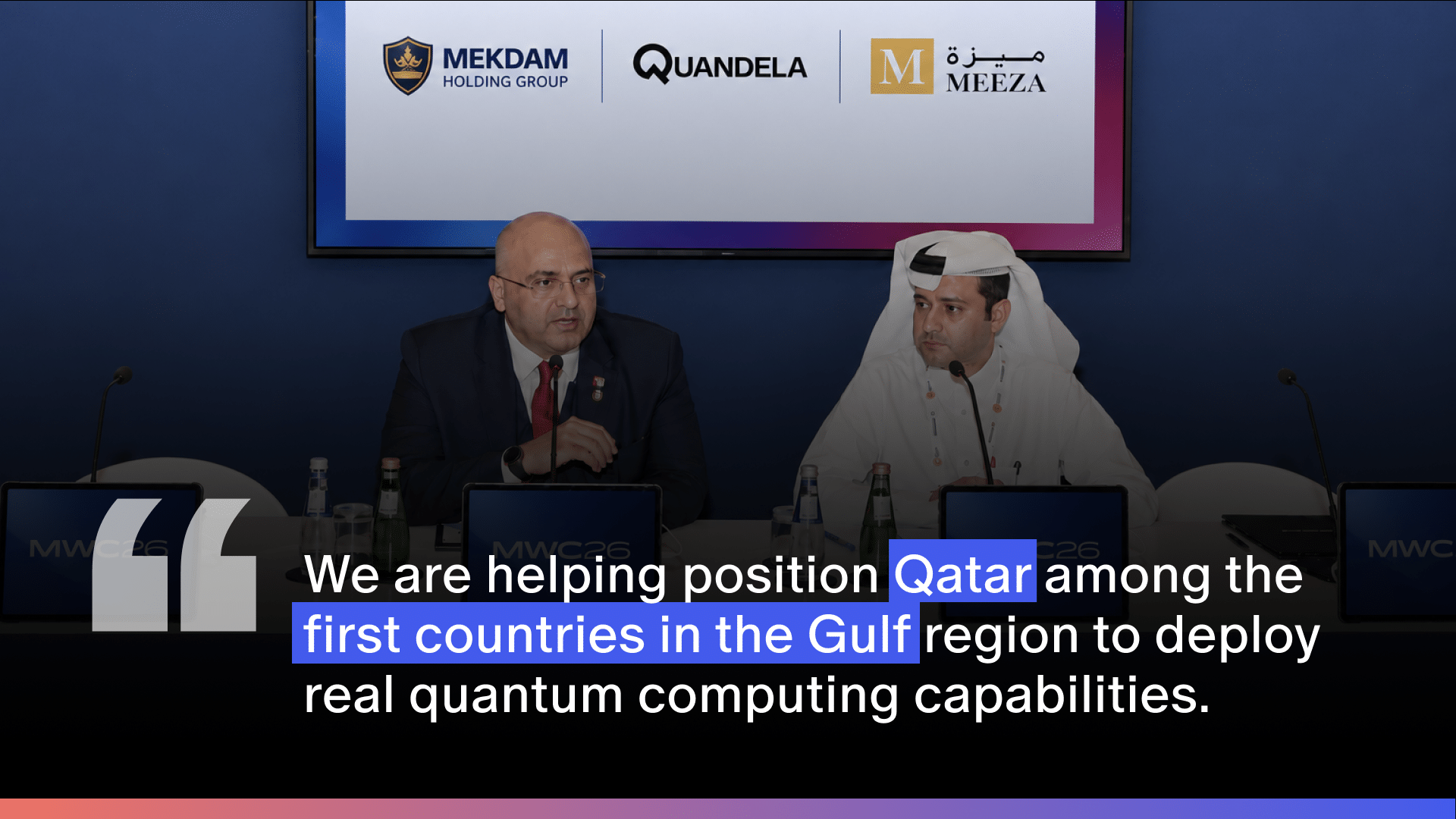
Quandela Expands International Photonic Footprint with Deployment Alliance in Qatar and Foundry MoU in Taiwan

On November 18, 2026, Quandela announced two international collaborations: a tripartite partnership in Qatar with Mekdam Holding Group and MEEZA to deploy photonic quantum systems across GCC states, and a memorandum of understanding with Taiwan-based Hermes-Epitek Corporation to co-develop and industrialize integrated photonic quantum hardware. These agreements aim to advance sovereign quantum infrastructure in the Middle East and photonic component industrialization in Asia.

Read at Quantum Computing Report

Quantum Computing Report Mohamed Abdel-Kareem

Alice & Bob Accelerates Modular Cat-Qubit Roadmap to 200 Logical Qubits from 3,600 Physical Qubits by 2030

Alice & Bob has unveiled an accelerated quantum computing roadmap, aiming for 200 logical qubits from 3,600 physical cat qubits by 2030 in their Carbon system, and scaling to 2,048 logical qubits by 2034. This advancement is due to their cat qubits' ability to suppress bit-flip errors, reducing the physical-to-logical qubit ratio. The modular architecture and AI-assisted design contribute to bypassing single-fridge scaling limits, enabling complex simulations and…

Read at Quantum Computing Report

arXiv (research papers) Matias Karjula

The magical memory cost of entanglement spectrum compression

How much quantum memory is needed to faithfully retain the entanglement spectrum of a bipartite pure state after separating out Bell pairs through local unitaries? We derive the exact tradeoff between Bell-pair yield, residual memory, and reconstruction fidelity under local unitaries, defining an operational measure of entanglement-spectrum complexity. Smoothed entanglement spread bounds this memory cost from below, while diverging nonlocal magic forces unbounded memory at…

Read at arXiv (research papers)

The Quantum Insider Matt Swayne

Bradesco and evolutionQ Begin Quantum Communication Tests to Assess New Data Protection Models

Insider Brief PRESS RELEASE — A pioneering initiative in Brazil’s financial sector seeks to study, in a controlled environment, the feasibility of the technology and its potential to strengthen the security of information exchange among companies, financial institutions and startups in the coming years. São Paulo, September 2026 — Bradesco, through inovabra, has begun pioneering

Read at The Quantum Insider

arXiv (research papers) Christopher Kang

On Reaction Depth and Fast Fault-Tolerant Boolean Logic

Reducing runtimes of quantum applications is critical for practical viability. On quantum computers, the runtime can depend both on the speed of quantum operations and on how often the program must wait for the classical coprocessor to determine adaptive operations. Some recent approaches to reducing this overhead have focused on minimizing the "reaction depth" of a computation, informally defined as the number of times the classical coprocessor must be consulted while…

Read at arXiv (research papers)

Phys.org Quantum Physics

Quantum physics can verify a person's location, researchers show

Imagine a corporate treasurer directing her company's financial network to make a $50 million wire transfer. How can the network be certain the command is coming from a secure terminal in the company's headquarters, and not a hacker's laptop across the globe?

Read at Phys.org Quantum Physics

arXiv (research papers) Laura Lewis

A provably efficient classical algorithm for simulating OTOC$^{(1)}$ in 1D

Out-of-time-order correlators (OTOCs) are quantities of broad interest in many-body physics due to their connection with information scrambling and quantum chaos. Recently, estimating higher-order OTOCs in random quantum circuits was proposed as a promising avenue for quantum advantage, yet the classical hardness of this task remains poorly understood. Even for first-order OTOCs, where growing evidence suggests classical tractability, no efficient classical algorithm with…

Read at arXiv (research papers)

arXiv (research papers) Gerhard Hellstern

Instanton tunnelling as a verifiable benchmark for digital quantum simulation: circuit structure, classical simulability and hardware reproducibility

We use instanton-mediated tunnelling in the quartic double well as a benchmark for digital quantum simulation that is checkable against an exact answer at every step. The instanton enters through the classical analysis; the hardware tests the dynamics of the lattice model. A unary (single-excitation) encoding maps N lattice sites to N qubits, with the single-excitation dynamics as a reference that remains classically cheap at any N. For a second-order Trotter circuit with…

Read at arXiv (research papers)

arXiv (research papers) Imogen Forbes

Number-correlated photon entanglement with a quantum memory interferometer

Strong photon-photon interactions are central to quantum optical technologies yet remain challenging to realise at the single-photon level. Here, we show how embedding a quantum memory within a Mach-Zehnder interferometer enables a coherent transformation that converts single-mode photon states into number-correlated entangled states. Using an off-resonant ladder-type atomic interaction, storage and retrieval within a quantum memory maps a single-photon excitation onto a…

Read at arXiv (research papers)

arXiv (research papers) Shengjun Wu

Measurement-order dependence bounds uncertainty, contextuality, steering, and Bell nonlocality

Two quantum measurements applied to the same input in opposite orders give two joint distributions of the same outcomes. For Lüders instruments we measure how far apart these order records can be, over all inputs, by their total-variation distance $\mathcal{T}$, their Jensen-Shannon divergence $\mathcal{J}$ (in bits), and their squared Hellinger distance. These order scores vanish exactly when the measurements commute, and $\mathcal{T}=\|[A,B]\|/4$ for two binary sharp…

Read at arXiv (research papers)

arXiv (research papers) C. L. Liu

No-Go Theorems for Ordered Universal Entanglement Purification

Entanglement purification is a fundamental tool for obtaining high-fidelity entangled states used in various quantum technologies. It aims to increase the fidelity of noisy shared entangled states with a fixed maximally entangled state through LOCC. In distributed quantum systems, such as networks employing quantum repeaters, limited memory, probabilistic entanglement generation, and unequal storage times can leave a finite collection of nonidentical pairs. Their states may…

Read at arXiv (research papers)

Phys.org Quantum Physics

How electrons find their way to diamond's quantum defects

A diamond's most useful quantum properties come from defects, places where the regular arrangement of carbon atoms is broken. One of these, a nitrogen atom situated next to a vacancy caused by a missing carbon atom, has become a key component in quantum technology.

Read at Phys.org Quantum Physics

arXiv (research papers) Joshua Aftergood

Gutzwiller Quantum-Classical Embedding for Dynamics Simulations of Correlated Electron Systems

Simulating the real-time dynamics of correlated electron systems requires a nonperturbative treatment of local correlations over long times, a challenge for classical methods. We present the time-dependent Gutzwiller quantum-classical embedding framework, t-GQCE, for generic multi-orbital lattice models with time-dependent Hamiltonians. Within the time-dependent ghost Gutzwiller approximation, the lattice dynamics is mapped onto a noninteracting quasiparticle lattice…

Read at arXiv (research papers)

Quantum (journal) Shoham Jacoby, Rotem Arnon-Friedman, and Serge Rosenblum

Hardware-Efficient Entanglement Distillation Using Bosonic Systems

Quantum 10, 2277 (2026). https://doi.org/10.22331/q-2026-11-18-2277 High-fidelity entanglement shared between distant quantum systems is an essential resource for quantum communication and computation. Entanglement distillation addresses this need by converting multiple noisy Bell pairs into fewer higher-fidelity pairs, using only local quantum operations and classical communication. However, this approach typically requires a substantial overhead in the number of qubits. To…

Read at Quantum (journal)

arXiv (research papers) Daniele Cenni

On a local hidden-variable model for postselected EPR correlations

A theoretical and numerical analysis of a Bell-type experiment is presented, where linear polarization measurements on nonmaximally entangled two-qubit states are modeled through a sigmoid-based threshold mechanism that violates the fair-sampling assumption required by the CHSH inequality. Numerical simulations characterize how closely this local construction can reproduce quantum-like correlations in the postselected detected sample, for both the |Phi_r> and |Psi_r> states…

Read at arXiv (research papers)

Quantum (journal)

Quantum Channel Testing in Average-Case Distance

Quantum 10, 2276 (2026). https://doi.org/10.22331/q-2026-11-18-2276 We study the complexity of testing properties of quantum channels. First, we show that testing identity to any channel $\mathcal N: \mathbb C^{d_{\mathrm{in}} \times d_{\mathrm{in}}} \to \mathbb C^{d_{\mathrm{out}} \times d_{\mathrm{out}}}$ in diamond norm distance requires $\Omega(\sqrt{d_{\mathrm{in}}} / \varepsilon)$ queries, even in the strongest algorithmic model that admits ancillae, coherence, and…

Read at Quantum (journal)

arXiv (research papers) J. G. Cardoso

A Relativistic Quantum Mechanical Formulation of Wu-Shaknov Entanglements

It is suggested that a spontaneous formation of quantum mechanical entanglements does actually occur between spin, helicity and polarization states involved in creation-annihilation processes. A framework built up earlier that presumably affords a unified relativistic quantum mechanical description of free particle-antiparticle pairs of any spin is used to propose a comprehensive formulation of Wu-Shaknov entanglements. Explicit relationships between amplitudes and Born-like…

Read at arXiv (research papers)

SiliconANGLE AI Ryan Stevens SI

Quantum computing drops its decade-away tag as error rates fall 200-fold in two years

Quantum computing is shedding its reputation as speculative as gains in quantum error correction turn fragile machines into reliable ones. For the supercomputing community, which now measures data centers in gigawatts of power, the more pressing question is how quantum fits beside the processors already on the floor. For years, the field faced a trade-off

Read at SiliconANGLE AI

The Quantum Insider Matt Swayne

Brazil Receives Parts for Two Quantum Computers in Partnership With China

Insider Brief Brazil received parts for two quantum computers under a deal with Chinese technology company China Electronics Technology Group Corporation, or CETC. The equipment arrived Nov. 16 in João Pessoa, the capital of the northeastern state of Paraíba, Brazil’s Ministry of Science, Technology and Innovation said in a news release. The ministry valued the

Read at The Quantum Insider

The Quantum Insider Matt Swayne

New OQI Impact Tool Supports The Responsible Design of Quantum Computing Applications

Insider Brief PRESS RELEASE — The Open Quantum Institute (OQI), in collaboration with GESDA and the UN Beyond Lab, has launched the OQI Impact Tool, an open, online tool for quantum computing applications developers. It supports responsible innovation by bringing consideration of societal benefits and risks into their design from the very start, advancing the

Read at The Quantum Insider

arXiv (research papers) Sacha Gressani FEMTO-ST, AUREA TECHNOLOGY, CSUG, UMLP

Doppler effect on dual-downlink time-bin quantum key distribution and a proposed ephemeris-assisted witness-field correction

Time-bin entanglement is promising for satellite Quantum Key Distribution (QKD) due to its compatibility with telecom fiber networks, but its phase-sensitive measurements are vulnerable to Doppler effects induced by satellite motion. We present a spectral-temporal framework for time-bin-entangled photon pairs generated onboard a satellite via Spontaneous Parametric Down Conversion (SPDC) and distributed to two Optical Ground Stations (OGSs) over independent downlinks with…

Read at arXiv (research papers)

The Quantum Insider Mohib Ur Rehman

SEALSQ Signs Letter of Intent to Acquire QuintessenceLabs

Insider Brief PRESS RELEASE — SEALSQ Corp (NASDAQ: LAES) (“SEALSQ” or “Company”), a company that focuses on developing and selling Semiconductors, PKI, and Post-Quantum technology hardware and software products, today announced that it has signed a non-binding letter of intent (the “LOI”) with QuintessenceLabs Pty. Ltd., an Australian quantum cybersecurity company, leading to exclusive negotiations

Read at The Quantum Insider

arXiv (research papers) Abhishek Ghosh

Spontaneous emission of atomic systems near metallic and semiconducting atomic chains

We investigate the spontaneous emission of a quantum emitter placed near finite atomic chains described by the Su-Schrieffer-Heeger model. By tuning the chain from a metallic to a semiconducting character through dimerization, we analyze how the electronic structure of an atomic-scale scatterer, together with the illumination profile, determines the strength, bandwidth, and spatial structure of the spontaneous emission enhancement. The resonant enhancement depends on both…

Read at arXiv (research papers)

Older stories