Results for “model”

AWS Machine Learning Blog Mariah Miller SI

How Social Department built culture-aware video discovery

Social Department, an AI operating system for entertainment marketing, worked with TrackIt and AWS to build QuickSearch: single-action queries that surface shareable scenes, quotable lines, memeable frames, and trend-aligned moments across large video libraries, using TwelveLabs models on Amazon Bedrock and Amazon OpenSearch Serverless.

Read at AWS Machine Learning Blog

The Decoder Matthias Bastian SI

Google Deepmind's Project Genie update brings Genie 4, chainable worlds, and a community gallery for remixing

With Genie 4, Google DeepMind is launching its most realistic world model to date for Google AI Ultra subscribers. It generates interactive 3D worlds that can be modified in real time via text input and, for the first time, includes native sound. A community gallery allows users to share and remix the worlds they've created. The article Google Deepmind's Project Genie update brings Genie 4, chainable worlds, and a community gallery for remixing appeared first on The Decoder.

Read at The Decoder

arXiv (research papers) William Fleshman Security

Living off the Local Model: Abusing Browser-Embedded Language Models for Post-Exploitation

Browsers now ship local language models to ordinary endpoints. Google includes Gemini Nano in Chrome to enable productivity features such as summarization, with inference running entirely on the device. These browser-embedded models provide new living-off-the-land opportunities for attackers, each instance a potential post-exploitation engine already installed, signed by the vendor, and invisible to network monitoring. The Gemini model is multimodal, capable of processing…

Read at arXiv (research papers)

arXiv (research papers) Syed Ahzaz Shah Security

PriTabICL: Differentially Private Tabular In-Context Learning with Task-Aligned Cluster-Wise Synthesis

Tabular in-context learning (TabICL) enables large language models (LLMs) to predict target records using a handful of labeled demonstrations in their prompts. However, these demonstrations often contain sensitive personal information. Differential privacy (DP) offers principled protection, but noise-based methods introduce substantial noise, distorting the feature-label relationships essential for accurate prediction, especially as data dimensionality grows. In this work…

Read at arXiv (research papers)

The New Stack Jessica Wachtel

Qwen4-Max vs. Claude Opus 5.5: The cheaper model costs you somewhere else.

Qwen4-Max, made available in preview to Token Plan subscribers on November 11 and generally released on November 16, is quite

Read at The New Stack

arXiv (research papers) Jiaru Qian

DVBench: End-to-End Benchmark for Real-World UVM Design Verification Agents

Design verification (DV) remains a major bottleneck in hardware development, with large-scale verification using the Universal Verification Methodology (UVM) being highly labor-intensive. Recent advances in large language models (LLMs) and agentic systems offer new opportunities for DV automation. However, existing benchmarks primarily construct mutually decoupled subtasks, which deviates from the real-world workflow. In this paper, we present DVBench, the first end-to-end…

Read at arXiv (research papers)

arXiv (research papers) Matthew D. Laws Security

Attacks and Defenses in Decentralized Multi-Agent Systems with Hop-by-Hop Task Decomposition and Delegation

Decentralized multi-agent LLM systems enable independently administered agents, each with its own operator, model, memory, and configuration, to collaborate on complex tasks without centralized coordination. Agents autonomously decompose tasks, execute subtasks and delegate remaining work to peers, enabling scalability and eliminating single points of failure. However, decentralization also introduces significant security challenges, as no single entity has complete…

Read at arXiv (research papers)

AWS Machine Learning Blog Puneeth Komaragiri SI

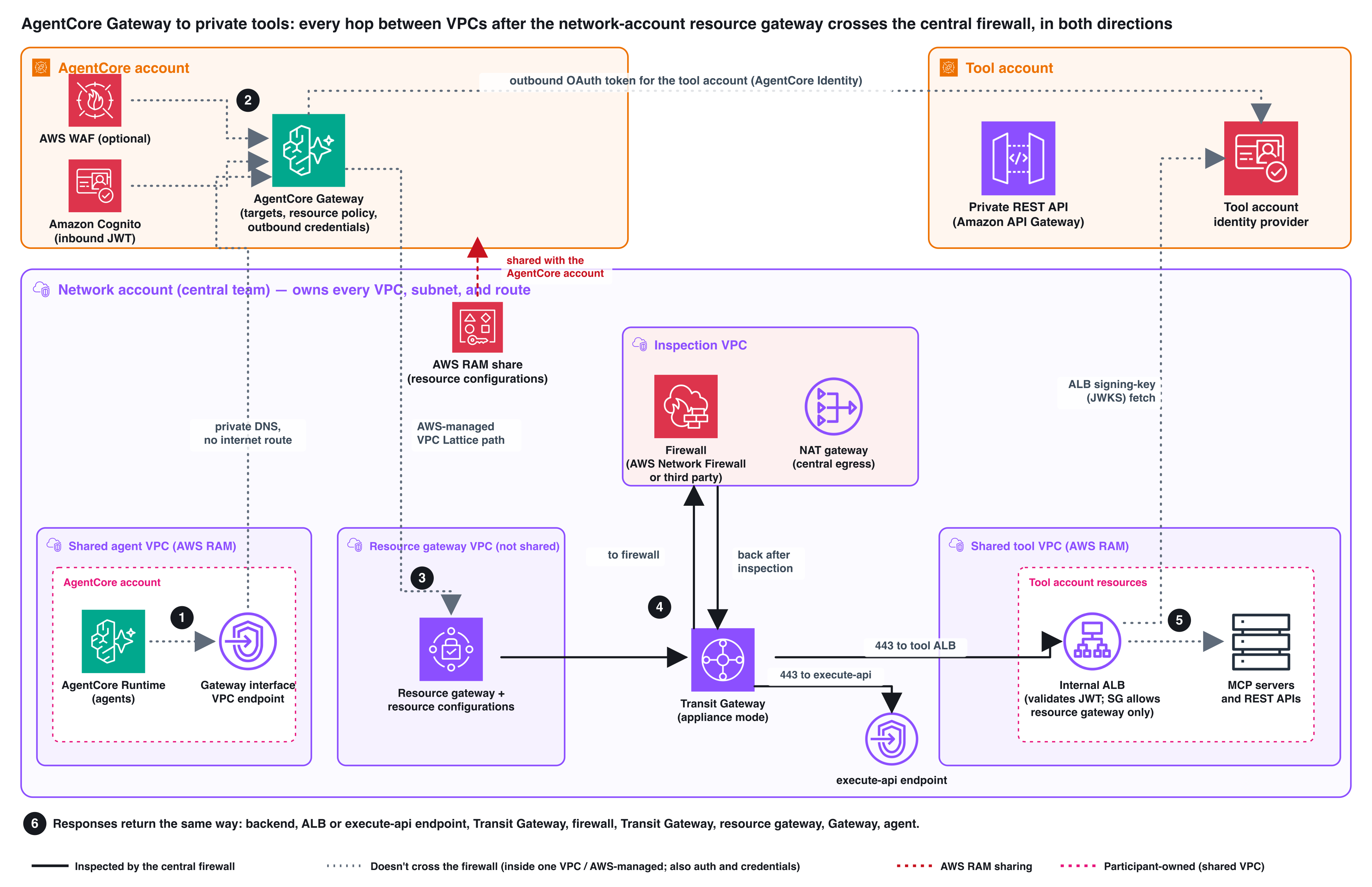
Connect Amazon Bedrock AgentCore Gateway to private APIs in a hub-and-spoke network with centralized inspection

Many enterprises run a centralized network model: one account owns every VPC and a central firewall inspects all traffic. This post shows a tested pattern for connecting Amazon Bedrock AgentCore Gateway to private APIs and MCP servers in that model, with the VPC Lattice resource gateway in the network account so every hop crosses the firewall.

Read at AWS Machine Learning Blog

arXiv (research papers) Junjie Ye

$Z$-sight: Unifying Vision-Language-Action and Latent World Modeling

We introduce $Z$-sight, a unified robot foundation model that couples vision-language-action (VLA) and generative latent world modeling. Video-based world action models (WAMs) show the value of joint future-and-action generation for control, yet inherit the heavy cost of video generators. Recent latent-space policies avoid pixel generation, yet typically align intermediate features or rely on frozen target encoders, decoupling future prediction from the VLM's native feature…

Read at arXiv (research papers)

arXiv (research papers) Yupeng Zheng

Phoenix: Learning Scene Structure Representations for Generalizable World-Action Models

World-action models jointly predict future observations and actions, yet reconstruction-oriented visual representations do not explicitly emphasize the spatial relationships and object-state changes needed for manipulation. We introduce Phoenix, which learns representations of scene structure for world-action modeling. Specifically, Phoenix Encoder enriches DINOv3's general visual semantics through dual-teacher distillation of geometric and spatiotemporal semantic knowledge…

Read at arXiv (research papers)

arXiv (research papers) Priyanka Sinha SI

Knowing What You Know: A Trait Theory of Reviewer Value in Human-AI Cognitive Systems

When a capable model and a human reviewer cooperate on the same decision, which human still adds value? We argue this is a question about a single cognitive trait, metacognitive calibration: the alignment between a reviewer's behavioral confidence and the actual correctness of their judgments. We develop a trait theory of reviewer value to make it precise. The theory makes five claims: value is governed by calibration rather than by activity, speed, agreement, or tenure…

Read at arXiv (research papers)

arXiv (research papers) Sarah H. Cen SI

Mapping the AI Supply Chain: Dependencies, Vulnerabilities, and Market Concentration in the AI Ecosystem

AI systems are built across many organizations that contribute models, data, compute, capital, talent, and other assets. While the layers of the AI stack are relatively well understood, the relationships between actors and components across layers remains sparsely documented. In this work, we focus on the organizations that make up the AI supply chain: the complex network of actors that contribute to the development and deployment of AI. We motivate the examination of the…

Read at arXiv (research papers)

arXiv (research papers) Zi-ang Cao

Grana: Compositional Reward Modeling for Long-Horizon Robot Manipulation

Robot reward modeling faces two challenges: generalizing across tasks and accurately tracking progress in long-horizon manipulation. General-purpose reward models demonstrate broad task transfer, but transfer from short-task pretraining to long-horizon tasks remains underexplored. Long-horizon progress models often rely on task-specific subtask classifiers or fixed action vocabularies, limiting the reuse of learned progress knowledge when adapting to new tasks. To address…

Read at arXiv (research papers)

arXiv (research papers) Yash Jangir

Render the Robot, Generate the World: One Video World Model Across Embodiments

Predicting the consequences of an agent's actions requires modeling both the body's motion and the environment's response. Most video world models attempt to learn both from numerical actions, even though geometry and kinematics already specify the intended motion. We introduce Doppel, an embodiment-agnostic video world model conditioned on camera-aligned renderings of future body configurations and numerical action trajectories. By explicitly providing the intended motion…

Read at arXiv (research papers)

The Decoder Jonathan Kemper SI

Microsoft is replacing outside AI models in its own products with cheaper in-house alternatives

Microsoft's AI division MAI unveiled seven new models for code, security, images, language, and routing at Ignite. MAI Code 2 reaches 98 percent of GPT-6.1 Sol's performance at 40 percent of the cost, according to Microsoft. The models are built for running AI agents around the clock in enterprises. The article Microsoft is replacing outside AI models in its own products with cheaper in-house alternatives appeared first on The Decoder.

Read at The Decoder

arXiv (research papers) Muhammad Rizky Wellyanto SI

Who are you? The Personal Imitation Game

Large Language Models (LLMs) now perform strongly on Alan Turing's 1950 Imitation Game, so we propose a harder challenge, the Personal Imitation Game, which asks whether a machine can replicate a specific individual in conversation rather than a generic human. Testing with 30 participants, we establish a human baseline and report the identity signals interrogators rely on: stylometric features, personality traits, and biographical facts. To demonstrate the framework, we…

Read at arXiv (research papers)

arXiv (research papers) Zhiyu Liu SI

Auditing black-box clinical prediction models with a large language model through queries alone: a blinded test with planted flaws

Large language models (LLMs) are used to explain clinical prediction models, on the promise that they can say what a model computes, find its faults and even reveal new knowledge in it. We tested the three promises where the answers could be checked. From the International Stroke Trial we trained four kinds of model (logistic regression, explainable boosting machine, gradient-boosted trees, neural network) for two outcomes on patients randomised earlier, planted one flaw in…

Read at arXiv (research papers)

arXiv (research papers) Beyazit Yalcinkaya

Learning to Interact in Multi-Agent Self-Play for Controllable Autonomous Driving Scenario Generation

Large-scale, multi-agent self-play trains robust driving policies effectively in simulation, but controlling these models to generate specific, safety-critical edge cases remains a key challenge. Existing goal-conditioned self-play frameworks rely primarily on static map-location goals and fail to reliably produce complex agent interactions such as aggressive tailgating or adversarial cut-offs. These agent interactions are necessary for rigorous autonomous vehicle (AV)…

Read at arXiv (research papers)

arXiv (research papers) Mingliang Zhai SI

WorldRuler: Interactive World Modeling under Configurable Rules

Rules govern how player actions change interactive worlds. Different rules create distinct gameplay experiences within similar scenes and action spaces. For customizable gameplay, generative world models must follow user-defined rules beyond real-world behaviors. However, realizing user-defined rules presents two challenges: Rule-State Persistence and Rule-to-Visual Realization. The former requires preserving rule definitions, dependencies, and world states across saving and…

Read at arXiv (research papers)

arXiv (research papers) Chenjie Zhao

NereidVLA: Learning to Understand and Navigate the Underwater World

Underwater navigation requires translating visual spatial cues into motion, yet marine vision-language datasets rarely include paired robot trajectories. We present NereidVLA, a vision-language-action model that transfers marine spatial knowledge to language-conditioned 3D navigation. We first train Sea2Know on approximately two million marine examples to learn target grounding, spatial relations, and scene structure without paired robot-motion supervision. We then adapt it…

Read at arXiv (research papers)

arXiv (research papers) Adrián Juan-Delgado

Time-Varying Medium from an Ensemble of Laser-Dressed Quantum Emitters

We propose a minimal quantum-mechanical model of a frequency dispersive, time-modulated medium that explicitly incorporates the pumping mechanism. It consists of a homogeneous ensemble of quantum emitters dressed by a pump laser. We analyze their dispersive, time-varying response to a perturbative probe field by deriving the macroscopic polarizability of the ensemble, and then solving Maxwell's equations via the Floquet formalism. This yields a rich band structure that…

Read at arXiv (research papers)

arXiv (research papers) Mark Marosi SI

General progress substitutes for specific training data in language models

Language models acquire their capabilities from training data, and developers withhold data during training to keep models from learning capabilities that could be misused. How long this delays a capability, and how much data is needed to acquire it later, is unknown. Here we show that the general progress a model makes on the rest of its training data substitutes for the data that was withheld. We withheld the training signal for individual skills in models of chess…

Read at arXiv (research papers)

arXiv (research papers) Binay Kumar Singh SI

Does the Action Matter? Probing Action-Conditioned Semantic Forecasting as a World Model for Autonomous Driving

World models are increasingly used in autonomous driving to predict how a scene evolves under the ego vehicle's actions, supporting counterfactual reasoning and model-based planning. However, existing evaluations focus on prediction fidelity and planning performance, and rarely verify that the predictions depend on the conditioning action. In this paper, we study action dependence in action-conditioned semantic forecasting, which predicts future semantic segmentation from…

Read at arXiv (research papers)

arXiv (research papers) Akshay L Chandra

DiWALI: Diffusion Policy Learning in World Models via Latent Action Inference from Human and Robot Play

Learning robot manipulation is constrained by the availability of action-labeled robot data, for both imitation and world models. Humans can demonstrate skills in seconds, but their demonstrations lack the required robot actions. We introduce DiWALI, a framework that learns and improves diffusion policies within a world model trained on human and robot play. DiWALI infers latent actions from consecutive frames using an inverse dynamics model, enabling world model training…

Read at arXiv (research papers)

The Decoder Matthias Bastian SI

OpenAI says its models delivered a year's worth of chip optimization on top of AMD's own engineering

Working with AMD, OpenAI achieved up to 14 percent PPA improvement on AMD's flagship GPU IP in less than five months. According to OpenAI, that's roughly a year's worth of progress, and AMD has already folded the changes into a design sent to production. Anthropic is also applying AI to chip work to optimize cost and performance per dollar. The article OpenAI says its models delivered a year's worth of chip optimization on top of AMD's own engineering appeared first on The…

Read at The Decoder

Google (The Keyword) Diego Rivas Group Product Manager Google DeepMind

Genie 4 is now available

We are rolling out a new Project Genie experience to eligible Google AI Ultra subscribers, opening access to our new Genie 4 world model.

Read at Google (The Keyword)

arXiv (research papers) Haoran Ye SI

A Foundation Model to Measure and Predict Human Behaviour

Large language models (LLMs) are increasingly used to infer psychological attributes, predict individual behaviour, and simulate human populations. However, despite generating plausible responses, they often misrepresent individuals and distort population statistics. Here we introduce Chiron, a foundation model to measure and predict human behaviour. We jointly fine-tune an LLM to represent psychological constructs, predict individual behaviour, and align population response…

Read at arXiv (research papers)

arXiv (research papers) Baran Kaynak SI

LAaDT-DSS: decision support for non-experts on rooftop PV, incentive and grid simulations under Turkish tariff rules

Rooftop photovoltaics raise three questions: should a household invest, which incentive costs the state least, and does the feeder stay within limits? Those who ask are rarely modellers. We present LAaDT-DSS, decision-support software that answers all three under Turkish tariff rules from one simulation core. Non-experts reach it by clicking a house on a 3D map or by asking in plain words; a language model is asked to call the simulation tools, not to compute. Each entry of…

Read at arXiv (research papers)

arXiv (research papers) Valeria Repetto SI

Soft Mixture of Quantum Experts for Hybrid Quantum-Classical Learning

Quantum Machine Learning (QML) has attracted increasing interest as a possible route to construct feature representations that are difficult to reproduce with classical models. However, near-term QML architectures based on trainable parametrized quantum circuits remain affected by limited hardware resources, noise, and severe optimization difficulties such as barren plateaus. In this work we propose Soft-MoQE, a Soft Mixture of Quantum Experts architecture that replaces…

Read at arXiv (research papers)

Older stories