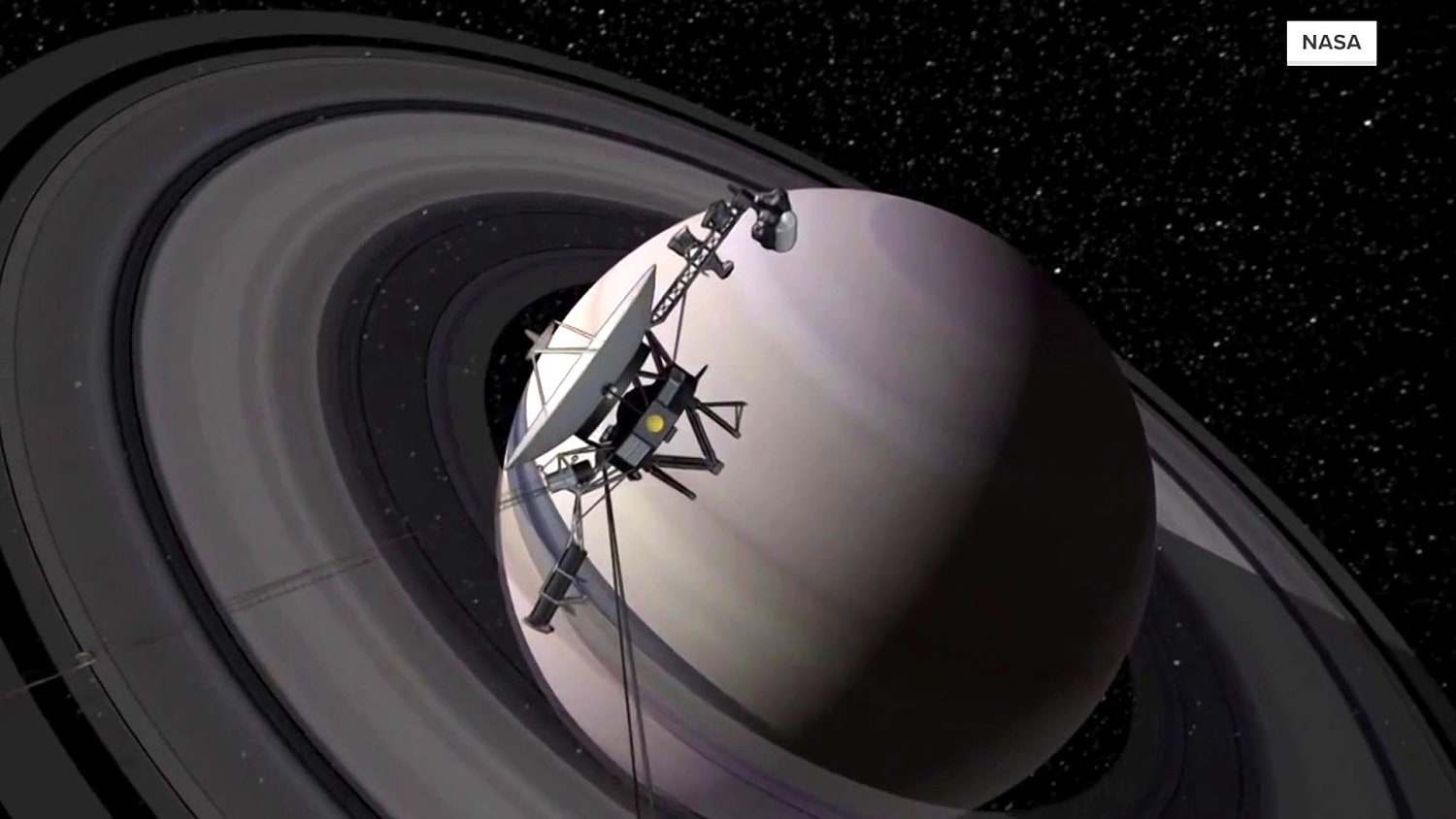
Voyager 1 reaches one light-day from Earth after 49 years in space
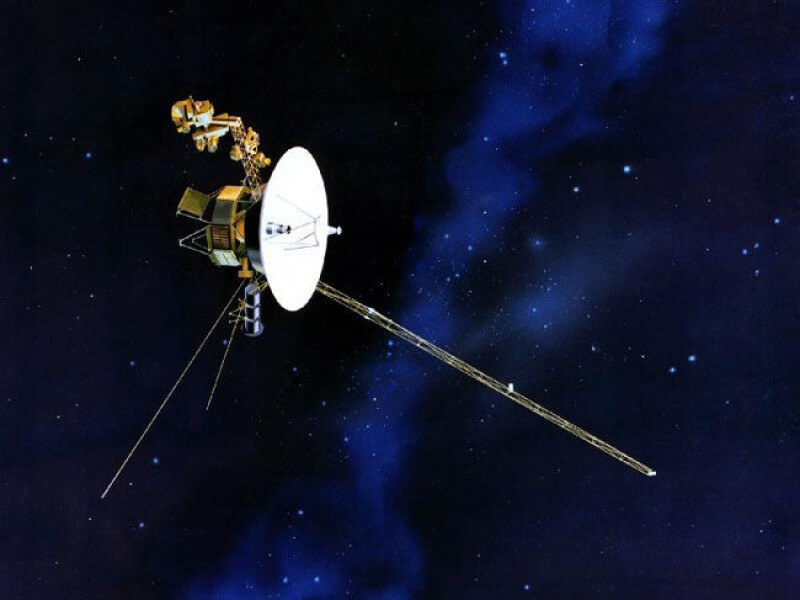
NASA’s Voyager 1 has reached a record distance of more than 16 billion miles from Earth, 49 years after its launch.
NASA’s Voyager 1 has reached a record distance of more than 16 billion miles from Earth, 49 years after its launch.
Due to unfavorable weather, NASA and SpaceX are standing down from Wednesday’s undocking opportunity of the Dragon cargo spacecraft that arrived at the International Space Station on Oct. 15.
We introduce $Z$-sight, a unified robot foundation model that couples vision-language-action (VLA) and generative latent world modeling. Video-based world action models (WAMs) show the value of joint future-and-action generation for control, yet inherit the heavy cost of video generators. Recent latent-space policies avoid pixel generation, yet typically align intermediate features or rely on frozen target encoders, decoupling future prediction from the VLM's native feature…
Symmetry-preserving (SP) variational quantum circuits restrict evolution to physically relevant sectors of Hilbert space, but symmetry preservation alone does not guarantee accessibility within those sectors. We show that a restricted generator set can possess a residual dynamical Lie algebra whose commutant further decomposes the target symmetry sector into invariant blocks. The associated block populations are conserved and impose a kinematic upper bound on the fidelity…
Calculating molecular energies is expected to be an important application of quantum computers, but the most efficient algorithms to achieve this typically have significant space requirements. Scaling quantum processors to thousands of logical qubits is a daunting engineering challenge, so developing algorithms that run with reduced qubit requirements is of particular importance. Moreover, most algorithms are benchmarked on active spaces with about as many orbitals as…
The night sky is as good a place as any for a mystery. Back in 2002, astronomer Scott Hyman and his colleagues detected five mysterious bursts of radio waves coming from near the center of our galaxy, spaced roughly 77 minutes apart. The signals were detected again in 2003 and 2004, but then disappeared. Despite years of searching, there was no sign of their return.
Rules govern how player actions change interactive worlds. Different rules create distinct gameplay experiences within similar scenes and action spaces. For customizable gameplay, generative world models must follow user-defined rules beyond real-world behaviors. However, realizing user-defined rules presents two challenges: Rule-State Persistence and Rule-to-Visual Realization. The former requires preserving rule definitions, dependencies, and world states across saving and…
NASA launched a new competition inviting U.S. companies to produce prototypes of mid-power Hall effect thrusters – a type of electric propulsion system considered crucial for future space operations and exploration. Hall effect thrusters use an electric field to accelerate a propellant gas, producing efficient thrust for long-duration missions. Used for propelling satellites and deep
Certifying quantum non-classicality like Wigner negativity typically demands full optical state tomography. This work introduces a noise-resilient framework for witnessing optical Wigner negativity using phase-resolved quantum photon-induced near-field electron microscopy (QPINEM). By mapping electron coherences directly to symmetrically ordered optical characteristic functions within a coupling-limited phase-space region, the protocol bypasses full optical reconstruction. A…
The Empire State Building is seen illuminated in gold to celebrate NASA’s Voyager 1 spacecraft as it was about to pass one light-day away from Earth, a distance reached by no other human-made object, Nov. 17, 2026. The color gold represents the gold-plated copper phonograph record that is flying on Voyager; the Golden Record contains
NASA's Voyager 1 spacecraft became the first human-made object to reach a distance of one light-day from Earth early Wednesday, crossing the threshold at 5:16:07 a.m. EST (10:16:07 UTC) as it sped away from the sun at nearly 38,000 mph.
A method for detecting the intrinsic magnetic fields of exoplanets, based on the effect of atomic alignment (the redistribution of populations among magnetic sublevels under the action of anisotropic radiation from the host star), has been adapted for observations with the Spektr-UV space telescope. A procedure for selecting sensitive transitions is proposed, and triplet absorption lines in the UV range that are sensitive to alignment are identified. On the basis of…
Neural networks with randomly initialized, fixed weights and trainable biases are universal approximators, yet the dynamics of bias-only training remain largely unexplored. We study these dynamics in one-hidden-layer ReLU networks through activation codes, the binary patterns of active neurons that partition the input space into convex polyhedral regions. We show that the gradients with respect to the biases depend on each input only through its activation code, and hence…
Neural networks trained on the same task develop related weight-space structures, yet remain distinguishable after learning. Do these differences merely reflect alternative solutions, or do they preserve information about individual learning histories? We tested whether final weights reveal initialization, task order, and earlier trajectory states. Training reorganized the ensemble: initial pairwise distances did not consistently predict final distances. Nevertheless, all 30…
Researchers often examine online violent extremism through the content, accounts, and interactions visible on individual digital platforms. This approach helps identify extremist material and enforce platform rules, but offers only a partial view of how online activity develops over time. Past research has already documented movement between mainstream platforms and more private or encrypted spaces. The question is therefore not
In this episode of SpaceMinds, SpaceNews’ Mike Gruss talks with Thomas Sinn, the CEO of Dcubed, at Space Tech Expo Europe. They discuss the company’s new $30 million funding round,
NPU design-space exploration for LLM inference mainly relies on an expensive simulator that often returns only scalar feedback such as latency and power. Such feedback can rank evaluated configurations, but gives little information for deciding why a configuration is slow or which architecture parameter should be changed next. This limitation is especially severe because prefill and decode workloads can be limited by different resources, including compute throughput and HBM…
Agents that do science must choose informative experiments and reason from their results, but most discovery benchmarks cannot separate that skill from recall, unstated scoring rules or shortcut policies. We introduce Openhagen Worlds, a suite of 27 procedurally generated environments (some with finite truth spaces), from classic puzzles of experimental reasoning to simulator-grounded physics and chemistry, in which an agent runs experiments under a budget and commits an…
Discover 10 polite ways to set boundaries with family and colleagues while protecting your time, energy, personal space and emotional well-being.
NASA's Voyager 1 probe, which has been traveling through space for nearly 50 years, hit a milestone distance of one light-day away from Earth on Wednesday.
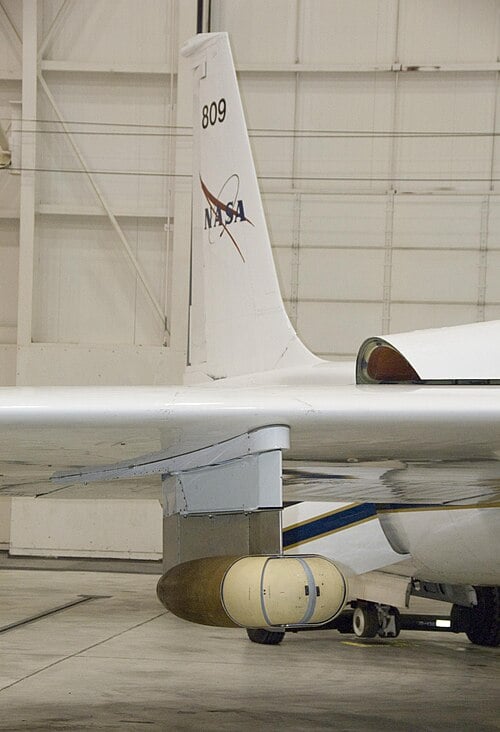
Astronomers can find valuable information in even the tiniest objects. That was certainly the case recently when twelve dust grains collected by a high-altitude aircraft helped solve a mystery about the birth of our Solar System. Or at least that is the argument in a new paper published in Science Advances by researchers at NASA’s Johnson Space Center and UCLA. According to the paper, the region beyond Neptune once had a massive isolated reservoir of “heavy water” that never…
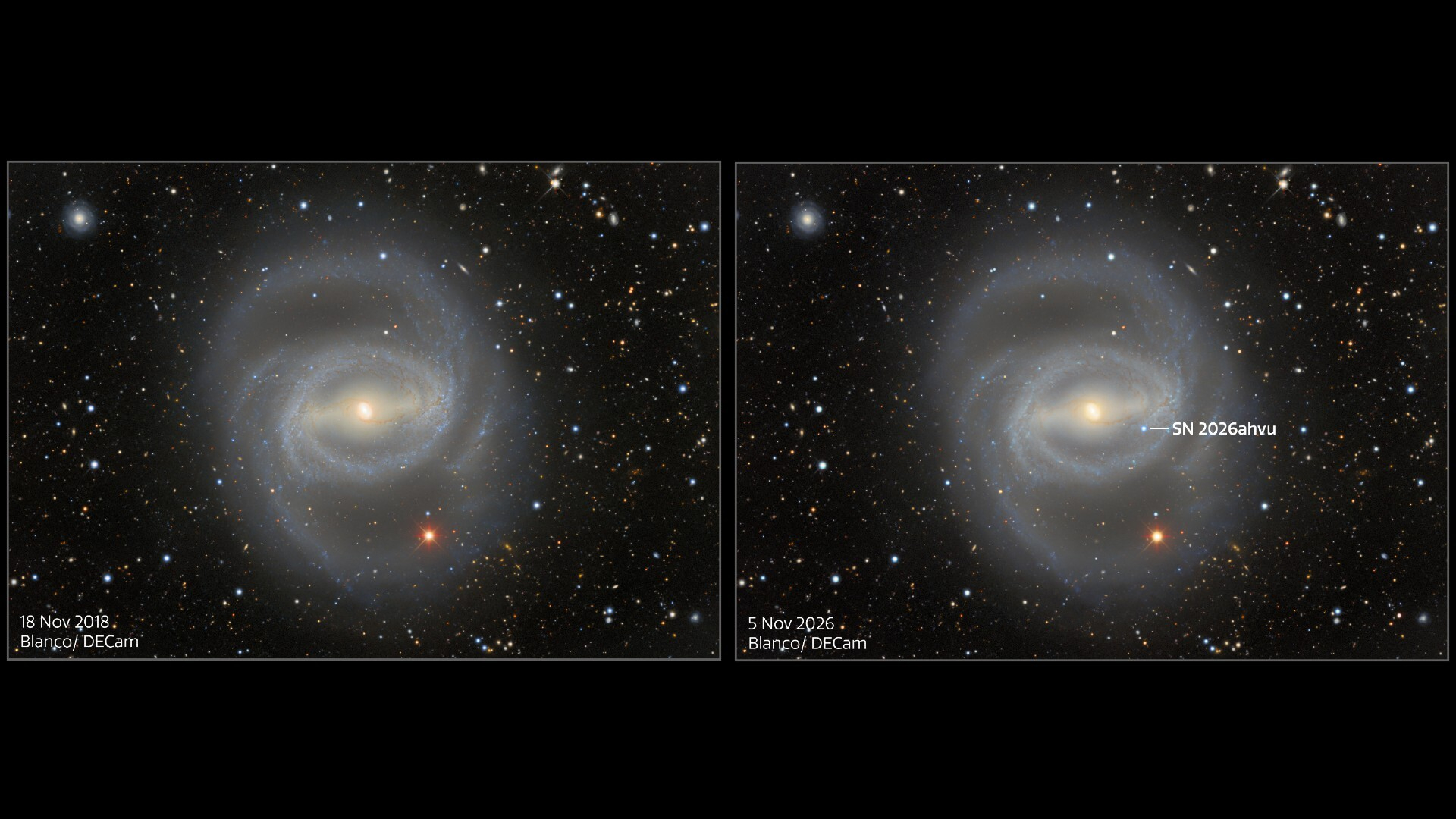
A new supernova (SN 2026 ahvu) has been found in the spiral galaxy NGC 1433, about 50 million light-years from Earth.
As the world is hit by IT snafu after IT snafu, Voyager sails on, almost half a century after launch
Europe’s space industry is heating up, and it’s starting to attract outside attention. CUBECOM, the South African company developing RF communications systems for satellites, today announced it’s opening a new office in Delft, the Netherlands as part of an effort to lock down more deals across the continent. The new office will initially host the…
Inflection Space System's first mission, Pax, will launch NET 2028 on a rideshare booked through Exolaunch.
The Indian space-tech startup SatLeo Labs is betting that near-real-time temperature data from satellites can help the world stay ahead of escalating climate disasters.
After 49 years of traveling in space, NASA’s unmanned Voyager spacecraft has become the first human object to reach a full light day from Earth, meaning it would take a full 24 hours to reach the spacecraft traveling at the speed of light — 670 million miles per hour! NBC’s Tom Costello reports for TODAY on the spacecraft’s remarkable journey.
We investigate whether a weight edit can alter how a model trades off honoring a commitment against benefiting more people. In a concept-supervised text model, we alter fitted choice weights so that the benefit required to override a formal pledge is larger than for an ordinary promise. Across six independently trained text readers, the edit selects the larger group in both orders on 100% of targeted ordinary conflicts and 83.3% of targeted formal conflicts. It preserves the…
Early Sunday morning Korea time, two steel arms in Texas caught a spacecraft that had just circled Earth 14 times. It was a magnificent display of human ingenuity. The previous day, Starship’s booster had failed to return to the pad. The upper stage still made it home. This week brings a different test of human
EPC Space LLC of Andover, MA, USA (which manufactures high-reliability radiation-hardened enhancement-mode gallium nitride-on-silicon discrete transistors, ICs and modular devices for power management in space and other harsh environments) has expanded its portfolio of radiation-tolerant GaN HEMTs by adding plastic QFN (PQFN) and hermetic packaging options for next-generation space power systems...