Rumors about next year’s 20th anniversary iPhone Pro models have been ramping up, and they suggest Apple is designing an ‘iPhone 20 Pro’ that combines traits from two current models.
Ask an artificial intelligence model to grade a job interview or test answers, and a person’s accent may change the score. That is according to new University of Washington research that looked at how some of the most advanced AI models rated English speakers with different accents, both on what they said and how they said it. In the scripted tests, every speaker said the same words, and AI models transcribed the accented speech accurately, meaning the models understood the…
Advanced technologies are being applied to improve forecast quality, with data from numerical models, satellites, radars and observation systems integrated into forecasting operations. JICA continues supporting Vietnam in quantitative precipitation forecasting Vietnam to host international conference on hazardous weather forecasting Observation systems key to stronger forecasting, sustainable development
With the Pixel 11 Pro, Pixel 11 Pro XL, and Pixel 11 Pro Fold, but for now we are checking out the day’s best Android game and app deals. We have collected all of the this week’s for you today down below, just beside to scope $100 off all Pixel Watch 5 models, the ongoing all-time low Google Home Speaker and the first discounts on these Googlebook models from HP and Lenovo.
Token prices for AI models fell 21 percent in six weeks while usage volume hit a record high, according to the Ramp AI Index. Anthropic dominates with nearly 59 percent of token spending. Data from Ramp, Stripe and OpenRouter independently show the same pattern: the AI industry is still growing, but revenue momentum is cooling. The article AI industry growth remains strong, but the pace is slowing appeared first on The Decoder.
Videos reveal how the world changes, but rarely the actions that cause those changes. Latent action learning recovers such supervision from visual transitions, yet often learns the underlying dynamics largely from scratch. We ask whether a pretrained video generator can instead provide the prior for both inverse and forward dynamics. We introduce O$^{2}$LaF, built on a simple principle: one prior, two dynamics. We initialize both models from the same pretrained video DiT and…
Simulating rigid-body dynamics with contact is fundamental to robotics, from motion synthesis and control to mechanism design. Many widely used simulators rely on cone complementarity formulations, whose physical assumptions and numerical solution require substantial background. While excellent surveys, monographs, and course notes exist, they mostly address computational mechanics or computer graphics or document a single simulator. To the best of our knowledge, a…
Robotic vision-language-action (VLA) models can execute diverse individual manipulation skills, yet they still struggle with long-horizon loco-manipulation tasks, where temporal structure, skills, and precision are tightly coupled within a monolithic model. We propose Physically Grounded Execution (PGX), a framework that offloads temporal and precision control to two classical training-free components, allowing the VLA to focus on stage-specific skill dynamics. PGX…
Vision-language models (VLMs) integrate visual and textual information, but their outputs do not reveal internal concept representations. Global workspace theory (GWT) proposes that information is selected from parallel brain processes, integrated in a shared workspace, and made available to specialised processes. We introduce the Multimodal Concept Lens (MC-Lens), a multimodal Jacobian lens, to study these functions in VLM concept processing. Its vision encoder and language…
Graphic designs are ordered compositions of RGBA layers whose separation enables selection, movement, and reuse. Existing layered models represent each layer with a full-canvas or region-sized spatial latent grid, so representation size grows with the cumulative spatial extent of the layers. We present ProtoDiffusion, a latent-diffusion framework built on ProtoVAE, a multi-layer variational autoencoder that encodes a design into one shared spatial prototype and one candidate…
Ground-state measurement statistics characterize quantum matter. Selected correlations can guide the classical training of a quantum sampler even when sampling the full distribution is difficult. We ask whether training across related ground-state distributions helps the sampler reproduce their correlations more accurately. We train a hypernetwork to map Hamiltonian parameters to circuit angles, sharing information across the phase diagram before local fine-tuning with…
Vision-Language-Action (VLA) models have advanced rapidly in language-conditioned robotic manipulation, yet existing benchmarks mainly evaluate gripper--object contact and largely ignore how objects interact with the environment through gravity, friction, inertia, and mass distribution. As a result, it remains unclear whether current policies truly understand physics or merely interpolate from their training data. We address this gap through the lens of dynamic extrinsic…
When multimodal decision models determine actions, moderation outcomes, or quality judgments, their reliability depends on preserving semantic decisions across presentation changes, ignoring irrelevant additions, and distinguishing information consistent with task evidence from information that conflicts with it. Existing evaluations study decision-interface biases and multimodal model behavior in separate settings, leaving no common protocol to compare multimodal decision…
Agents based on large language models (LLMs) can now delete files and send payments on behalf of their users. News media reports routinely describe failures of these agents (e.g., Replit's coding agent deleting a production database), but a report often only says what went wrong and rarely (in)validates the incident or finds its root cause. Incident catalogs collect these reports, and benchmarks record whether agents fail, but neither replicates an incident nor tests the…
Linear probes are the cheapest LLM lie detectors but often fail to transfer across kinds of lie. Label-free directions from honest and deceptive role-play are untested at 70B scale and on lies about knowledge, where a lie and an honest denial can be identical. We widen a published persona bank with roles that deny knowledge they have, plus honest counterparts. At each model's middle layer the resulting persona direction ranks lies across Liars' Bench better than…
Current audio-driven video diffusion models can synthesize realistic talking-head videos but generally require dozens of diffusion denoising steps over multi-second video chunks, making them unsuitable for streaming applications such as voice assistants and virtual avatars, where low-latency and online causal generation are required properties. AURA generates video chunk by chunk with a rolling KV cache, requiring only the audio of the current chunk to start generating…
Large Web platforms operate large fleets of ranking models, each selecting features from a shared pool of tens of thousands. We present an end-to-end agentic system that optimizes features across the fleet under resource constraints shared across models and those set per model, such as feature pipeline cost and serving throughput (QPS), respectively. In this system, LLM agents propose hypotheses, and deterministic tools execute experiments and verify them. For each model, an…
Pongbot's Black Friday offers include six AI-powered training packages for tennis, pickleball and padel, with Aura models starting at $599.99 and Pace S Pro options for dedicated tennis players.
Decision models enable fast, confidence-aware decisions by scoring candidate answers in a single forward pass, without generating text or intermediate reasoning. Yet reasoning can substantially improve decision quality, raising the question of whether its benefits can be retained without the cost of generating it. We investigate this question with \textbf{GLiDE}, a family of decision models spanning 0.4B to 27B parameters. Building on Qwen hybrid language models, GLiDE…
Commercial video-generation APIs bill by model and tier, while intermediaries could substitute cheaper models, lower tiers, or cached clips. What can a delivered file establish about its origin? We combine measurements of passive attribution and cryptographic provenance into a graded audit. We test attribution probes and zero-shot detectors under re-encoding, downscaling, and frame-rate changes, and survey C2PA and GB 45438 metadata across 19 commercial endpoints. Only…
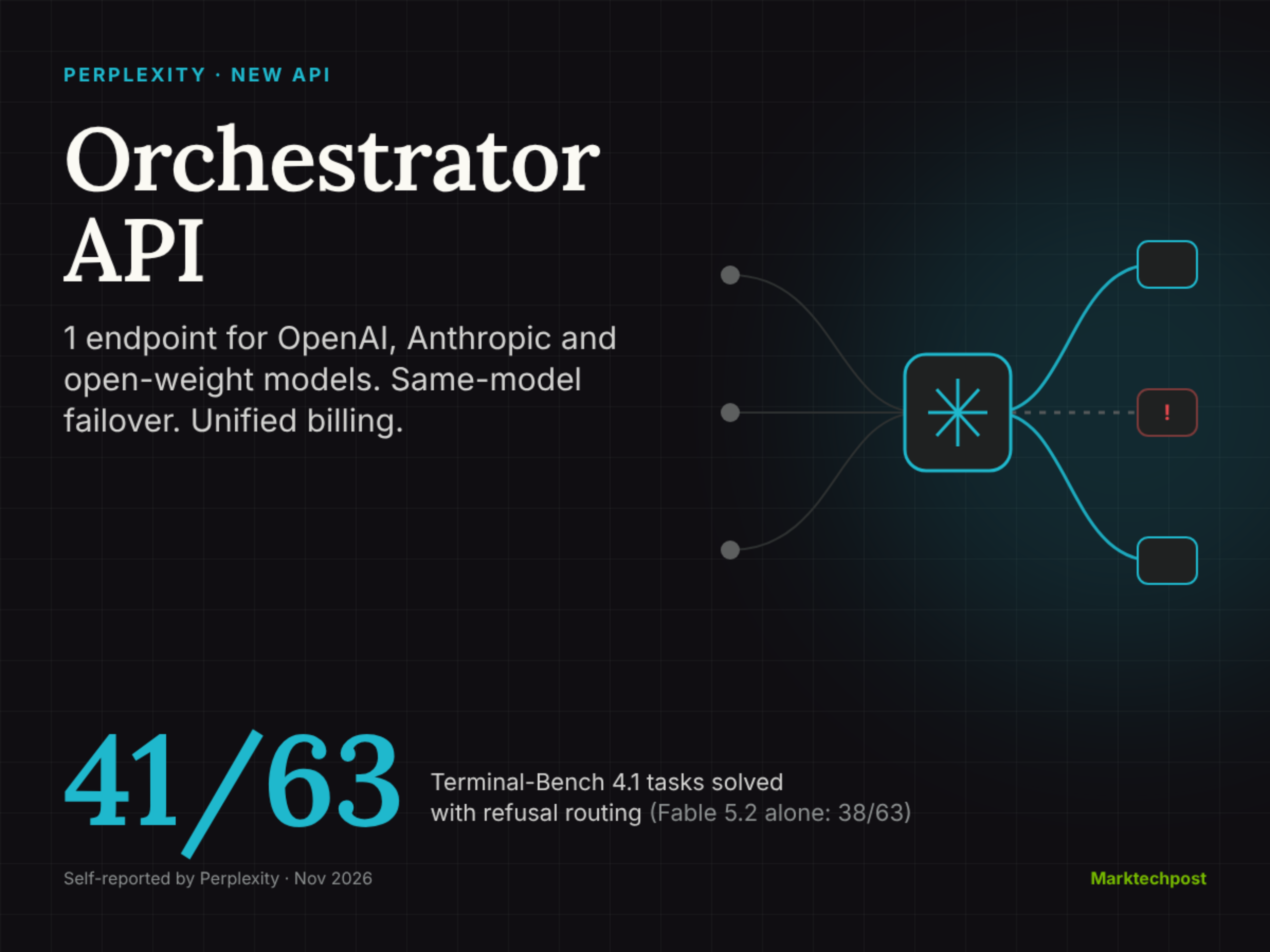
Perplexity’s Orchestrator API serves OpenAI, Anthropic, Google, xAI and open-weight models through 1 endpoint, with same-model provider failover, unified billing and a preview perplexity/auto router that sends each request to a described route.
Pretrained language models (LMs) remain unreliable on exact multi-digit arithmetic without gradient fine-tuning or external tool interpreters. We introduce closed-form, zero-gradient circuit-grafting primitives that compile deterministic computation directly into pretrained LM weights using zero training examples and zero runtime hooks, while bounding per-layer normalization drift and preserving natural-language (NL) competence. Our construction combines three analytical…
Black Friday brings substantial savings on portable projectors, 4K laser models, and home theater upgrades, including $200 off Optoma's Photon Go and discounts from Epson, JMGO, Dangbei, and XGIMI.
Frontier text-to-image (T2I) foundation models predominantly rely on multi-billion parameter Diffusion Transformers (DiTs) pretrained across massive compute clusters, creating an accessibility barrier for academic laboratories. When training DiTs from scratch on single consumer GPUs (e.g., an NVIDIA RTX 4090 with 24\,GB VRAM), practitioners encounter three primary bottlenecks: quadratic attention sequence costs, Just-In-Time (JIT) compilation graph breaks induced by variable…
Roborock has launched its Black Friday 2026 deals with some killer discounts including up to half off select models, and over $1650 off its flagship offering.
Vision-Language-Action (VLA) models have recently been equipped with tactile sensing to perceive visually subtle contact events in contact-rich manipulation. However, adding tactile input yields inconsistent gains, and some visuo-tactile VLA models rely little on tactile input, because much of the tactile change, such as the gel deformation during gripper closure, is predictable from visual observations and executed actions. To address this problem, we introduce TacInno…
A key challenge in fault-tolerant quantum error correction (QEC) is that the syndrome extraction circuits are themselves faulty. Such circuit-level noise is commonly described by a detector error model (DEM). In Stim and in almost all related works, DEMs are binary: every non-binary circuit error (e.g., CNOT gate), is decomposed into independent binary error mechanisms. In this work, we introduce non-binary DEMs, in which each fault location of the syndrome extraction…