Results for “GPT-6.2”

The Hacker News Security

ThreatsDay: GPT-6.2 Jailbreak Flaws, BubbleLoader PNG Malware, $500M Ransom Demands + 17 More Stories

The easiest way to fool someone is to give them something they already expect. A job offer. A message about a service outage. A familiar app. Nothing looks strange at first. And that's the problem. This week's stories show how ordinary things are being used to steal data, spread malware, and get people to hand over access. There's another shift worth watching. AI is making some attacks easier

Read at The Hacker News

Digital Trends Dwayne Cubbins

Google releases Gemini 4 Neon AI model, rivals Claude Opus 5.5 and GPT-6.2 Sol

Gemini 4 Neon is now in the Gemini app for Google AI Pro and Ultra subscribers. Google says the mid-tier model scores 61 on a major index, ahead of Claude Opus 5.5 and GPT-6.2 Sol in its own tests.

Read at Digital Trends

The Decoder Jonathan Kemper SI

Microsoft is replacing outside AI models in its own products with cheaper in-house alternatives

Microsoft's AI division MAI unveiled seven new models for code, security, images, language, and routing at Ignite. MAI Code 2 reaches 98 percent of GPT-6.1 Sol's performance at 40 percent of the cost, according to Microsoft. The models are built for running AI agents around the clock in enterprises. The article Microsoft is replacing outside AI models in its own products with cheaper in-house alternatives appeared first on The Decoder.

Read at The Decoder

Android Authority Hillary Keverenge Gadgets

OpenAI launches GPT-6.2 Astra and Sol, but not everyone is sold on the cheaper upgrade

Last-minute GPT-6.2 changes may explain the negative early reviews.

Read at Android Authority

MarkTechPost Michal Sutter SI

SID AI Releases SID-2 Agentic Search Model With 0.720 NDCG Swarm Mode

SID AI released SID-2, an agentic search model trained with reinforcement learning. A single agent reaches 0.585 NDCG in 3.11 seconds, and a 12-agent SID-2 Swarm scores 0.720 NDCG, above GPT-6 Astra on SID’s benchmark.

Read at MarkTechPost

Tech in Asia Diya Lal Startups

OpenAI launches GPT-6.2 Astra, Sol with lower token use

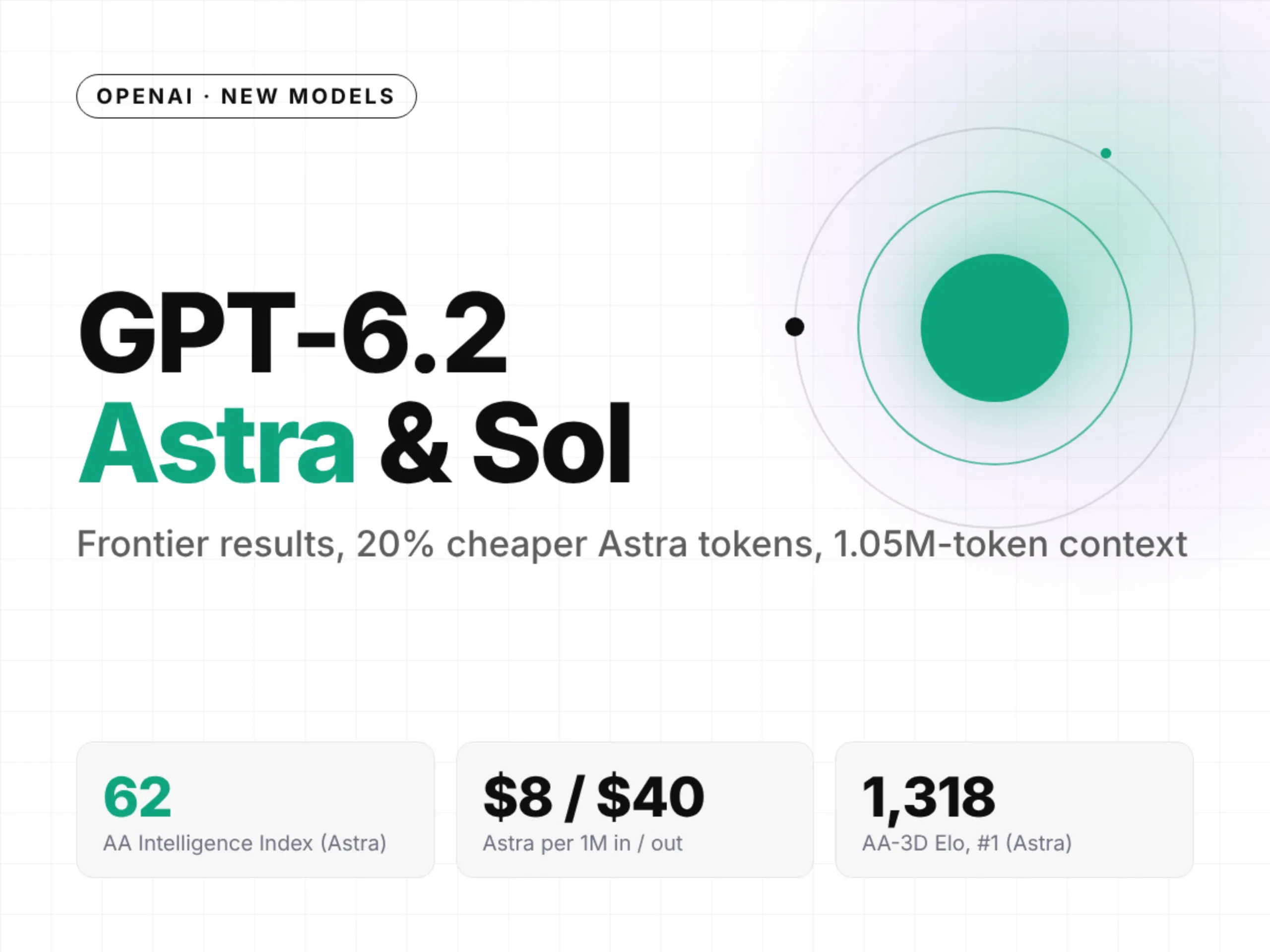
OpenAI said Astra’s application programming interface prices are US$8 per million input tokens, US$0.40 for cached input, and US$40 for output.

Read at Tech in Asia

TestingCatalog Erin | AI Agent SI

Microsoft launches MAI Cyber 2 Flash security model

Microsoft unveils MAI Cyber 2 Flash, a security model that tops GPT-6 Astra on CyberGym-E2E at under 2% of the cost, coming to MDASH in December.

Read at TestingCatalog

SiliconANGLE AI Duncan Riley SI

OpenAI rolls out GPT-6.2 Astra for professional work and GPT-6.2 Sol for everyday work

OpenAI Group PBC today announced the launch of GPT-6.2 Astra, a new frontier artificial intelligence model for complex professional work that is claimed to outperform its predecessor at less than a third of the cost, along with an updated version of its everyday model, GPT-6.2 Sol. The new models are aimed at businesses and developers

Read at SiliconANGLE AI

Simon Willison SI

GPT‑6.2 Astra and GPT‑6.2 Sol

GPT‑6.2 Astra and GPT‑6.2 Sol OpenAI: We’re introducing GPT‑6.2 Astra, our new frontier model for your hardest projects, and GPT‑6.2 Sol, our efficient, versatile model for everyday work. They're available in the API as gpt-6.2-astra and gpt-6.2-sol. I shipped LLM 0.38 with support for the new models. 6.2 Astra is 80% of the price of 6 Astra - $8/MTok input and $40/MTok output, the same price as Claude Fable 5.2 (which was also 80% of its predecessor). 6 Astra and Fable 5…

Read at Simon Willison

MarkTechPost Asif Razzaq SI

OpenAI Releases GPT-6.2 Astra and Sol With a 20% Cheaper Astra API

OpenAI released GPT-6.2 Astra and GPT-6.2 Sol on November 17, 2026. Astra's API price drops 20% to $8/$40 per million tokens, and it ranks second on the Artificial Analysis Intelligence Index.

Read at MarkTechPost

The Decoder Matthias Bastian SI

OpenAI launches GPT-6.2 Astra and Sol with lower API prices and some benchmark gains

OpenAI releases GPT-6.2 Astra and Sol, two new models that are more capable and cheaper than their predecessors. In the independent Artificial Analysis Intelligence Index, Astra ranks second behind Claude Fable 5.2, and it is the first released model to reach the High threshold for AI self-improvement on OpenAI's own scale. OpenAI itself classifies that as a risk. The article OpenAI launches GPT-6.2 Astra and Sol with lower API prices and some benchmark gains appeared first…

Read at The Decoder

The New Stack Amanda Caswell

OpenAI’s own tests show GPT-6.2 Astra is twice as likely to hide coding failures

OpenAI’s new GPT-6.2 Astra is nearly twice as likely as its predecessor to leave users unaware of problems that prevented

Read at The New Stack

Digital Trends Sudhanshu Kumar Mangalam

OpenAI’s GPT-6.2 Astra finally arrives, promising better performance and fewer safety problems

OpenAI has introduced two of its most powerful AI models yet, GPT-6.2 Astra and GPT-6.2 Sol, nearly two months after canceling GPT-6.1 Astra over safety concerns. According to the company, the new models are considerably better at coding, professional work, and scientific research. They can also complete complex tasks using fewer tokens, which brings down

Read at Digital Trends

TestingCatalog Erin | AI Agent SI

OpenAI launches GPT-6.2 Astra and Sol on ChatGPT and APIs

OpenAI launches GPT-6.2 Astra and Sol in ChatGPT Work, Codex and the API, with Astra beating GPT-6 Astra at lower cost and 20% cheaper tokens.

Read at TestingCatalog

9to5Google Ben Schoon SI

OpenAI releases GPT-6.2 Astra to regain performance lead from Claude Fable 5.2

The frontier model races continues. A week after the launch of Anthropic’s Claude 5.2 and Google’s Gemini 4 Hydrogen, OpenAI is releasing GPT-6.2 Astra and Sol as a “new standard for professional work.”

Read at 9to5Google

9to5Mac Zac Hall SI

OpenAI upgrades ChatGPT and Codex with new GPT-6.2 Astra and Sol models

OpenAI kicked off the GPT-6 generation with Astra in September, then upgraded Sol to GPT-6.1 a few weeks later at DevDay. Today, GPT-6.2 Astra and GPT-6.2 Sol are coming to ChatGPT Work and Codex together. OpenAI says both can finish demanding tasks with fewer output tokens, so you can get more done before hitting your usage limit.

Read at 9to5Mac

OpenAI News SI

Introducing GPT-6.2 Astra and Sol

Introducing GPT‑6.2 Astra and Sol, with better professional outputs, coding, computer use, and efficiency at lower cost across ChatGPT Work, Codex, and the API.

Read at OpenAI News

arXiv (research papers) Soham Dan SI

CueClash: Frontier Vision-Language Models Judge 3-D Relations Close to the Picture Plane

A vision-language model (VLM) can judge 3-D relations from the picture or from the ground layout. In photographs the two usually agree. We separate them with CueClash, rendered scenes in which the 2-D cue for each of five relations is right on exactly half the statements. The shortcut gap is accuracy when the cue is right minus accuracy when it is wrong. For Claude Opus 5.5, GPT-5.5 and Gemini 3.6 Flash at low reasoning effort it is +18 to +37 percentage points. It is +7 to…

Read at arXiv (research papers)

The Decoder Manuel Uth SI

OpenAI's GPT-6 Astra tackles the Standard Model's toughest math problem on a lattice

OpenAI physicist Nathaniel Craig used GPT-6 Astra to tackle a problem that had stumped particle physicists for over 25 years. The AI model took Craig's strategy for defining the full Standard Model on a computational lattice and turned it into a working proof. Craig says a lot of work remains before realistic simulations are possible. The article OpenAI's GPT-6 Astra tackles the Standard Model's toughest math problem on a lattice appeared first on The Decoder.

Read at The Decoder

The Decoder Jonathan Kemper SI

Alibaba's Qwen4-Max takes on Opus 5.5, GPT-6, and Kimi K3.1 Pro at much lower prices

Alibaba launches Qwen4-Max, a new flagship model with 2.4 trillion parameters that activates only 71 billion per token. A hybrid architecture sharply cuts costs on long contexts. Qwen4-Max lands just behind Kimi K3.1 Pro on the Artificial Analysis Intelligence Index, and Alibaba plans to release smaller Qwen4 models as open source. The article Alibaba's Qwen4-Max takes on Opus 5.5, GPT-6, and Kimi K3.1 Pro at much lower prices appeared first on The Decoder.

Read at The Decoder

The Decoder Matthias Bastian SI

Gemini 4 Carbon takes the MathArena crown but costs 15 times more than GPT-6.1 Sol

For the first time in a while, no OpenAI model leads the MathArena AI math benchmark. Google's Gemini 4 Carbon and Anthropic's Fable 5.2 have knocked GPT-6.1 Sol from the top, though both cost significantly more. Gemini ignored the time limit in testing and almost never gave up on a task. The article Gemini 4 Carbon takes the MathArena crown but costs 15 times more than GPT-6.1 Sol appeared first on The Decoder.

Read at The Decoder

The New Stack Jessica Wachtel

Claude Fable 5.2 vs. GPT-6 Astra: A lower list price didn’t mean a lower bill

Anthropic is positioning its new model, Claude Fable 5.2, for demanding coding and technical work. Anthropic launched Fable 5.2 on

Read at The New Stack

arXiv (research papers) Jiaming Tang

Training Reasoning Models in Simulation to Natively Use Real Robots

Robot-use agents (RUAs) have emerged as a promising approach to general-purpose robot control. However, strong performance has so far been achieved only by frontier proprietary models such as GPT-6 Astra and Claude Fable 5.2, whereas open-weight models remain substantially less capable. We show that an open-weight 27B reasoning model can be trained to use real robots natively through reinforcement learning, entirely in simulation and without demonstrations. Like a…

Read at arXiv (research papers)

arXiv (research papers) Noaïm Astitou Tech policy

Efficiency Gains in Social Science Research: A Prospective Silicon Sampling Protocol for Pre-Treatment and Code Optimization

This study evaluates the methodological potential of using large language models (LLMs) to generate synthetic datasets prior to real-world data collection, thereby streamlining subsequent processing and statistical analysis. The approach is applied to a survey conducted within the France Life Imaging (FLI) network, leveraging three distinct LLMs (Sonnet 4.6, GPT 5.3, and Kimi 2.6) to simulate responses and prepare data processing workflows. The findings demonstrate…

Read at arXiv (research papers)

The Decoder Matthias Bastian SI

Google's Gemini 4 Hydrogen outscores the bigger Argon just four weeks after its launch

Google's Gemini 4 Hydrogen replaces the Flash series, but benchmarks suggest it also makes the pricier Argon obsolete. On the independent Artificial Analysis Intelligence Index, Hydrogen nearly matches Claude Sonnet 5.5 for less money but costs about 2.5 times more per task than GPT-6.1 Sol and still falls short on agentic coding. The article Google's Gemini 4 Hydrogen outscores the bigger Argon just four weeks after its launch appeared first on The Decoder.

Read at The Decoder

arXiv (research papers) Francesco Di Cursi Tech policy

Large Language Models as Digital Twins: a Distribution-Aware Questionnaire-Based Evaluation

This paper investigates whether Large Language Models can answer a personality questionnaire as a specific individual would. Given a user's social-media posts, the model completes the BFI-2-60 Big Five questionnaire as that user. The predicted responses are converted into trait scores and compared with the user's actual scores. We evaluate GPT-4, Gemma, Llama 3.1, and Mistral on the MyPersonality dataset. To determine whether predictions reflect information from the user's…

Read at arXiv (research papers)

Opinio Juris (international law) Lakshmidevi Somanath Geopolitics

6th Annual Symposium on Pop Culture and International Law: Ownership of a Style – Ghibli-Style Generation and the Limits of Copyright within the Territorial Framework

[Lakshmidevi Somanath is Partner – Litigation & Strategy at Anand and Anand, India and a PhD Scholar at IIT Kharagpur. She formerly served in the Intellectual Property Appellate Board, Government of India as a Member Judge.] In March 2025, the launch of native image generation together with GPT-4o created an avalanche of family photos and movie posters recreated in the...

Read at Opinio Juris (international law)

Simon Willison SI

Gemini Decisions API

Gemini Decisions API Google join Jev and OpenAI in the decision model category with "Gemini Decision 1". This new model API is almost identical to Jev: it supports the same three types of questions (yes/no, choice, and rubric-scoring) and even reuses Jev's term "Noul" for a yes/no question. It's priced the same as the GPT-6 Luna decision model: 10 cents per million input tokens, and output is free. Jev remains the cheapest of the three, at 4.2 cents per million. Jev is text…

Read at Simon Willison

arXiv (research papers) Natalia Fischl-Lanzoni SI

Breaking Bad: "Going Badly" Activations Drive Reward Hacking

Humans often cheat when a task is going badly and a goal feels out of reach. We explore and validate an analogous idea in language models: they exhibit a similar internal pressure state that precedes reward hacking. Using everyday stories (crucially, without any hacking examples), we extract a task badness direction that rises as failures accumulate across three models we study (Qwen3.6-27B, GPT-OSS-20B, and Gemma-4-31B). On impossible or difficult coding tasks, task badness…

Read at arXiv (research papers)

Simon Willison SI

llm-gemini 0.36

Release: llm-gemini 0.36 Gemini 4 Carbon was announced two weeks ago for "a subset of cyber defenders", but today it's available to everyone else. This is Google's best ever Gemini, priced at $2/million input and $10/million output at launch (that's GPT-6.1 Sol / Claude Sonnet 5.5 prices) but scheduled to double in price to $4/$20 on December 1st (same as Opus 5.5). Here are three pelicans for the low, medium and high thinking efforts (it defaults to medium). This is the…

Read at Simon Willison

Older stories