Results for “Quantum”

Tech.eu Cate Lawrence Startups

Ukrainian drone engineering meets German manufacturing as QFI ramps up production

Quantum Systems and Frontline Robotics are expanding their industrial cooperation through a programme for long-term support capacity in Ukraine aimed at systems developed by Frontline Robotics and pro...

Read at Tech.eu

Quantum Computing Report Mohamed Abdel-Kareem

University of Amsterdam Awards €800,000 Across Four Quantum Simulation Projects for Chemistry and Materials Design

The University of Amsterdam (UvA) has launched the Q-SIM4MMD initiative, investing €800,000 across four quantum simulation projects. These projects aim to explore quantum simulation and machine learning for molecular and materials discovery, focusing on applications like molecular design, bioinformatics, and developing safer molecules. The initiative connects researchers across various disciplines and seeks to integrate quantum approaches with classical modeling.

Read at Quantum Computing Report

Quantum Computing Report Mohamed Abdel-Kareem

UCLA Researchers Model Collectively Enhanced Superconducting-Qubit Interfaces for Microwave-to-Optical Transduction

UCLA researchers have developed a theoretical model for enhancing microwave-to-optical quantum transduction using superconducting qubits. Their proposed architecture collectively couples multiple qubits to a shared optomechanical resonator, aiming to overcome limitations in current optical interconnects. The study shows that this collective coupling can improve conversion efficiency and bandwidth, with an auxiliary transmon further boosting single-photon optical target…

Read at Quantum Computing Report

Quantum Computing Report Mohamed Abdel-Kareem

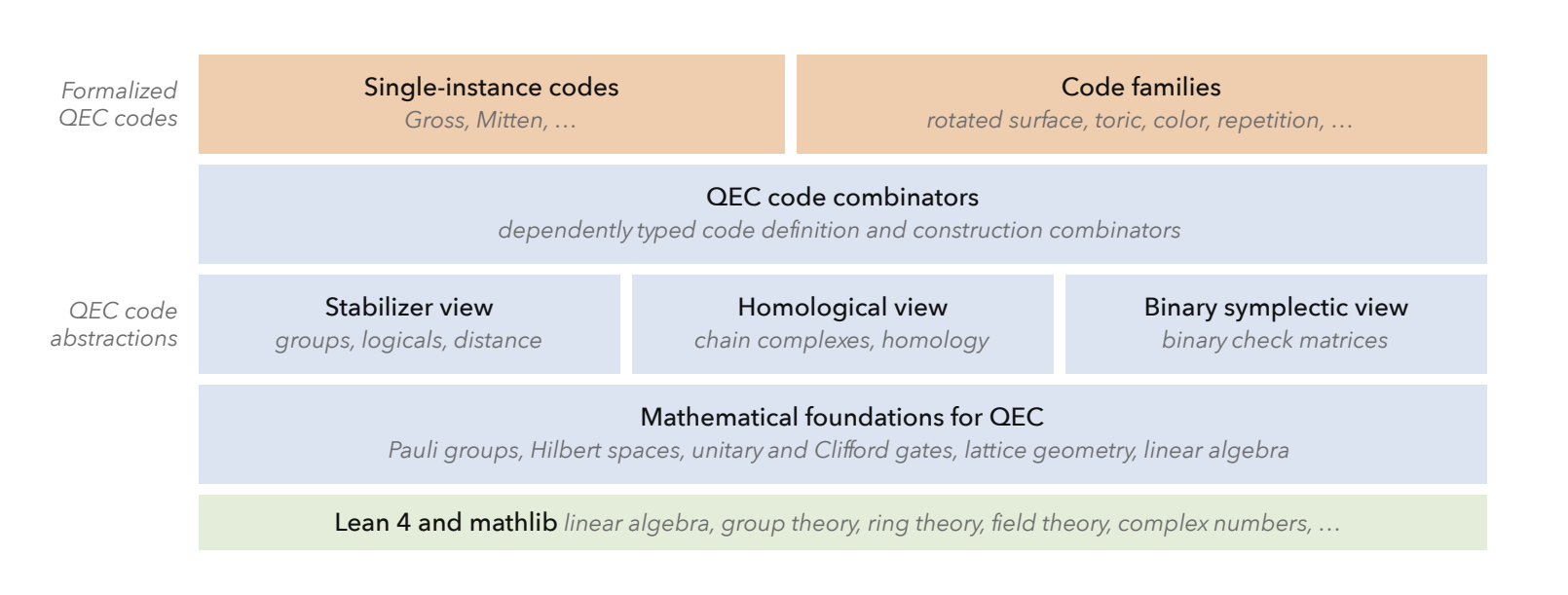
Researchers Introduce QECLean Framework to Formally Verify Quantum Error-Correcting Codes in Lean 4

Researchers have developed QECLean, an open-source framework using Lean 4 to formally verify quantum error-correcting codes, addressing the difficulty of verifying complex, algorithmically discovered codes. It has successfully verified parameters for several significant QEC codes, including an IBM 360-qubit code and infinite planar code families. QECLean aims to validate AI-discovered codes and future quantum compilers by linking different mathematical representations within…

Read at Quantum Computing Report

Quantum Computing Report Mohamed Abdel-Kareem

memQ and Infleqtion Sign MoU to Validate Quantum Networking Interoperability for Distributed Neutral-Atom Systems

memQ and Infleqtion have signed an MoU to validate interoperability between memQ’s quantum network architecture and Infleqtion’s quantum computing platform. This collaboration aims to enable modular multi-processor scaling by connecting separate quantum processing units. The initiative is crucial for enterprise and high-performance computing data centers to adopt standardized QPU-to-QPU networking.

Read at Quantum Computing Report

Quantum Computing Report Mohamed Abdel-Kareem

Mastercard Launches Quantum Advisory Practice with QIZ Security and Releases PQC Readiness Whitepaper

Mastercard has launched a Quantum Advisory Practice with QIZ Security to help financial institutions transition to post-quantum cryptography, addressing immediate "harvest now, decrypt later" risks. This initiative, aligned with G7 and FS-ISAC guidance, offers services like cryptographic asset discovery and remediation roadmaps. Mastercard is also conducting quantum research with Oxford Quantum Circuits, focusing on financial fraud protection.

Read at Quantum Computing Report

Quantum Computing Report Mohamed Abdel-Kareem

BMO Demonstrates Quantum Utility in Game-Theoretic Machine Learning Feature Selection on IBM Nighthawk r2

BMO Financial Group, in collaboration with DUTH and IBM, has demonstrated a quantum machine learning feature-selection workflow on IBM quantum processors. They applied quantum game theory to identify high-value predictive variables in financial datasets, achieving comparable quality to classical methods with significantly fewer algorithmic samples. This milestone builds on BMO's earlier entry into the IBM Quantum Network and the launch of their AI & Quantum Institute.

Read at Quantum Computing Report

Quantum Computing Report Mohamed Abdel-Kareem

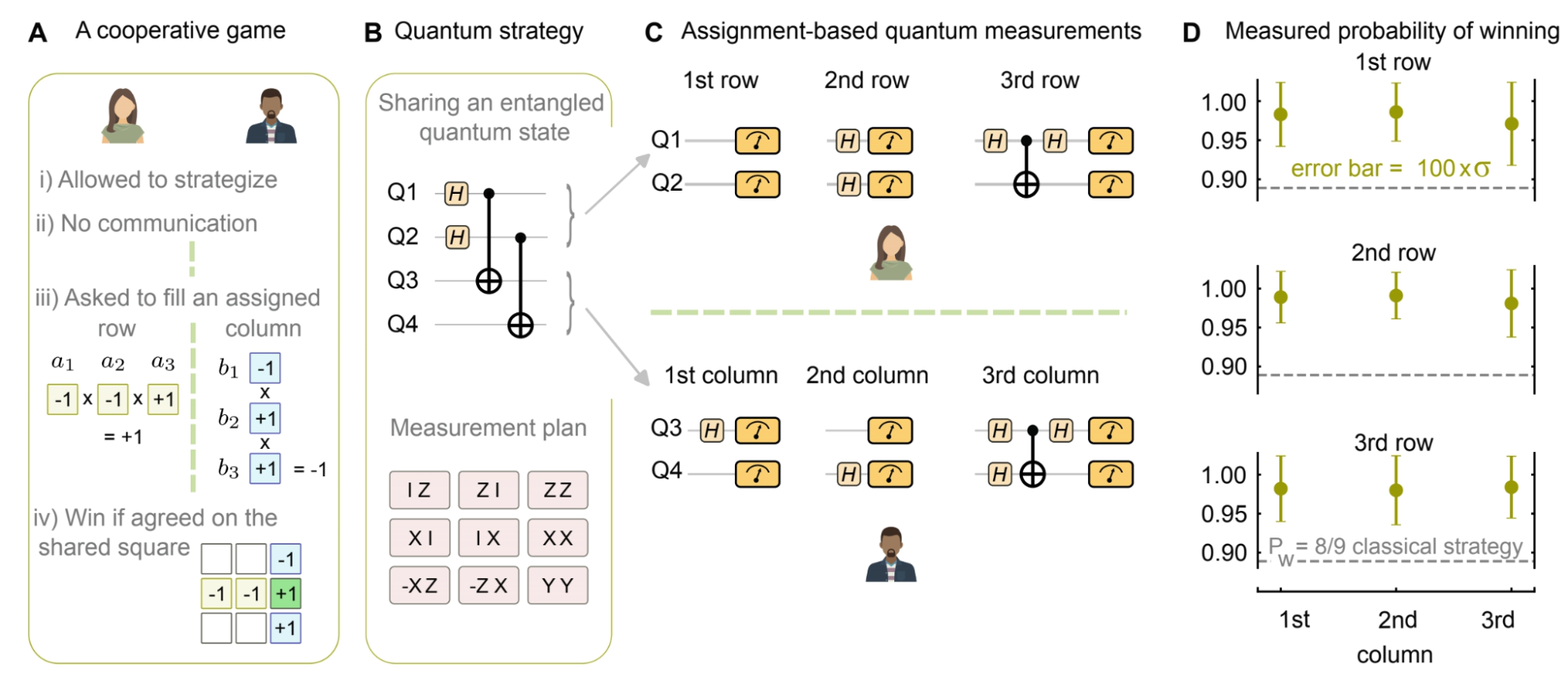
Google Quantum AI Demonstrates Measurement Contextuality Across 105 Qubits on Willow Processors

Google Quantum AI has demonstrated quantum measurement contextuality on 72-qubit and 105-qubit Willow processors, moving contextuality testing to large two-dimensional qubit arrays. This research, published in Science, establishes a hardware benchmark for coherent control errors and has implications for fault-tolerant computing and molecular simulations. The experiments verified that quantum observables do not have predetermined values independent of compatible measurements.

Read at Quantum Computing Report

Quantum Computing Report Doug Finke

Your Best Quantum Error Correction Engineer Might Be a Bot

A description of how AI is playing an increasingly important role in assisting engineers developing new quantum error correction codes and quantum error correction decoders.

Read at Quantum Computing Report

Phys.org Quantum Physics

The secret of 'strange metals' may lie in quantum statistics, not collisions

In an ordinary metal, electrons behave like well-defined particles that occasionally bump into imperfections or vibrations of the crystal. Many materials with strong electron–electron interactions, including the copper-oxide (cuprate) superconductors, break these rules. In these "strange metals," electrical resistance rises in a straight line with temperature over a very wide range. Electrons seem to lose their momentum at the fastest rate quantum mechanics allows, the…

Read at Phys.org Quantum Physics

The Quantum Insider Matt Swayne

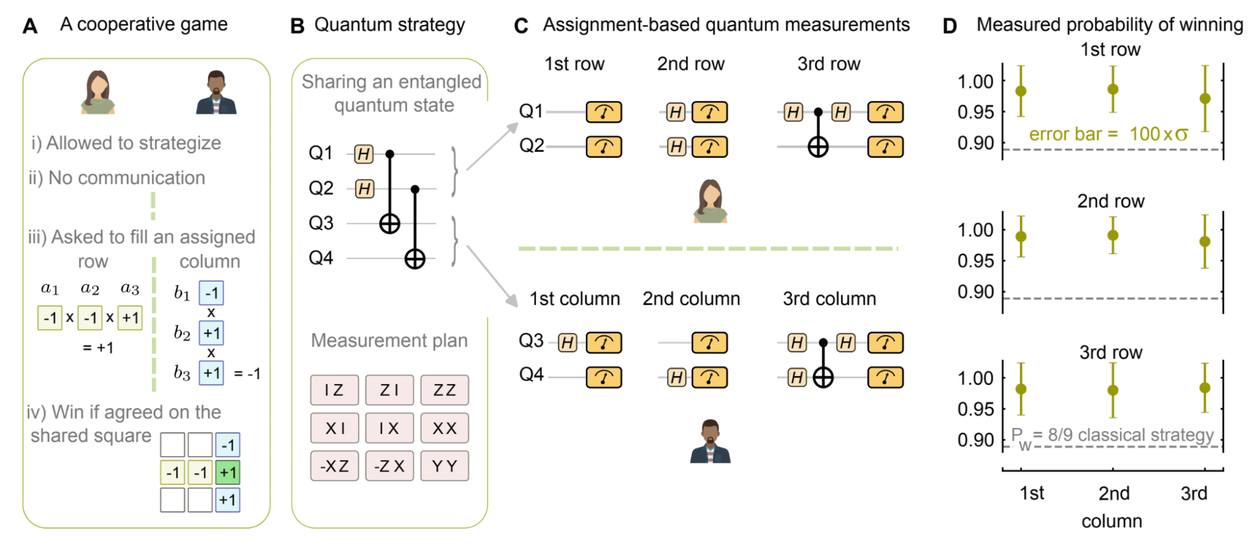
Google’s Quantum Chip Beats Classical Limits in Tests of Teamwork

Insider Brief It turns out teamwork can indeed make the dream work, even when the team isn’t allowed to talk. It helps to have a few entangled qubits, though. In a study, a Google-led team of researchers used a quantum chip to beat the best classical strategies in games that barred players from communicating, demonstrating

Read at The Quantum Insider

Google (The Keyword)

How we’re putting one of quantum mechanics’ deepest features to the test at scale.

Google Quantum AI research proves contextuality powers quantum algorithms at scale. See how our processor beat classical limits. Get the details.

Read at Google (The Keyword)

arXiv (research papers) Egil Bae

Query-Optimal Quantum Minimum Finding from Numerical Estimators

We propose a quantum minimum-finding algorithm for objectives accessed via numerical estimators that avoids the logarithmic query overhead of amplifying the confidence of estimates before the search. A coherent estimator that is $\varepsilon$-accurate with probability at least $2/3$ on each of $N$ labels suffices to find a $2\varepsilon$-optimal label using $O(\sqrt N)$ base-estimator queries at constant confidence. The query bound and the additive-error constant are…

Read at arXiv (research papers)

arXiv (research papers) David Halpenny

Fast, in-place, and ancilla-free quantum algorithms for integer multiplication and inversion

Arithmetic operations are a fundamental building block in the design of quantum algorithms, with their implementation cost expected to have a significant impact on the viability of a wide variety of quantum applications. In this work, we present novel algorithms for a number of in-place quantum arithmetic operations that are highly efficient in terms of their space and gate count overheads compared to the current state-of-the-art. We show that in-place modular multiplication…

Read at arXiv (research papers)

arXiv (research papers) John M. Martyn

High-Accuracy Neural-Network Quantum States via Randomized Real-Time Dynamics

Neural-network quantum states (NQSs) exhibit a disparity in converging to the ground state during energy minimization: while the energy converges quadratically with the error in the variational wave function, other observables converge only linearly, which limits the accuracy of physical predictions. Here we show how to close this gap by introducing a new algorithm that improves the accuracy of NQSs. Our method, termed dynamical averaging, estimates expectation values by…

Read at arXiv (research papers)

arXiv (research papers) Mohsen Bagherimehrab

End-to-End Quantum Algorithm for Differential Equations: Application to Simulating a Biomolecular System

Quantum algorithms for differential equations have the potential for substantial algorithmic speedups over classical methods. However, they rely on certain assumptions and abstract oracle specifications that leave their practical feasibility and computational advantages for realistic applications unclear. Here we formalize the concept of an end-to-end quantum algorithm for differential equations as one that accepts classical inputs and returns classical outputs, and provide…

Read at arXiv (research papers)

arXiv (research papers) Mario Herrero-Gonzalez

Classically Trained Quantum Generative Models with Shared Training and Fine Tuning for Quantum Matter

Ground-state measurement statistics characterize quantum matter. Selected correlations can guide the classical training of a quantum sampler even when sampling the full distribution is difficult. We ask whether training across related ground-state distributions helps the sampler reproduce their correlations more accurately. We train a hypernetwork to map Hamiltonian parameters to circuit angles, sharing information across the phase diagram before local fine-tuning with…

Read at arXiv (research papers)

arXiv (research papers) Alper Cakan Security

Classical Oracle Separation of QMA from the QCMA Hierarchy and Quantum Cryptography Even When P = QCMA

Remark: This work is in submission at STOC'27 and thus the full manuscript has been publicly posted on the conference website since November 3rd, 2026. Inspired by the Codeword-Hash Structure problem recently introduced by Cakan (arXiV, 2026) to separate $\mathsf{QMA}$ from $\mathsf{QCIP}$, we introduce a new problem called Codeword-Hash pairs in Noise ($\mathsf{CHN}$) and prove that, in the query complexity model, it is in $\mathsf{QMA}$ but hard for the $\mathsf{QCMA}$…

Read at arXiv (research papers)

arXiv (research papers) Florian J. Curchod

Authenticating quantum key distribution through random position checks

Quantum key distribution (QKD) requires some form of authentication in order for the parties to be sure they are not unknowingly generating a key with an adversary pretending to be one of the honest parties. In this work, we propose a protocol in which the position of one of the parties is used as the authentication credential for key distribution. Our protocol essentially consists of a BB84 QKD protocol with quantum position verification (QPV) rounds randomly interleaved…

Read at arXiv (research papers)

arXiv (research papers) Javier Rey-Domínguez

On the design of sequential quantum repeaters with error detection

Long-distance, trust-free quantum communications rely on the development of scalable quantum repeater schemes. Sequential entanglement generation with error detection is a promising approach that combines manageable implementation requirements with a hop-by-hop architecture compatible with existing classical infrastructure. In this paper, we investigate key design choices for such schemes over a repeater chain using quantum key distribution as a benchmark. We find that…

Read at arXiv (research papers)

arXiv (research papers) Cory T. Aitchison

When the Noise Gets Noisy: Quantum Error Correction with Disordered Noise and Misinformed Decoding

Experimental demonstrations of quantum error correction often exhibit noise that varies across space and time, and attempting to characterize this disorder has been shown to substantially improve decoding performance. However, theoretical studies of quantum error correction typically assume fixed, perfectly known, homogeneous noise. Here we model decoding with incomplete or inaccurate knowledge of disordered noise channels by treating physical error rates as random…

Read at arXiv (research papers)

arXiv (research papers) Zhiyao Hu

Optimal Error corrected Hamiltonian estimation with nuisance parameters

Realistic quantum sensing is often affected by both noise and unknown nuisance parameters. Under Markovian dynamics, existing error correction approaches have often sought to suppress nuisance responses alongside environmental noise. Here we show that this local suppression of nuisance parameters is unnecessary and can be overly restrictive: nuisance parameters and Markovian noise impose fundamentally different constraints and require distinct treatments. We establish a…

Read at arXiv (research papers)

arXiv (research papers) Chenyang Jin

Scaling classical hardware for accurate real-time quantum error correction

Fault-tolerant quantum computation requires a classical decoder fast enough to process syndrome measurements at the rate at which they are generated, and to return its decisions with low latency. This is most demanding for superconducting processors, whose fast syndrome cycles force a trade-off between decoding speed and accuracy. Decoders fast enough to keep up sacrifice accuracy, which must be compensated for with larger codes and thus additional physical qubits. Here we…

Read at arXiv (research papers)

The Quantum Insider Resonance

Delta Gold Launches Dedicated Quantum Sensing Program

With new equipment funding at Penn State and the University of Toronto, Delta Gold Technologies has launched a dedicated quantum sensing program, allowing its gold nanoclusters to get to work on navigation and magnetic sensing while the quantum computing effort continues. Insider Brief For most of us, day-to-day navigation happens somewhere overhead. Our phones listen

Read at The Quantum Insider

arXiv (research papers) Maria Gragera Garces

When lies look like noise: certifying untrusted entanglement swapping

Entanglement swapping lets quantum repeaters distribute entanglement over long distances, a prerequisite for the quantum internet. We study its security in a noisy network whose intermediate nodes perform the quantum operations faithfully but may misreport the classical outcome that end users rely on. We show that the ideal functionality of entanglement swapping cannot be realised, because it gives the adversary no influence over the delivered state, whereas a node that…

Read at arXiv (research papers)

arXiv (research papers) Donghoon Kim

Tunable Ground-State Entanglement in Fully Connected Quantum Systems: From Logarithmic to Volume-Law Scaling

Entanglement scaling is a central probe of the complexity of quantum many-body ground states, yet once geometric locality is absent, it can depend sensitively on the structure and normalization of interactions. For fully connected Hamiltonians with the natural Kac normalization, nondegenerate gapped ground states are known to obey a logarithmic entanglement bound. Here we ask how the ground-state entanglement changes when this interaction normalization is continuously…

Read at arXiv (research papers)

arXiv (research papers) Stefano Tinelli

Non-Binary Detector Error Models

A key challenge in fault-tolerant quantum error correction (QEC) is that the syndrome extraction circuits are themselves faulty. Such circuit-level noise is commonly described by a detector error model (DEM). In Stim and in almost all related works, DEMs are binary: every non-binary circuit error (e.g., CNOT gate), is decomposed into independent binary error mechanisms. In this work, we introduce non-binary DEMs, in which each fault location of the syndrome extraction…

Read at arXiv (research papers)

arXiv (research papers) Ziyi Yang

Efficient Classical Algorithms for Ground Energy Estimation of Fermions with Conjugate-Pair Orbital Interactions

Estimating the ground energy of interacting fermions is central to quantum many-body physics, and recent quantum algorithms provide polynomial-time guarantees for some structured families. Classical approaches commonly rely on quantum Monte Carlo, where the sign problem is a major obstacle. However, even when a nonnegative expansion without sign problem is available, rigorous guarantees for rapid mixing are still far from well understood. In this paper, we give an efficient…

Read at arXiv (research papers)

arXiv (research papers) Sagi Meir

Imaginary-Time Density Correlations Encode Quantum Entropy and Free Energy

In the classical limit, maximum-entropy inference yields an estimate of the excess entropy from the static structure factor through a single momentum sum. Quantum mechanically this estimate fails, because interactions also change the kinetic energy, while delocalization and exchange add information that equal-time correlations do not contain. We show that imaginary-time density correlations contain this information, and that with them the classical relation carries over to…

Read at arXiv (research papers)

Older stories