Results for “Qubits”

Quantum Computing Report Mohamed Abdel-Kareem

UCLA Researchers Model Collectively Enhanced Superconducting-Qubit Interfaces for Microwave-to-Optical Transduction

UCLA researchers have developed a theoretical model for enhancing microwave-to-optical quantum transduction using superconducting qubits. Their proposed architecture collectively couples multiple qubits to a shared optomechanical resonator, aiming to overcome limitations in current optical interconnects. The study shows that this collective coupling can improve conversion efficiency and bandwidth, with an auxiliary transmon further boosting single-photon optical target…

Read at Quantum Computing Report

Quantum Computing Report Mohamed Abdel-Kareem

Google Quantum AI Demonstrates Measurement Contextuality Across 105 Qubits on Willow Processors

Google Quantum AI has demonstrated quantum measurement contextuality on 72-qubit and 105-qubit Willow processors, moving contextuality testing to large two-dimensional qubit arrays. This research, published in Science, establishes a hardware benchmark for coherent control errors and has implications for fault-tolerant computing and molecular simulations. The experiments verified that quantum observables do not have predetermined values independent of compatible measurements.

Read at Quantum Computing Report

The Quantum Insider Matt Swayne

Google’s Quantum Chip Beats Classical Limits in Tests of Teamwork

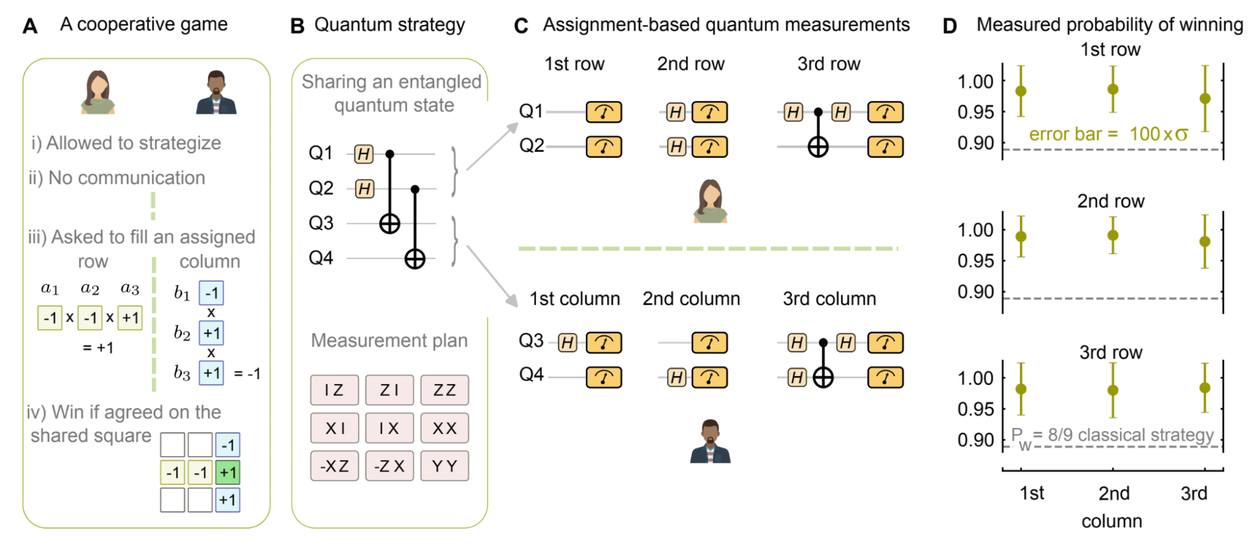
Insider Brief It turns out teamwork can indeed make the dream work, even when the team isn’t allowed to talk. It helps to have a few entangled qubits, though. In a study, a Google-led team of researchers used a quantum chip to beat the best classical strategies in games that barred players from communicating, demonstrating

Read at The Quantum Insider

arXiv (research papers) Chenyang Jin

Scaling classical hardware for accurate real-time quantum error correction

Fault-tolerant quantum computation requires a classical decoder fast enough to process syndrome measurements at the rate at which they are generated, and to return its decisions with low latency. This is most demanding for superconducting processors, whose fast syndrome cycles force a trade-off between decoding speed and accuracy. Decoders fast enough to keep up sacrifice accuracy, which must be compensated for with larger codes and thus additional physical qubits. Here we…

Read at arXiv (research papers)

arXiv (research papers) Sugumi Kanno

Entanglement, records, and quantum recovery in qubit chains

We investigate entanglement, readable records and quantum recovery using an exactly solvable chain of sequentially interacting qubits. For weak interactions, entanglement reaches a later environment site before that site carries an equally strong local record. The leading local record is encoded in an off-diagonal element of the reduced density matrix and can be detected by a Pauli measurement, while a population measurement gives a higher-order signal. We further…

Read at arXiv (research papers)

arXiv (research papers) Ivan A. Boldin

Dressed-State Quantum Information Processing Using a Multilayer Ion Trap Chip with an Integrated Radio Frequency Resonator

We present the experimental preparation of a radio frequency (RF)-dressed-state qubit, the coherent operation of a single RF-dressed qubit, and the selective readout of RF-dressed hyperfine states of $^{171}$Yb${^+}$ ions trapped using a novel microstructured ion trap chip. We demonstrate the individual addressing of RF-dressed-state qubits in a two-ion Coulomb crystal. To this end, we developed, manufactured, and characterized a trap chip specifcally designed for quantum…

Read at arXiv (research papers)

arXiv (research papers) Aleksei V. Ivanov

Quantum Simulation of First-Quantised Chemistry with a Sum-of-Squares Representation

Calculating molecular energies is expected to be an important application of quantum computers, but the most efficient algorithms to achieve this typically have significant space requirements. Scaling quantum processors to thousands of logical qubits is a daunting engineering challenge, so developing algorithms that run with reduced qubit requirements is of particular importance. Moreover, most algorithms are benchmarked on active spaces with about as many orbitals as…

Read at arXiv (research papers)

The Quantum Insider Mohib Ur Rehman

QuEra Computing and Berkeley Lab Publish Nature Study of Quantum Dynamics on Up to 180 Qubits

Insider Brief PRESS RELEASE — The National Energy Research Scientific Computing Center (NERSC) at Lawrence Berkeley National Laboratory and QuEra Computing, the leader in neutral-atom quantum computing, today announced the publication of a new study in Nature. Using Aquila, QuEra’s analog neutral-atom quantum computer, coupled with classical calculations on NERSC’s Perlmutter supercomputer, the team observed

Read at The Quantum Insider

Quantum Computing Report Mohamed Abdel-Kareem

Alice & Bob Accelerates Modular Cat-Qubit Roadmap to 200 Logical Qubits from 3,600 Physical Qubits by 2030

Alice & Bob has unveiled an accelerated quantum computing roadmap, aiming for 200 logical qubits from 3,600 physical cat qubits by 2030 in their Carbon system, and scaling to 2,048 logical qubits by 2034. This advancement is due to their cat qubits' ability to suppress bit-flip errors, reducing the physical-to-logical qubit ratio. The modular architecture and AI-assisted design contribute to bypassing single-fridge scaling limits, enabling complex simulations and…

Read at Quantum Computing Report

arXiv (research papers) Gerhard Hellstern

Instanton tunnelling as a verifiable benchmark for digital quantum simulation: circuit structure, classical simulability and hardware reproducibility

We use instanton-mediated tunnelling in the quartic double well as a benchmark for digital quantum simulation that is checkable against an exact answer at every step. The instanton enters through the classical analysis; the hardware tests the dynamics of the lattice model. A unary (single-excitation) encoding maps N lattice sites to N qubits, with the single-excitation dynamics as a reference that remains classically cheap at any N. For a second-order Trotter circuit with…

Read at arXiv (research papers)

Quantum (journal) Shoham Jacoby, Rotem Arnon-Friedman, and Serge Rosenblum

Hardware-Efficient Entanglement Distillation Using Bosonic Systems

Quantum 10, 2277 (2026). https://doi.org/10.22331/q-2026-11-18-2277 High-fidelity entanglement shared between distant quantum systems is an essential resource for quantum communication and computation. Entanglement distillation addresses this need by converting multiple noisy Bell pairs into fewer higher-fidelity pairs, using only local quantum operations and classical communication. However, this approach typically requires a substantial overhead in the number of qubits. To…

Read at Quantum (journal)

The Quantum Insider Matt Swayne

Alice & Bob’s Updated Roadmap Targets 200 Logical Qubits From 3,600 Physical Qubits by 2030

Insider Brief PRESS RELEASE — Alice & Bob, a leader in fault-tolerant quantum computing, today unveiled an updated, modular roadmap. The company targets 200 logical qubits as soon as 2030, double its previous target, with Carbon, which will be built from just 3,600 physical cat qubits. “Cat qubits give an efficient path to fault tolerance. They

Read at The Quantum Insider

Phys.org Quantum Physics

Using a microwave link to transfer a three-level quantum state

Quantum technologies, devices and systems that process, store, transfer or collect information leveraging the laws of quantum mechanics, could outperform their classical counterparts on some real-world tasks. Many of these technologies encode quantum information in qubits, which can exist in either of two basic states or a superposition of them.

Read at Phys.org Quantum Physics

arXiv (research papers) Sebastian Wölckert

Gradient Blindness in Adaptive Architecture Search for IQP Born Machines

Instantaneous quantum polynomial (IQP) Born machines learn a probability distribution from data with a circuit of commuting gates that a classical computer trains at hundreds of qubits. Adaptive algorithms grow a sparse circuit from a small seed by adding in every round the candidate gates with the largest loss gradient. Such algorithms never add a candidate whose gradient vanishes, so the choice of seed decides which circuits they can reach. Here we show that a candidate…

Read at arXiv (research papers)

arXiv (research papers) Jiale Huang

Accelerating Quantum Error Correction Simulations under Coherent Noise with Compiled Clifford-Augmented Matrix Product States

Reliable assessment of quantum error correction requires understanding how coherent errors affect logical performance. Although tensor networks naturally capture coherent interference, entanglement growth and large qubit counts make repeated sampling costly. Here we develop a compiled Clifford-Augmented Matrix Product State (CAMPS) framework that reuses Clifford transformations across shots, recycles qubits released by measurements, evolves a compressed residual state, and…

Read at arXiv (research papers)

arXiv (research papers) Zhi-Lei Zhang

Topological Quantum Reservoir Computing

Scaling universal quantum computation and implementing quantum machine learning with protected logical qubits remain challenging. To harness the computational potential of existing fault-tolerant quantum platforms, we introduce topological quantum reservoir computing, a novel approach using protected degrees of freedom for storage and the host system's intrinsic dynamics for information processing. Using a one-dimensional Kitaev chain, we show how long-lived Majorana edge…

Read at arXiv (research papers)

Quantum Computing Report Mohamed Abdel-Kareem

IQM Researchers Benchmark Projected Quantum Kernels Across 45 Qubits Using Cross-Device Referee-Challenger Protocol

IQM Researchers have successfully benchmarked projected quantum kernels across 45 qubits using a cross-device referee-challenger protocol, demonstrating a significant advantage over classical models in quantum machine learning tasks. Their study, conducted on IQM Emerald and Garnet processors, highlights the effectiveness of adaptive Pauli twirling in mitigating errors and achieving near noise-free accuracy. The findings suggest a promising path for quantum advantage in 2D…

Read at Quantum Computing Report

Quantum Computing Report Mohamed Abdel-Kareem

IQM Announces Zero-Downtime Upgrade Program for Halocene Product Line Scaling Past 1,000 Qubits

IQM Quantum Computers has launched a zero-downtime upgrade program for its Halocene quantum error-correction product line, enabling a seamless transition from 150-qubit processors to systems exceeding 1,000 qubits. This program, designed for HPC and enterprise data centers, ensures continuous operation during hardware upgrades by installing new units alongside existing ones. It also integrates with current software toolchains and allows for hybrid AI and simulation workflows…

Read at Quantum Computing Report

arXiv (research papers) Luca Hofele

Teleportation of Logical Qubits using Lattice Surgery with Superconducting Circuits

Demonstrating a quantum advantage when solving large-scale computational problems on a quantum computer requires the correction of errors that occur due to limitations in control accuracy and coherence. Using the concept of quantum error correction, fault-tolerant logical qubits can be realized and manipulated with logical single- and two-qubit gates. In this paper, we experimentally analyze fault-tolerant lattice-surgery, which is a key primitive that enables operations…

Read at arXiv (research papers)

Quantum Computing Report Mohamed Abdel-Kareem

Moth Demonstrates Topology-Aware Quantum Data Encoding Across 120 Qubits Without SWAP Overhead

Moth Quantum has developed Tessa, a hardware-native data encoding scheme for quantum processors that significantly reduces overhead by eliminating SWAP gates and ancilla qubits. This method, detailed in a technical preprint, allows for encoding and retrieval of a large number of real-valued parameters across qubits, outperforming previous methods. Tessa is now integrated into Moth's Atlas platform, offering quantum-driven creative tools for various media.

Read at Quantum Computing Report

arXiv (research papers) Evan McKinney

PRISM: A Logical-Physical Boundary Compiler for Dual-Rail Qubits

Quantum computers can encode each logical qubit across multiple physical degrees of freedom so that errors on the physical qubits can be detected or corrected. A compiler must then translate each logical gate into native instructions, and one gate can have several equivalent realizations that interact through different wires. Routing moves those wires, so a realization chosen before routing can force SWAPs that another would avoid, making code expansion and physical routing…

Read at arXiv (research papers)

arXiv (research papers) Kamran Akbari

Symmetry-selected entanglement death at Floquet resonances of parametrically coupled qubits

Periodic modulation of a qubit--qubit coupling is a standard way to engineer quantum interactions, but a strong modulation also reorganizes the transitions through which the qubits dissipate into a comb of Floquet channels. We study two identical, strongly coupled qubits whose transverse coupling is modulated anharmonically, as by a nonlinear coupler, with each qubit damped by its own reservoir. The modulation raises the ground-state concurrence of the cycle-averaged…

Read at arXiv (research papers)

arXiv (research papers) Saad Yalouz

Quantum Information Transfer in Molecular Polaritonic Networks: A Van Vleck Effective-Hamiltonian Approach

Achieving high-fidelity transfer of an arbitrary quantum state between spatially separated qubits is a central challenge for reliable quantum hardware. We address this question within a polaritonic framework by introducing Projected-Block Van Vleck Perturbation Theory (PB-VVPT). Based on quasidegenerate perturbation theory, this approach describes a molecular network coupled to an optical cavity and local phonons through a generalized Holstein--Tavis--Cummings Hamiltonian…

Read at arXiv (research papers)

arXiv (research papers) Carlo A. Trugenberger

Complexity and precision in quantum associative retrieval

We show that efficient and high-precision quantum associative retrieval is possible with an exponential complexity advantage with respect to the classical brute force approach and with a polynomial capacity advantage with respect to classical neural network implementations for any number of patterns scaling polynomially in the number of qubits. Both classical neural and quantum associative memories store the patterns in a Hamiltonian; in the classical case the dynamics is…

Read at arXiv (research papers)

arXiv (research papers) Alex Kwiatkowski

Simplifying models of noisy stabilizer QEC on leakage qubits by Pauli twirling

The growing capabilities of quantum error-correction (QEC) experiments make it increasingly important to develop methods that predict or assess logical performance over many QEC cycles. Prior work has shown that a stabilizer QEC cycle subject to Pauli-stochastic noise can be modeled by a classical Markov process over syndrome states, with a logical Pauli channel attached to each syndrome transition. Here, we extend this framework to systems in which physical qubits are…

Read at arXiv (research papers)

arXiv (research papers) Asen L. Georgiev

Quantitative measurement of microwave power at millikelvin temperatures: Comparison between dispersively and directly coupled superconducting qubits

The Rabi frequency of a two-level system is directly proportional to the electric field amplitude being incident on this system. Taking advantage of this relationship, it is possible to use two-level systems as quantitative sensors of electric fields. Here, we apply this concept to superconducting qubits and use them for quantitative measurement of microwave power at millikelvin temperatures. Our superconducting circuit design includes three transmon qubits directly coupled…

Read at arXiv (research papers)

Phys.org Quantum Physics

Reading superconducting qubits while suppressing unwanted state transitions

Recently an artificial intelligence proved an 18-year-old conjecture in computer science, called the Aaronson–Ambainis conjecture. The proof settles a long-standing conjecture (educated guess) that eliminates one proposed route to enormous quantum computer speedups, ruling out one particular variant of "quantum supremacy," the term for the hypothesis that a programmable quantum computer can solve a problem that no classical computer can solve in any "feasible" amount of time.

Read at Phys.org Quantum Physics

Phys.org Quantum Physics

Hidden defects return a qubit's lost energy

Today, many leading quantum computers are built from superconducting circuits. However, the qubits in these circuits can easily lose energy to their surroundings, scrambling the fragile quantum information they hold.

Read at Phys.org Quantum Physics

Phys.org Quantum Physics

Quantum teleportation method uses weaker entanglement to transfer encoded information

Over the past several decades, researchers have demonstrated quantum teleportation, the transfer of one quantum system's state to another, in a range of systems. However, many quantum computers encode logical qubits (units of quantum information) across groups of physical qubits, which makes teleporting the encoded state without losing information more challenging.

Read at Phys.org Quantum Physics

arXiv (research papers) Jiaxuan Zhang

Rate-1/2 Quantum LDPC Codes for Multi-tier Superconducting Hardware

Quantum error correction is essential for scalable quantum computing, while its resource overhead is governed in large part by the encoding rate, namely the number of logical qubits encoded per physical data qubit. Recent quantum low-density parity-check (qLDPC) constructions have entered the ultra-high-rate regime with encoding rates above 1/2, but their syndrome-extraction circuits generally rely on reconfigurable connectivity or long-range qubit transport, making them…

Read at arXiv (research papers)

Older stories