Adam Smith Institute (free-market)

Recent stories from Adam Smith Institute (free-market).

Adam Smith Institute (free-market) Tim Worstall Geopolitics

Do we really want malaria back in Bristol?

By Tim Worstall Professor Mazzucato tells us that much, much, more should be within the state. Professor Weber tells us that anti-fascist economics should be done by utilising the fascist economic tactics of a nominal market based capitalism but with the state setting all the prices. Given this revival of century old policies perhaps we could run with another one? Bristol could become home to the UK’s first “wetland city” thanks to a charity’s efforts to create vast wildlife…
Read at Adam Smith Institute (free-market)

Adam Smith Institute (free-market) Madsen Pirie Geopolitics

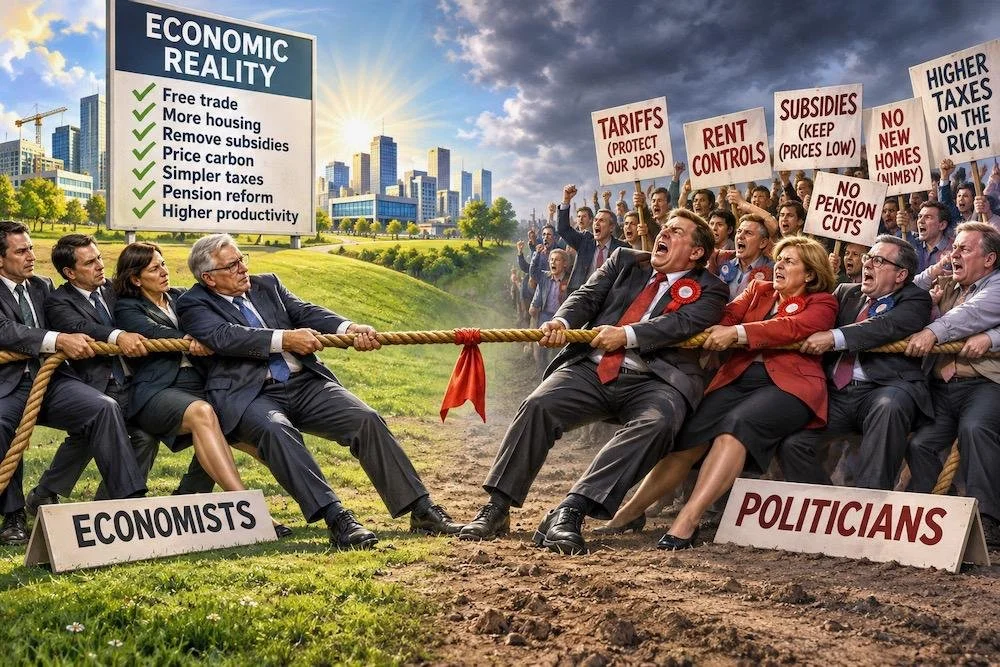
Where economics and politics collide

There are many real-world examples where economic logic runs into political walls. These are cases where sound economic decisions are hard to implement because of political resistance, short-term thinking, or public perceptions. The one most currently in the public eye is between free trade and protectionism. Economists from Adam Smith onwards have known that free trade leads to growth and prosperity. Public perception, unfortunately, is that cheap imports threaten local…

Read at Adam Smith Institute (free-market)

Adam Smith Institute (free-market) Tim Worstall Geopolitics

It’s not knowing economics that makes people disagree with it

By Tim Worstall It’s not necessary to travel far - the opinion pages of The Guardian for example - to find people whining that economic growth just isn’t the thing. We need to concentrate upon the wider picture, leisure, externalities, the real and proper measures of consumption. Thus all conventional - for which read market, capitalist, non-socialist even - economics has to be disposed of. Well, yes: A major question raised by critics of economic growth is whether we have…

Read at Adam Smith Institute (free-market)

Adam Smith Institute (free-market) Madsen Pirie Geopolitics

I'm betting on Poland

It shows good growth achieved by sensible policies and a willingness to work. It is rising faster than most competitors, and will likely soon overtake many of them, including ourselves, in living standards. Poland is a strong bet. Few countries have done so much, so fast, from such a low base. In 1994, Poland’s GDP per capita at purchasing power parity was $7,040, less than a third of Japan’s. By 2024 it stood at $51,263, just behind Japan’s $52,039. The IMF and World Bank…

Read at Adam Smith Institute (free-market)

Adam Smith Institute (free-market) Tim Worstall Geopolitics

But the very point of capitalism is to clean up messes like Poundland

No, we do not know why Poundland is in financial difficulties. Further, the why is not important to this next point. The very point - the thing it does so well - of free market capitalism is to clear up messes like Poundland: Protect Poundland from predatory capitalism, MPs tell government That predatory capitalism is the solution here, not the problem. MPs have called on the government to protect Poundland and other high street stores from “predatory capitalism” and…

Read at Adam Smith Institute (free-market)

Adam Smith Institute (free-market) Madsen Pirie Geopolitics

Genes, Guesses and Going Concerns

Biological evolution, scientific progress and the market economy run on the same engine. Something new is tried. Most attempts fail. The few that survive are kept and built upon. Genes, theories and businesses all advance this way, by trial and the elimination of error. The obvious objection is that nature is random while science and commerce are purposive. Mutations happen by accident. Scientists and entrepreneurs act by design. Surely that changes everything? It changes…

Read at Adam Smith Institute (free-market)

Adam Smith Institute (free-market) Tim Worstall Geopolitics

Let’s have that glorious poverty of peasantry back!

One of the old lefty tropes is about to have another run: The English peasant died during the enclosure of our common land. Enclosure, codified in a succession of Acts of Parliament through the 17th, 18th and 19th centuries, not only privatised land across England, but installed a mindset in land management that took us away from usufruction (use rights) to dominion (exclusionary ownership rights). It tore to shreds the peasant traditions that valued sustainability…

Read at Adam Smith Institute (free-market)