Fields: space, quantum, biotech, agritech, IoT and robotics: research

Journal articles, academic blogs, think-tank reports and papers in this section, newest first. Back to the news.

arXiv (research papers) Wei Tang Space

JCMT--Venus: Daily Monitoring of HDO and SO$_2$ Absorption in Venus' Mesosphere

We present three multi-week, disc-integrated James Clerk Maxwell Telescope (JCMT) campaigns monitoring HDO and SO$_2$ absorption in Venus' upper mesosphere at altitudes of approximately 80--110 km. Obtained in February 2022, July 2023, and August--September 2023, these observations provide dense temporal sampling and complementary observing geometries, enabling the disentanglement of short-term, long-term, and local solar time (LST) variability, which has been challenging in…
Read at arXiv (research papers)

arXiv (research papers) Lorenzo Bagnasacco

Fer expansion converges almost twice as far as Magnus for qubits

The Fer expansion writes the propagator of a time-dependent Hamiltonian as a product of unitary exponentials whose error decreases doubly exponentially with the number of factors, while the Magnus expansion improves by one order at a time. Its convergence, however, was guaranteed only below a radius of about $2.6058$, smaller than the Magnus radius $π$. We establish a guaranteed convergence threshold of about $6.2106$, or $1.98\,π$, for a qubit. This is almost twice the…

Read at arXiv (research papers)

arXiv (research papers) Eleanor Pike Space

JWST/NIRISS-SOSS Spectroscopic Variability and Auroral Modelling of Warm Ultracool Dwarf LSR J1835+3259

Auroral variability in ultracool dwarfs (UCDs) has been proposed as a key source of optical and infrared modulation, yet its physical origin remains poorly understood. We present JWST Near Infrared Imager and Slitless Spectrograph/Single Object Slitless Spectroscopy (NIRISS/SOSS) time-series spectroscopy of the M8.5 UCD LSR J1835+3259. These observations probe the object's wavelength-dependent rotational variability, providing insight into the atmospheric processes…

Read at arXiv (research papers)

arXiv (research papers) Cristhiano Duarte

An Incomplete-Preference Quantum Anscombe--Aumann Representation

This work develops a generalised Anscombe--Aumann framework in which acts map a finite set of states of the world into the effect interval of a finite-dimensional Hilbert space, while preferences need not be complete. The construction keeps three logically distinct questions separate. First, an incomplete-preference multi-utility theorem supplies affine utility functionals. Second, finite-dimensional operator geometry determines the form of each affine functional. Third…

Read at arXiv (research papers)

arXiv (research papers) Bogdan S. Damski

Maximally Entangled Mutually Unbiased Bases in Bipartite Systems of Unequal Prime Dimensions

Mutually unbiased bases with prescribed entanglement properties are of fundamental interest in quantum information theory. In the interesting case of a bipartite Hilbert space of unequal prime dimensions, $\mathcal{H}_p\otimes\mathcal{H}_q$, with $p<q$ prime, the standard solution provides $p+1$ product bases. For any such dimension $d=pq$ we construct $p+1$ bases, such that $p$ of them are represented by complex Hadamard matrices, each equivalent to a Fourier matrix $F_d$…

Read at arXiv (research papers)

arXiv (research papers) Siyu Li

Spin Interferometry Generated by Cavity Memory

We report the control and observation of coherent spin interferometry generated by cavity memory using an ensemble of nitrogen-vacancy (NV) centers coupled to a microwave cavity. The abrupt switch-on and switch-off of a detuned drive produce transient fields at the cavity frequency that supply the two spin rotations for Ramsey interferometry, observed using both microwave and fluorescence readout. Spectrally scanning the spin profile across the cavity and drive frequencies…

Read at arXiv (research papers)

arXiv (research papers) Gang Zhou

Entropic quantum error correction for independent and correlated amplitude damping errors

The idea of using quantum entropy for quantum error correction (QEC) has existed for a long time. However, its computational complexity has limited its practical use: even a $[[4,1]]$ code for standard independent amplitude damping errors involves a $256\times 256$ Hermitian matrix, so the approach scales poorly as the codeword length increases. For correlated errors, the situation is even worse. In this paper, we show that, by using the insights developed in our previous…

Read at arXiv (research papers)

arXiv (research papers) Taro Suzuki

NPU-Accelerated GNSS Signal Acquisition

On small single-board computers (SBCs), GNSS signal acquisition is a major CPU load. This paper proposes using the neural processing unit (NPU) of an SBC not for machine learning but as an accelerator for the parallel code search in GNSS signal acquisition. The discrete Fourier transform (DFT) used in acquisition is decomposed by the four-step DFT into matrix products of small DFTs and expressed by $1\times1$ convolutions, element-wise products, and transposes, which NPUs…

Read at arXiv (research papers)

arXiv (research papers) Yundi Cai

ESI: An Embodied Self-Improvement Flywheel for LLM-VLA Agents

Independently pretrained language models and vision-language-action (VLA) policies provide complementary building blocks for embodied agents, but connecting them does not automatically produce coordinated behavior. The VLA may generate actions that diverge from the LLM's intended subtask and, upon regaining control after a correction, undo the promising state restored by the LLM. We introduce ESI (Embodied Self-Improvement), an automated flywheel that uses environmental…

Read at arXiv (research papers)

arXiv (research papers) Jun Miura

Evaluating Language Models as Spatial Priors for Object-Goal Navigation

Semantic exploration methods for object-goal navigation use large language models (LLMs) to score how strongly a target object is associated with a room type or with a nearby object. This paper considers obtaining from the LLM a spatial prior instead: a distribution over the position of the target in a room. We evaluate whether two open-weight LLMs, Qwen3.5-27B and Gemma-4-31B-it, can provide such a prior. Using real room layouts from CubiCasa5K and ScanNet, we measure the…

Read at arXiv (research papers)

arXiv (research papers) Yael Fassbind

PoliMop: Policy-in-the-Loop Motion Planning in 3D Spaces for Mobile Robots

Reaching a goal state in a complex environment often requires a robot to overcome challenging terrain and obstacles. Which routes are accessible depends on the robot's physical design, the control policy it uses, and how it modifies its surroundings. We present a kinodynamic rapidly-exploring random tree (RRT) planner that uses physics simulation to exploit skills encoded in the control policy, which allows it to find a path in the scene with respect to the robot's…

Read at arXiv (research papers)

arXiv (research papers) N. -E. Nèmec Space

Model Choice or Model Bias? How stellar spectral libraries and activity modelling choices influence Ariel spectra- I. Forward model

The Ariel mission will conduct a population-level survey of approximately 1000 exoplanet atmospheres across its nominal lifetime, requiring unprecedented consistency in the treatment of stellar contamination of transmission spectra. We present a systematic comparison of stellar spectral libraries and modelling approaches for computing facular and spot contamination spectra across the full Ariel wavelength range (0.5-7.8 microns) for six stellar spectral types spanning F3 to…

Read at arXiv (research papers)

arXiv (research papers) Vladimir Martinusi Space

Separability defects in artificial satellite theory: intermediaries, zonal harmonics and secular separatrices

A five-input Poisson-bracket operator, which reproduces the Levi-Civita separability expressions and is cubic in the Hamiltonian, is used as a diagnostic of artificial satellite theory, in a modified polar-nodal chart regular at prograde equatorial orbits. For the general intermediary proposed by the author in 2020, covering those of Sterne, Garfinkel, Brouwer, Aksnes, Cid and Lahulla and Deprit, the linearised defects vanish if and only if the integrability ansatz holds…

Read at arXiv (research papers)

arXiv (research papers) Xianxu Wu

A Generalizable Approach to Safety-Aware Robotic Behavior Planning with an Explicit Constraint Space

Large language and vision-language models have substantially advanced robotic behavior planning from natural-language instructions and visual observations. However, safe manipulation in tabletop environments remains challenging because the safety constraints required for a task depend on the surrounding scene and may not be explicitly specified in the instruction. We propose a safety-aware behavior planning framework based on an explicit Constraint Space that stores reusable…

Read at arXiv (research papers)

arXiv (research papers) Sol Choi

Reusing Locomotion Training Recipes Across Humanoids via Body-Aligned Virtual Joints

Reinforcement learning has enabled robust humanoid locomotion, yet training recipes (rewards, architectures, hyperparameters) remain hard to reuse across robots with different native joint coordinates, since policies output native joint angles while action scales, bounds, gains, and penalties are defined in those robot-specific coordinates. Existing transmission models convert native targets into actuator commands but do not standardize the coordinate interface exposed to…

Read at arXiv (research papers)

arXiv (research papers) Ye Ma Space

Symbolic Regression Fitting for Roche Lobe Radius

We present a compact approximation to the dimensionless, volume-equivalent Roche lobe radius $R_{\rm L}/a$, obtained by applying symbolic regression to radii calculated from the full Roche potential. Over $10^{-5}\leq q\leq10^5$, the expression reduces the root mean square error from $1.97\times10^{-3}$ for Eggleton's formula to $5.95\times10^{-4}$, while its maximum relative error is $1.39\%$, compared with Eggleton's $0.83\%$. Calculations at additional mass ratios give a…

Read at arXiv (research papers)

arXiv (research papers) Seunghwan Jang

Per-Agent-Safe Navigation of Globally Driven Robot Collectives via Affine Field Design

Safe navigation of robot collectives requires coordinating motion and deformation so that the collective can traverse constrained environments while ensuring each robot's safety. Existing controllers for swarmalator collectives largely rely on local control, where each robot receives an individual command, which causes the control and communication requirements to grow with the number of agents. We introduce a broadcast control formulation in which a single spatially affine…

Read at arXiv (research papers)

arXiv (research papers) Mizuho Okitani

Multimodal Person Concept Model for Person Identification under Varying Observation Conditions

Service robots in domestic and office environments must identify users to provide personalized services based on their preferences and previous interactions. This is challenging because only a few observations may be available for learning, while observation conditions change owing to appearance, environmental noise, and utterance content. To address this challenge, this study proposes a multimodal person concept model that learns person concepts from a small number of…

Read at arXiv (research papers)

arXiv (research papers) Yu Zhou

Beyond Prediction Gain: LASR as a Metric for Action-Grounded Latents in World Models

World models that support planning, control, and interpretable reasoning require latent representations that genuinely encode action. Yet the large-scale video data from which such models are learned overwhelmingly lack action annotations. Latent-action models infer action-like variables from observation sequences, enabling action-aware learning from unlabeled videos or trajectories. A fundamental concern, however, remains: a latent that improves future prediction may simply…

Read at arXiv (research papers)

arXiv (research papers) Zixuan Jiang

When Does Cross-View Consistency Matter in Multi-View Appearance Augmentation? A Controlled Study for Visuomotor Policies

Multi-view visual augmentation often seeks consistency across cameras, but it is unclear which forms of consistency matter for downstream control. We use simulation-state replay to manipulate cross-view coupling while preserving the per-camera perturbation distributions, physical trajectories, and action labels. Across seven LIBERO manipulation tasks, marginal-matched changes in global appearance, ghost injection, and target color have small average costs for a late-fusion…

Read at arXiv (research papers)

MIT News AI Zach Winn | MIT News SI

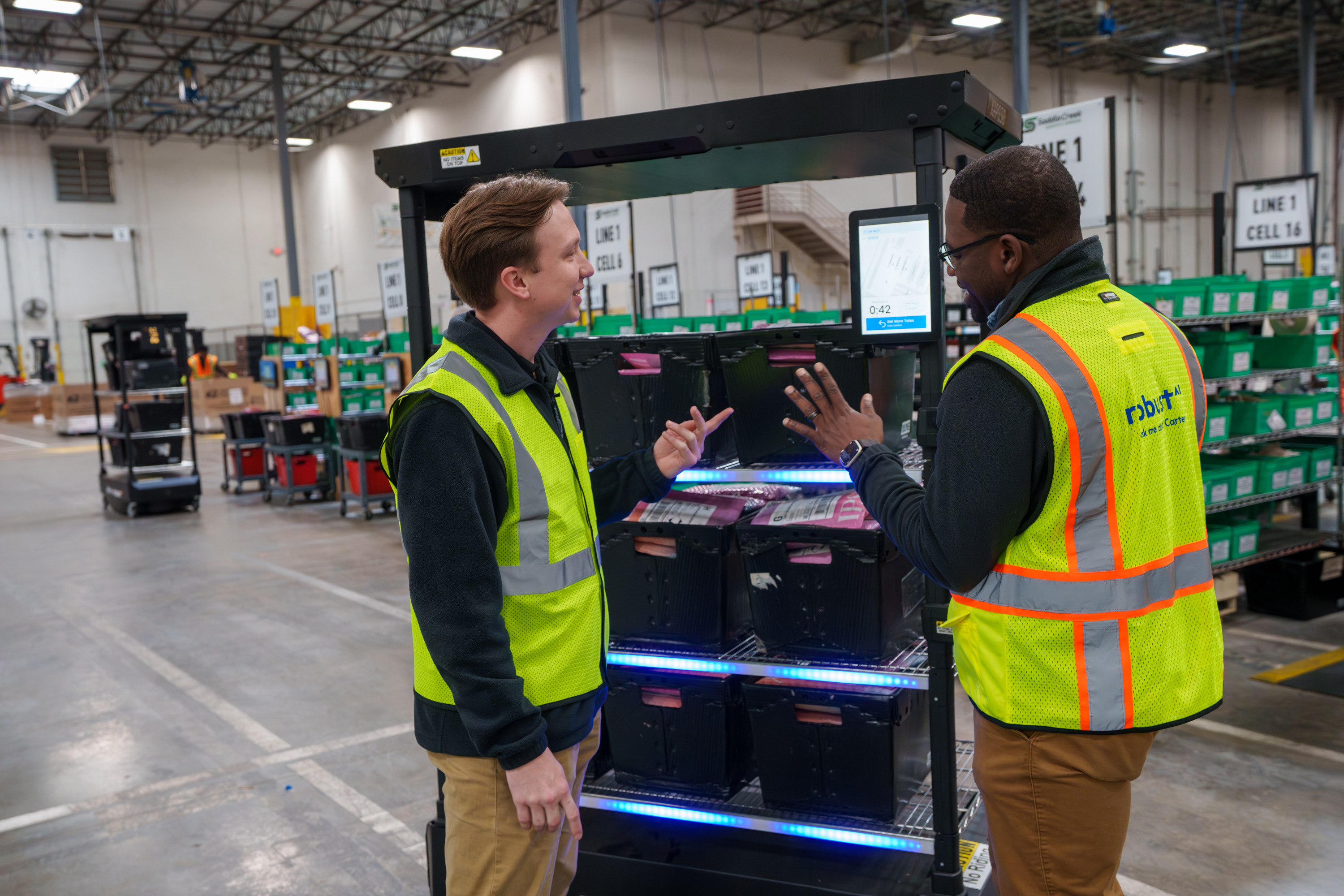
Helping robots fit into the human workplace

Founded by Anthony Jules ’92, SM ’92 and Professor Emeritus Rodney Brooks, Robust AI’s robots are designed to collaborate with humans in factories and warehouses.

Read at MIT News AI

arXiv (research papers) Shunyang Huang

ERA: Error-Resistant Autonomous Object Navigation with Predicted Depth

Depth and 3D foundation models can predict geometry from RGB images, allowing zero-shot object navigation without a depth sensor. However, when predicted depth is mapped as if it came from a sensor, view-dependent errors accumulate in the map, remove exploration goals, and end the search before the agent can observe and correct them. We propose ERA, a training-free object navigation system that replaces the depth sensor with depth predicted from RGB images and poses. ERA…

Read at arXiv (research papers)

arXiv (research papers) Yu Dong

Ego2Flow: Benchmarking the Traffic-System Impact of Autonomous Driving on Maps Distilled from Real-World Roads

End-to-end autonomous driving is predominantly evaluated through ego-vehicle safety and task completion. Its deployment in urban traffic, however, creates sustained interactions among vehicles whose collective effects remain insufficiently evaluated. We introduce Ego2Flow, a closed-loop benchmark for assessing the traffic-system impact of autonomous driving on maps distilled from real-world cities. To construct realistic 3D urban environments for sustained closed-loop…

Read at arXiv (research papers)

arXiv (research papers) Li-Chin Yeh Space

On the Existence of a Third Planet and an Apsidal Resonance Chain in the Kepler-396 System through TESS Data

The possible existence of a third planet in the Kepler-396 system has been previously proposed. Given that the planetary mass is poorly constrained and the orbit could be either interior or exterior to planet Kepler-396 c, that proposal is not clearly known in the community. In order to address this and further investigate Kepler-396 system's configuration, new TESS data are employed to form a long baseline of transit timing. Using the pixel-level decorrelation technique…

Read at arXiv (research papers)

arXiv (research papers) Lu Xiong

EViDS: An Environment--Vehicle Dynamics Integrated Simulation Platform for Intelligent Chassis Development

The development of intelligent chassis increasingly requires the integration of environmental and perception information with high-fidelity vehicle dynamics to support environment-aware intelligent chassis control. However, existing autonomous-driving simulators and professional vehicle-dynamics tools are generally developed for different purposes, making it difficult to integrate environmental information, vehicle dynamics, and chassis algorithms. This paper proposes EViDS…

Read at arXiv (research papers)

arXiv (research papers) Christopher Malili

Imitation Policies Learn a Proprioceptive Anchor: A Predictive Law for Perception Noise and Its Closed Loop Cost

Imitation policies for robot manipulation are often trained on noisy object positions, and they learn to discount the noisy reading. We show how much they discount it, and why. Because demonstrators steer toward the object, the robot's own state carries information about where the object is. A trained policy combines this proprioceptive anchor with the reading and weights the reading by $α= V/(V + s^2)$, where $s^2$ is the reading noise and $V$ the anchor's error variance…

Read at arXiv (research papers)

arXiv (research papers) Zhijun Song Space

DART ejecta reveal the recoil momentum budget of a kinetic impact

Double Asteroid Redirection Test (DART) demonstrated that ejecta recoil enhances asteroid deflection, but the ejecta processes generating and distributing this recoil remained unclear. We reconstruct three-dimensional ejecta evolution from time-resolved morphology and brightness observations, recovering previously missing constraints on momentum transfer and material transport. Integrating reconstructed momentum yields momentum enhancement factors $β_\mathrm{D}=2.13 \pm 0.19…

Read at arXiv (research papers)

arXiv (research papers) Hiroyuki Tetsuka

AI-guided robotic in situ fabrication of curvature- and tissue-adaptive wireless bioelectronics

Personalized bioelectronic devices for wound therapy require not only conformal fabrication on complex body surfaces but also functional adaptation of their electrical characteristics to individual wound geometries. Here, we present an AI-guided robotic in situ printing platform for fabricating wireless wound electrotherapy devices directly on transparent wound dressings. The system integrates a 3D vision camera, a six-degree-of-freedom robotic arm, direct-ink-writing, and…

Read at arXiv (research papers)

arXiv (research papers) Leon Kim

On the Utility of Pre-Trained Visual Representations for Policy Learning of Contact-Rich Insertion Tasks

Visuomotor imitation learning has become a predominant paradigm for real-world robotic manipulation, yet it remains data-inefficient and brittle to task-irrelevant visual shifts. Pre-trained visual representations promise to ease this burden by distilling priors from internet-scale data, but the ``right'' representation for robotics remains unresolved: existing studies span broad but sparse task distributions and reach conclusions that vary and even conflict, pointing to…

Read at arXiv (research papers)

arXiv (research papers) Huiwen Han

TouchTwin: Scaling Human Touch Data via Real-to-Sim-to-Real

Human demonstrations are becoming the main source of data for dexterous manipulation, and real-to-sim-to-real pipelines multiply each demonstration in simulation. These pipelines rebuild the interaction from vision, which recovers how the hand moves. Which fingers touch, when, and how hard remain unobserved, because a hand pose shows where each finger stops on the surface rather than how far it is driven to close. This gap is a force gap: on held-out recordings, a hand…

Read at arXiv (research papers)

Older stories