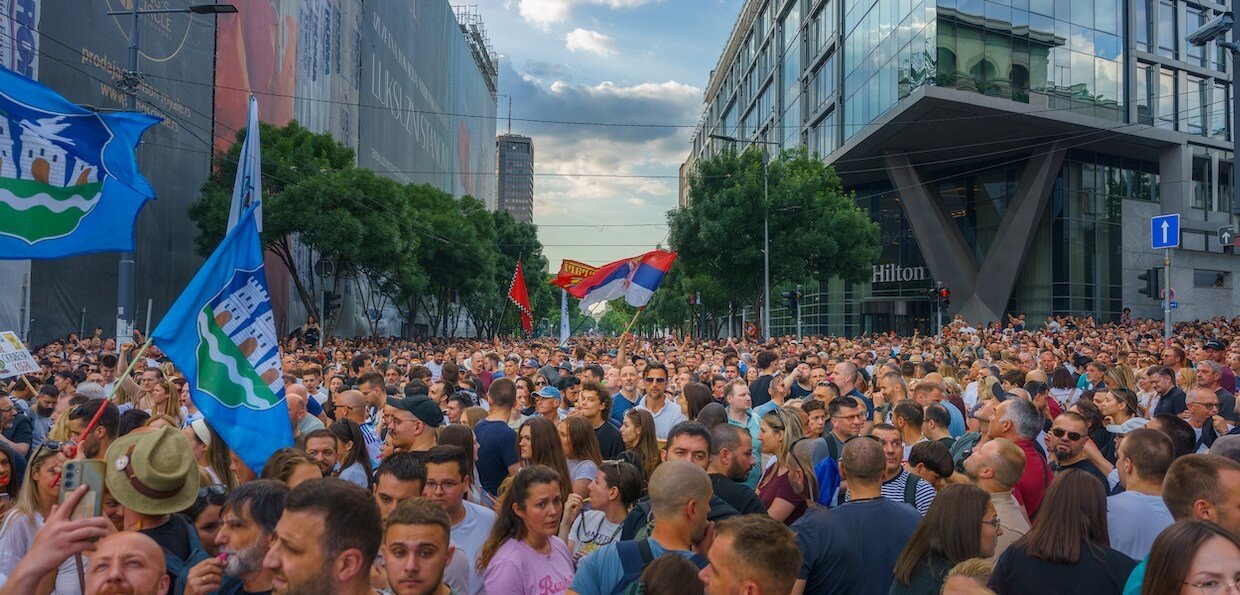
Prof. Bieber: Serbia Must Avoid the Mistakes That Allowed Authoritarianism to Return After 2000
In an exclusive interview with the European Center for Populism Studies (ECPS), Professor Florian Bieber, Professor of Southeast European
Journal articles, academic blogs, think-tank reports and papers in this section, newest first. Back to the news.
In an exclusive interview with the European Center for Populism Studies (ECPS), Professor Florian Bieber, Professor of Southeast European
On this week’s episode of the podcast, Sharan Grewal of American University joins Marc Lynch to discuss his book, The Rise and Fall of Tunisian Democracy: Populism, Polarization, and the Perils of Power-Sharing. The book takes an in-depth look at Tunisia’s transition and then explores how far the theory travels through a quantitative analysis of
In this commentary for the European Center for Populism Studies (ECPS), Rev. Dr. Colin Bossen examines the significance of
In this commentary for the European Center for Populism Studies (ECPS), Professor Lester Spence of Johns Hopkins University challenges
In an interview with the ECPS, Professor Marcel Lewandowsky, Professor of Government and Public Policy at Martin Luther University
In an in-depth interview with the ECPS, Professor Sead Turčalo, Dean of the Faculty of Political Sciences at the
In an interview with the ECPS, Dr. Andrew O’Donohue, Postdoctoral Fellow at Princeton University and Fellow at the Carnegie
Date/Time: Tuesday, December 8, 2026 / 18:00-19:30 (CET) Click here to register Chair “Manufacturing Political Outrage: Disinformation, Propaganda, and
In this commentary, Nikoletta Syvak examines Europe’s energy trilemma—the competing imperatives of affordability, energy security, and environmental sustainability—and how
Israel’s Arab citizens voted in record numbers, winning their largest Knesset bloc ever. But when will those votes equal a seat at the table? Source
In the early 2000s, Russia faced an emerging and large-scale threat posed by neo-Nazi and extreme-right violent organisations. The government response at the time was strong – security forces and police relentlessly pursued violent groups, arresting their members and handing out long sentences, many for life. For almost two decades, while single incidents of right-wing violence still took place, the
In this commentary, Dr. João Ferreira Dias examines the troubling intersection of antisemitism, political polarization, and the politics of
Political uncertainty in Israel has intensified following inconclusive election results. Since the election, the political right has sought to delegitimise the unprecedented electoral success of Arab citizens, whose representatives secured 19 of the Knesset’s 120 seats. The right has united behind Netanyahu’s unprecedented "election-theft" campaign, portraying Arab participation in government as treasonous support for terrorism and Islamization. This delegitimisation effort…
Using WhatsApp as his hub, André Janones mobilised millions of supporters to amplify Lula’s messages and challenge Bolsonarism for dominance on social media. O post Lula’s digital army apareceu primeiro em Latinoamérica 21.
This past summer, on the anniversary of D-Day, U.S. “Secretary of War” Pete Hegseth delivered the customary remarks at an American military cemetery in northern France. After describing the heroism...
Last week’s election was likely the opening bell of a major fight over the future of the political right.
Labor law was always in tension with classical liberalism. It doesn’t have to be.
Anti-technology and anti-artificial intelligence (AI) sentiments have proliferated, driven by legitimate grievances about the effects of tech on society. However, because technology grievances have led to violence in the past, and studies have found “evidence of a robust association between technological fear and support for political violence among U.S. adults,” it is vital to understand how this narrative is evolving.
The election of Abdul El-Sayed and other Muslim officeholders has stirred fears of an Islamist takeover. But their records tell a different story. Our democracy can survive any group’s participation. Source
Pope Leo XIV's tour of Latin America aims to restore the Catholic Church's influence in the face of political polarization and the rise of the far right. O post The return of the shepherd: Leo XIV and the geopolitics of faith in Latin America apareceu primeiro em Latinoamérica 21.
In this commentary for the European Center for Populism Studies (ECPS), Dr. Amir Ali examines the resurgence of India’s
As the lament swells around democratic crisis and the rise of the right, with populist moped-riders sweeping elections and traditional political parties left “shocked”, attention increasingly turns to the actual processes and spaces of political deliberation and their corrosion through social media and artificial intelligence (AI). Contentions around “too much screen time”, however, fall short of addressing both the significant place that social media holds in…
In “My Hometown,” part of his Born in the U.S.A. album, Bruce Springsteen sings nostalgically about growing up in Freehold, his hometown, in the 1950s. What is striking about this song is that the same story could be told about thousands of towns in the country. Indeed, as a key site during the Revolutionary War and the inspiration for Springsteen’s 1985 classic, Freehold Borough is invested in its authenticity as an historic and “all-American” city. Drawing on this poetic…
Since 2021, the far-right micro-party Freie Sachsen has been acting as a political rallying point for the regional neo-Nazi scene in the German state of Saxony. In the 2024 local elections, it presented itself as a force opposed to the establishment, seeking to attack the democratic system from below. This strategy enabled it to gain seats in a number of local parliaments. This study examines the party's local political activities by analyzing Telegram posts and municipal…
Abstract Ireland has largely avoided the escalation of far-right populism seen across Europe. There has, however, been an upsurge in far-right politics and activism, underpinned by anti-immigration sentiment. Within this context, this paper aims to determine how two Irish political parties commonly identified by media outlets as far-right present their websites, which issues they seek to own and whether these issues align with far-right ideology. Qualitative thematic…
The populist turn in international relations (IR) has directed attention to aesthetic, popular cultural forms and affective practices constituting ‘the people’. Building on this insight, the article turns to sound as a less examined dimension of world-making through which belonging is produced antagonistically between those authorised to sound as the nation and those compelled to listen. The article develops sonic populism to explain how performances, circulation and…
In an exclusive interview with the ECPS, Professor Nebojša Vladisavljević of the University of Belgrade examines Serbia’s student-led electoral
In an exclusive interview with the ECPS, Professor Mukulika Banerjee of the London School of Economics and Political Science
In an interview with the ECPS, Dr. Filip Balunović, Research Fellow at the Institute for Philosophy and Social Theory,
Deportation is being reshaped amid the consolidation of common European policies and the rise of ethnonationalist and far-right politics. Against this backdrop, this Special Issue offers fine-grained empirical analyses of deportation practices to examine the actual operation, transformation, politics, and effects of contested European deportation regimes. The contributions cover Northern, Central, Eastern, and Southern European contexts. They show how distinct deportation…