Quantum technology: quantum computers and qubits, error correction, quantum communication and sensing, post-quantum cryptography, and the companies, labs and governments racing to build them, from The Quantum Insider, Quantum Computing Report, IEEE Spectrum, Phys.org and Quanta Magazine, with research from arXiv, npj Quantum Information and the journal Quantum.
Software developer Gloria Amos describes her experience in making a contribution to the open source Qiskit platform and provides insights into some of the things contributors should watch out for.
This article announces several strategic appointments in the quantum technology sector. SemiQon appointed Dr. Thierry Botter as CCO, OrangeQS named Raj Badoni as CCO, and IonQ expanded its finance leadership with Gary Merrill as CFO and Thomas A. Austin as CAO. Additionally, Haiqu appointed Kortny Rolston-Duce as Head of Ecosystem Development and Marketing, and Jij named Oren Bernstein as VP of Business Development for North America.
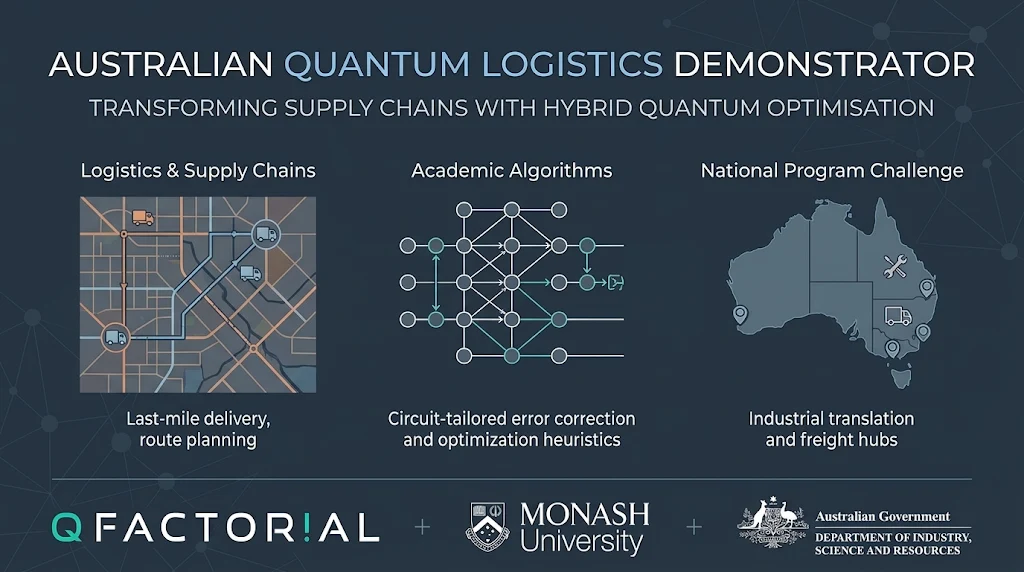
QFactorial and Monash University have received a A$1.12 million Australian government grant to develop a hybrid quantum-classical optimization solver for freight and last-mile delivery. The 15-month project aims to advance QFactorial's routing and fleet-utilization platform. This initiative, part of the Critical Technologies Challenge Program, involves a consortium including IBM Quantum, AWS, and Fujitsu, and seeks to overcome limitations of classical solvers in large-scale…
Quantum XChange's Phio TX cryptographic management software (version 4.5.6) is the first post-quantum cryptography (PQC) management platform to achieve EUCC certification, adding to its existing U.S. FIPS validation. This certification, valid until November 9, 2031, allows for the secure deployment of post-quantum algorithms and quantum key distribution interfaces within the European Union, simplifying procurement and supporting data sovereignty.
JIJ Inc. has expanded its quantum-HPC and industrial R&D collaborations with three new partnerships. These collaborations involve Mitsubishi Electric for thermal-fluid engineering simulation, Q-CTRL for electrical power-grid optimization, and Tinuviel Therapeutics for predictive gut microbiome modeling. JIJ's hybrid algorithmic stack will be used across these diverse applications.
JIJ Inc. has launched its SQOA Solver in the IBM Quantum Functions Catalog, allowing users to tackle complex optimization problems with more variables than available qubits. This solver utilizes a novel approach that combines variable-compression encoding and classical subspace diagonalization, eliminating the need for iterative quantum hardware optimization. It has demonstrated success in solving large-scale problems like 384-node MaxCut and 200-node Maximum Independent Set…
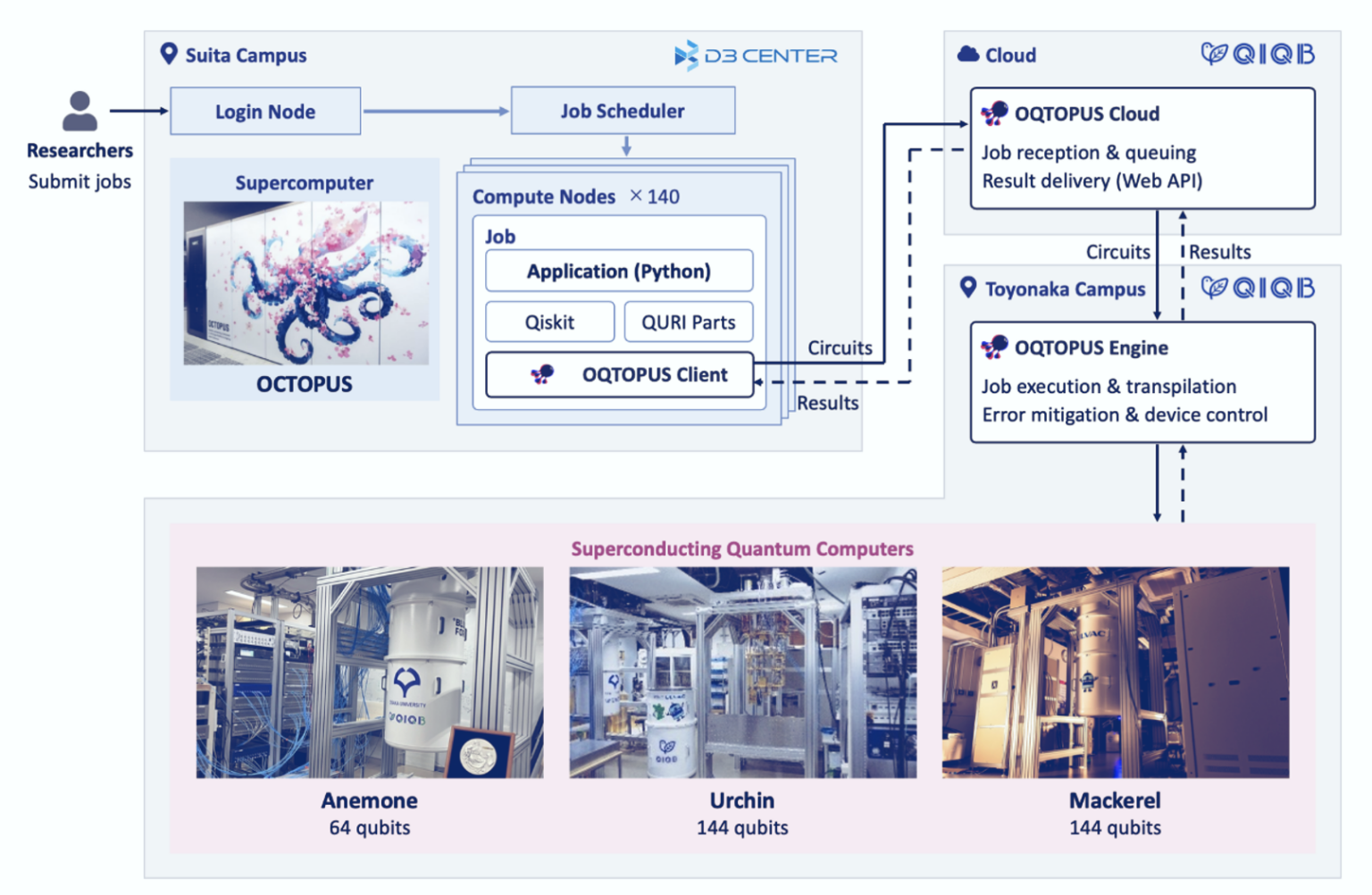
The University of Osaka has launched SEAFOOD, a hybrid computing platform integrating its OCTOPUS supercomputer with domestic superconducting quantum processors. This platform, the first of its kind in Japan, aims to tackle complex computational problems in fields like drug discovery and materials engineering by distributing workloads across classical and quantum systems. The project, supported by various Japanese initiatives, will offer trial access to research teams in…
Atom Computing has finalized a $100 million R&D agreement with the U.S. Department of Commerce to accelerate the commercialization of fault-tolerant, utility-scale quantum systems. This funding will support hardware engineering and manufacturing scale-up at their Boulder, Colorado operations, moving logical-qubit architectures into repeatable commercial production. The company is also the only neutral-atom vendor in Stage C of the DARPA Quantum Benchmarking Initiative…
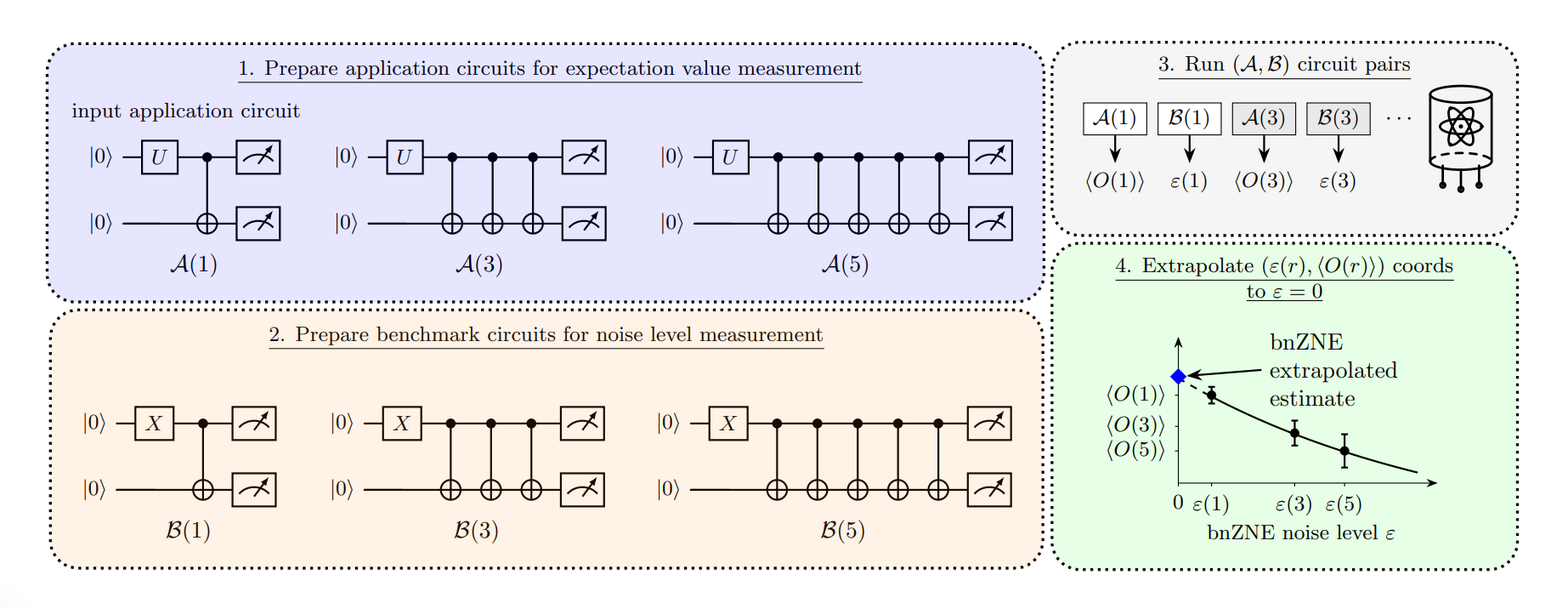
Researchers at the German Aerospace Center (DLR) have developed an improved quantum error mitigation protocol, randomized benchmarked-noise zero-noise extrapolation (bnZNE). This method enhances expectation-value accuracy without increasing measurement shot budgets, validated on 100-qubit IBM and IQM processors. The bnZNE protocol incorporates Pauli twirling, dynamical decoupling, and twirled readout error extinction (TREX), outperforming standard zero-noise extrapolation…
A research team from QodeX Quantum, NVIDIA, RTX BBN, and U.S. Navy researchers successfully demonstrated gradient-free forecasting of nonlinear partial differential equations (PDEs) on unstructured engineering meshes using up to 52 qubits on an IBM Quantum Heron r3 processor. Their hybrid quantum reservoir network (QRN) achieved significant error reduction compared to classical baselines and executed circuits far longer than typical qubit coherence times. This advancement…
Rigetti Computing has integrated Quantum Elements' Constellation simulation environment into its quantum error correction (QEC) workflow. This allows Rigetti to model processor behavior and predict system performance, including single and two-qubit gate fidelity, on their 36-qubit and 108-qubit quantum processing units. This integration helps Rigetti characterize device physics and optimize hardware designs before running on actual quantum processing units, aiding in the…
Researchers at National Taiwan University (NTU) have reported the first experimental evidence of heat-current-driven transverse accumulation of electrons' orbital angular momentum, a phenomenon known as the orbital Nernst effect. The study was recently published in Nature Communications.
Q-CTRL, a quantum infrastructure software provider, has raised $290 million in Series C funding led by Salesforce Ventures, valuing the company at over $1 billion. This funding will be used to expand its AI-driven control software and scale global commercial deployments in various sectors. The company's software products, Fire Opal, Boulder Opal, and Ironstone Opal, focus on quantum computer noise suppression, calibration automation, and GPS-denied quantum magnetic…
Insider Brief U.S. quantum ambitions could outpace the supply chains needed to turn laboratory advances into a commercial industry, four policy analysts warn. In a policy piece published by the Foundation for American Innovation, Joshua Levine, Prineha Narang, Jacqueline Tame and Alexandra Seymour Gabel, write that Washington must invest in the components and manufacturing capacity
An international research team led by Nobuhiro Yanai from the University of Tokyo and Michael R. Wasielewski from Northwestern University has created polarized radical pairs, molecules with unpaired electrons whose spins align, in metal–organic frameworks (MOFs), porous materials consisting of metal ions linked by organic molecules.
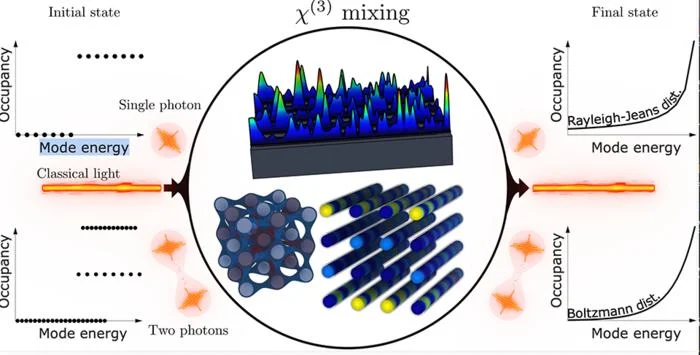
Insider Brief PRESS RELEASE — An international research team of scientist from Saint Louis University (SLU) and two institutions in Germany has shown that multimode nonlinear optical platforms can be harnessed to induce effective quantum interactions between photons, subsequently thermalizing them. In a study published in Sciences Advances, a research team from SLU’s School of
Insider Brief PRESS RELEASE — The tiny atomic defects so important for future quantum technologies can be difficult to spot. Fortunately, they leave behind some clues The defects can alter how a material responds to light, producing a distinctive optical fingerprint that scientists can measure. The challenge is figuring out which fingerprints belong to which
Quantum computers have the potential to perform calculations more quickly than supercomputers, but they could be even faster and more energy-efficient if they were built with photons as their basic units, called qubits.
Qunova Computing achieved a breakthrough in quantum chemistry by simulating an 80-qubit iron-sulfur cluster with chemical accuracy using a hybrid approach combining IBM Quantum System Two and the Fugaku supercomputer. Their HI-VQE algorithm reduced classical computing costs by approximately 300x while matching classical benchmarks. This advancement has significant implications for understanding complex biological and industrial processes.
A collaboration between Cleveland Clinic, RIKEN, and IBM Quantum has achieved the largest heterogeneous quantum-classical (HQC) electronic-structure calculation to date, simulating protein-ligand complexes exceeding 12,000 atoms. This research utilized 156-qubit IBM Heron r2 processors and leadership supercomputers to significantly advance molecular size and fragment energy accuracy in drug binding simulations. The team developed an Embedded Wavefunction (EWF) formalism and…
Insider Brief An ordinary qubit remembers too much and listens too well. Its delicate phase is the hidden part of a qubit’s state. It carries much of the qubit’s information and is very easy to disturb. The phase takes account of every stray field, lattice vibration, and fluctuating charge. In turn, a qubit lives a
LTM has launched its AI-QEM software in the IBM Quantum Functions Catalog, becoming the first global systems integrator to do so. This software utilizes an AI-powered approach to mitigate hardware noise in quantum circuits without additional quantum processing unit (QPU) runtime. It has demonstrated high accuracy on up to 100-qubit circuits and provides a more efficient alternative to conventional error-mitigation protocols.
Kipu Quantum has launched its Rimay quantum feature extraction service on the IBM Quantum Functions Catalog, allowing IBM Quantum users to access quantum-enhanced machine learning for feature engineering. This service, which operates as a preprocessing layer for classical machine learning models, has demonstrated improved recall and AUC scores in credit risk classification. It's designed to provide enriched data matrices for use with standard frameworks like scikit-learn.
PsiQuantum and AMD are expanding their partnership with an equity investment from AMD to co-design the infrastructure for fault-tolerant quantum systems. The collaboration integrates AMD's GPUs, CPUs, and software with PsiQuantum's silicon photonics architecture to enhance real-time error correction and classical computing for hybrid workloads. They are prioritizing pharmaceutical research and molecular simulation, with plans to present further technical details at the SC26…
Researchers from the Faculty of Physics at the University of Warsaw (UW) and the Center for Optical Quantum Technologies at the University of Warsaw's Center for New Technologies (CeNT UW) have developed a method for ultrasensitive microwave sensing. Using cold, strongly interacting Rydberg atoms as a microwave detector, the researchers observed that carefully engineered interactions between the atoms make the atomic state resistant to loss.
Researchers have developed a new approach that can precisely count from zero to more than 9,000 individual photons. The advance opens new possibilities for studying quantum light at large scales and making precise optical measurements.
Researchers at Cornell have developed a laser-cooling technique that could potentially remove a significant bottleneck in the development of larger, faster quantum computers.
First, one person stands up, followed by their neighbors, one after another, until a wave sweeps through the stadium. Atoms within a material move in a similar way: rather than remaining completely still in their positions, they vibrate together around their respective positions. In physics, these collective lattice vibrations are known as "phonons." Some of them can interact with light and change its energy in the process.
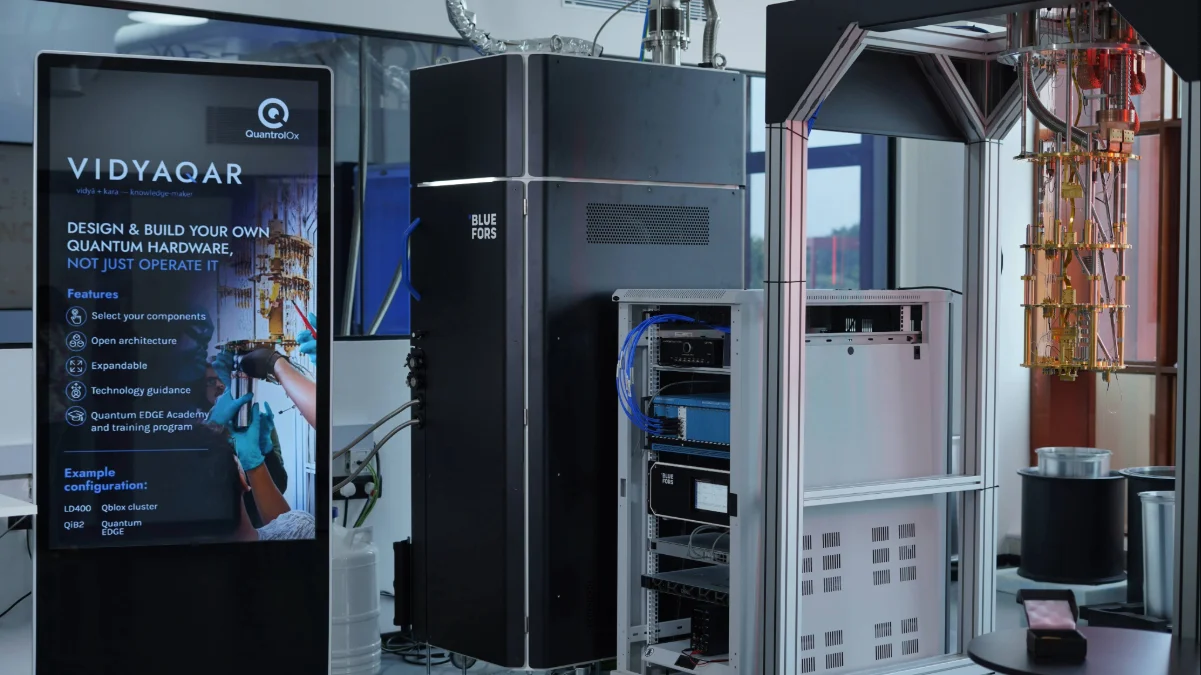
Through its partnership with QuantrolOx, Manipal Academy of Higher Education is preparing educators like Dr. Chandrakantha Bekal to run a live quantum facility. Insider Brief For Chandrakantha Bekal, teaching had never been a lifelong interest. After completing his master’s degree in product design and manufacturing, Bekal stepped into the hustle and bustle of job hunting