Robotics: research

Journal articles, academic blogs, think-tank reports and papers in this section, newest first. Back to the news.

arXiv (research papers) Yundi Cai

ESI: An Embodied Self-Improvement Flywheel for LLM-VLA Agents

Independently pretrained language models and vision-language-action (VLA) policies provide complementary building blocks for embodied agents, but connecting them does not automatically produce coordinated behavior. The VLA may generate actions that diverge from the LLM's intended subtask and, upon regaining control after a correction, undo the promising state restored by the LLM. We introduce ESI (Embodied Self-Improvement), an automated flywheel that uses environmental…
Read at arXiv (research papers)

arXiv (research papers) Jun Miura

Evaluating Language Models as Spatial Priors for Object-Goal Navigation

Semantic exploration methods for object-goal navigation use large language models (LLMs) to score how strongly a target object is associated with a room type or with a nearby object. This paper considers obtaining from the LLM a spatial prior instead: a distribution over the position of the target in a room. We evaluate whether two open-weight LLMs, Qwen3.5-27B and Gemma-4-31B-it, can provide such a prior. Using real room layouts from CubiCasa5K and ScanNet, we measure the…

Read at arXiv (research papers)

arXiv (research papers) Yael Fassbind

PoliMop: Policy-in-the-Loop Motion Planning in 3D Spaces for Mobile Robots

Reaching a goal state in a complex environment often requires a robot to overcome challenging terrain and obstacles. Which routes are accessible depends on the robot's physical design, the control policy it uses, and how it modifies its surroundings. We present a kinodynamic rapidly-exploring random tree (RRT) planner that uses physics simulation to exploit skills encoded in the control policy, which allows it to find a path in the scene with respect to the robot's…

Read at arXiv (research papers)

arXiv (research papers) Xianxu Wu

A Generalizable Approach to Safety-Aware Robotic Behavior Planning with an Explicit Constraint Space

Large language and vision-language models have substantially advanced robotic behavior planning from natural-language instructions and visual observations. However, safe manipulation in tabletop environments remains challenging because the safety constraints required for a task depend on the surrounding scene and may not be explicitly specified in the instruction. We propose a safety-aware behavior planning framework based on an explicit Constraint Space that stores reusable…

Read at arXiv (research papers)

arXiv (research papers) Sol Choi

Reusing Locomotion Training Recipes Across Humanoids via Body-Aligned Virtual Joints

Reinforcement learning has enabled robust humanoid locomotion, yet training recipes (rewards, architectures, hyperparameters) remain hard to reuse across robots with different native joint coordinates, since policies output native joint angles while action scales, bounds, gains, and penalties are defined in those robot-specific coordinates. Existing transmission models convert native targets into actuator commands but do not standardize the coordinate interface exposed to…

Read at arXiv (research papers)

arXiv (research papers) Seunghwan Jang

Per-Agent-Safe Navigation of Globally Driven Robot Collectives via Affine Field Design

Safe navigation of robot collectives requires coordinating motion and deformation so that the collective can traverse constrained environments while ensuring each robot's safety. Existing controllers for swarmalator collectives largely rely on local control, where each robot receives an individual command, which causes the control and communication requirements to grow with the number of agents. We introduce a broadcast control formulation in which a single spatially affine…

Read at arXiv (research papers)

arXiv (research papers) Mizuho Okitani

Multimodal Person Concept Model for Person Identification under Varying Observation Conditions

Service robots in domestic and office environments must identify users to provide personalized services based on their preferences and previous interactions. This is challenging because only a few observations may be available for learning, while observation conditions change owing to appearance, environmental noise, and utterance content. To address this challenge, this study proposes a multimodal person concept model that learns person concepts from a small number of…

Read at arXiv (research papers)

arXiv (research papers) Yu Zhou

Beyond Prediction Gain: LASR as a Metric for Action-Grounded Latents in World Models

World models that support planning, control, and interpretable reasoning require latent representations that genuinely encode action. Yet the large-scale video data from which such models are learned overwhelmingly lack action annotations. Latent-action models infer action-like variables from observation sequences, enabling action-aware learning from unlabeled videos or trajectories. A fundamental concern, however, remains: a latent that improves future prediction may simply…

Read at arXiv (research papers)

arXiv (research papers) Zixuan Jiang

When Does Cross-View Consistency Matter in Multi-View Appearance Augmentation? A Controlled Study for Visuomotor Policies

Multi-view visual augmentation often seeks consistency across cameras, but it is unclear which forms of consistency matter for downstream control. We use simulation-state replay to manipulate cross-view coupling while preserving the per-camera perturbation distributions, physical trajectories, and action labels. Across seven LIBERO manipulation tasks, marginal-matched changes in global appearance, ghost injection, and target color have small average costs for a late-fusion…

Read at arXiv (research papers)

MIT News AI Zach Winn | MIT News SI

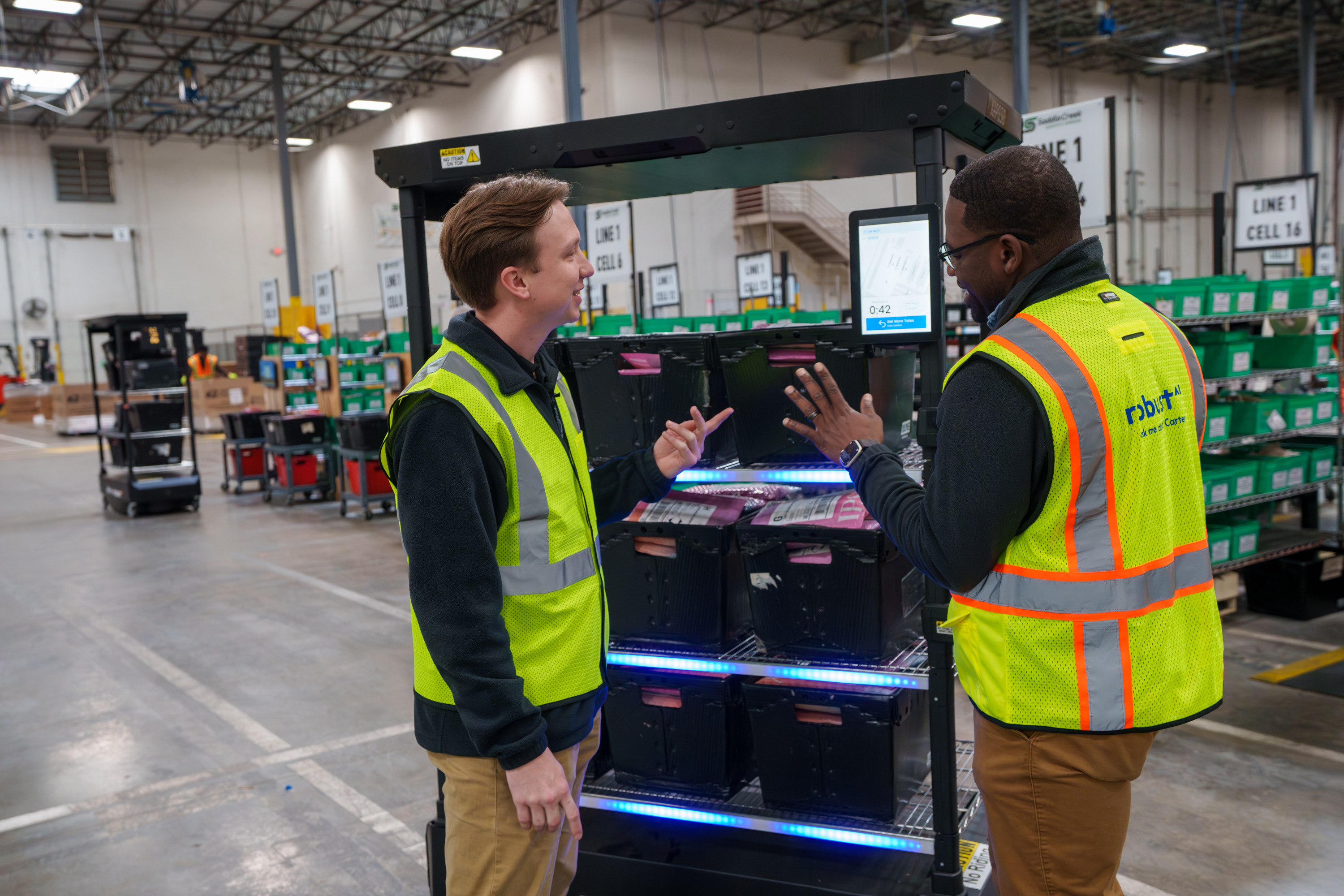
Helping robots fit into the human workplace

Founded by Anthony Jules ’92, SM ’92 and Professor Emeritus Rodney Brooks, Robust AI’s robots are designed to collaborate with humans in factories and warehouses.

Read at MIT News AI

arXiv (research papers) Shunyang Huang

ERA: Error-Resistant Autonomous Object Navigation with Predicted Depth

Depth and 3D foundation models can predict geometry from RGB images, allowing zero-shot object navigation without a depth sensor. However, when predicted depth is mapped as if it came from a sensor, view-dependent errors accumulate in the map, remove exploration goals, and end the search before the agent can observe and correct them. We propose ERA, a training-free object navigation system that replaces the depth sensor with depth predicted from RGB images and poses. ERA…

Read at arXiv (research papers)

arXiv (research papers) Yu Dong

Ego2Flow: Benchmarking the Traffic-System Impact of Autonomous Driving on Maps Distilled from Real-World Roads

End-to-end autonomous driving is predominantly evaluated through ego-vehicle safety and task completion. Its deployment in urban traffic, however, creates sustained interactions among vehicles whose collective effects remain insufficiently evaluated. We introduce Ego2Flow, a closed-loop benchmark for assessing the traffic-system impact of autonomous driving on maps distilled from real-world cities. To construct realistic 3D urban environments for sustained closed-loop…

Read at arXiv (research papers)

arXiv (research papers) Lu Xiong

EViDS: An Environment--Vehicle Dynamics Integrated Simulation Platform for Intelligent Chassis Development

The development of intelligent chassis increasingly requires the integration of environmental and perception information with high-fidelity vehicle dynamics to support environment-aware intelligent chassis control. However, existing autonomous-driving simulators and professional vehicle-dynamics tools are generally developed for different purposes, making it difficult to integrate environmental information, vehicle dynamics, and chassis algorithms. This paper proposes EViDS…

Read at arXiv (research papers)

arXiv (research papers) Christopher Malili

Imitation Policies Learn a Proprioceptive Anchor: A Predictive Law for Perception Noise and Its Closed Loop Cost

Imitation policies for robot manipulation are often trained on noisy object positions, and they learn to discount the noisy reading. We show how much they discount it, and why. Because demonstrators steer toward the object, the robot's own state carries information about where the object is. A trained policy combines this proprioceptive anchor with the reading and weights the reading by $α= V/(V + s^2)$, where $s^2$ is the reading noise and $V$ the anchor's error variance…

Read at arXiv (research papers)

arXiv (research papers) Hiroyuki Tetsuka

AI-guided robotic in situ fabrication of curvature- and tissue-adaptive wireless bioelectronics

Personalized bioelectronic devices for wound therapy require not only conformal fabrication on complex body surfaces but also functional adaptation of their electrical characteristics to individual wound geometries. Here, we present an AI-guided robotic in situ printing platform for fabricating wireless wound electrotherapy devices directly on transparent wound dressings. The system integrates a 3D vision camera, a six-degree-of-freedom robotic arm, direct-ink-writing, and…

Read at arXiv (research papers)

arXiv (research papers) Leon Kim

On the Utility of Pre-Trained Visual Representations for Policy Learning of Contact-Rich Insertion Tasks

Visuomotor imitation learning has become a predominant paradigm for real-world robotic manipulation, yet it remains data-inefficient and brittle to task-irrelevant visual shifts. Pre-trained visual representations promise to ease this burden by distilling priors from internet-scale data, but the ``right'' representation for robotics remains unresolved: existing studies span broad but sparse task distributions and reach conclusions that vary and even conflict, pointing to…

Read at arXiv (research papers)

arXiv (research papers) Huiwen Han

TouchTwin: Scaling Human Touch Data via Real-to-Sim-to-Real

Human demonstrations are becoming the main source of data for dexterous manipulation, and real-to-sim-to-real pipelines multiply each demonstration in simulation. These pipelines rebuild the interaction from vision, which recovers how the hand moves. Which fingers touch, when, and how hard remain unobserved, because a hand pose shows where each finger stops on the surface rather than how far it is driven to close. This gap is a force gap: on held-out recordings, a hand…

Read at arXiv (research papers)

arXiv (research papers) Jiaxin Huang

X-Nav Technical Report: Real-World Long-Horizon Indoor-to-Outdoor Navigation on a Humanoid Robot

Long-horizon navigation from indoors to outdoors remains an open problem for humanoid robots: one instruction covers rooms, doors and roads, and the camera moves with the gait. Worken, AGIBOT's measure of productive robot work, depends on robots that reach their workplaces autonomously. We present X-Nav, to our knowledge the first system to take a bipedal humanoid through a language-instructed long-horizon mission from indoors to outdoors. X-Nav covers a pipeline from data…

Read at arXiv (research papers)

arXiv (research papers) Arne Sachtler

Natural Swing-Up of an Underpowered Double Pendulum

Robots with weak motors must ride their natural dynamics rather than fight them. We swing up a direct-drive planar two-link robot, whose motors deliver only about 6\,\% of its shoulder gravity torque, along its nonlinear normal modes, two-dimensional invariant manifolds consisting of periodic orbits. On a non-strict mode, injecting energy necessarily moves the state off the manifold, so pumping and stabilization compete for the same bounded torque. We split the input torque…

Read at arXiv (research papers)

arXiv (research papers) Mariana Sosa Guzmán

Grounding Object-to-Object Hazard Reasoning into 3D Risk Fields for Task-Conditioned Safety

Safety in robotics does not solely depend on geometric constraints, but also on semantics: the given task, environment properties, and interactions between objects in the scene. We present a framework based on vision-language models (VLMs) to infer task- and scene-dependent safety constraints for robot manipulation. We provide the VLM a structured safety tool based on an RGB-D observation and a natural-language task instruction that first decides whether the task should be…

Read at arXiv (research papers)

arXiv (research papers) Deepu Krishnareddy

Talk to Act: A Synthetic Multi-Turn Dialogue Benchmark for Human Intent Extraction and Action Planning in Robotics

Multi-turn conversational human-robot interaction (HRI) continues to be a challenging problem in robotics, as many existing systems rely on rigid, command-driven interfaces that can be unintuitive for users. Recent advances in Large Language Models (LLMs) provide a promising direction, given their ability to process natural language, generate structured outputs, and support tool-based reasoning, all of which are relevant for interpreting user intent in robotic settings…

Read at arXiv (research papers)

arXiv (research papers) Konstantinos Mylonas

Learning Latent Goal Costs for Visual World-Model Planning with an Expanding Curriculum

Image-goal planning with a frozen visual world model depends on how predicted observations are scored against the goal. Mean-squared error (MSE) between embeddings from a pretrained visual encoder can provide a useful signal near a goal, yet favor states across an obstacle that are visually similar to the goal and difficult to reach. We fit a small residual adapter on top of frozen I-JEPA embeddings to improve this latent goal cost. Starting near each goal, a planner…

Read at arXiv (research papers)

arXiv (research papers) Maitree Meher

Racing the Clock: Teaching VLNs Budget-Conditioned Object Search

A rescue robot entering a building with thirty seconds on the clock should sprint toward the single most promising room; given ten minutes, it should instead explore a broader tour. Yet vision-language-navigation (VLN) models are typically evaluated under a fixed episode limit that the policy never observes, even though time-critical missions require behavior to adapt to the available budget. We study budget-conditioned object search: given a target category and an explicit…

Read at arXiv (research papers)

arXiv (research papers) Guangyuan Sui

ProtoVis-Nav: Prototypical Visual Imagination for Visual-Spatial Aligned UAV Navigation

Vision language navigation (VLN) is very challenging for Unmanned Aerial Vehicles (UAVs) since small errors in 3D motion prediction can lead to navigation errors and collisions. Unable to fathom execution outcomes in 3D environments, existing methods often struggle to predict accurate navigation waypoints from language instructions. To solve this, we introduce the Prototypical Visual Imagination framework, shortened as ProtoVis-Nav, which forces the model to imagine an…

Read at arXiv (research papers)

arXiv (research papers) Yichi Zhang

HEIR: Harness Egocentric Intent for Human-Robot Interactions

For robots to assist, serve, and collaborate with humans, they must not only interpret human requests conveyed through language and multimodal intentional cues, but also execute long-horizon tasks that interleave navigation and manipulation. In this paper, we introduce HEIR, a resource for studying how to Harness Egocentric Intent for Human-Robot Interaction. HEIR pairs human speech, measured gaze, and egocentric video with robot observations and teleoperated…

Read at arXiv (research papers)

arXiv (research papers) David R. Martin

Collaborative Task Allocation for Heterogeneous Multi-Robot Systems Through Iterative Clustering

Multi-robot systems face the challenge of efficiently allocating teams of heterogeneous robots to tasks. The task allocation problem is complicated by collaborative interactions between robots where teams of robots develop emergent capabilities that enable them to complete tasks that would be inefficient or impossible for individual robots. To address these challenges, we present an iterative clustering algorithm for collaborative task allocation in heterogeneous multi-robot…

Read at arXiv (research papers)

arXiv (research papers) Donglin Yang

UAV-Flow++: A Unified Suite for Benchmarking and Learning Language-Guided UAV Flight

Language-guided UAV navigation has largely focused on long-horizon route planning, leaving short-range, object-relative flight maneuvers underexplored. To address this gap, we formulate Flying-on-a-Word (Flow), a task requiring a UAV to convert concise natural-language instruction, egocentric visual observation, and current state dynamics into continuous flight actions. Flow encompasses both primitive motion commands and complex object-interactive behaviors, assessing motion…

Read at arXiv (research papers)

arXiv (research papers) Kerui Gu

XBot-Omni: An Omni-Modal Model for Embodied Understanding and Interaction

Embodied interaction requires an agent to integrate multimodal perception with verbal and nonverbal behaviors to effectively communicate its intentions, including speech, body motion, and facial expressions. We present XBot-Omni, a Thinker--Talker--Actor architecture that extends the Omni paradigm to robotic modalities, including body motion and facial expressions, with ``X'' representing the extensibility to robotic-specific modalities. The Thinker processes text, images…

Read at arXiv (research papers)

arXiv (research papers) Benjamin A. Christie

Inner Product Regularization for Imitation Learning

Robots that learn from demonstrations should extrapolate their policy despite state perturbations such as sensor noise, scene variation, and compounding errors. One approach to this robustness is regularization. Prior regularizers consider each state on its own and limit how sensitive the policy is to any perturbation at that state. By contrast, we explore how the policy's output shifts when given the same perturbation at different states. Our insight is that, locally, the…

Read at arXiv (research papers)

arXiv (research papers) Liangjun Xing

FORGE: Force-Aware Multi-Granularity Control for Efficient Humanoid Loco-Manipulation

Humanoid loco-manipulation requires coordinated locomotion, balance regulation, and manipulation under frequent contacts, making teleoperated demonstration collection difficult: a practical controller must simultaneously provide precision, stability, and contact awareness. We propose FORGE, a force-aware multi-granularity control system with a coarse-to-fine command space spanning velocity navigation, planar foot placement, wrist-pose tracking, and optional…

Read at arXiv (research papers)

Older stories