Results for “Agent”

arXiv (research papers) Petter Törnberg SI

Designing Institutions for Autonomous AI

As autonomous AI agents increasingly interact in persistent populations, their collective capabilities and alignment depend not only on individual models, but also on the institutions governing their interactions. Yet AI research has largely focused on individual agents. In this Perspective, we argue that institutional design must become a distinct focus of AI research. Drawing on institutional political economy, social epistemology and organizational theory, we develop…
Read at arXiv (research papers)

AWS Machine Learning Blog Josh DeMuth SI

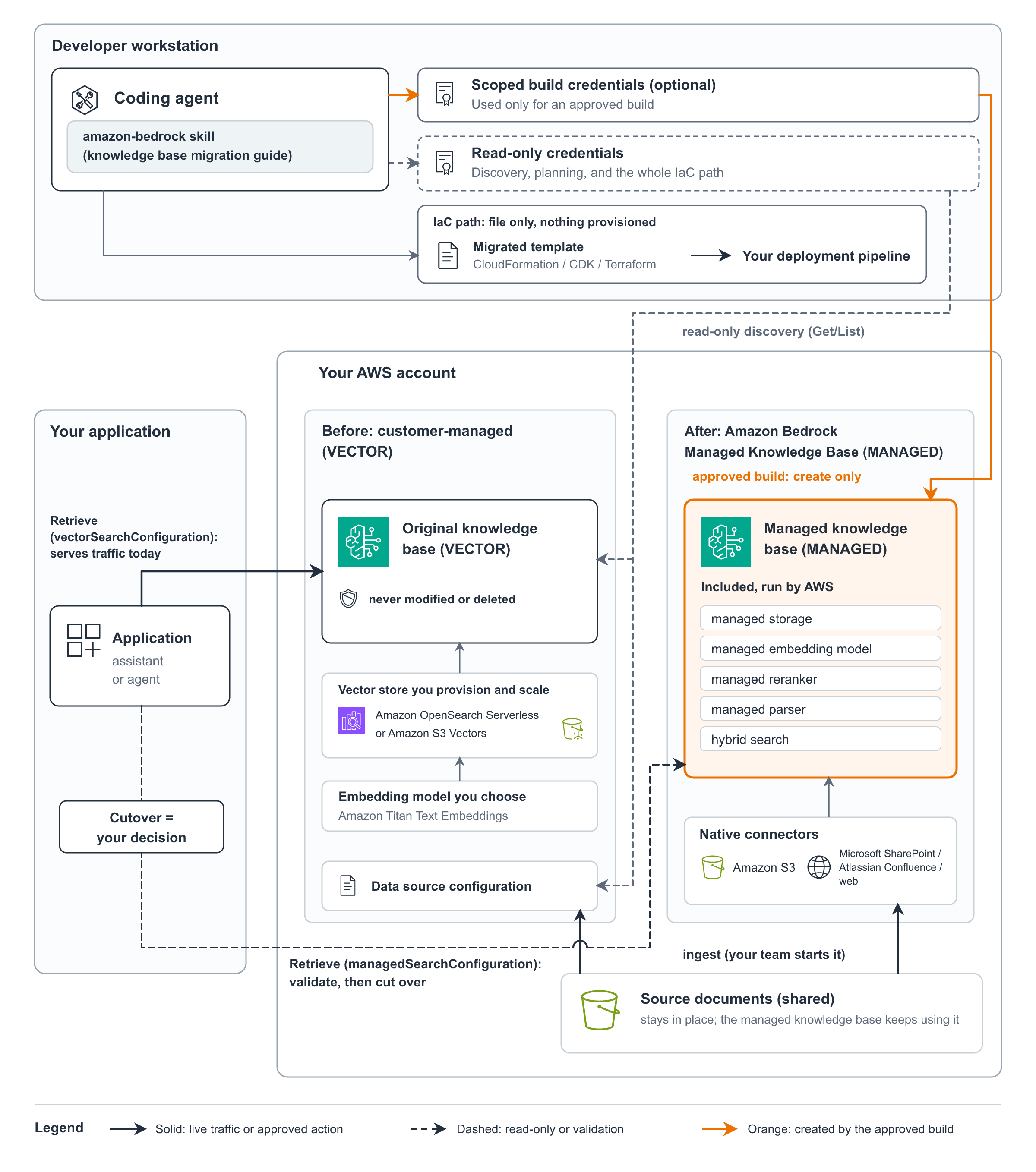
Migrate to Amazon Bedrock Managed Knowledge Base with your coding agent

The migration guide in the amazon-bedrock skill helps you migrate a customer-managed Amazon Bedrock knowledge base to a Managed Knowledge Base. Your coding agent plans the move with read-only discovery, creates the new knowledge base or an infrastructure-as-code template alongside the original, and validates retrieval before you cut over.

Read at AWS Machine Learning Blog

AWS Machine Learning Blog Amit Chaudhary SI

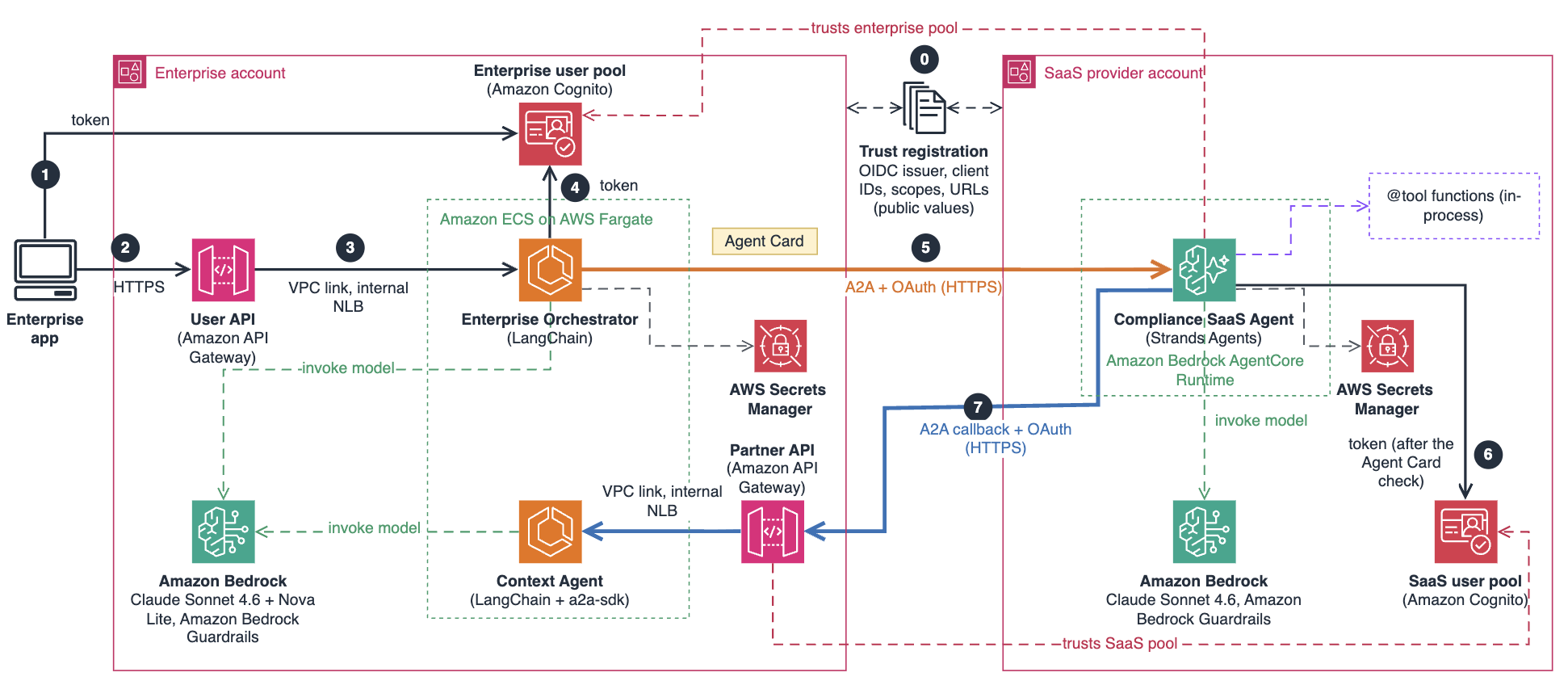
Build composable, interoperable multi-agent systems with A2A on AWS

Build a composable, interoperable multi-agent system on AWS with the Agent-to-Agent (A2A) protocol. A LangChain orchestrator on Amazon ECS communicates with a Strands agent on Amazon Bedrock AgentCore across organizational boundaries, using bidirectional, OAuth-authenticated calls, with neither side depending on the other's framework or SDK.

Read at AWS Machine Learning Blog

AWS Machine Learning Blog Renya Kujirada SI

Fine-grained access control for Amazon Bedrock Managed Knowledge Base tools

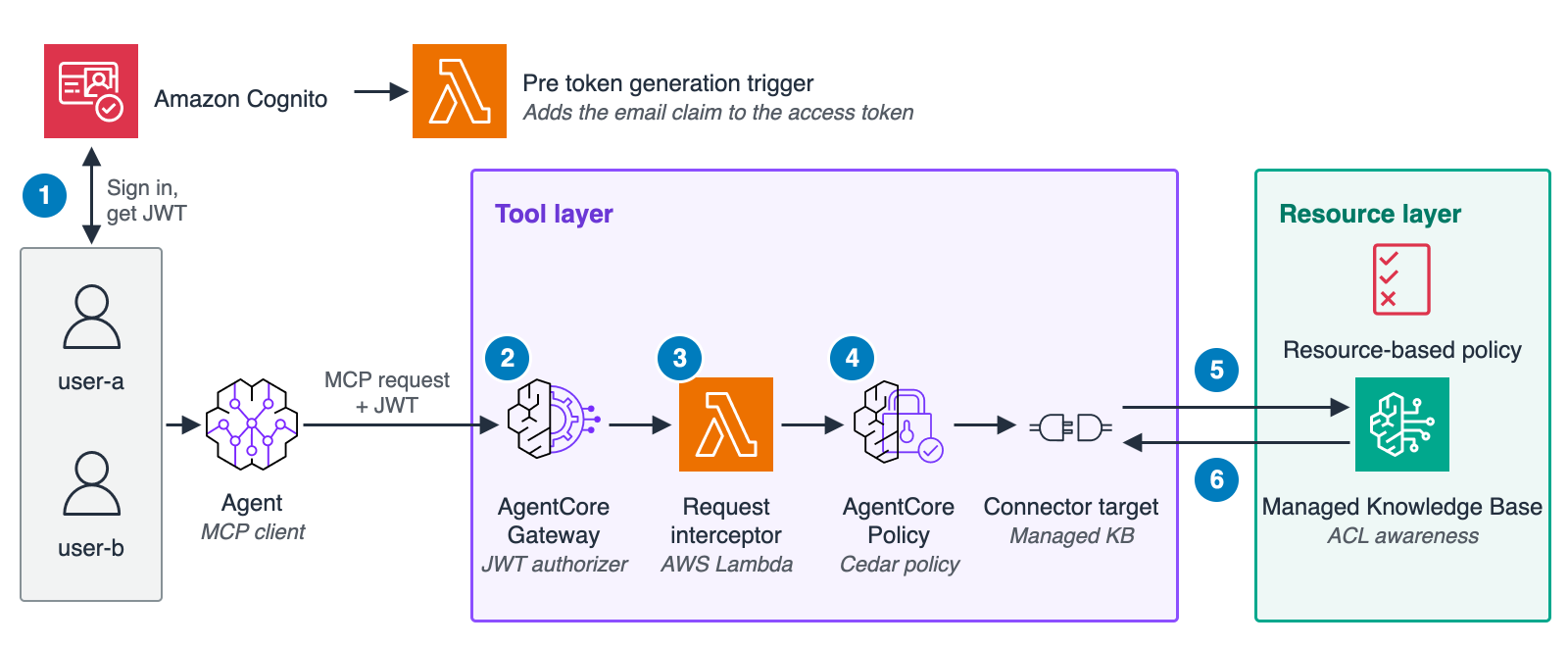
Learn how to expose an Amazon Bedrock Managed Knowledge Base to AI agents as MCP tools through Amazon Bedrock AgentCore Gateway while keeping per-user access control. A request interceptor injects verified identity, Policy in AgentCore validates it independently, and a resource-based policy restricts direct access to the knowledge base.

Read at AWS Machine Learning Blog

AWS Machine Learning Blog Yuan Wei SI

From prototype to production: Engineering agents with Agent DLC

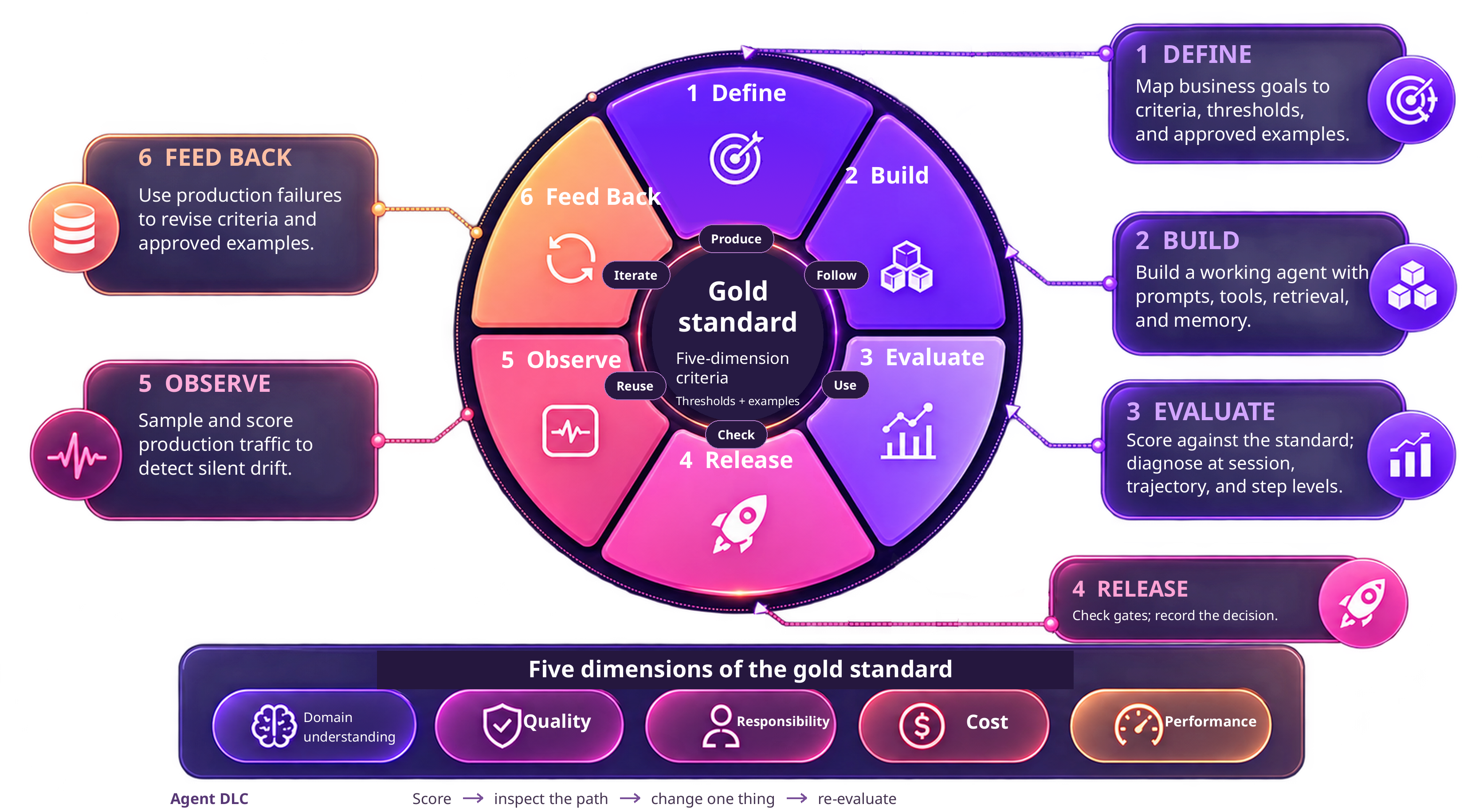
Agents stall between demo and release when teams lack a repeatable way to measure how good an agent is and whether the last change helped. This post covers three agent properties that break traditional CI/CD, a measured case where an aggregate metric hides a coverage gap, and Agent DLC: one lifecycle, two loops, and one explicit standard for judging every change.

Read at AWS Machine Learning Blog

The Register Richard Speed SI

United Airlines wants you to check in, not your chatbot

AI agents face restrictions over safety checks that require a human touch

Read at The Register

Help Net Security Industry News Security

Picus puts AI agents on the offensive with autonomous pentesting

Picus Security has announced Picus Autonomous Penetration Testing, an agentic pentesting capability that puts AI agents on the offensive: they think like attackers, chain real exploits toward an organization’s crown jewels, and prove what a breach would look like, under governance the agent cannot override. The launch rebuilds Picus’s automated penetration testing for the agentic era on five years of enterprise deployments and thousands of automated pentests. In the…

Read at Help Net Security

Unit 42 (Palo Alto Networks) Unit 42 Security

Attackers Use Autonomous AI to Target Semiconductor, Defense and Civil Society Sectors

Our analysis of how attackers used the open-source Cairn AI agent framework to autonomously breach semiconductor, defense and civic targets.

Read at Unit 42 (Palo Alto Networks)

arXiv (research papers) ACE-CaP Team

ACE-CaP-0: Real-World Code-as-Policies in the Era of Experience

Recent advances in frontier models have pushed the boundaries of agentic robot control, enabling agents to perform complex robotic tasks through reasoning and interaction. However, repeated calls to these models during execution can substantially increase task completion time. Code as Policies (CaP) offers a route for coding agents to acquire physical skills through experience and retain them in executable programs, allowing the reasoning invested in development to be reused…

Read at arXiv (research papers)

ERR News (Estonian public broadcaster)

Estonian films could reach Russia without local producers' knowledge

Estonian films can still reach Russia through international sales agents and co-production deals, despite efforts to restrict such sales.

Read at ERR News (Estonian public broadcaster)

TechPowerUp AleksandarK Geopolitics

NVIDIA Co-Founder and CEO Jensen Huang Officially Resigns

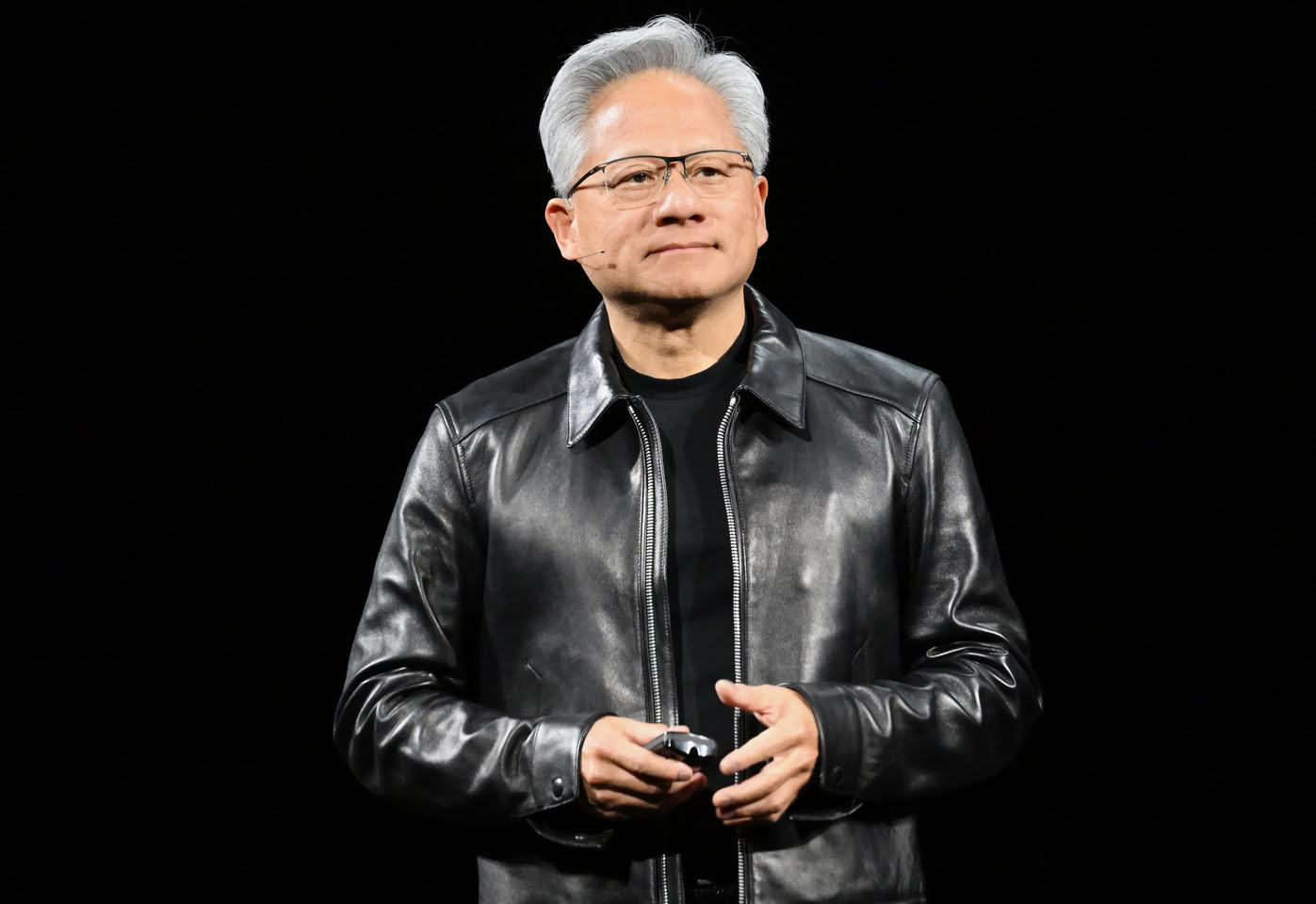
NVIDIA's co-founder, chief executive officer, and president has officially signed a letter of resignation, stepping down from the role he has held since 1993. Following a series of controversies, NVIDIA announced on Sunday that the company's board of directors is launching a full-scale independent investigation into recent reports of founder and CEO Jensen Huang having a relationship with a woman the U.S. intelligence community believes is an agent of the Chinese state…

Read at TechPowerUp

9to5Mac Bradley C SI

Mount Thor raises $45 million to build Mac data centers for AI agents

Apple @ Work is exclusively brought to you by Mosyle, the only Apple Unified Platform. Mosyle is the only solution that integrates in a single professional-grade platform all the solutions necessary to seamlessly and automatically deploy, manage & protect Apple devices at work. Over 45,000 organizations trust Mosyle to make millions of Apple devices work-ready with no effort and at an affordable cost. Request your EXTENDED TRIAL today and understand why Mosyle is everything…

Read at 9to5Mac

NBC News Steve Kopack

Nvidia CEO Jensen Huang resigns after reports of extramarital relationships

Nvidia CEO Jensen Huang has resigned in the wake of reports that he had multiple extramarital relationships, including one with a woman who reports to him and another with a suspected agent of China — a stunning turn of events for the head of a company at the heart of the global AI investment boom.

Read at NBC News

The Decoder Maximilian Schreiner SI

ElevenLabs Scribe v3 Live uses conversational context to stop voice agents from cutting off callers mid-sentence

ElevenLabs has released Scribe v3 and Scribe v3 Live, two new speech recognition models designed to transcribe accurately through background noise and crosstalk. Benchmarks from Artificial Analysis confirm that Scribe v3 narrowly beats competitors like OpenAI, Google, and Microsoft on accuracy. That precision comes at a cost, though. Rivals like Microsoft and xAI run many times faster and charge roughly half the price. The article ElevenLabs Scribe v3 Live uses…

Read at The Decoder

YourStory Startups

Kutlerri.ai raises $4M to help US restaurants grow revenue and cut costs using AI agents

Founded by former HighRadius executives Kiran Rana and Payal Tripathy, Kutlerri.ai charges restaurants a percentage of the revenue its AI agents generate or the costs they save.

Read at YourStory

The Record Security

Kazakhstan-linked hackers used AI agent to spy on Central Asian governments

Suspected Kazakhstan-linked hackers used an artificial intelligence agent to help spy on Central Asian governments, steal sensitive documents and infiltrate critical infrastructure networks, according to new research.

Read at The Record

arXiv (research papers) Yiheng Zhao SI

Scale-Induced Semantic Shift in Visual Prompt Injection Against VLMs and Web Agents

Visual content in multimedia systems may be resized, compressed, or re-rendered before it is interpreted by a vision-language model. We study a security failure mode in which these transformations change the machine-readable semantics of an image: a textual instruction is not recovered at a $512\times512$ presentation resolution under our evaluation protocol but becomes recoverable after aggressive downsampling. We formulate this behavior as Scale-Induced Semantic Shift…

Read at arXiv (research papers)

arXiv (research papers) Yaru Niu

EgoX: Egocentric Cross-Embodiment Manipulation with Embodiment Dreaming

Generalist manipulation policies can benefit from the complementary experience of humans, real robots, and simulated agents. However, differences in morphology, sensing, and control interfaces make it difficult to learn effectively from their combined demonstrations. We introduce EgoX, an egocentric cross-embodiment learning framework that organizes heterogeneous demonstrations through semantically corresponding observation and action modalities. EgoX pretrains a Modularized…

Read at arXiv (research papers)

Notes from Poland Alicja Ptak

Poland dismisses Russia’s claim of breaking up Polish spy network as “disinformation”

Russia claims to have arrested two agents conducting espionage in Kaliningrad.

Read at Notes from Poland

The Decoder Alan Truly SI

Google Deepmind shifts genomics AI from bulk tissue predictions to single cell type resolution with AlphaGenome 2

Google Deepmind has unveiled AlphaGenome 2, an AI model that analyzes genetic variants for individual cell types rather than across bulk tissue. Trained on more than 107 million cell profiles, it identifies nearly twice as many disease-relevant gene changes as its predecessor. The model is available for noncommercial research through an API and is set to be integrated into Google's agentic platform Antigravity. The article Google Deepmind shifts genomics AI from bulk tissue…

Read at The Decoder

arXiv (research papers) Yingbin Jin Security

MobileProbe: Adaptive Security Evaluation of Mobile Agents via Trajectory-Aware Injection

Mobile GUI agents read the screen of a phone and operate apps on a user's behalf to complete multi-step tasks such as online shopping or messaging. Because the agent acts on whatever the screen shows, an attacker can embed malicious instructions into ordinary UI content and redirect its actions. We refer to this threat as environmental injection attack (EIA). Existing benchmarks measure this risk by pinning hand-crafted payloads to a fixed step of a fixed task. This approach…

Read at arXiv (research papers)

The Hacker News Security

Webinar: See How Identity Blind Spots Put Your SOC at Risk and How to Close Them

Security teams have more alerts, logs, and monitoring tools than ever. Yet when an attack happens, one simple question can still take too long to answer: Who or what is behind this activity, and what can they access? A suspicious login might belong to an employee. An unusual API call could come from a machine account. Or an AI agent might be accessing sensitive systems using permissions nobody

Read at The Hacker News

Tech.eu Tamara Djurickovic Startups

Mondrio secures $3.75M to rethink B2B pricing with AI agents

AI-powered B2B pricing platform Mondrio hasraised a $3.75 million funding round led by Heartcore Capital, with participationfrom Pretiosum VC, Hersir Ventures, Cambrena Capital and Momo VC, alongsidea...

Read at Tech.eu

Help Net Security Anamarija Pogorelec Security

Microsoft Entra adds a seven-day safeguard against irreversible identity deletion

Microsoft Entra’s Hard Deletion Protection, now in preview, gives administrators a seven-day window to recover selected identities before they can be permanently erased. The feature is designed to help organizations respond to accidental or malicious deletion of critical directory objects. It supports users that are not synchronized from on-premises systems, cloud-only groups, applications, and service principals. Entra Agent ID objects are covered through their underlying…

Read at Help Net Security

SiliconANGLE AI Jonathan Anthony SI

Agents that build their own databases are forcing a data foundation rethink

AI agents are changing how enterprises create, move and govern information, and data observability is turning into a prerequisite rather than a nice-to-have. Models get most of the attention, but the data beneath them decides whether they hold up in production. That pressure is now reaching the cloud-native community, where KubeCon organizers added a dedicated

Read at SiliconANGLE AI

Help Net Security Mirko Zorz Security

Stolen Claude API keys can turn Claude Code into a remote-controlled implant

Darktrace researchers turned Claude Code into a remote-controlled implant in a lab test, steering the coding agent through the memory stores feature of Anthropic’s Claude platform and pulling a 1 GB file out through the Claude Files API. Once the agent was set up, every job and every result traveled through api.anthropic.com, the endpoint the agent already calls for inference, so the attacker’s traffic looked like a coding agent doing its job. The technique needs … More →

Read at Help Net Security

Kyiv Post Kyiv Post

FSB Detains 4 Alleged Ukrainian Agents in 3 Separate Incidents

The FSB said on Thursday it detained four individuals, one a foreign national, in the Republic of Adygea, the so-called Donetsk People’s Republic and the Omsk Region. It accused them of working for Ukrainian intelligence and said it had recovered an IED and a grenade in Donetsk.

Read at Kyiv Post

Analytics India Magazine Siddharth Jindal SI

Meet Netweb, the Only Indian Company Building NVIDIA-Certified GPU Servers

Netweb is betting on AI infrastructure, with new initiatives spanning agent security, GPU optimisation, and sovereign computing.

Read at Analytics India Magazine

South China Morning Post Leopold Chen Geopolitics

Cross-industry association in Hong Kong releases guide on responsible AI use

A Hong Kong group comprising leaders from different industries has launched a guide to promote responsible use of artificial intelligence, calling for organisations to designate clear owners for their AI initiatives to strengthen accountability. Releasing the 209-page Guidelines on Responsible Corporate and Institutional Adoption of Artificial Intelligence on Thursday, the Artificial Intelligence Association of Hong Kong said that with the rise of autonomous AI agents…

Read at South China Morning Post

arXiv (research papers) You Wu

AstroMemBench: A Benchmark for Memory Systems in Embodied Spacecraft Agents

Long-term spacecraft autonomy requires embodied agents to use operational history under communication delays, time-critical operations, environmental uncertainty, complex physical interactions, power and computational constraints, and safety and reliability requirements. We introduce AstroMemBench and a Scenario-Challenge-Capability design method that maps these requirements to executable memory tests. The benchmark covers 16 memory subchallenges through 140 templates and…

Read at arXiv (research papers)

Older stories