Results for “Quantum”

The Quantum Insider Matt Swayne

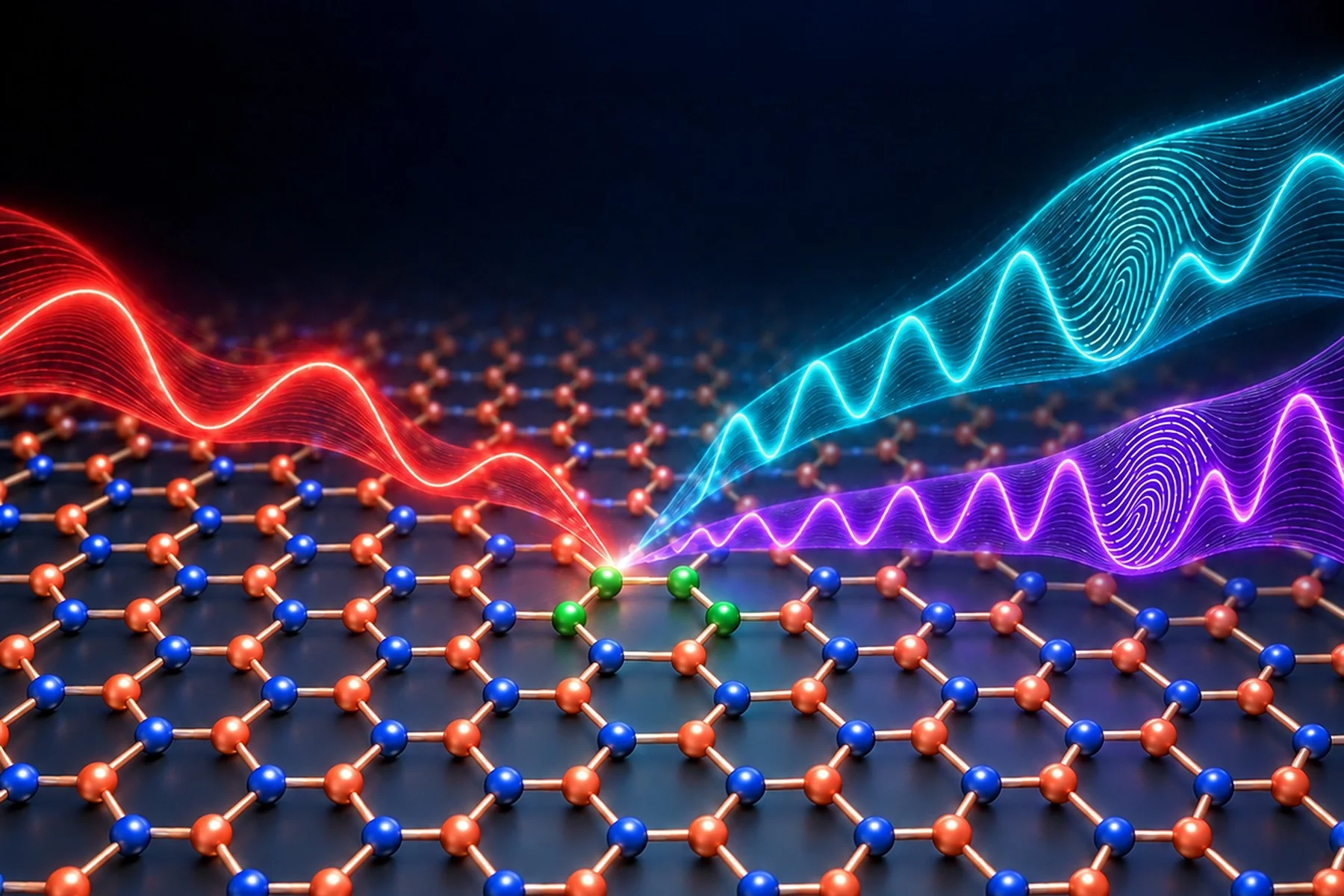
University at Buffalo Study Decodes Quantum Material’s ‘Optical Dingerprints’

Insider Brief PRESS RELEASE — The tiny atomic defects so important for future quantum technologies can be difficult to spot. Fortunately, they leave behind some clues The defects can alter how a material responds to light, producing a distinctive optical fingerprint that scientists can measure. The challenge is figuring out which fingerprints belong to which

Read at The Quantum Insider

Ukrainska Pravda Ivanna Kostina,Ivan Diakonov

German drone manufacturer Quantum Systems supplying Ukraine suffers cyberattack

Quantum Systems, a German defence company supplying reconnaissance drones to Ukraine, has confirmed a cyberattack detected in October. Germany's armed forces have suspended use of its drones as a precaution.

Read at Ukrainska Pravda

Phys.org Quantum Physics

Research advances quantum computing that harnesses speed of light

Quantum computers have the potential to perform calculations more quickly than supercomputers, but they could be even faster and more energy-efficient if they were built with photons as their basic units, called qubits.

Read at Phys.org Quantum Physics

Quantum Computing Report Mohamed Abdel-Kareem

Qunova Computing Achieves Chemical Accuracy at 80 Qubits on Iron-Sulfur Cluster Using IBM Quantum System Two and Fugaku

Qunova Computing achieved a breakthrough in quantum chemistry by simulating an 80-qubit iron-sulfur cluster with chemical accuracy using a hybrid approach combining IBM Quantum System Two and the Fugaku supercomputer. Their HI-VQE algorithm reduced classical computing costs by approximately 300x while matching classical benchmarks. This advancement has significant implications for understanding complex biological and industrial processes.

Read at Quantum Computing Report

Quantum Computing Report Mohamed Abdel-Kareem

Cleveland Clinic, RIKEN, and IBM Cross 12,000-Atom Barrier in Heterogeneous Quantum-Classical Drug Binding Simulations

A collaboration between Cleveland Clinic, RIKEN, and IBM Quantum has achieved the largest heterogeneous quantum-classical (HQC) electronic-structure calculation to date, simulating protein-ligand complexes exceeding 12,000 atoms. This research utilized 156-qubit IBM Heron r2 processors and leadership supercomputers to significantly advance molecular size and fragment energy accuracy in drug binding simulations. The team developed an Embedded Wavefunction (EWF) formalism and…

Read at Quantum Computing Report

The Quantum Insider Ajay P. Manuel

The Geometry of Quantum Memory: How Anyons Rewrite the Rules of Remembering and Computation in the Quantum Realm

Insider Brief An ordinary qubit remembers too much and listens too well. Its delicate phase is the hidden part of a qubit’s state. It carries much of the qubit’s information and is very easy to disturb. The phase takes account of every stray field, lattice vibration, and fluctuating charge. In turn, a qubit lives a

Read at The Quantum Insider

Quantum Computing Report Mohamed Abdel-Kareem

LTM Becomes First Global Systems Integrator to Launch Function in IBM Quantum Functions Catalog with AI-QEM

LTM has launched its AI-QEM software in the IBM Quantum Functions Catalog, becoming the first global systems integrator to do so. This software utilizes an AI-powered approach to mitigate hardware noise in quantum circuits without additional quantum processing unit (QPU) runtime. It has demonstrated high accuracy on up to 100-qubit circuits and provides a more efficient alternative to conventional error-mitigation protocols.

Read at Quantum Computing Report

Quantum Computing Report Mohamed Abdel-Kareem

Kipu Quantum Launches Rimay Quantum Feature Extraction in IBM Quantum Functions Catalog

Kipu Quantum has launched its Rimay quantum feature extraction service on the IBM Quantum Functions Catalog, allowing IBM Quantum users to access quantum-enhanced machine learning for feature engineering. This service, which operates as a preprocessing layer for classical machine learning models, has demonstrated improved recall and AUC scores in credit risk classification. It's designed to provide enriched data matrices for use with standard frameworks like scikit-learn.

Read at Quantum Computing Report

Quantum Computing Report Mohamed Abdel-Kareem

PsiQuantum and AMD Expand Partnership with Equity Investment to Co-Design Utility-Scale Quantum Infrastructure

PsiQuantum and AMD are expanding their partnership with an equity investment from AMD to co-design the infrastructure for fault-tolerant quantum systems. The collaboration integrates AMD's GPUs, CPUs, and software with PsiQuantum's silicon photonics architecture to enhance real-time error correction and classical computing for hybrid workloads. They are prioritizing pharmaceutical research and molecular simulation, with plans to present further technical details at the SC26…

Read at Quantum Computing Report

Phys.org Quantum Physics

Engineered atomic interactions help microwave sensor capture three times as much information

Researchers from the Faculty of Physics at the University of Warsaw (UW) and the Center for Optical Quantum Technologies at the University of Warsaw's Center for New Technologies (CeNT UW) have developed a method for ultrasensitive microwave sensing. Using cold, strongly interacting Rydberg atoms as a microwave detector, the researchers observed that carefully engineered interactions between the atoms make the atomic state resistant to loss.

Read at Phys.org Quantum Physics

Phys.org Quantum Physics

Multiplexed detector system precisely counts more than 9,000 photons

Researchers have developed a new approach that can precisely count from zero to more than 9,000 individual photons. The advance opens new possibilities for studying quantum light at large scales and making precise optical measurements.

Read at Phys.org Quantum Physics

Dark Reading Ericka Chickowski Security

Getting Past the Post-Quantum Cryptography Discovery Phase

Most organizations haven't sorted out their cryptographic estate enough to even know where they'd start with post-quantum cryptography (PQC).

Read at Dark Reading

Phys.org Quantum Physics

Chip-based laser cooling could ease quantum computing bottleneck

Researchers at Cornell have developed a laser-cooling technique that could potentially remove a significant bottleneck in the development of larger, faster quantum computers.

Read at Phys.org Quantum Physics

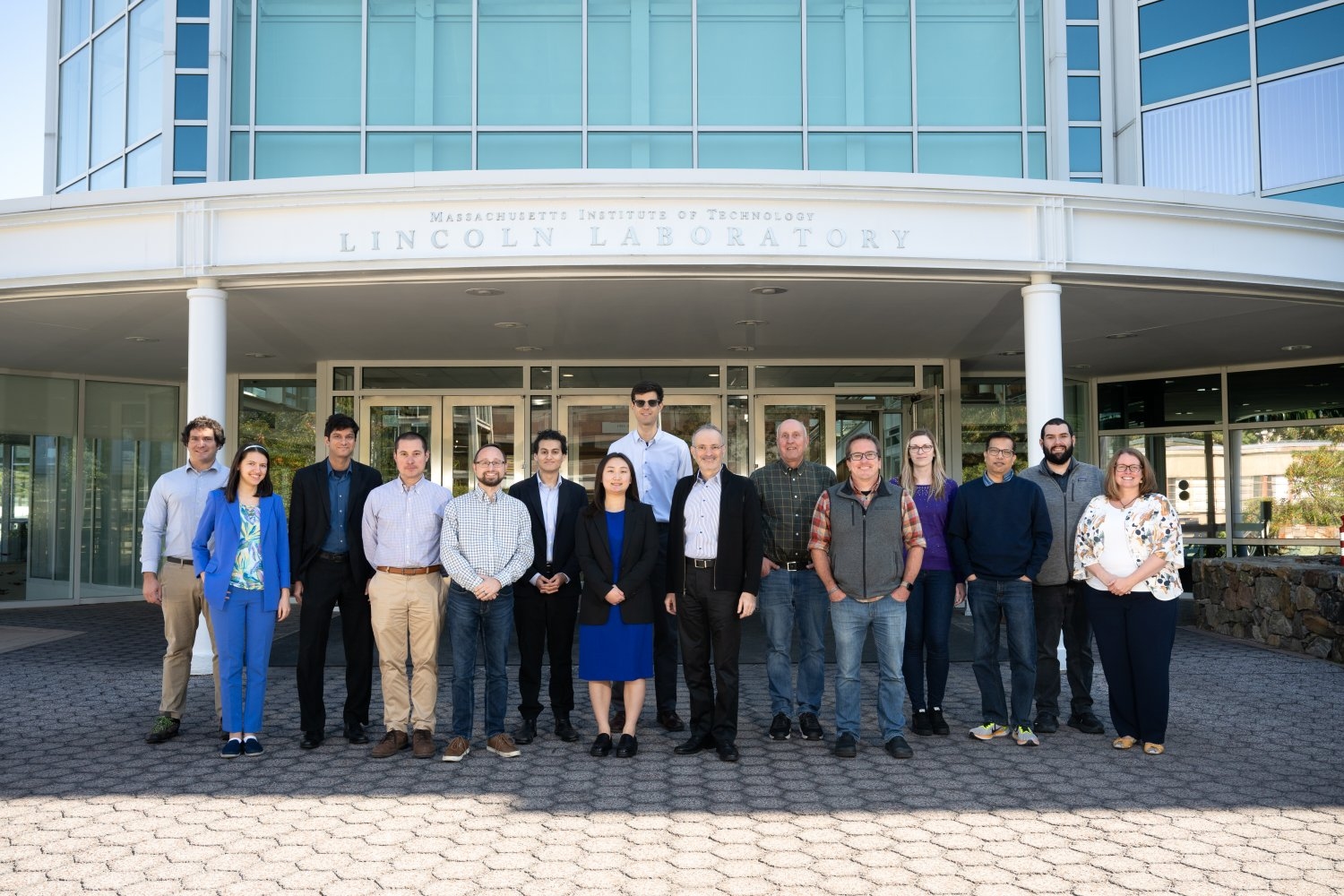
MIT News AI Kylie Foy | MIT Lincoln Laboratory SI

Three Lincoln Laboratory technologies receive 2026 R&D 100 Awards

A secure operating system, a quantum microsystem platform, and a 5G interference-canceling algorithm are named among the year's most significant innovations.

Read at MIT News AI

arXiv (research papers) Saptarshi Mandal

Ensemble phase transitions in measurement-unitary hybrid quantum circuits

The universal properties of state ensembles generated by quantum dynamics provide a refined lens into Hilbert-space ergodicity and deep thermalisation, or lack thereof. We investigate deep-ergodicity breaking transitions of an ancillary qubit entangled with a system undergoing dynamics via hybrid quantum circuits, where unitary evolution is interspersed with projective measurements. Specifically, we analyse the statistical properties of two distinct state ensembles: the…

Read at arXiv (research papers)

arXiv (research papers) Omar Bachain

Quantum Metrology and Quantum Battery in a Hyperfine-Coupled Spin System

We investigate multiparameter quantum metrology and the energetic properties of an effective electron--proton spin system inspired by the hyperfine structure of the hydrogen atom. Considering the external magnetic field $\mathcal B$ and the hyperfine coupling strength $Λ$ as unknown parameters, we derive the quantum Fisher information matrix and establish the corresponding quantum Cramér--Rao bounds for their simultaneous estimation. We analyze the estimation precision and…

Read at arXiv (research papers)

arXiv (research papers) Bibek Saha

Statistics of Fock-space correlation lengths in the many-body localised phase

The presence of long-ranged, many-body resonances in the many-body localised phase of disordered quantum systems is manifest in strong inhomogeneities of eigenstate amplitudes on the Fock space. We develop a quantitative, microscopic theory for this, centred on two-point Fock-space correlation functions. Exact diagonalisation of the disordered tilted-field Ising chain uncovers a stark contrast: typical correlations decay perfectly exponentially, whereas average correlations…

Read at arXiv (research papers)

arXiv (research papers) Paula I. Villar

Traces of Vacuum Squeezing: A Superconducting Transmission-Line Analogue of Cosmological Particle Creation

Particle creation in time-dependent quantum fields is a central phenomenon in early-universe cosmology, yet it remains experimentally inaccessible in its original context. We show theoretically that superconducting circuits based on a waveguide-like transmission line loaded with dc-SQUIDs can provide a direct analogue of a scalar field in a radiation-dominated Friedmann--Robertson--Walker universe in conformal time. The mode equation of the circuit reduces to the Weber…

Read at arXiv (research papers)

arXiv (research papers) Zhiyao Yang

Sharp Uniform Fisher Information Bounds from Projective Designs

Fixed measurements for multiparameter pure-state metrology must remain informative without knowing the input state. We quantify this requirement by the Fisher floor, the smallest fraction of the quantum Fisher information that a measurement retains over all pure states and tangent directions. We determine the Fisher guarantees, namely lower bounds on Fisher floors, implied by projective design order alone in every dimension $d\ge 2$. These guarantees are sharp at order $t=2$…

Read at arXiv (research papers)

arXiv (research papers) Bowen Xiao

Near-Optimal Multiparameter Pure-State Metrology with a Constant Number of Bases

Multiparameter pure-state metrology is limited by the incompatibility of measurements optimized for different parameters. We characterize uniform sensitivity by the Fisher floor, the smallest fraction of the quantum Fisher information (QFI) retained over all pure states and parameter directions. We prove that a constant number of fixed orthonormal bases suffices for a nearly optimal Fisher floor, independently of the Hilbert-space dimension $d$. With high probability, five…

Read at arXiv (research papers)

arXiv (research papers) Pablo G. M. Dantas

Stiffness in Confined Quantum Walks

We investigate boundary-induced stiffness in discrete-time quantum walks confined to a finite lattice by unitary reflecting boundaries implemented through coin-flip operations. We define a dimensionless spreading stiffness from the instantaneous variation of the spatial width relative to the asymptotic spreading rate of the corresponding unconfined Hadamard walk and compare localized, Gaussian, and truncated-uniform initial states. The long-time response retains a strong…

Read at arXiv (research papers)

arXiv (research papers) Konstantin Beyer

Observation of Genuine Multi-Time Quantum Memory

Memory effects in open quantum systems do not by themselves imply quantum memory, since non-Markovian dynamics can often be reproduced by classical-memory models. Known criteria certify the presence of quantum memory in the environment by comparing the evolution of the system at two different times. We show that quantum memory can remain hidden from all such pairwise tests and become detectable only when three or more times are considered jointly. We derive an analytical…

Read at arXiv (research papers)

arXiv (research papers) Gilberto Borges

A deployed four-city entanglement-based QKD network with real-time key delivery, benchmarked against finite-key security bounds

Quantum key distribution (QKD) generates shared secret keys whose security rests on the laws of physics rather than on computational assumptions. We report the entanglement-based segment of the Slovak national quantum communication infrastructure, connecting four cities in western Slovakia over deployed telecommunication fiber. Polarization-entangled photons generated at a central node are passively routed by wavelength to form a trusted-node-free, fully meshed sub-network…

Read at arXiv (research papers)

arXiv (research papers) Alev Orfi

Scalable Pauli propagation through $\mathbb{F}_2$-linear partitioning

Pauli propagation simulates quantum circuits and many-body dynamics by evolving observables in the Heisenberg picture as sparse sums of Pauli strings. As Pauli-string operations reduce to bit manipulations, its performance is limited by memory bandwidth and capacity rather than computational throughput. Pooling the memory of many cores and nodes is hindered by the deduplication step after every gate, which can require global synchronization. We avoid this bottleneck by…

Read at arXiv (research papers)

arXiv (research papers) Sandro Donadi

Non-interferometric tests of gravitational decoherence models with mechanical oscillators

Phenomenological models of quantum-gravity-induced decoherence can leave observable effects even in experiments that do not rely on interferometric measurements. We study three such models, based respectively on deformed relativistic symmetries, stochastic metric fluctuations, and a stochastic generalized uncertainty principle, all of which induce decoherence in the momentum basis. For a free particle, the models preserve momentum distribution and mean energy but produce…

Read at arXiv (research papers)

arXiv (research papers) Christiano M. S. Nascimento

Implementation of a 1D Gaussian-modulated CV-QKD under finite-size parameter estimation

Continuous-variable quantum key distribution (CV-QKD) is a promising technology for quantum-secure communications, offering high secret-key rates and straightforward integration with coherent optical communication systems. Conventional Gaussian-modulated CV-QKD encodes information in both optical-field quadratures, increasing requirements for state preparation, modulation, and calibration, while potentially introducing additional preparation imperfections. Unidimensional…

Read at arXiv (research papers)

arXiv (research papers) Tiago de Souza Farias

Programming Quantum Circuit Parameters with Large Language Models

Large language models (LLMs) have recently demonstrated the ability to generate parameters for variational quantum circuits without conventional optimization. However, the conditions under which this approach is effective remain unclear. Here, we investigate a frozen, general-purpose LLM that generates complete circuit parameter vectors from symbolic circuit and Hamiltonian descriptions, with optional iterative energy feedback. We evaluate the approach on general random…

Read at arXiv (research papers)

arXiv (research papers) Romit Chakraborty

Quantum Boltzmann Equation for Static Correlation with Cumulant Kernel Closure

We present a Quantum Boltzmann Equation for static correlation by mapping the Bogoliubov-Born-Green-Kirkwood-Yvon hierarchy to discrete atomic-orbital matrix mechanics via the Wigner-Weyl isomorphism to evaluate scattering of the correlated two-body cumulant. This Quantum Boltzmann Equation converges to the active-space static correlation limit and preserves pure $N$-representability constraints during the kinetic relaxation. To resolve scaling bottlenecks of explicit…

Read at arXiv (research papers)

The Quantum Insider Resonance

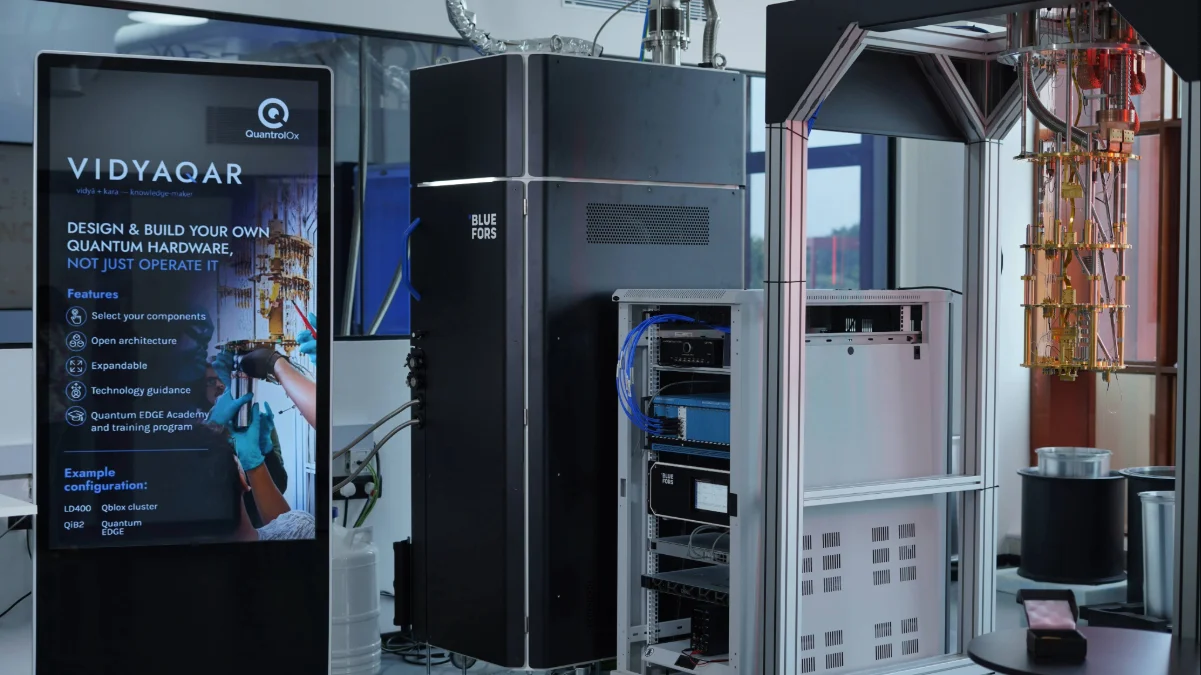
Train the Trainer: Inside MAHE’s Hardware-First Bet on Quantum

Through its partnership with QuantrolOx, Manipal Academy of Higher Education is preparing educators like Dr. Chandrakantha Bekal to run a live quantum facility. Insider Brief For Chandrakantha Bekal, teaching had never been a lifelong interest. After completing his master’s degree in product design and manufacturing, Bekal stepped into the hustle and bustle of job hunting

Read at The Quantum Insider

arXiv (research papers) Illia Lukin

Efficient computation of PEPS gradients for optimized quantum state preparation on 2D topologies

Quantum state preparation is a fundamental subroutine for quantum computation. For complex, entangled initial states it is, however, difficult to prepare shallow quantum circuits approximating the state with sufficient accuracy. Tensor networks provide a promising avenue of synthesis of such circuits, but most approaches employ 1D Matrix Products States, which struggle to accurately express entangled states in higher dimensions. Here we present a hardware topology-aware…

Read at arXiv (research papers)

Older stories