Results for “model”

TechPowerUp DrUsmanSaleem Gadgets

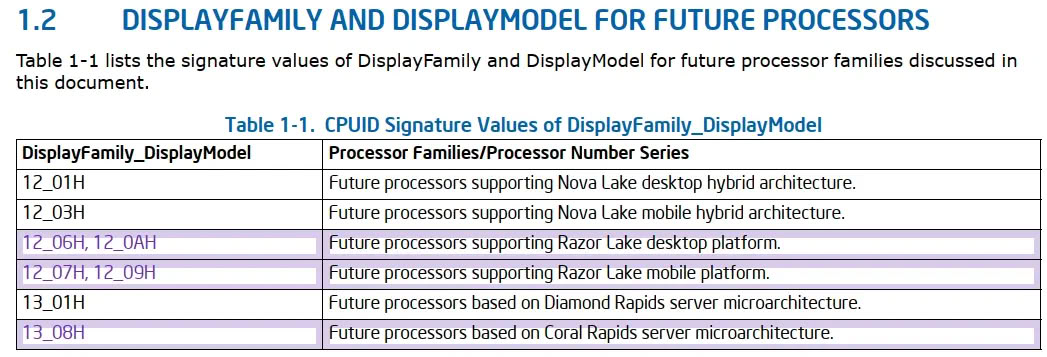
Intel's ISA Reference Confirms Razor Lake Desktop and Laptop Model IDs

Intel has added Razor Lake and Coral Rapids to the November edition of its Architecture Instruction Set Extensions Programming Reference, the document developers use to prepare software for upcoming chips. Revision 063 gives Razor Lake four new model values under family 18 (12H), the same family as Nova Lake, with 12_06H and 12_0AH covering desktop parts and 12_07H and 12_09H covering laptops. The Coral Rapids Xeon family gets 13_08H, following Diamond Rapids at 13_01H…


Read at TechPowerUp

TechCrunch AI Julie Bort SI

AI agent startup LangChain hits $3B valuation

LangChain now claims 7,000 customers of its model and platform agnostic agent management tool LangSmith.

Read at TechCrunch AI

9to5Mac Ryan Christoffel

Apple releases tvOS 27.2.1 and HomePod 27.2.1, here’s what’s new

Apple has just released tvOS 27.2.1 for Apple TV 4K and HomePod 27.2.1 for HomePod models, here’s what’s new.

Read at 9to5Mac

MacRumors Juli Clover Gadgets

Apple Releases tvOS 27.2.1 With Siri AI for Older Apple TVs

Apple today released tvOS 27.2.1, an update to the tvOS 27 operating system that launched in September. tvOS 27.2.1 comes nearly three weeks after Apple released tvOS 27.2. tvOS 27.2.1 brings Siri AI support to the 2nd- and 3rd-generation Apple TV 4K models, but it is available for all ‌Apple TV‌ 4K models that support tvOS 27. Apple announced ‌Siri‌ AI for the ‌Apple TV‌ when debuting the 4th-generation ‌Apple TV‌ 4K. A separate tvOS…

Read at MacRumors

arXiv (research papers) Owen Ramsey Security

Stargate: Security Analysis and Mission-Aware Firewall for the CubeSat Space Protocol

The CubeSat Space Protocol (CSP) is widely used for communication in CubeSat missions, yet its security model and attack surface remain largely unexplored. In this work, we present a systematic security analysis of CSP and identify fundamental limitations in its trust assumptions, coarse-grained network abstractions, privileged management services, application command semantics, and lack of mission-context awareness. Based on these findings, we develop a taxonomy of CSP…

Read at arXiv (research papers)

TechPowerUp Nomad76

(PR) GlobalFoundries Breaks Ground on First New Semiconductor Fab Under Landmark U.S.-Japan Initiative

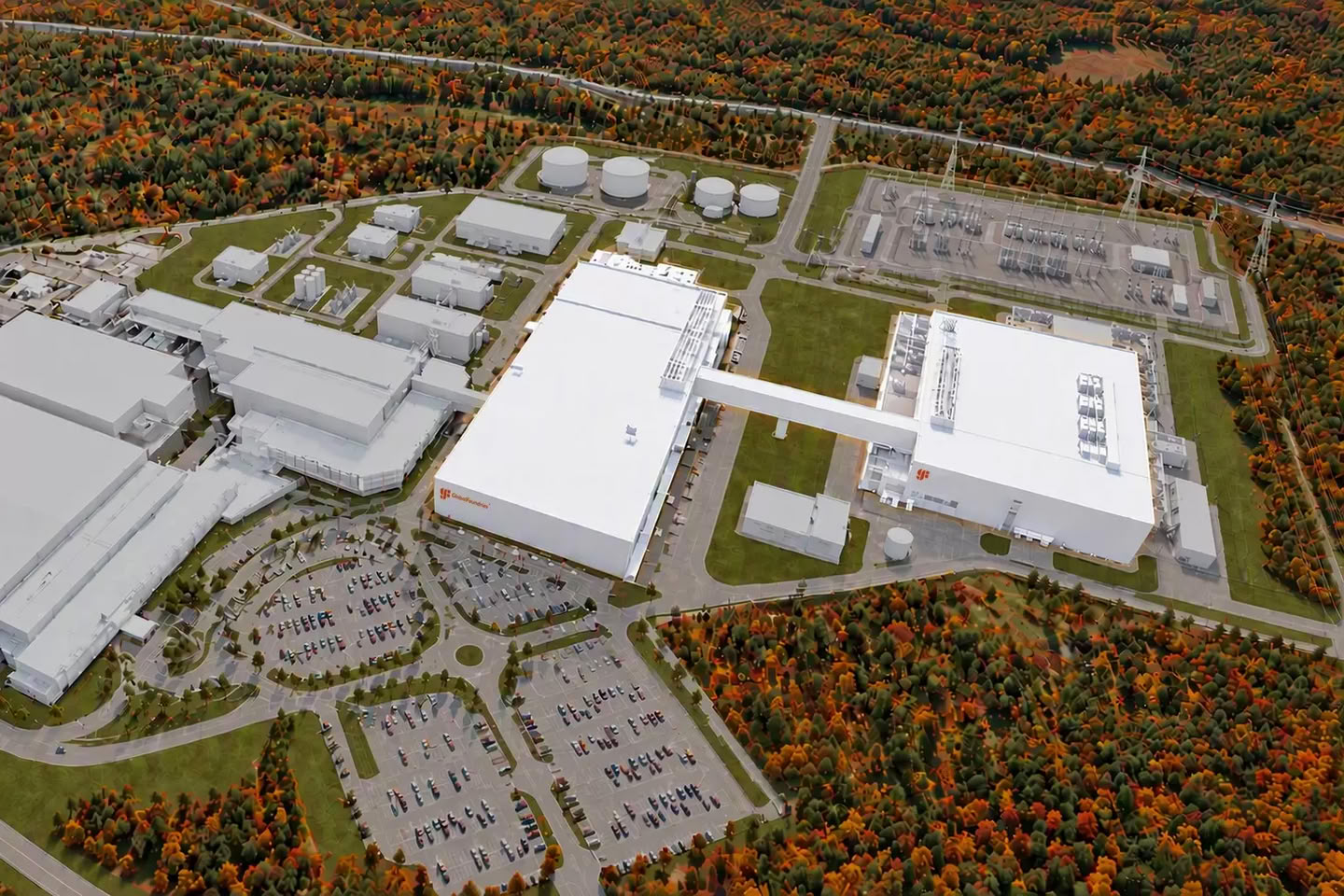
GlobalFoundries (Nasdaq: GFS) (GF) today joined U.S. and Japanese government officials, state and local leaders, customers, partners, employees and community members to break ground on the first new semiconductor manufacturing facility planned for its Malta, New York, site under a landmark U.S.-Japan initiative. The groundbreaking marks the start of construction on a new 300 mm fab and a first-of-its-kind model that brings together Japanese investment with GF's technology…

Read at TechPowerUp

arXiv (research papers) Valavan Manohararajah

Exstill: The Most Efficient Single-Chip Processor for the Next Token

Generating a token with a language model requires a fixed amount of arithmetic, whose energy sets a floor beneath any hardware. For Qwen3-1.7B at a 16K-token context, gate-level measurements at 5 nm place this floor at 0.89 mJ per token, yet an NVIDIA B300 spends 391-1,120x that. The excess is the price of generality, software layers, programmable hardware and moving weights and key-value (KV) caches from external memory, and it widens with each process generation. We…

Read at arXiv (research papers)

arXiv (research papers) Jiaming Tang

Training Reasoning Models in Simulation to Natively Use Real Robots

Robot-use agents (RUAs) have emerged as a promising approach to general-purpose robot control. However, strong performance has so far been achieved only by frontier proprietary models such as GPT-6 Astra and Claude Fable 5.2, whereas open-weight models remain substantially less capable. We show that an open-weight 27B reasoning model can be trained to use real robots natively through reinforcement learning, entirely in simulation and without demonstrations. Like a…

Read at arXiv (research papers)

arXiv (research papers) Aayush Marasini SI

WeightBench: Evaluating Language Models as Weight-Space Programmers

Recent work shows that large language models (LLMs) can operate directly on the parameters of other neural networks. They can read what a network was trained to do, fix a network that fails, and write working networks from scratch, all without gradient descent. This capability has been termed Weight-Space Programming (WSP). Exploring this new paradigm systematically requires a robust benchmark. We introduce WEIGHTBENCH, a benchmark that evaluates LLMs of increasing…

Read at arXiv (research papers)

arXiv (research papers) Jia Shen

Modeling the Frictional Contact of Continuum Robots with Environments through Linear Complementarity Problem

Accurate friction modeling in continuum robots is essential for precise motion control and path planning. However, current approaches make predictions only for the mechanism's internal friction that is limited by the boundary forces of the Coulomb friction cone, which fail to characterize the static friction and motion hysteresis. In this paper, we propose a novel friction model based on complementarity constraints under the Coulomb friction assumption. This model predicts…

Read at arXiv (research papers)

arXiv (research papers) Cole Becker SI

Elliptic Sampling: Optimal Interpolant Schedules for Gaussians and Beyond

Generative modeling based on stochastic interpolants requires specifying two key choices: an interpolant schedule bridging the initial and target distributions, and an efficient discretization of the resulting probability-flow ODE. In this work, we introduce a new framework for joint schedule/discretization design based on the analyticity properties of the (complexified) ODE trajectories, which in turn ensure good numerical behavior. Our formulation can be solved exactly via…

Read at arXiv (research papers)

arXiv (research papers) Zelin He SI

ModHarness-RL: Recasting Harnesses as Learnable and Evolving Programs for Agentic RL

Agentic reinforcement learning (RL) increasingly relies on a harness, the scaffold around the model that decides what it sees of its own interaction and what guidance it receives. Most existing approaches train under a hand-written harness that stays fixed throughout. However, an effective harness depends on the domain, the data and the model, and keeps changing as the model trains. We introduce ModHarness-RL, which recasts the harness as programs that are learned from data…

Read at arXiv (research papers)

arXiv (research papers) Thomas Brennan SI

Alignment by Socialization: Learning Tradeoffs Under Selection

Artificial intelligence (AI) agents are expected to complete tasks while following rules of conduct, but these objectives can conflict. We study how evolutionary selection shapes an agent's choices between them, and whether experience can make those choices reflect human judgments and withstand subsequent pressures. In our model, copies of an agent face a common uncertain reward state, and only those taking the rewarded action reproduce. We show that long-run growth is…

Read at arXiv (research papers)

TechCrunch Tim Fernholz SI

Export-banned Nvidia chips are behind China’s most powerful AI models—uh oh, Jensen!

New research shows the most advanced AI models from China were trained on banned Nvidia chips.

Read at TechCrunch

arXiv (research papers) Yimin Gao

Mutable Inference: Architecting LLM Accelerators for Inference-Time Learning

Long-context LLMs must retain growing histories, but full attention makes each new token increasingly expensive. Inference-time learning (ITL) offers another approach. The model keeps training on the context during inference, retaining what it learns in its weights. Recent work shows that ITL can match full-context attention quality while attending only to a recent fixed-size window. This bounds attention costs but adds Learning (backward computation and weight updates)…

Read at arXiv (research papers)

arXiv (research papers) Mohamed Aghzal SI

Can Mechanistic Interpretability Help Explain LLM Agent Failures? A Case Study on Web Element Hallucination

Mechanistic Interpretability (MI) has made significant progress in explaining the internal computations of Large Language Models (LLMs); however, these advances have yet to demonstrate comparable success in explaining the decision-making processes of LLM-based agents. This paper examines the challenges MI tools face when applied to realistic agentic failures. We focus on one such failure: web agents hallucinating actions that are not available on a website. We apply a series…

Read at arXiv (research papers)

arXiv (research papers) Mohammed Efaz SI

MeReader: An Offline, Privacy-Preserving, Progress-Aware AI Assistant for Narrative eBook Reading

This paper introduces MeReader, a privacy-preserving, offline and progress-aware AI assistant designed to function as a contextual companion for narrative reading on consumer hardware. Unlike conventional Large Language Model (LLM)-based systems that process documents/books online in an all-texts-at-once type of way, thereby risking narrative spoilers, MeReader confines both retrieval and generation to the reader's distinct position in the text. The system integrates a…

Read at arXiv (research papers)

arXiv (research papers) Robert Schade

Complex fluid flow dynamics by bright scattershot boson sampling

Boson sampling machines have become a fruitful tool for establishing new concepts, which connect fundamental physics with computer science applications. Here, we exploit the intrinsically high-dimensional correlations generated by the measurement outcomes of a multiphoton boson sampling machine and demonstrate how a reconfigurable architecture can be programmed to autonomously model the time evolution of nonlinear dynamical systems that describe complex fluid flows. By…

Read at arXiv (research papers)

The New Stack Alex Wilhelm

The context problem: It’s what’s really breaking AI agents at scale

AI models are getting smarter, tokens are getting cheaper, and agents are improving. But the context gap sits between the

Read at The New Stack

arXiv (research papers) Nenyi Kweku Nkensen Dadson

In Situ Monitoring and Predictive Modeling of Harmful Algal Blooms with Autonomous Surface Vehicles

Harmful Algal Blooms (HABs) pose significant environmental, economic, and public-health challenges in coastal and inland water bodies, creating a need for scalable methods to collect spatially distributed water-quality data. This paper presents an autonomous surface vessel-based sensing system for in-situ water-quality monitoring related to harmful algal bloom detection. The system integrates a BlueBoat Autonomous Surface Vessel (ASV), a motorized winch for depth-controlled…

Read at arXiv (research papers)

arXiv (research papers) Dhruv Dixit SI

ARCHER: From Rationale Imitation to Executable Reasoning in Small Language Models

Small language models are attractive for local, low-cost, and privacy-sensitive deployment, but they remain unreliable on mathematical reasoning tasks that require decomposition, exact computation, tool use, and verification. We introduce \textbf{ARCHER}: \textbf{A}ction-trace \textbf{R}einforcement for \textbf{C}alculator-grounded \textbf{H}ierarchical \textbf{E}xecutable \textbf{R}easoning, a two-stage framework for training small language models (SLMs) to produce…

Read at arXiv (research papers)

AWS Machine Learning Blog Shantanu Tripathi SI

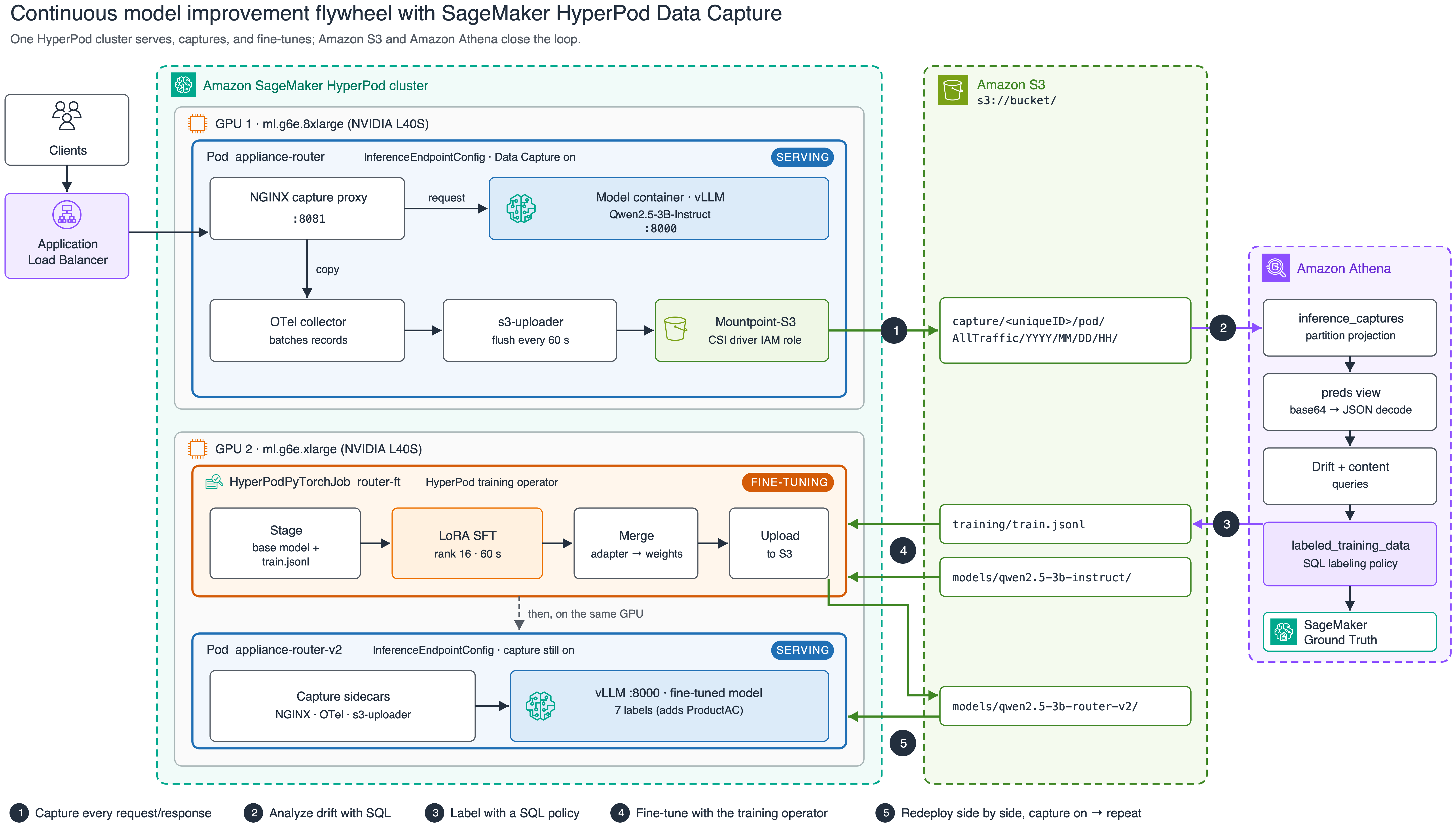
Build a model improvement flywheel with Amazon SageMaker HyperPod Data Capture

Amazon SageMaker HyperPod Data Capture records live inference inputs and outputs to Amazon S3. This post walks through one end-to-end example: capturing a support router's production traffic, surfacing a new-product blind spot with Amazon Athena, fine-tuning on the captured data with the HyperPod training operator, and measuring the before-and-after lift.

Read at AWS Machine Learning Blog

arXiv (research papers) Robin Shing Moon Chan SI

Interactive Program Induction with Language Model Priors

Program induction refers to the process in which a learner aims to recover a program from a few given input-output examples. This paradigm broadens programming access by letting users demonstrate the rule-based behavior they want to apply to unseen data, instead of having to implement it themselves. However, recovering a program from finite input-output examples is fundamentally ambiguous, as a finite set of input-output examples is theoretically consistent with infinitely…

Read at arXiv (research papers)

arXiv (research papers) Yifan Jin SI

When to Trust Simulated Patient Responses:Support-Gated World Models for Vasopressor Decision Support

Clinical world models expose language-model agents to predicted patient responses, but simulations can be unreliable for poorly supported treatments or unfamiliar hospitals. We introduce Support-Gated World-Model decision support, a lightweight extension of a propose--simulate--refine agent. A recurrent dynamics ensemble predicts short-horizon physiological responses to documented norepinephrine dose categories, while a behavior model estimates observational action support…

Read at arXiv (research papers)

arXiv (research papers) Adnan Jaljuli

Symmetry-Controlled Quantum State Transfer in Poly-bi-[8]-annulenylene: From Heisenberg to Hubbard Dynamics

We investigate quantum state transfer in the poly-bi-[8]-annulenylene lattice using isotropic Heisenberg and Hubbard models. For a 16-site lattice, reflection symmetry separates the single-excitation Hamiltonian into independent triplet and singlet sectors, allowing analytical determination of the energy spectra. Although perfect state transfer is forbidden for positive couplings, appropriately chosen coupling ratios enable pretty-good transfer with arbitrarily high…

Read at arXiv (research papers)

arXiv (research papers) Wang Ma SI

Black-Box Uncertainty Quantification for Large Language Models via Ensemble-of-Ensembles

Reliable use of large language models (LLMs) requires uncertainty estimates that separate ambiguity intrinsic to a prompt from genuine knowledge gaps. Bayesian and deep-ensemble methods deliver this aleatoric/epistemic decomposition in principle, but are computationally prohibitive at LLM scale and require white-box access. Existing black-box methods, in contrast, summarize to a single scalar that cannot make the distinction. We introduce a two-level ensemble that bridges…

Read at arXiv (research papers)

arXiv (research papers) Te Han Space

Eleven Trans-Neptunian Objects and Eight Candidates Discovered by TESS

We report a blind search for trans-Neptunian objects (TNOs) in Transiting Exoplanet Survey Satellite (TESS) full-frame images from 2018 July 25 through 2026 November 6. We search 572 CCD fields near the ecliptic across 95 TESS sectors. After modeling and subtracting Gaia stars with the TESS-Gaia Light Curve package, we stack the residuals along curved trial paths and link detections across sectors. We identify eleven new TNOs, each detected blindly in two to five TESS…

Read at arXiv (research papers)

MarkTechPost Michal Sutter SI

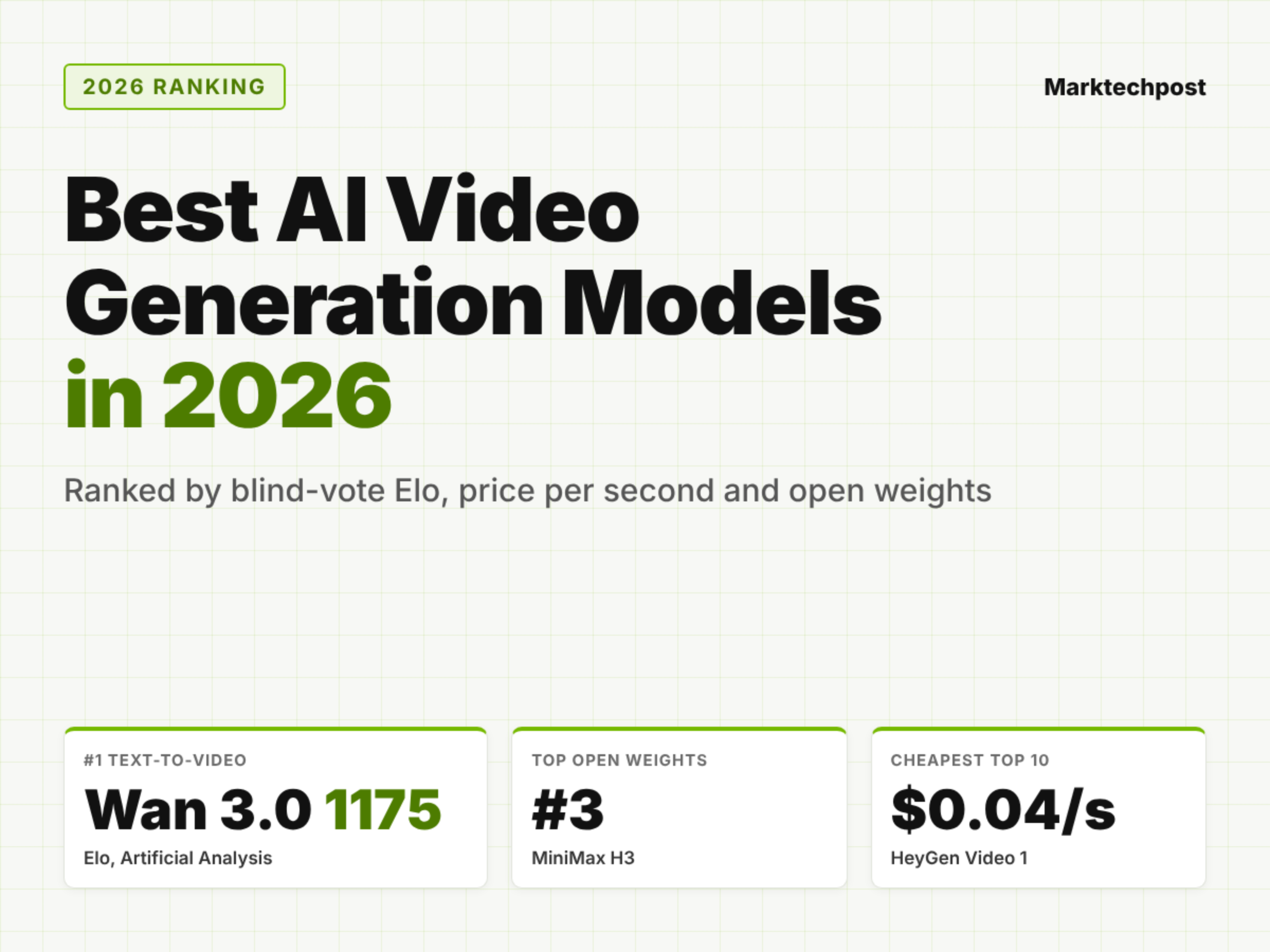
Best AI Video Generation Models in 2026: Elo, Price per Second, Open Weights

The AI video leaderboard looks very different from 12 months ago. Native audio is now table stakes. Clips run 15–30 seconds. And an open-weights model sits in the top 3. This ranking (as of Nov 13, 2026) uses one quality signal: blind human-preference Elo from the Artificial Analysis Video Arena. We pair it with API

Read at MarkTechPost

arXiv (research papers) Noaïm Astitou Tech policy

Efficiency Gains in Social Science Research: A Prospective Silicon Sampling Protocol for Pre-Treatment and Code Optimization

This study evaluates the methodological potential of using large language models (LLMs) to generate synthetic datasets prior to real-world data collection, thereby streamlining subsequent processing and statistical analysis. The approach is applied to a survey conducted within the France Life Imaging (FLI) network, leveraging three distinct LLMs (Sonnet 4.6, GPT 5.3, and Kimi 2.6) to simulate responses and prepare data processing workflows. The findings demonstrate…

Read at arXiv (research papers)

arXiv (research papers) Paolo Simonetti Space

The effect of vertical mixing on oxygen sequestration by refractory elements in the atmosphere of giant planets

The most widely used route to study the formation history of giant exoplanets is the C/O ratio, usually derived from H$_2$O, CO, CO$_2$ and CH$_4$. However, refractory elements can sequester a significant fraction of O, causing the observed C/O ratio to be overestimated with respect to the intrinsic one. Previous calculations of this bias relied on chemical equilibrium models. Here we quantify the impact of vertical mixing using the 1-D chemical kinetics code VULCAN…

Read at arXiv (research papers)

Older stories