Results for “model”

Simon Willison SI

datasette-llm 0.1a11

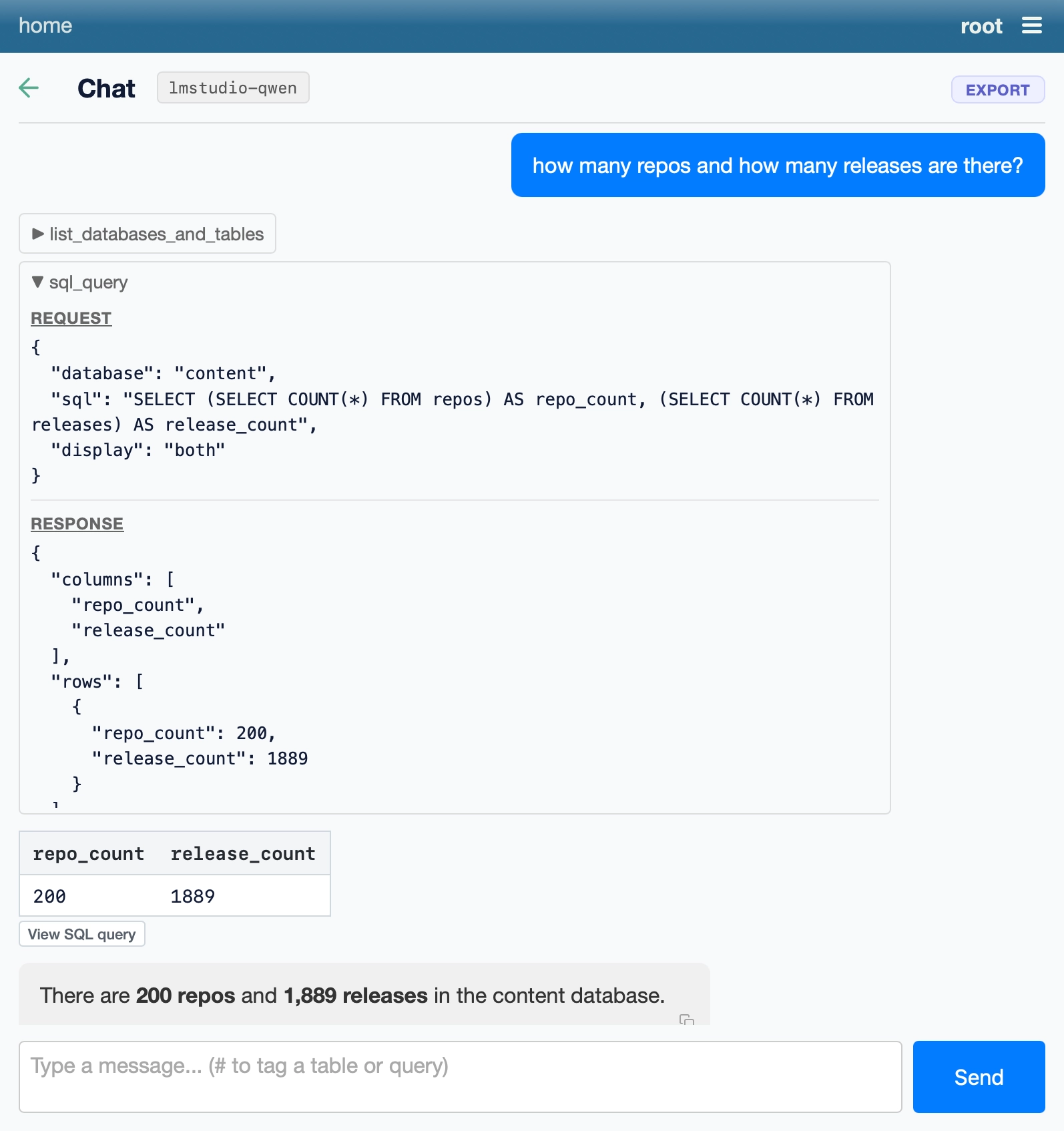
Release: datasette-llm 0.1a11 datasette-llm is the intermediate plugin for Datasette that supports configuring LLMs for use with other Datasette plugins. This release adds support for OpenAI-compatible endpoints, so you can configure Datasette to use an LLM hosted anywhere that talks the OpenAI pseudo-standard web protocol. This means that if you're running local models with LM Studio or Ollama or llama.cpp (which just hit v1.0.0) you can run Datasette via uvx like this…

Read at Simon Willison

arXiv (research papers) Paolo Simonetti Space

A new chemical network to explore the disequilibrium chemistry of silicates and iron in hot gas giants

Chemical equilibrium modeling of gas giant planet atmospheres has shown that the production and condensation of silicates plays an important role in shaping their final composition. However, no chemical kinetics network for these species are available, preventing the opportunity to analyze the impact of chemical disequilibrium processes. In this paper we present \texttt{SILANE}, a new chemical network that include Mg, Si, Fe and 15 carriers of these elements, including…

Read at arXiv (research papers)

arXiv (research papers) Harish Santhanalakshmi Ganesan SI

Agent Authenticator: Passkey-Grade, Hardware-Bound Authentication for AI Agents

AI coding agents now push code, publish packages, call model APIs and operate cloud resources on behalf of developers. They authenticate to these services with the same bearer secrets humans use, personal access tokens, API keys and package-registry tokens, stored where the model, its subprocesses and any co-resident malware can read them. Incidents in 2025 and 2026, including prompt-injection attacks on coding agents and self-propagating supply-chain worms, show that this…

Read at arXiv (research papers)

The Decoder Matthias Bastian SI

Gemini 4 Carbon takes the MathArena crown but costs 15 times more than GPT-6.1 Sol

For the first time in a while, no OpenAI model leads the MathArena AI math benchmark. Google's Gemini 4 Carbon and Anthropic's Fable 5.2 have knocked GPT-6.1 Sol from the top, though both cost significantly more. Gemini ignored the time limit in testing and almost never gave up on a task. The article Gemini 4 Carbon takes the MathArena crown but costs 15 times more than GPT-6.1 Sol appeared first on The Decoder.

Read at The Decoder

MarkTechPost Asif Razzaq SI

Cmpnd Releases dspy-wsp: Weight-Space Programming Comes to DSPy

Cmpnd released dspy-wsp, a prototype DSPy optimizer for weight-space programming. A frontier LLM reads a small model’s weights, edits them in a sandbox, and tests each change, with no gradients and about $5 to $10 per run.

Read at MarkTechPost

The Decoder Matthias Bastian SI

Anthropic says outdated prompting habits are slowing down Claude Opus 5.5

Anthropic has made Claude Opus 5.5 the default model on all paid plans and published a guide that does away with old prompting habits. The main takeaway is to drop "think hard" and start at Medium effort. The article Anthropic says outdated prompting habits are slowing down Claude Opus 5.5 appeared first on The Decoder.

Read at The Decoder

arXiv (research papers) Iaroslav Chelombitko SI

Do Rule-Based Tools Help LLMs Translate Endangered Uralic Languages in the Prompt or over MCP?

Komi-Zyrian, Moksha, Erzya and Udmurt have mature rule-based resources, among them finite-state analysers, constraint grammars and bilingual dictionaries, which language models do not use. We ask whether giving a model access to these resources improves machine translation from the four languages into English, and whether it matters how the access is provided: as analyses computed in advance and written into the prompt, or as tools that the model calls itself through the…

Read at arXiv (research papers)

SCMP China Phoebe Zhang

Zero capital, 116 projects: AI spots the devils in the details of China corruption case

Disciplinary staff in Wuhan, provincial capital of Hubei in central China, were going about their routine workday when a red alert landed. It was from a large data model – flagging a possible case of corruption. “A company took on more than 10 projects this year. Its registered capital reduced from 50 million yuan (US$7.5 million) to 10 million, yet it’s paid-in capital is still zero,” the alert said. “Moreover, over 80 per cent of the projects it took were [residential]…

Read at SCMP China

The New Stack Jessica Wachtel

Claude Fable 5.2 vs. GPT-6 Astra: A lower list price didn’t mean a lower bill

Anthropic is positioning its new model, Claude Fable 5.2, for demanding coding and technical work. Anthropic launched Fable 5.2 on

Read at The New Stack

South China Morning Post Cannix Yau Geopolitics

Hong Kong rail giant warns of cash crunch despite Northern Metropolis land grant

Hong Kong’s MTR Corp has warned that it will face significant cash flow pressures over the next few years, even with the government’s grant of eight new sites for developing the Northern Link rail project in the Northern Metropolis. The warning came as the Liber Research Community cast doubt on MTR Corp’s model of using property developments to fund rail construction, pointing out that about a third of the 18 sites granted in total were idle plots where developers had opted…

Read at South China Morning Post

The Decoder Matthias Bastian SI

OpenAI reassigns robotics researchers to other teams as general-purpose models might make specialized robotics AI unnecessary

OpenAI is dissolving its standalone robotics team for the second time, but not because it lacks data. General-purpose models like GPT-6 Astra can apparently control robots directly, making a dedicated unit unnecessary. The researchers are being redistributed across other teams in what the company frames as a way to accelerate its robotics efforts. The article OpenAI reassigns robotics researchers to other teams as general-purpose models might make specialized robotics AI…

Read at The Decoder

The Decoder Matthias Bastian SI

Anthropic can already retrain Mythos with "a fraction of the compute originally needed," says former researcher Coxon

Former OpenAI and Anthropic researcher Jacob Coxon points to a slide from Anthropic's IPO roadshow as a reason he left, saying it shows the company's algorithms are improving not just quickly but at an accelerating rate. Coxon continues to call for a pause on frontier model development so competitors can catch up and human-level AI can become a commodity. The article Anthropic can already retrain Mythos with "a fraction of the compute originally needed," says former…

Read at The Decoder

The Decoder Tomislav Bezmalinović SI

Runway's open-source Praxis-1 turns video AI into a robot controller

Runway releases its robotics model Praxis-1 with open weights and source code under the Apache 2.0 license. The model uses knowledge from video training for robot control and leads the World Action Model category on Nvidia's RoboLab-120 benchmark. It can't yet plan complex action sequences on its own, though. The article Runway's open-source Praxis-1 turns video AI into a robot controller appeared first on The Decoder.

Read at The Decoder

arXiv (research papers) Aritra Bagchi

Rethinking KV Caching for LLM Decode: Free-Space Optical KV Regeneration for Reduction of Memory Traffic

Long-context large language model (LLM) decoding repeatedly reads the historical key-value (KV) cache, making multi-head attention (MHA) memory-bandwidth-bound. Caching layer-input activations instead halves historical-cache storage and traffic, but requires regenerating KV from each cached activation. On digital accelerators such as GPUs, this regeneration takes far longer than fetching the activation from HBM. The KV regeneration overhead outweighs the savings from reduced…

Read at arXiv (research papers)

arXiv (research papers) Akshay Vyas SI

Neural Dual Bounds: Valid-by-Construction JGLP Warm-Starts for MAP and Constrained MAP

We present Neural Dual Bounds, a calibration-free framework that produces deterministic upper bounds for MAP inference in probabilistic graphical models using a single neural-network forward pass. The framework trains a network to output the edge messages of a mini-bucket style upper bound on a given join-graph decomposition in a self-supervised manner by directly minimizing a smooth dual objective. The output of this network can be used at test time to warm-start a standard…

Read at arXiv (research papers)

arXiv (research papers) Yusuf Khalid Shire Security

Operating-Point Failure of Frozen Guardrail Probes Under Backbone Updates

We freeze a guardrail probe and threshold, then measure its operating point across 18 cells covering 16 public language-model updates. At a 1% target, the threshold fails closed in 8 of 9 cells in the first phase and either fails closed or open in 3 of 9 cells in a registered second phase (descriptive). The two phases also differ in update type and input format. The largest increase is from 1.01% to 15.12%, while the area under the receiver operating characteristic curve…

Read at arXiv (research papers)

arXiv (research papers) Pengyu Chen SI

Mem2Fair: Online Fairness Control for Text-to-Video Generation via Fair Memory

Text-to-video (T2V) generation models can produce systematically unfair demographic outcomes when prompts leave protected attributes unspecified. For example, prompts describing nurses without specifying gender may disproportionately generate videos depicting female nurses. Mitigating unfairness in T2V generation is particularly challenging: training-based methods that modify model internals require architecture-specific access and risk disrupting temporal consistency, while…

Read at arXiv (research papers)

arXiv (research papers) Zane Fu SI

On-policy distillation as a Backdoor Propagation Channel

On-policy distillation (OPD) is emerging as an important paradigm for the post training of large language models, improving student models by leveraging supervision generated online by teacher models. However, whether this process also transfers latent security risks from teacher models to student models remains insufficiently studied. In this work, we reveal a new security risk in which an attacker first implants a conditional backdoor into the teacher model through…

Read at arXiv (research papers)

arXiv (research papers) Nikhil Kumar Jha SI

What Moves a LoCoMo Score? Memory Context, Answer Prompts and Judges

LoCoMo is a widely reported benchmark for long-term conversational memory, but published scores mix memory quality with choices of answer prompt, judge and baseline layout that are rarely reported together. We measure how much these choices move a score, and evaluate Becos, a team memory system for coding agents, as a black box under all of them: ten conversations (1,540 questions), two answer models (gpt-4o-mini, gpt-4.1-mini), two answer prompts and three LLM judges…

Read at arXiv (research papers)

arXiv (research papers) Jae Hun Hwang

Self-Calibrating Vision-Agent-Action: Deploying Pick-and-Place to New Robot Cells without Demonstrations or Fine-Tuning

In simulation, Vision-Agent-Action (VAA) performs pick-and-place in robot cells with gripper or base-frame changes without robot demonstrations or fine-tuning. It uses pre-trained vision-language and language models for interpretation, measures the command map and camera geometry from its own motion and fingertips, estimates lens distortion, and plans grasps from measured object depth. A controlled study of eight public LIBERO-fine-tuned vision-language-action models (VLAs)…

Read at arXiv (research papers)

arXiv (research papers) Kevin Nguyen SI

Isolating Perception for Multi-View Planning under Occlusion-Induced Partial Observability

Vision-language models (VLMs) are beginning to saturate visual planning benchmarks, yet they fail to resolve depth ambiguity and degrade sharply with problem size under occlusion-induced partial observability (PO). We introduce BW-PO based on the Blocksworld domain, a controlled benchmark that reduces existing VLM planners and formalizers to near-zero performance, and propose VLM-as-perceiver, a paradigm that narrows the VLM's role to local perception while delegating…

Read at arXiv (research papers)

arXiv (research papers) Xiyu Bao SI

When Does Confidence Reveal Problem Difficulty?

While confidence signals are commonly evaluated for their ability to predict a model's own correctness, their relationship with problem difficulty remains less understood. In this work, we investigate a wide range of confidence-related signals and whether they can serve as indicators of problem difficulty across various task domains. We find that perturbation inconsistency, semantic entropy, and solution length exhibit strong associations with population difficulty than…

Read at arXiv (research papers)

arXiv (research papers) S M Rayeed SI

LABEL: Literature Asymmetry between Efficacy and Limits in Drug Knowledge and Language Models

Every medication comes with two types of medical facts: indications, which describe what conditions the drug treats (benefits), and contraindications, which describe who must avoid it to prevent serious harm (safety limits). Although contraindications are critical for patient safety and FDA regulations require listing them as rigorously as indications, we find that contraindications are far less documented than indications in general prose. In this paper, we measure how…

Read at arXiv (research papers)

arXiv (research papers) Cheng Siong Chin SI

MarineSparkLM-4B: A Lightweight Language Model for Marine and Offshore Engineering Built by Parameter-Efficient Adaptation

Marine and offshore engineering text is spread across preprints, open-access journals, encyclopedias and institutional documents, and the amount of it is small by pretraining standards. We ask how far a lightweight language model for marine and offshore engineering can be taken with parameter-efficient adaptation on a single workstation-class device. Starting from the 4-billion-parameter OceanGPT-basic-4B-Instruct, we train two independent LoRA adapters, each updating 33.0…

Read at arXiv (research papers)

arXiv (research papers) Rathindra Nath Karmakar

Asymptotic efficiency of tests for quantum statistical models

In classical statistics, local asymptotic normality provides a general framework for characterizing optimal testing power and constructing asymptotically efficient procedures. Extending this framework to quantum statistical models introduces additional challenges arising from the noncommutativity of observables and the need to optimize over quantum measurements. In this paper, we develop a theory of asymptotic efficiency for quantum hypothesis testing using quantum local…

Read at arXiv (research papers)

arXiv (research papers) Jieyuan Pei

SuperGlance: Driving at a Glance with a Vision-Language Model

Autonomous driving is turning to vision-language-action models (VLAs). They answer and plan by decoding, one step at a time. Each step is another forward pass, so a plan can take over a second of GPU time. Embodied AI often pairs such a slow, reasoning System 2 with a fast System 1 that acts. Human drivers plan at a glance, with System 1. Faster designs usually put System 1 outside the vision-language model (VLM), in a planner without its abilities. Yet before a VLM writes…

Read at arXiv (research papers)

arXiv (research papers) Charan Teja Nagisettygari SI

How Much Determinism Can Fine-Tuning Buy? Margin Regularisation Against Batch-Induced Token Flips

Greedy decoding at zero temperature is widely assumed to be deterministic, although the exact same prompt may yield different tokens depending on the number of other prompts sharing the batch for inference. The currently available solutions operate during inference, trading determinism for throughput. Can we train a model in such a way that fewer decoding steps would be susceptible? We characterize the perturbation empirically across six model families and three numerical…

Read at arXiv (research papers)

arXiv (research papers) Cheongho Han Space

OGLE-2018-BLG-0829L: A Microlensing System with a Planet Orbiting a Star Possessing a Brown-Dwarf Companion

We analyze the microlensing event OGLE-2018-BLG-0829, whose light curve exhibits a weak short-term anomaly in addition to the prominent caustic-crossing features of a binary lens. The anomaly cannot be explained by a binary-lens single-source (2L1S) model. We therefore investigate both binary-lens binary-source (2L2S) and triple-lens single-source (3L1S) interpretations and find that both models reproduce the additional anomaly, with the 3L1S model being favored by…

Read at arXiv (research papers)

arXiv (research papers) Fatih Temiz

Wireless Edge-Assisted Adaptive Latent Reasoning for Vision-Language-Action Models in Physical AI

Vision-language-action (VLA) models enable embodied artificial intelligence (AI) by translating visual observations and language instructions into robotic actions. Emerging use cases in physical AI are expected to drive the need for efficient inference and communication, as the computational demands of the VLA models pose challenges for real-time control with limited onboard resources. Test-time scaling through latent reasoning allows these models to refine hidden…

Read at arXiv (research papers)

Quantum Computing Report Mohamed Abdel-Kareem

JIJ Expands Quantum-HPC and Industrial R&D Collaborations with Mitsubishi Electric, Q-CTRL, and Tinuviel Therapeutics

JIJ Inc. has expanded its quantum-HPC and industrial R&D collaborations with three new partnerships. These collaborations involve Mitsubishi Electric for thermal-fluid engineering simulation, Q-CTRL for electrical power-grid optimization, and Tinuviel Therapeutics for predictive gut microbiome modeling. JIJ's hybrid algorithmic stack will be used across these diverse applications.

Read at Quantum Computing Report

Older stories