Results for “Qubits”

Quantum Computing Report Mohamed Abdel-Kareem

Cross-Platform Cloud Benchmark Reveals Wide Gap Between Physical Qubit Counts and Entangled GHZ State Sizes

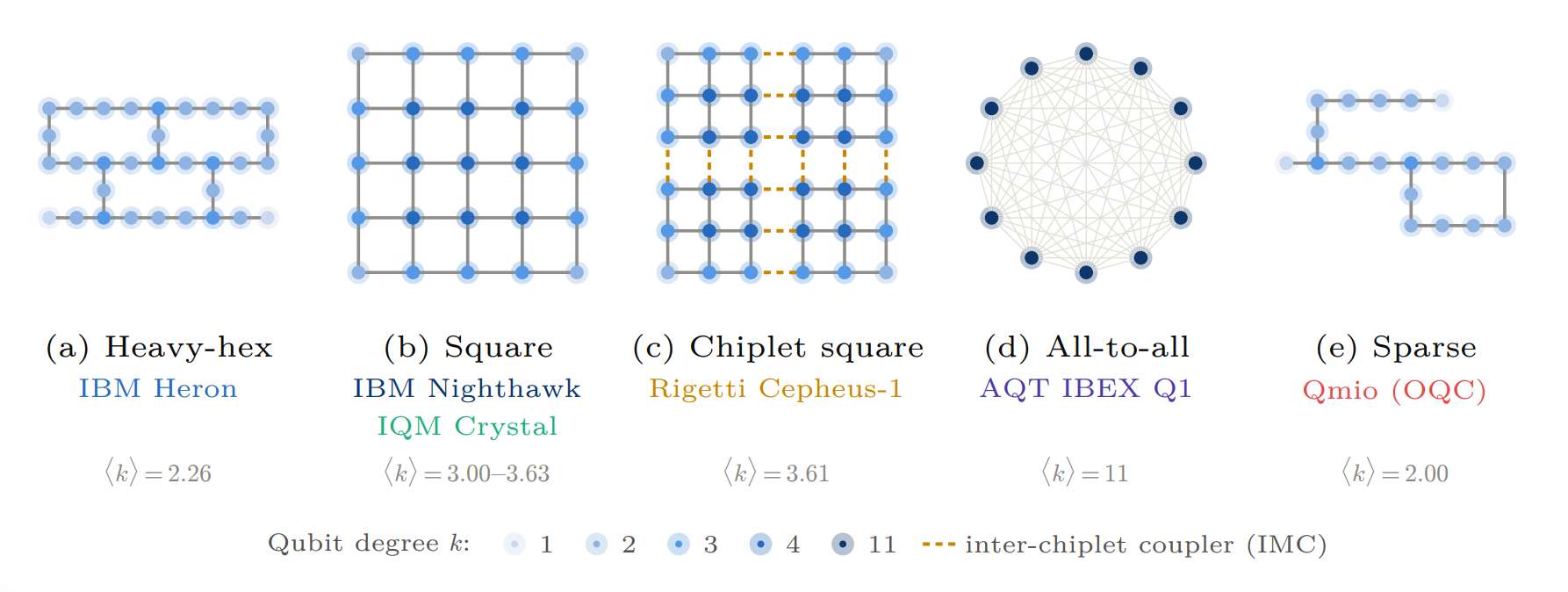
A new study benchmarked nine cloud-accessible quantum processors, revealing a significant gap between the number of physical qubits and the size of entangled GHZ states achievable without error mitigation. The research, which utilized standard remote cloud workflows, found that large superconducting processors only maintain multipartite entanglement across a small fraction of their physical registers. This highlights the challenges in achieving high-fidelity multipartite…
Read at Quantum Computing Report

arXiv (research papers) Ricardo Herrera Romero

Generalized Rotating-Wave Approximations Hierarchy for the Interacting Two-Qubit Rabi Model

We investigate the two-qubit quantum Rabi model for identical qubits symmetrically coupled to a single bosonic mode and interacting with each other through transverse and longitudinal couplings. We extend the adiabatic, generalized rotating-wave (GRWA), and squeezed generalized rotating-wave (SGRWA) approximations to include the qubit-qubit interactions, including self-consistent and variational choices of the bosonic parameters. The resulting analytical hierarchy allows us…

Read at arXiv (research papers)

arXiv (research papers) Haoyuan Tian

Graph spectra and late-time concurrence in a lossy reservoir network

We investigate how coupling the local environments of noninteracting qubits into a network changes their late-time entanglement dynamics. Each qubit interacts with a lossy bosonic memory mode, with coherent hopping between memory modes determined by an underlying graph. The initial state contains at most two excitations. We show that the graph spectrum selects the collective modes that survive longest, thereby controlling both the decay and spatial distribution of pair…

Read at arXiv (research papers)

Quantum Computing Report Mohamed Abdel-Kareem

JIJ Launches SQOA Solver in IBM Quantum Functions Catalog to Tackle Combinatorial Optimization Beyond Qubit Counts

JIJ Inc. has launched its SQOA Solver in the IBM Quantum Functions Catalog, allowing users to tackle complex optimization problems with more variables than available qubits. This solver utilizes a novel approach that combines variable-compression encoding and classical subspace diagonalization, eliminating the need for iterative quantum hardware optimization. It has demonstrated success in solving large-scale problems like 384-node MaxCut and 200-node Maximum Independent Set…

Read at Quantum Computing Report

Quantum Computing Report Mohamed Abdel-Kareem

QodeX Quantum, NVIDIA, RTX BBN, and U.S. Navy Researchers Forecast Unstructured PDEs on 52-Qubit IBM Hardware

A research team from QodeX Quantum, NVIDIA, RTX BBN, and U.S. Navy researchers successfully demonstrated gradient-free forecasting of nonlinear partial differential equations (PDEs) on unstructured engineering meshes using up to 52 qubits on an IBM Quantum Heron r3 processor. Their hybrid quantum reservoir network (QRN) achieved significant error reduction compared to classical baselines and executed circuits far longer than typical qubit coherence times. This advancement…

Read at Quantum Computing Report

arXiv (research papers) Avani Vivrekar

Gate tunable spin splitting for Andreev spin qubits in Ge quantum well heterostructures

Ge-based super-semi heterostructures are a promising platform for implementing Andreev spin qubits (ASQs). For example, they can be isotopically purified to eliminate nuclear spins that cause decoherence. However, spin-orbit coupling (SOC), which is a key ingredient for ASQs, is cubic in momentum for hole-based materials like Ge, in contrast with more-conventional ASQ materials (e.g., InAs wires), for which the SOC is linear in momentum. In this work, we study the interplay…

Read at arXiv (research papers)

arXiv (research papers) Aritra Lahiri SI

Agentic AI for Discovering Fault-Tolerant Quantum Circuits

Scaling quantum computing toward practical quantum advantage is currently limited by the efficiency of circuits that operate on information encoded by quantum error-correcting codes. The full stack of quantum computing encompasses several tasks: preparation of logical code states, implementation of logical gates, logical routines on encoded qubits, etc. Yet, these circuits are largely designed by hand for individual cases, with some recent works incorporating machine…

Read at arXiv (research papers)

arXiv (research papers) David A. Mazziotti

Solution of the Qubit Marginal Problem from Fermionic Representability

Whether local reduced states are compatible with a global quantum state---the quantum marginal problem---is central to quantum information and simulation. Here we present a solution to the ensemble marginal problem for qubits based on the representability theory of fermions. Encoding each qubit as one fermion in two orbitals, we prove that the representable qubit marginals form an exposed face of the set of $N$-representable fermionic reduced density matrices, selected by…

Read at arXiv (research papers)

arXiv (research papers) Ellen Martins Fernandes

Dissipation as a Resource for Entanglement via High-Spin Mediator Purification

We study entanglement generation between two spin qubits mediated by a single, thermally mixed, high-spin ($S=5/2$) magnetic impurity, using the Lindblad master equation to compare coherent and dissipative control of the mediator. We show that no coherent drive, however strong or resonant, can purify the mediator beyond its thermal value --- a direct consequence of unitary evolution exactly preserving state purity --- while a dissipative channel purifies it up to the limit…

Read at arXiv (research papers)

arXiv (research papers) Daniel Bultrini

Tessa: Encoding Classical Data Across an Entire Quantum Processor

We present Tessa, a hardware-aware, device-wide scheme to encode classical data on quantum computers. We use it to experimentally encode and decode up to $1568$ real values using IBM's Phoenix and Fez quantum computers on a variety of data. Tessa's construction is an extension of QPIXL and QCrank. However, it checkerboards address and data qubits across a coupling graph with neighbouring data qubits sharing only a subset of address qubits. When using the device's coupling…

Read at arXiv (research papers)

arXiv (research papers) Bonan Su

Formulating Uncomputation Beyond Classical Ancilla Use

Ancilla qubits are routinely used to simplify quantum circuit construction and reduce implementation costs, but their use introduces the burden of designing proper uncomputation afterward. To alleviate this, prior work has developed automated uncomputation synthesis based on a computational-basis formulation of ancilla use. However, this formulation is tailored to classically structured ancilla computations. For more general circuits, it may be undefined, yield unintended…

Read at arXiv (research papers)

arXiv (research papers) Lorenzo Bagnasacco

Fer expansion converges almost twice as far as Magnus for qubits

The Fer expansion writes the propagator of a time-dependent Hamiltonian as a product of unitary exponentials whose error decreases doubly exponentially with the number of factors, while the Magnus expansion improves by one order at a time. Its convergence, however, was guaranteed only below a radius of about $2.6058$, smaller than the Magnus radius $π$. We establish a guaranteed convergence threshold of about $6.2106$, or $1.98\,π$, for a qubit. This is almost twice the…

Read at arXiv (research papers)

Phys.org Quantum Physics

Research advances quantum computing that harnesses speed of light

Quantum computers have the potential to perform calculations more quickly than supercomputers, but they could be even faster and more energy-efficient if they were built with photons as their basic units, called qubits.

Read at Phys.org Quantum Physics

Quantum Computing Report Mohamed Abdel-Kareem

Qunova Computing Achieves Chemical Accuracy at 80 Qubits on Iron-Sulfur Cluster Using IBM Quantum System Two and Fugaku

Qunova Computing achieved a breakthrough in quantum chemistry by simulating an 80-qubit iron-sulfur cluster with chemical accuracy using a hybrid approach combining IBM Quantum System Two and the Fugaku supercomputer. Their HI-VQE algorithm reduced classical computing costs by approximately 300x while matching classical benchmarks. This advancement has significant implications for understanding complex biological and industrial processes.

Read at Quantum Computing Report

arXiv (research papers) Palash Pandya

Explicit Absolutely Maximally Entangled states in dimensions twice a prime power

Absolutely maximally entangled (AME) states are pure multipartite states with maximally mixed reductions on every set of at most half the parties. We construct explicit families in local dimension $2q$, twice an odd prime power $q$, using an established coupling of qubits and $q$-level systems. The $q$-level states remove interference between branches, so the qubit states need maximally mixed reductions only on average. This gives AME$(9,2q)$ and AME$(11,2q)$ for every odd…

Read at arXiv (research papers)

The Register Dan Robinson

Quantum leap: IBM plans to scale beyond 1,000 qubits in 2027 with Nighthawk r3 processor

New unit sports more qubits and is planned to be part of future fault-tolerant rig

Read at The Register

Analytics India Magazine Mukundan Sivaraj SI

LTM Integrates AI Tool to Fix Quantum Computing Errors on IBM

LTM's AI-QEM technology uses classical post-processing to address device-specific errors, with tests involving quantum circuits of more than 100 qubits.

Read at Analytics India Magazine

The Quantum Insider Matt Swayne

Qunova’s Hybrid Computing Method Matches Classical Benchmark for Iron-Sulfur Cluster

Insider Brief PRESS RELEASE — Qunova Computing, a world leader in quantum computations for advanced chemistry, today announces that its HI-VQE algorithm has become the first quantum algorithm to reach chemical accuracy (a level of precision required for practical use) at 80 qubits. It did so while simulating the 4Fe-4S iron-sulfur cubane cluster in a

Read at The Quantum Insider

MarkTechPost Michal Sutter SI

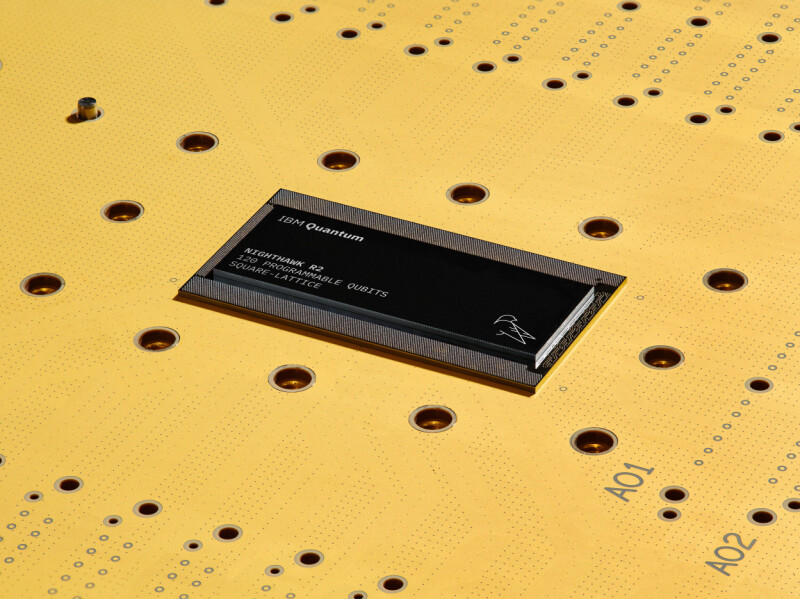
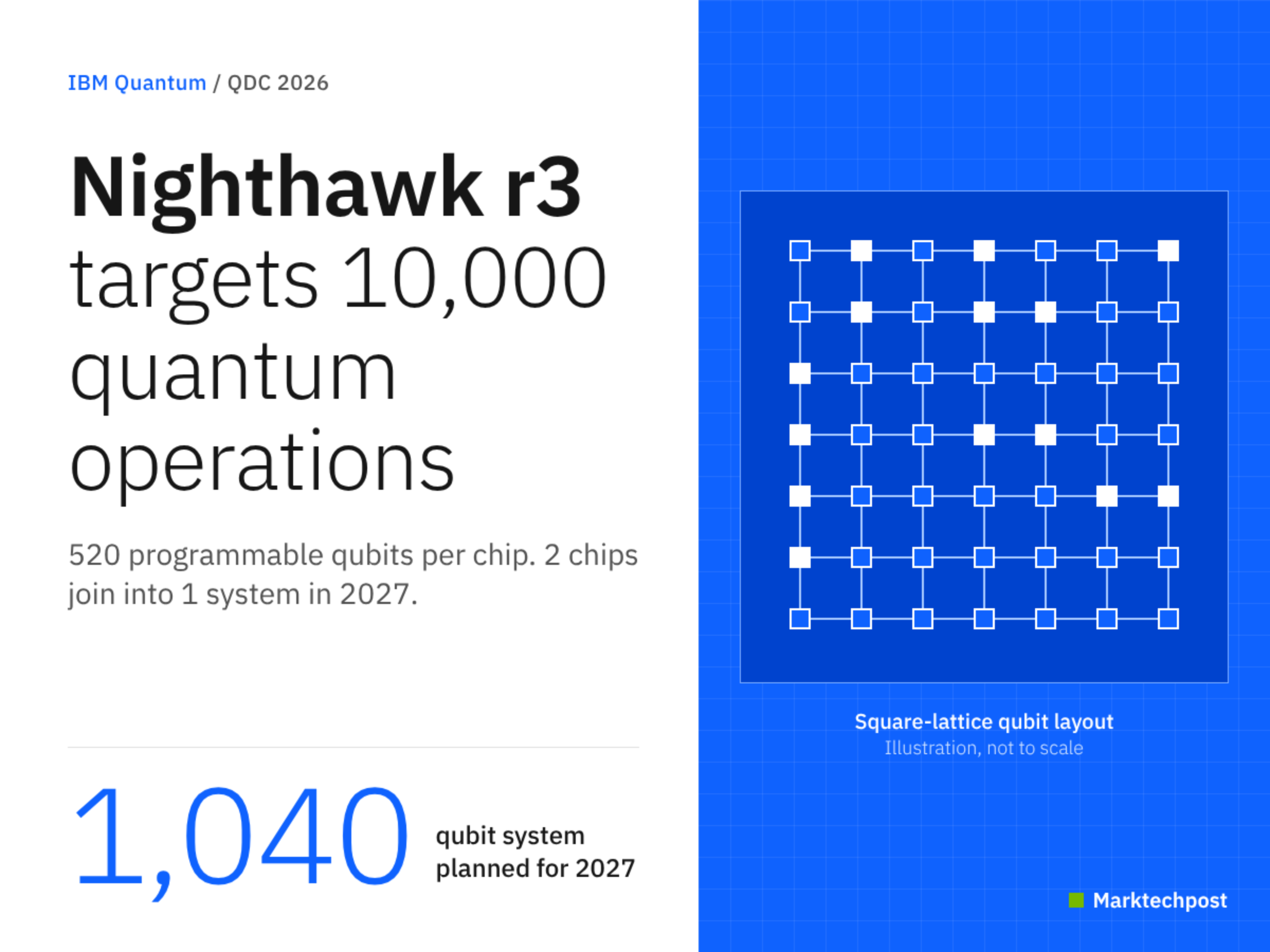
IBM Announces IBM Quantum Nighthawk r3: A New Processor to Support 10k Quantum Operations on 520 Programmable Qubits

IBM announced Quantum Nighthawk r3, a 520-qubit processor designed for 10,000 quantum operations. 2 r3 chips will link into a 1,040-qubit system in 2027, while Nighthawk r2 already posts up to 19x speedups over Heron.

Read at MarkTechPost

Quantum Computing Report Mohamed Abdel-Kareem

IBM Unveils 520-Qubit Nighthawk r3 Processor, 1,040-Qubit Linked Roadmap, and Managed Hybrid Workflows at QDC 2026

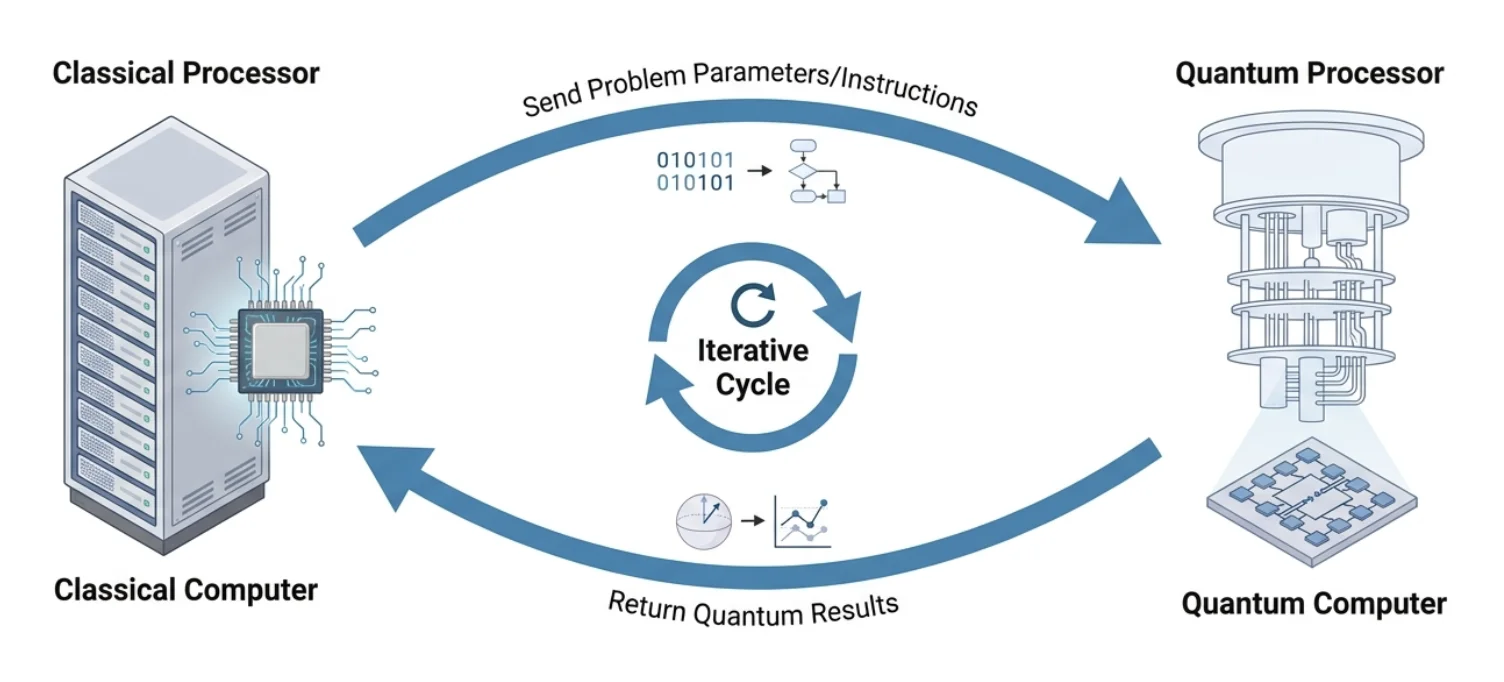
IBM introduced the Nighthawk r3 processor with 520 programmable qubits and a roadmap to 1,040 qubits by 2027, demonstrating advancements in quantum computing hardware and software. The company also unveiled an expanded software stack, including Managed Workflows, and reported significant speedups and circuit executions with its Nighthawk r2 processors. These developments are geared towards achieving fault-tolerant quantum systems and addressing complex applications in…

Read at Quantum Computing Report

Quantum Computing Report Mohamed Abdel-Kareem

Q-CTRL Expands Fire Opal Suite with Constrained Optimization, Estimator Twirling, and Monte Carlo Solver

Q-CTRL has updated its Fire Opal platform with new features including constrained optimization for QAOA, significantly increasing approximation ratios. They've also introduced Monte Carlo integration for quantitative finance, capable of scaling hardware execution up to 17-27 qubits. Additionally, Fire Opal now includes Estimator Pauli Twirling to improve signal-to-noise ratio with zero additional QPU shot overhead.

Read at Quantum Computing Report

The Quantum Insider Mohib Ur Rehman

IBM Plans 1,040-Qubit Quantum System with Next-Generation Nighthawk Processors

Insider Brief PRESS RELEASE — IBM (NYSE: IBM) today announced IBM Quantum Nighthawk r3, its next-generation processor, will be built to accurately execute 10,000 quantum operations across 520 qubits to tackle larger, more complex problems while maintaining the speed and quality demonstrated by the current generation Nighthawk available today. In 2027, IBM plans to link

Read at The Quantum Insider

arXiv (research papers) A. Palmer

Reducing TLS Losses in Superconducting Circuits Using Solid Neon

Two level systems (TLSs) are a major source of loss in superconducting devices, limiting the performance of qubits, detectors, and resonators. These defects arise from a range of sources, including surface oxides, crystal defects, as well as fabrication residues which are often difficult to remove. Using NbTiN coplanar waveguide resonators, we show that depositing and subsequently removing a solid neon film can significantly improve device performance. Analysis of the…

Read at arXiv (research papers)

arXiv (research papers) Kübra Sümer

Quantum synchronization in XX chains under relaxation

We study stable synchronization in qubit XX chains with site-dependent frequencies and exchange couplings under multi-local amplitude damping noise, extending the uniform-chain results of B. Çakmak et al., [Phys. Rev. A 114, L030202 2026] in several directions. We establish that the dark-mode energies are precisely the eigenvalues shared by all undamped segments separated by the damped sites. Generic stable synchronization of the edge qubits occurs if and only if these…

Read at arXiv (research papers)

arXiv (research papers) Artur Czerwinski

Towards Distributed Quantum Computing: Quantum Gate Teleportation via Satellite-Distributed Entanglement under Atmospheric Depolarization

We investigate quantum gate teleportation as a primitive for satellite-enabled distributed quantum computing. In the considered architecture, a satellite distributes entangled photon pairs to two optical ground stations, which transfer the shared quantum resource to remote quantum processing units. This entanglement is then used to implement a nonlocal controlled-NOT gate between two circuit qubits located in different processors. We formulate the minimal four-qubit…

Read at arXiv (research papers)

arXiv (research papers) Feiyu Li

Implementing rapid reset of superconducting qubits with on-chip dissipation

Rapid and high-fidelity qubit reset is essential for quantum state initialization and quantum error correction. Conventional reset protocols for superconducting qubits often rely on dissipative elements connected to external circuitry, exposing qubits to thermal noise from higher-temperature environments. Here, we experimentally demonstrate a scalable approach to qubit reset and leakage removal over multiple transmon qubits using dedicated dissipation units comprising…

Read at arXiv (research papers)

arXiv (research papers) M. V. Bastrakova

High-Speed Control of a Fluxonium Qubit via Picosecond Pulses from Josephson Digital Circuits

We develop a control strategy for fluxonium qubits based on picosecond single-flux-quantum (SFQ) pulses generated by Josephson digital circuits. A major challenge is that SFQ protocols originally designed for transmon control become inefficient for low-frequency fluxonium. In this regime, the asymmetry of flux and charge couplings leads either to excessive leakage or excessively long gate times. We show that this limitation can be overcome by two complementary protocols. The…

Read at arXiv (research papers)

arXiv (research papers) Gubio G De Lima

PINNverse meets Jordan--Wigner: learning the Hamiltonian of long spin chains

Inverse physics-informed neural networks (PINNverse) learn the parameters of a quantum Hamiltonian from measured expectation values, but the network output grows as $4^N$ with the number of qubits $N$. We show that, for spin chains with nearest-neighbor exchange interactions, the Jordan-Wigner transformation removes this exponential cost: the dynamics closes on an $N\times N$ one-body density matrix, so the network needs only $N^2$ outputs and the data are local observables…

Read at arXiv (research papers)

Quantum (journal) Soham Sau and Michal Sedlák

Sequential realization of Quantum Instruments

Quantum 10, 2262 (2026). https://doi.org/10.22331/q-2026-11-10-2262 In adaptive quantum circuits classical results of mid-circuit measurements determine the upcoming gates. This allows POVMs, quantum channels or more generally quantum instruments to be implemented sequentially, so that fewer qubits need to be used at each of the $N$ measurement steps. In this paper, we mathematically describe these problems via adaptive sequence of instruments (ASI) and show how any…

Read at Quantum (journal)

arXiv (research papers) Minho Jang

Coherent Optical Readout of Neutral-Atom Qubits via Homodyne Detection of Resonant Fluorescence

Fast, non-destructive qubit readout is essential for repeated sampling, mid-circuit measurement, and fault-tolerant neutral-atom quantum processing, but camera-based fluorescence detection introduces electronic latency beyond fluorescence-collection time. We propose coherent readout of the state-dependent resonant fluorescence using balanced homodyne detection with photodiodes. An analytic model quantifies the effect of atomic motion on the time-integrated quadrature signal…

Read at arXiv (research papers)

Older stories