Results for “Quantum”

Quantum Computing Report Mohamed Abdel-Kareem

IBM, RIKEN, and NVIDIA Achieve 79x Accuracy Gain in Quantum-Classical Simulations of Iron-Sulfur Clusters

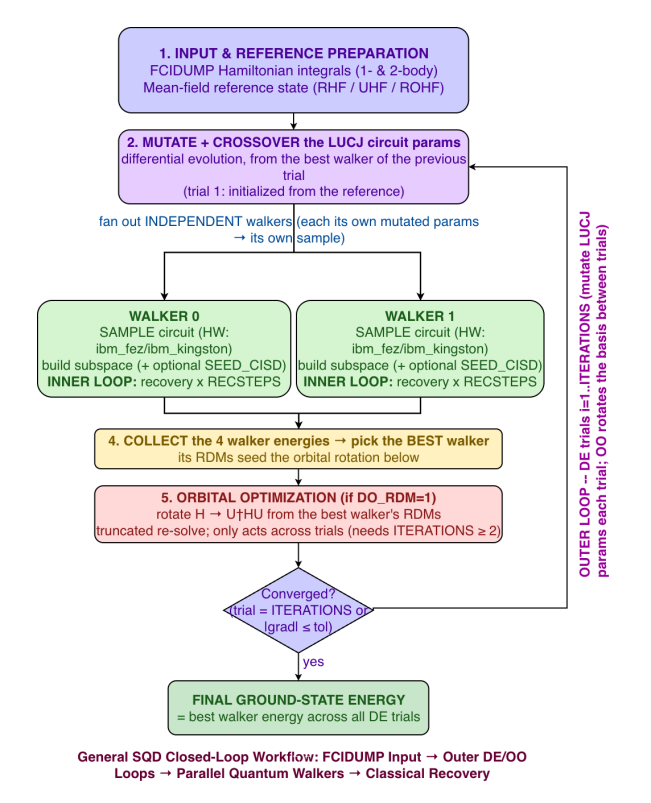
Researchers from IBM Quantum, RIKEN, and NVIDIA have achieved a 79-fold improvement in energy accuracy for quantum-classical simulations of iron-sulfur clusters. This was done by initializing Sample-Based Quantum Diagonalization (SQD) with broken-symmetry unrestricted Hartree-Fock (BS-UHF) reference states, bringing ground-state energy estimates for a 72-qubit [Fe4S4(SCH3)4]2− active space within 4.3 millihartree of high-precision classical benchmarks. The study highlights…

Read at Quantum Computing Report

arXiv (research papers) Yang-Zhi Chou

Double quantum dots as dynamical impurities in one-dimensional transport

We study single-electron scattering in a tight-binding chain capacitively coupled to double quantum dots, which act as dynamical two-level-system impurities with electrically tunable level splittings. For a single impurity, we solve the scattering problem exactly and show Feshbach-like perfect elastic reflection, whose resonant condition distinguishes the initial two-level state. For several impurities in a strongly reflecting chain, transmission peaks at an intermediate…

Read at arXiv (research papers)

Quantum Computing Report Mohamed Abdel-Kareem

IBM and AMD Open-Source Pelagos GPU Decoder Framework for Large-Scale qLDPC Error Correction Simulations

IBM and AMD have open-sourced Pelagos, a GPU-accelerated quantum error-correction (QEC) decoding framework for evaluating qLDPC codes at supercomputing scale. This release, announced at SC26, aims to advance quantum computing through vendor-neutral, efficient error correction, building on a joint QEC co-design platform. Pelagos offers significant speedups and efficient multi-GPU orchestration, enabling large-scale simulations crucial for fault-tolerant quantum computing.

Read at Quantum Computing Report

arXiv (research papers) Mohammad I. Husain Security

The Provenance-Privacy Paradox: Can Private Cloud Compute (PCC) Prove That Apple Reference Images Are Not Used for Learning?

Apple Reference Image (ARI) combines camera-sensor signatures, Secure Enclave attestation (SEP), cryptographic timestamp bounds, Private Cloud Compute (PCC), and a final post-quantum signature to establish photographic provenance. PCC is central to this process because it validates the secure digital negative and develops authenticated raw sensor measurements into a reference JPEG. Although the secure digital negative is encrypted during transmission, the authorized PCC…

Read at arXiv (research papers)

arXiv (research papers) Alec Eickbusch

Resolving and Suppressing Temporally Correlated Noise in Quantum Error Correction

Scaling fault-tolerant quantum error correction (QEC) requires suppressing errors in both space and time, yet standard logical memory experiments primarily probe spatial faults. Here, we use a 105-qubit Willow superconducting quantum processor to realize and scale the surface code stability experiment, which is alternatively sensitive to temporal error chains. Scaling from patch sizes of $3 \times 3$ to $7 \times 7$, we realize a timelike block suppression factor of $μ_T =…

Read at arXiv (research papers)

arXiv (research papers) Yu-Jie Liu

Optimal Quantum Sensing Algorithms for Discrete-Frequency Spectroscopy

Spectroscopy is a versatile tool that drives scientific discovery and underpins modern technologies. Quantum sensing offers promising opportunities to advance spectroscopy through enhanced sensitivity and spectral and spatial resolution. However, existing approaches largely focus on improving general measurement capabilities, often overlooking the structure of specific sensing tasks and leaving potential performance gains untapped. Here, we develop an algorithmic approach to…

Read at arXiv (research papers)

arXiv (research papers) José Daniel Viqueira

Benchmarking memory and nonlinear processing capacity of quantum recurrent neural networks for time series prediction

Quantum machine learning has emerged as a promising approach to time series prediction. While quantum reservoir computing has been widely explored for this setting, variational quantum models tailored to sequential data remain comparatively understudied, largely because they are difficult to train. In this work, we present a rigorous benchmark of variational quantum recurrent neural networks (QRNNs) on time series prediction tasks, focusing on two key capabilities: memory…

Read at arXiv (research papers)

arXiv (research papers) Ekta Panwar

The speed limit of gravitational entanglement and the cost of noise

Is gravity quantum? A proposed test lets two small masses, each in a superposition of two places, become entangled through their mutual gravity. Gravity is weak, so the masses must stay coherent for seconds while random forces disturb them. Here we ask how fast gravity can entangle two masses, and what noise costs. Without noise we find the maximum rate exactly: it falls as the inverse cube of the separation, and two positions per mass achieve it. Above a noise level set by…

Read at arXiv (research papers)

The Quantum Insider Resonance

From First-Timers to PhDs: 1,000+ Builders Take on Quantum at the Qollab × IonQ Hackathon

Insider Brief Last month, more than 1,000 students, researchers and professionals in 37 countries spent a weekend writing quantum software, competing at 22 university sites from Finland to Argentina. Some of the best work came from people who had never written a line of quantum code. An avionics engineer in Argentina taught himself from online

Read at The Quantum Insider

arXiv (research papers) Jesús R. Abascal Security

Post-Quantum Migration of Wi-Fi Key Establishment: A Hybrid ML-KEM Design for OWE and FILS, Validated on OWE with hostapd

The key agreements that protect a Wi-Fi connection rely on Diffie-Hellman, which a sufficiently capable quantum computer would break; an adversary can therefore record an association today and decrypt its traffic years later. Key establishment is thus the part of IEEE 802.11 that has to be migrated first. This work targets the two protocols that perform that agreement inside the frames used to set up the link: Opportunistic Wireless Encryption (OWE), which encrypts otherwise…

Read at arXiv (research papers)

The Quantum Insider Mohib Ur Rehman

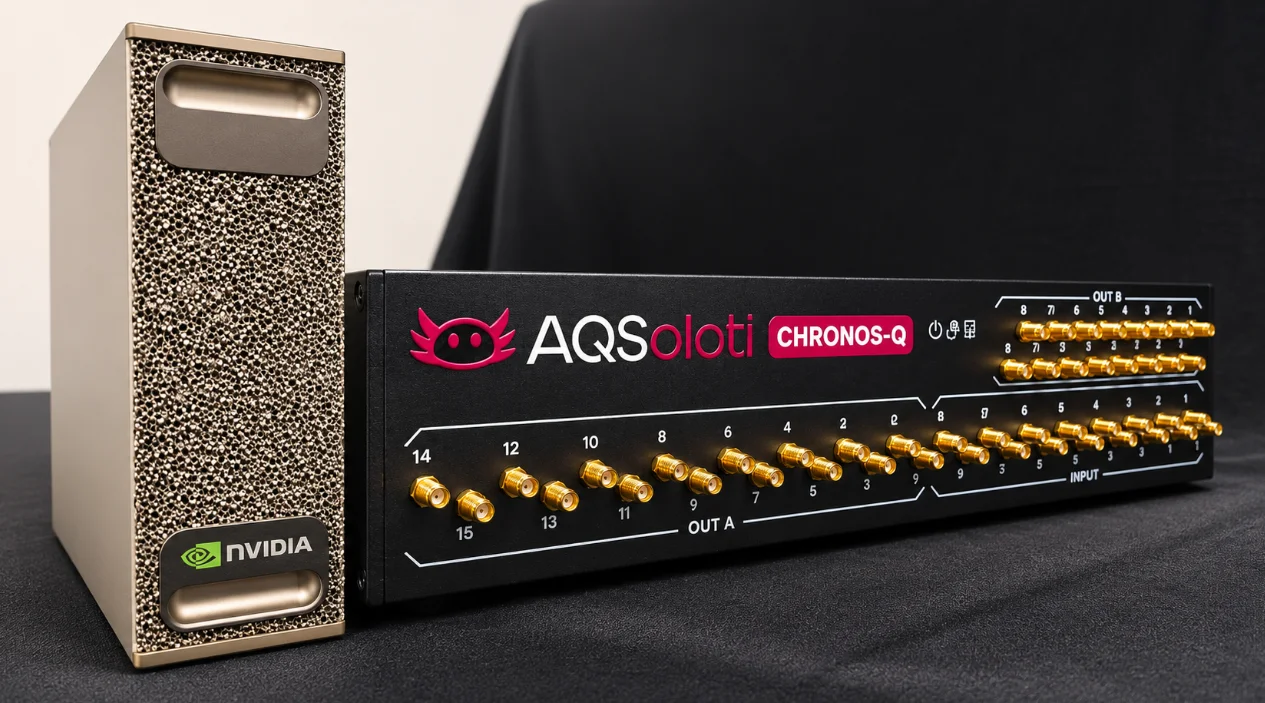
AQSolotl Reports 6.94-Microsecond Latency in NVIDIA NVQLink Integration Test

Insider Brief PRESS RELEASE — AQSolotl, a developer of quantum control systems, today announced initial results from integrating NVIDIA NVQLink into its Chronos-Q platform. Tests connecting Chronos-Q with NVIDIA DGX Spark recorded a minimum round-trip latency of 6.94 microseconds across 1,000 requests. Quantum processors rely on classical computing to control and fine-tune their operations. NVQLink

Read at The Quantum Insider

arXiv (research papers) Burhan Gülbahar

Exponential Quantum Memory Advantage for Late-Graph Smoothness and Spectral Estimation

Graph signal processing tests how smoothly the decisions of next-generation massive sensor networks with $N$ nodes vary over their neighbour graph. Memory becomes the bottleneck when the neighbour graph arrives only after data erasure, a late-graph setting motivated by dispersed sensor networks and telemetry. We analyse three collection scenarios, reliable rounds, continuous broadcast and ordered capture, and test the Dirichlet energy $\mathcal E_G=\mathbf z^{\mathsf…

Read at arXiv (research papers)

arXiv (research papers) Benedikt Tissot

Quantum Networks with Realistic Photonic Memories

Ensemble based photonic memories paired with photon pair sources are the essential ingredient for many quantum networking protocols. Most protocols and theoretical analyses focus on networks of identical nodes, however, realistic networks consist of nodes that may vary from device to device. We investigate a network of non-identical memories and develop mitigation strategies for the variation in performance. We find that by strategically distributing the memories among the…

Read at arXiv (research papers)

EE Times Gary Hilson

Taking a Tour of Canada’s Particle Accelerator

Located on Canada’s west coast, TRIUMF’s normal-conducting cyclotron, unique materials probes, and irradiation facilities serve everything from quantum materials and radiation-hardened electronics to medical isotopes.

Read at EE Times

arXiv (research papers) Vinh San Dinh

Experimental simulation of a Hilbert-space inner-product change

We simulate an effective change in a single qubit's inner product (IP) by implementing the channel $\mathcal{F}^η$ on a superconducting quantum processor. Whereas previous experiments simulated parity-time (PT)-symmetric dynamics with a fixed IP, this experiment implements the IP-change channel itself for metrics associated with PT-symmetric systems. Building on an earlier adversarial verification approach, we derive a process-fidelity threshold that rules out mixtures of…

Read at arXiv (research papers)

arXiv (research papers) Adán Cabello

Plenitude of ideal correlations explains quantum theory

We show that the Hilbert-space formalism and the Born rule of quantum theory are singled out by the following principle: every correlation that is possible in a theory in which every observable admits an ideal measurement is physically realizable. An ideal measurement is one that yields the same outcome when repeated and does not disturb any compatible observable.

Read at arXiv (research papers)

The Quantum Insider Mohib Ur Rehman

Saltgrain and NTT Research Develop Large-Universe Post-Quantum Encryption

Insider Brief PRESS RELEASE — Saltgrain, the data-centric security platform for sovereign data, incubated in Scale Academy at NTT Research, the Silicon Valley research arm of NTT, Inc., and the NTT Research Cryptography and Information Security (CIS) Lab today announced that the first practical large-universe post-quantum attribute-based encryption is headed for Saltgrain. The technology lets

Read at The Quantum Insider

arXiv (research papers) Alejandro Corichi

Geometry of squeezed states. The phase-space metric, relative vacua and cosmology

Geometry enters quantum theory in two places. The space of quantum states carries a symplectic form, which generates unitary evolution, and a metric, which governs uncertainties and transition probabilities. The classical phase space acquires a metric of its own when a vacuum is chosen: quantizing a linear system amounts to choosing a compatible complex structure, equivalently a compatible metric $g$. We take this second metric as the primary object and show that it plays…

Read at arXiv (research papers)

arXiv (research papers) Philipp Kleinpaß

Rethinking Entropic Uncertainty: How measuring without a trace leads to longer keys

In recent years, the entropic uncertainty relation (EUR) has been one of the most prominent tools to obtain tight key rates secure against general coherent attacks for a broad class of quantum key distribution (QKD) protocols. Despite its success, the fundamental question of how to incorporate the statistics of more than two mutually unbiased bases (MUBs) directly into the EUR is yet to be answered. Here, we introduce a simple yet powerful shift of perspective: Instead of…

Read at arXiv (research papers)

arXiv (research papers) Andrés Agustí Casado

Reinforcement Learning designs Quantum Repeater Protocols on Networks beyond the Chain Scenario

Small-scale quantum repeater protocols have been shown to distribute entanglement over existing telecommunication infrastructure by means of short range quantum communications and long range classical messages. For larger networks, there are a number of theoretical proposals about how to operate the network to achieve a good performance under varying metrics. Moreover, since the dimension of the space of possible protocols grows exponentially with network size, plenty of…

Read at arXiv (research papers)

arXiv (research papers) Lijun Wang

Sharp $L_p$-Regularity for Quantum Markov Semigroups

We determine the sharp universal constants in positive-input $L_p$-regularity for finite-dimensional quantum Markov semigroups with a faithful invariant state. For $1<p<\infty$, they are $p\sin(π/p)/(2(p-1))$ under KMS symmetry and $\frac{p}{2(p-1)}\tan(\fracπ{2}\min\{1/p,1-1/p\})$ without a symmetry assumption, with the endpoint values at $p=1$ given by $π/2$ and $π/4$, respectively.

Read at arXiv (research papers)

arXiv (research papers) Yasir Mehmood

Sequential strategy for depolarizing strength estimation

We study the advantages of applying a sequential strategy for enhancing the precision in estimating the strength $p$ of a depolarizing channel, using qudit and two-qubit probes. The sequential strategy requires that the same depolarizing channel is repeatedly applied $M$ times to the quantum probe. From the analysis of the probe's output state, both the quantum Fisher information (QFI) and its regularization RQFI, given from multiplication by $p$, are analyzed. We determine…

Read at arXiv (research papers)

The Quantum Insider Mohib Ur Rehman

IQM Supports NVIDIA’s Work to Make Quantum Computers Schedulable in Slurm

Insider Brief PRESS RELEASE — IQM Quantum Computers (Nasdaq: IQMX), a global leader in superconducting quantum computers, today announced at SC26 in Chicago its support for NVIDIA’s investment in making quantum processing units (QPUs) a schedulable resource in the Slurm workload manager by integrating IQM quantum computers. NVIDIA, which has committed to keeping Slurm open

Read at The Quantum Insider

The Quantum Insider Mohib Ur Rehman

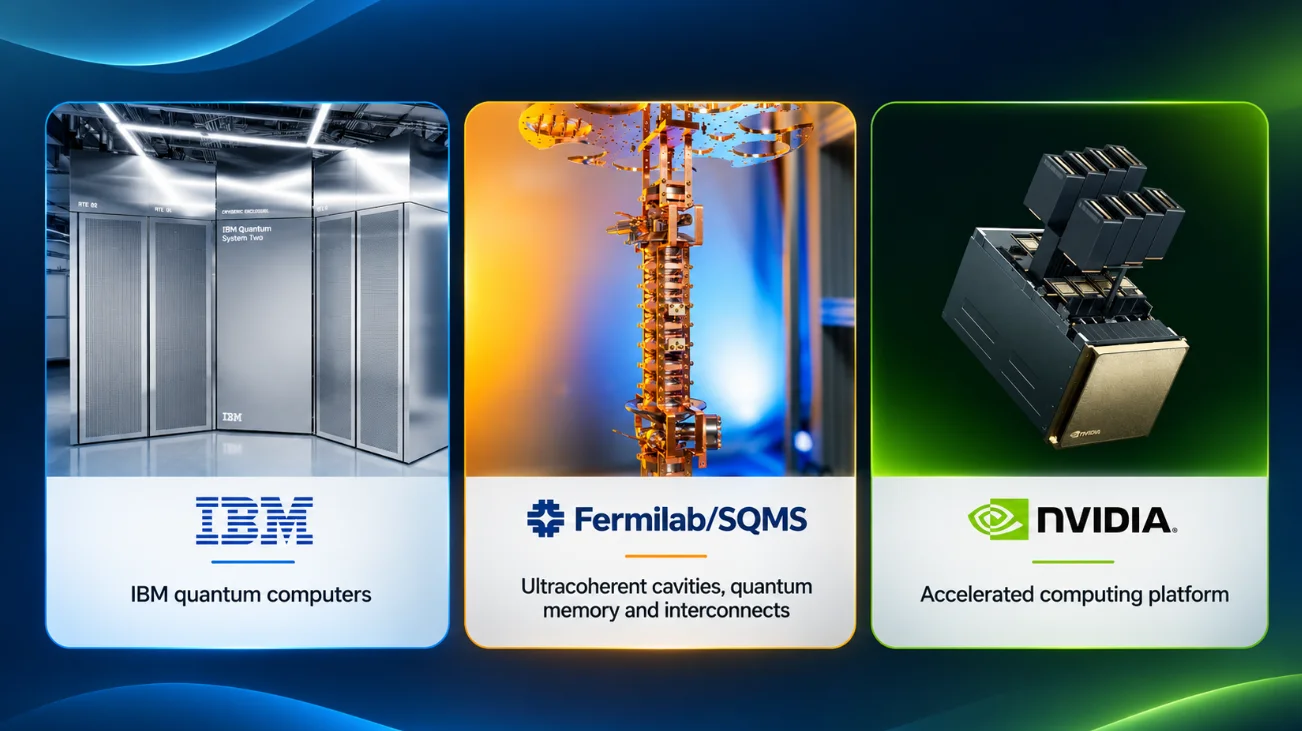
IBM, NVIDIA and Fermilab Plan Modular Quantum Computing Platform

Insider Brief PRESS RELEASE — IBM (NYSE: IBM) today announced plans to collaborate with NVIDIA and Fermi National Accelerator Laboratory (Fermilab) to advance the integration of quantum and classical computing and explore how these technologies can scale together in the modular architectures that will define fault-tolerant quantum computers. The work will span developing new scientific

Read at The Quantum Insider

arXiv (research papers) Rui Lin

Quantum adiabatic and diabatic optimization: A Hilbert space engineering strategy with Rydberg arrays

Neutral-atom arrays provide a versatile platform for encoding combinatorial optimization problems with arbitrary graph connectivity [Nguyen et al., PRX Quantum 4, 010316 (2023)]. Although the dynamics of individual encoding gadgets has been studied [Bombieri et al., PRX Quantum 6, 020306 (2025)], understanding annealing bottlenecks in larger networks remains challenging. We investigate how engineering the Hilbert-space geometry controls quantum annealing in a family of…

Read at arXiv (research papers)

Phys.org Quantum Physics

Reading superconducting qubits while suppressing unwanted state transitions

Recently an artificial intelligence proved an 18-year-old conjecture in computer science, called the Aaronson–Ambainis conjecture. The proof settles a long-standing conjecture (educated guess) that eliminates one proposed route to enormous quantum computer speedups, ruling out one particular variant of "quantum supremacy," the term for the hypothesis that a programmable quantum computer can solve a problem that no classical computer can solve in any "feasible" amount of time.

Read at Phys.org Quantum Physics

arXiv (research papers) Ben Howe

TCBP-JOBS: GPU-Accelerated Quantum Error Correction Decoding and Noise Learning with Near-Optimal Accuracy

Achieving near-optimal quantum error correction (QEC) decoding accuracy often requires computationally expensive searches that limit both large-scale simulation and real-time operation. We introduce trajectory-calibrated belief propagation (TCBP), which learns calibrated fault probabilities from BP trajectories, and jittered OSD beam search (JOBS), which uses these probabilities to guide parallel GPU searches. Across surface, color and bivariate-bicycle code memory and…

Read at arXiv (research papers)

NVIDIA Blog Sam Stanwyck SI

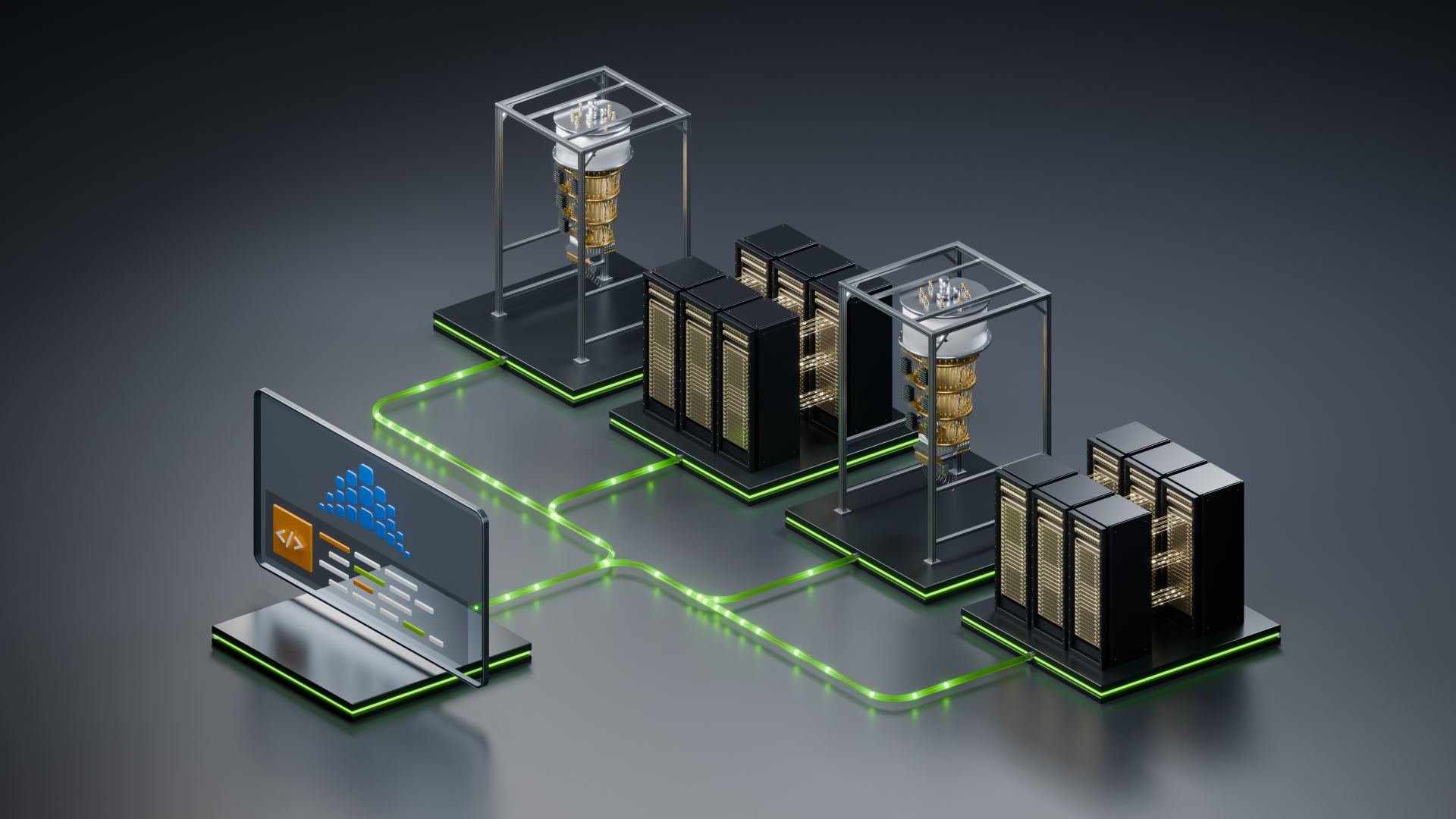
NVIDIA Expands Slurm to Bring Quantum Computing Into Supercomputing

Quantum processor deployments at supercomputing centers have grown nearly sevenfold over the past five years, with nearly 30 supercomputing centers around the world now in the process of deploying over 50 quantum processors. Many of these centers use Slurm to run scientific supercomputing workloads, so expanding its support for quantum processors builds on familiar workflows

Read at NVIDIA Blog

arXiv (research papers) Bolin Zhang

SCOPE: A Physical Execution Latency-Guided Quantum Circuit Compilation Framework

Quantum computing requires compilers to translate algorithms represented in the quantum circuit model into unitary operations supported by physical devices. Limited coherence time makes physical execution latency an important compilation objective. Gate fusion can shorten pulses, but gate count and depth do not capture fused targets' control demands. Evaluating every candidate with quantum optimal control (QOC) would embed pulse optimization in structural search. We present…

Read at arXiv (research papers)

arXiv (research papers) Rahul Security

PQC Migration: End-to-End Performance Profiling of Post Quantum Cryptographic Algorithms in mTLS

Emerging quantum computers threaten to break the classical key exchange algorithms. To safeguard against these threats, migration to new quantum-safe algorithms is underway and expected to be expedited. Though resistant to attacks, the quantum safe algorithms may impact the real-world performance due to their large key lengths. In this work, we analyze the end-to-end performance of the Transport Layer Security (TLS) protocol with the post-quantum (PQ) and hybrid…

Read at arXiv (research papers)

Older stories