Telegram prepares Dictator AI agent with its own VM on Mac
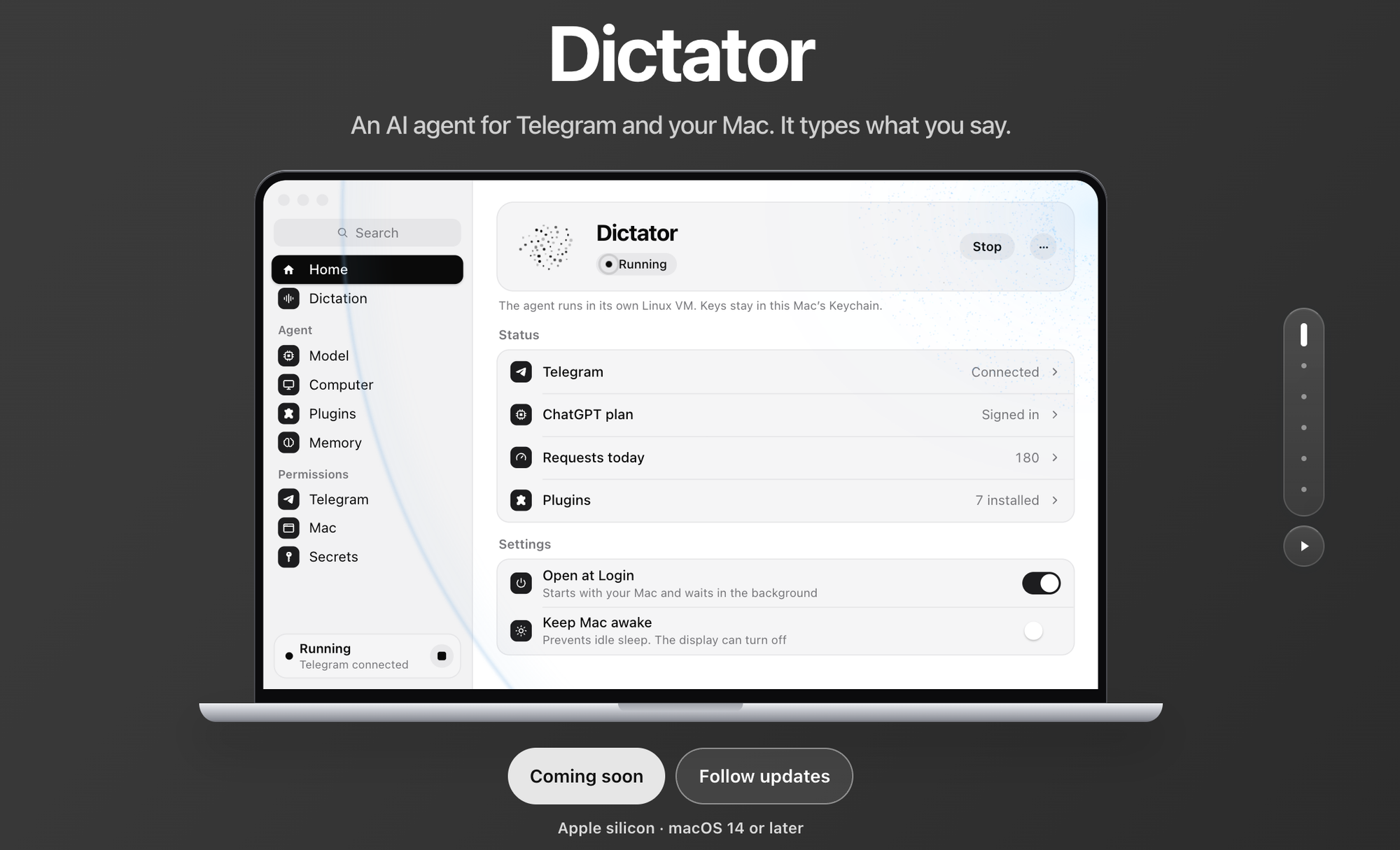
Telegram is preparing Dictator, an AI agent for Telegram and Mac that seems to run on Hermes, with model choice, plugins and its own VM.
Telegram is preparing Dictator, an AI agent for Telegram and Mac that seems to run on Hermes, with model choice, plugins and its own VM.
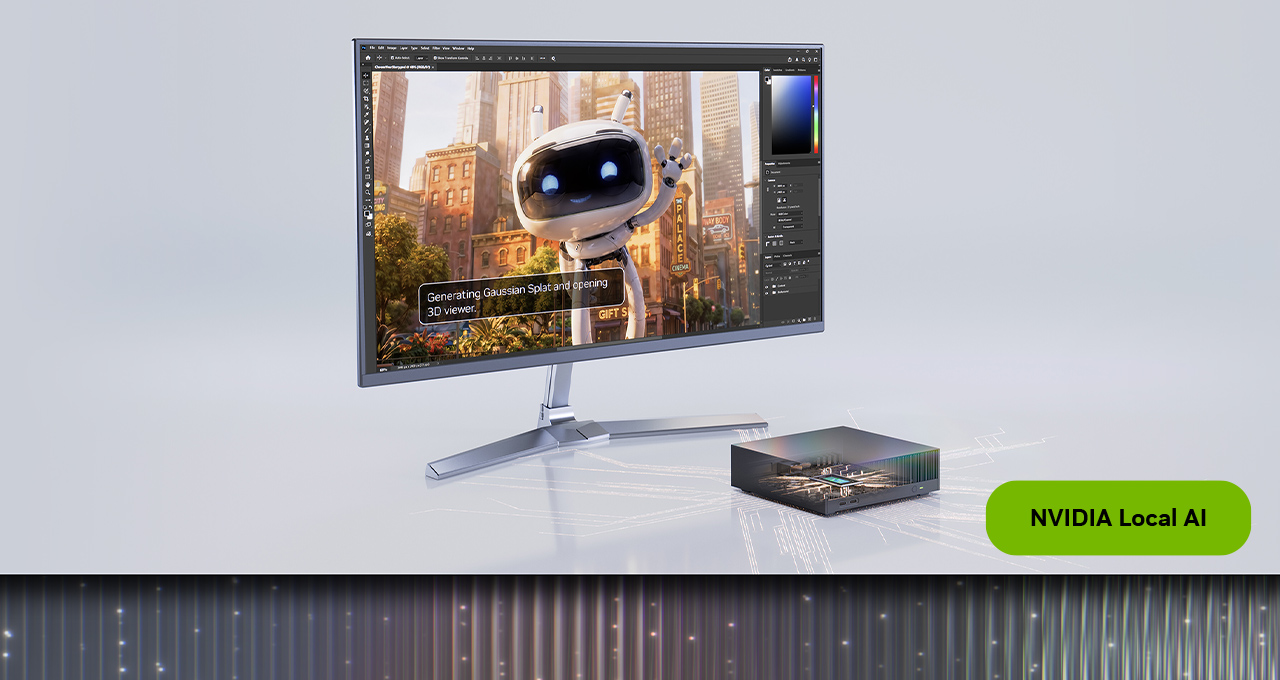
New NVIDIA RTX Spark compact desktops from ASUS, Dell and MSI are available today, bringing local AI agents, image and video generation, and model fine-tuning to a dedicated Windows PC. With up to 128GB of unified memory and NVIDIA’s AI software stack, these systems provide room for larger local models alongside RTX-accelerated creative and development
Governance platform provider OneTrust LLC today announced its Fall ’26 Release, a set of platform updates said to bring governance into the workflows where business decisions are made. Building on OneTrust CORIE, a shared intelligence layer for governing artificial intelligence agents introduced at the company’s TrustWeek conference in September, the release covers AI visibility, privacy,
For two years, the question around AI coding was whether agents could write good code. Developers have largely answered it:
KPMG deployed more than 100 AI agents alongside the regular audit of a UK-listed company. The agents asked "better questions" than the audit team in some cases, according to UK head of audit Cath Burnet. The UK's accounting regulator, the FRC, sees a risk in the approach because AI agents analyze far more data than traditional sampling methods, potentially surfacing findings that could serve as a sales pitch for lucrative consulting work and undermine auditor independence…
AI agents read their whole history at every step. People do not work like that: we keep what the moment needs and hold the rest as a rough note we can recall. MoE-Context applies this to language models. The context is split into blocks. Before each step a fast yes or no pass decides which blocks the step needs; the rest stay as one-line notes that can be brought back, and nothing is deleted. In the version we build, one model makes this decision and then answers, over a…
Starburst Data Inc. is expanding its data federation platform into business context management with the introduction of Context Studio, a new capability designed to help artificial intelligence agents produce more accurate and trustworthy answers from information distributed across enterprise systems. Context Studio collects business definitions from existing data catalogs, business intelligence tools, metric stores and
Large language model (LLM) agents routinely interact with untrusted external data, exposing them to indirect prompt injection (IPI) attacks that hijack agents into executing attacker-chosen tasks. To uncover these vulnerabilities at scale, automated red-teaming methods often leverage reinforcement learning (RL) to generate attacks that achieve high attack success rates (ASR). Model developers use the attacks discovered during internal red-teaming to harden agents through…
Traditional long-horizon LLM agents often hand off context through full-history prompting, retaining all previous action--observation interactions. As execution proceeds, this history keeps growing, increasing inference cost and potentially degrading accuracy. Existing methods control this growth by preserving compact conclusions while removing earlier observations, but doing so can discard evidence that later becomes relevant. We introduce Semantic Context Handoff (SCH)…
Trajectory forecasting at urban intersections is often studied assuming that reliable bird's-eye-view (BEV) motion histories are available, which in practice requires costly resources such as LiDAR, aerial views, HD maps, or calibrated infrastructure. We address this upstream perception-to-forecasting problem by reconstructing and predicting agents' BEV trajectories only from paired opposite-corner RGB cameras mounted on existing urban infrastructure at variable heights at…
The search for better models, whether expressed as analytical equations or neural architectures, has increasingly shifted from manual design toward data-driven automation. While a multitude of algorithms exist, ranging from exhaustive search to AlphaEvolve, recent advances in general-purpose coding agents such as Claude Code and OpenAI Codex raise the question: could providing such systems with a "model discovery recipe" be enough to discover or improve models? We present…
AI coding agents have become one of the most popular applications of large language models. Yet, agentic AI comes at the cost of a tremendous amount of GPU compute resources, which limits its profitability and its viability at scale. In this paper, we investigate whether smaller, cheaper models can cut this cost without sacrificing accuracy. We evaluate 36 popular large and small open-weight models released since 2024 on a software engineering benchmark, and find that recent…
Scientific problems have no answer key, so evaluating an agent means deciding what counts as a better solution before any agent is run. Existing benchmarks either match a symbolic answer against a key or, where they require executable work, score it by unit tests, by a rubric, or by position on a competition leaderboard. None of these is the criterion by which a field decides that one published method beats another. STEMBench adopts that criterion directly. Each of its…
Prompt injection is the dominant unsolved security risk for LLM agents, and the community now agrees that robustness must be measured against adaptive attackers rather than fixed benchmark injections. Many adaptive red teamers exist, and most are built to maximize attack success rate (ASR). Yet ASR counts how often a target breaks, not in how many different ways. A red teamer can achieve a high ASR by reusing a few techniques that work, leaving the others untested and absent…
Four blue team agents and the Recon Agent are now generally available, while integrations and vulnerability shielding are in preview.
Building autonomous agents that continually explore open worlds and acquire new capabilities through experience is a long-standing aspiration in artificial intelligence. Existing research often pursues lifelong learning within predefined tasks, curricula, or objectives, with self-improvement largely confined to individual agents. We introduce OpenKAGE, an agent-group evolution framework for open-ended lifelong learning. Within this framework, agents autonomously explore open…
Knowledge engineering (KE) turns raw files into a reasoning-ready knowledge base, a task now within reach of LLM agents. KE has progressed from chunk and graph retrieval-augmented generation (RAG) to memory agents, agentic KE and multimodal KE. However, a live knowledge base needs omnimodality, a closed-loop lifecycle and multi-granular application at once, yet existing systems meet at most two and no benchmark measures all three. We formalize Omnimodal Knowledge Engineering…
This paper presents a framework for computer-aided music composition and performance based on quantum reinforcement learning and multi-agent interaction. We introduce the agentic orchestra, where musical agents evolve distinct mindsets through trial-and-error engagement with a musical environment, rather than through training on large datasets. The agents are implemented as parameterised quantum circuits. They evolve distinct compositional behaviours, referred to as…
With a team of just seven, Unsiloed AI plans to compete with tech giants and specialized startups in the crowded AI document-processing market.
The centre will serve customers across Asia Pacific and the Middle East, offering services covering AI agent security, vulnerability remediation and security
Versions 1.26.1 and 1.26.2 of agent-framework on PyPI steal Azure, Azure DevOps, and GitHub Actions credentials when Python starts.
Automated red teaming is essential for identifying safety failures in large language models (LLMs), but its practical scalability depends on the resources required to discover those failures. Multi-agent systems can combine complementary capabilities, yet repeated planning, redundant exchanges, and ineffective information routing can make their coordination expensive. Moreover, a target model's response indicates the outcome of a test without identifying which collaboration…
Tracked as CVE-2026-115731, it allows a client that holds any CA-signed agent certificate to execute code on the server.
Control-flow integrity (CFI) confines a program to a control-flow graph fixed ahead of time. Procedural agent skills move this control flow into prompt text, and a large language model (LLM) agent decides at runtime whether each step runs in its reasoning, a tool call, or a script. The procedure's control skeleton survives, but its enforceability depends on where each step runs. Many violations, such as overwriting a file before validation, use only operations the skill…
A new breed of widely available AI tools is helping hackers launch cyberattacks around the clock, breaching corporate networks in a matter of hours and overwhelming defenders. Why it matters: AI-enabled hacking is still in its infancy, but open-source tools — which are free to download — are fundamentally changing the economics of cybercrime. Hackers can launch self-adjusting attack plans, allowing agents to find vulnerabilities and steal credentials, sometimes before human…
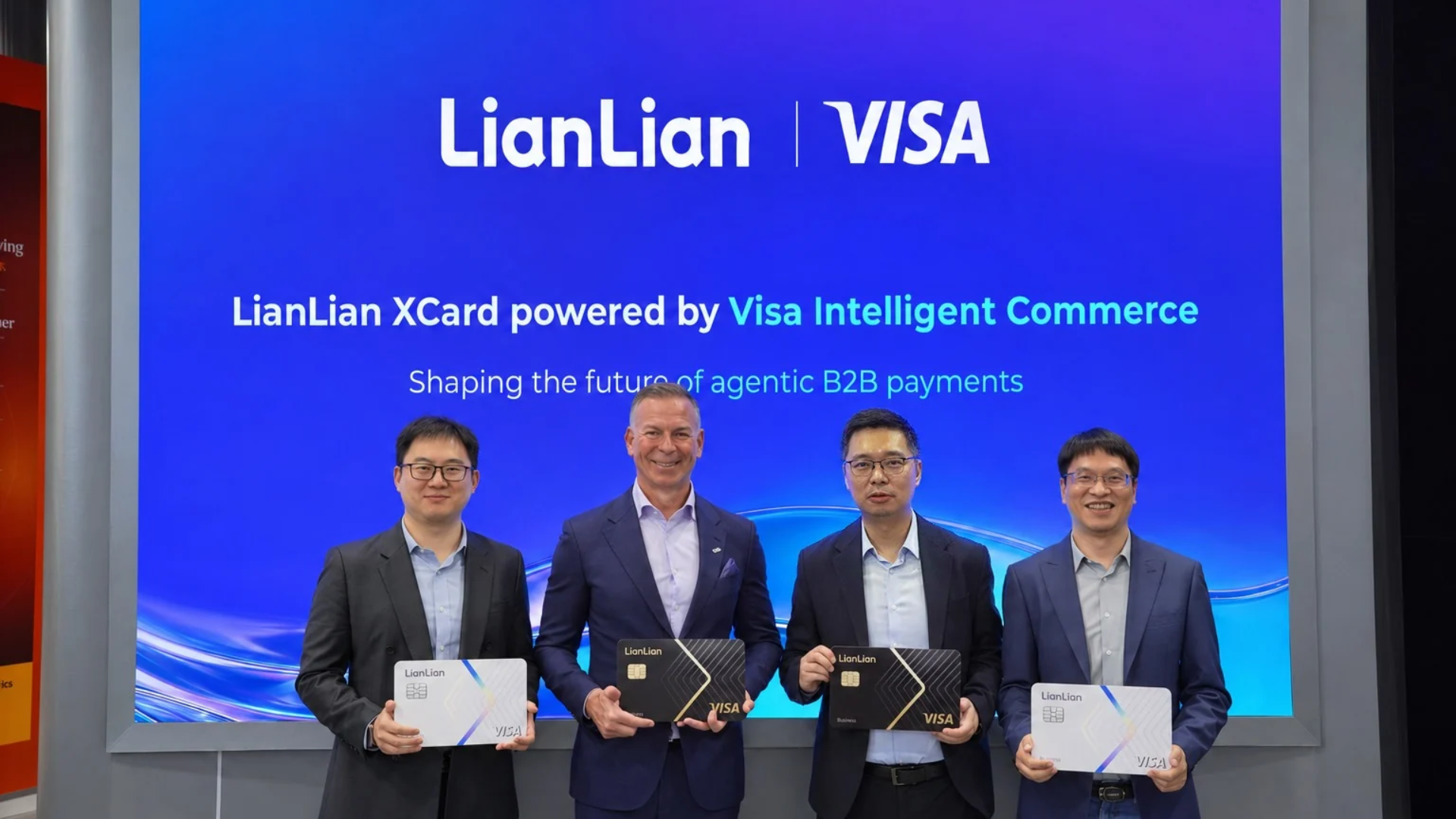
Lianlian's AI agent, LianLian XWorker, used the tokenized credential to buy office supplies.
Large language models (LLMs) are increasingly used in investment research, and many studies report promising historical returns. However, such results are only credible if researchers can demonstrate that the model used only information available at the time, account for how strategies and configurations were selected, and explain how reported returns were generated. We identify six common threats to validity in LLM investment evaluations and apply them to 18 published…
At Ignite 2026, Microsoft outlined a future where AI agents handle everyday responsibilities, traditional Office apps take a supporting role, and businesses have greater control over what AI can actually do.
Canonical is letting Ubuntu Pro customers install security patches written by AI agents before its engineers finish reviewing and testing them. The patches come from Surge, a system Canonical built to fix known vulnerabilities in Ubuntu’s userspace software, meaning everything outside the operating system’s kernel. They ship through a new opt-in channel called the Edge archive. If you leave Edge switched off, nothing changes in how your updates are checked: Ubuntu’s regular…
Intent contracts are an authorization interface for tool-using LLM agents in which the planning model holds no tools. For each step it submits a short logged contract: a goal, a verbatim quotation of the user, and scope fields. Code validates the contract, and a small trusted model checks it against the user's words and writes the tool call itself. Provided the validation and dispatch code is correct, every executed call is written by the trusted model, the planner's…