Results for “Agent”

Help Net Security Sinisa Markovic Security

Credential stealer slipped into Microsoft’s official Python agent framework

Two releases of Microsoft’s official agent-framework package on the Python Package Index (PyPI) carried code that steals cloud and CI/CD credentials from developers’ systems. Agent Framework is Microsoft’s open-source toolkit for building AI agents and running them in workflows. Three supply chain security companies, StepSecurity, OX Security and Socket, caught the malicious versions and shared their analysis. “On November 17, 2026, versions 1.26.1 and 1.26.2 of the official…


Read at Help Net Security

arXiv (research papers) Hyunjun Park

CRAFT: Analog Circuit Design by Reasoning LLM Agents from Pre-Computed Lookup Tables

Automated analog circuit sizing methods, from black-box optimizers to recent large language model (LLM) agents, typically search the design space with a SPICE simulator in the loop, whereas an experienced designer works out a design by hand analysis. This paper presents CRAFT, a flow in which an LLM agent designs a given topology by calculation, as a designer does, and without an initial sizing. The agent works only through DeX, a service that uses pre-computed lookup tables…

Read at arXiv (research papers)

arXiv (research papers) Youssef ElNahas Tech policy

Verifiable Logic in Medical LLMs: A Critical Review of Agentic Clinical Reasoning Optimization and Neuro-Symbolic Grounding

Clinical large language models are usually judged by whether the final answer is right. Yet a model can reach a fluent, plausible output through invalid reasoning that static benchmarks do not detect, and confident hallucination, causally invalid inference, and spurious demographic shortcuts can pass conventional evaluation. This critical review covers four paradigms in turn: how clinical hallucination arises and why static metrics miss it; the agentic hallucination cascade…

Read at arXiv (research papers)

arXiv (research papers) Xinzhuang Xiong

Meta-RTL: Evolving Agent Harnesses for RTL Optimization

Large language models enable agents to optimize RTL using EDA feedback, yet their executable search procedures remain largely hand- engineered. We present Meta-RTL, an EDA-grounded framework that evolves RTL optimization harnesses from a minimal loop while keeping the optimization model, EDA flow, and per-design budgets fixed. Compared with Dr. RTL, Meta-RTL* reduces aggregate WNS/TNS violations by 7.8%/11.0% across 20 development designs, with area reductions on 70% of…

Read at arXiv (research papers)

YourStory Startups

When agents go out of bounds: How Lasso is helping enterprises secure the AI agents they build and use

Enterprises are deploying AI agents faster than they can track them, and not every agent stays within the boundaries it was given. Lasso, part of NetApp Excellerator, is changing that.

Read at YourStory

arXiv (research papers) Ziyang Xu

From Sequence to Space: Explicit Spatial Belief with Vision-Language Distillation for Active Geo-Localization

Active geo-localization (AGL) asks an agent to navigate a small aerial search grid and reach a target specified by an aerial image, a ground-level photograph, or text. Existing methods align the goal modalities well, but they keep the navigation state inside a large sequential Transformer and train with a dense distance reward that uses the hidden goal location. This paper proposes EAGLE, an Explicit spatial-belief Agent for Geo-Localization and Exploration. Offline training…

Read at arXiv (research papers)

arXiv (research papers) Pironti Francesco Aurelio Security

RAVEN: A Self-RAG Based Agent for Threat Classification and Response

Security event analysis in large enterprises can be overwhelming, as each alert typically requires manual in- spection by human operators. This process is time-consuming and prone to inconsistencies, especially in high-volume Secu- rity Operations Center (SOC) environments. In this work- in-progress paper, we present RAVEN: Retrieval-Augmented Vulnerability & Event aNalysis, an agentic framework designed to support SOC analysts by automating the initial stages of alert…

Read at arXiv (research papers)

arXiv (research papers) Shengwei You Security

Signed but Unbound: The Authority Gap Between Agent Commerce Mandates and Crypto Wallet Signatures

When an artificial intelligence agent pays with a stablecoin, the commerce protocol can specify the merchant, order, amount, and facilitator. The token contract enforces the fields the wallet signs. We call the difference the authority gap, define nine constraint classes, and derive them for 12 authorization configurations, including Coinbase's deployed Commerce Payments Protocol. All 31,800 trials on local copies of deployed contract code match the derivation. A controlled…

Read at arXiv (research papers)

arXiv (research papers) Pironti Francesco Aurelio Security

ALIoTh: Orchestrating Multi-Agent LLMs for Autonomous IoT Penetration Testing

Penetration testing in Internet of Things (IoT) environments, especially those composed of various different devices, e.g., smart plugs, smart cameras, and smart doors, presents great challenges across the phases of information gathering, attack surface enumeration, privilege escalation, and lateral movement. This paper introduces ALIoTh, a multi-agent, workflow-driven penetration testing framework that integrates Large Language Models agents within a…

Read at arXiv (research papers)

Tech in Asia Grace Priscilla Teo Startups

Mastercard tests AI-agent payments with Antom in Singapore

In the Singapore pilot, Mastercard Agent Pay for Machines let a business set purchase and spending limits for an AI agent that bought digital services.

Read at Tech in Asia

arXiv (research papers) Zhenhao Tian Security

Hardening JavaScript Programs against LLM-Based Vulnerability Detection

JavaScript programs are often distributed as source code, so attackers can analyze them for vulnerabilities. LLM-based vulnerability detection agents now make this analysis much easier. To mitigate this emerging threat, we present AntiAgent, a defense that lets developers harden their programs against such detection agents. AntiAgent transforms a program before release to impede an agent's analysis. To find effective transformations, AntiAgent evolves a corpus of programs…

Read at arXiv (research papers)

Tech in Asia Minh Le Startups

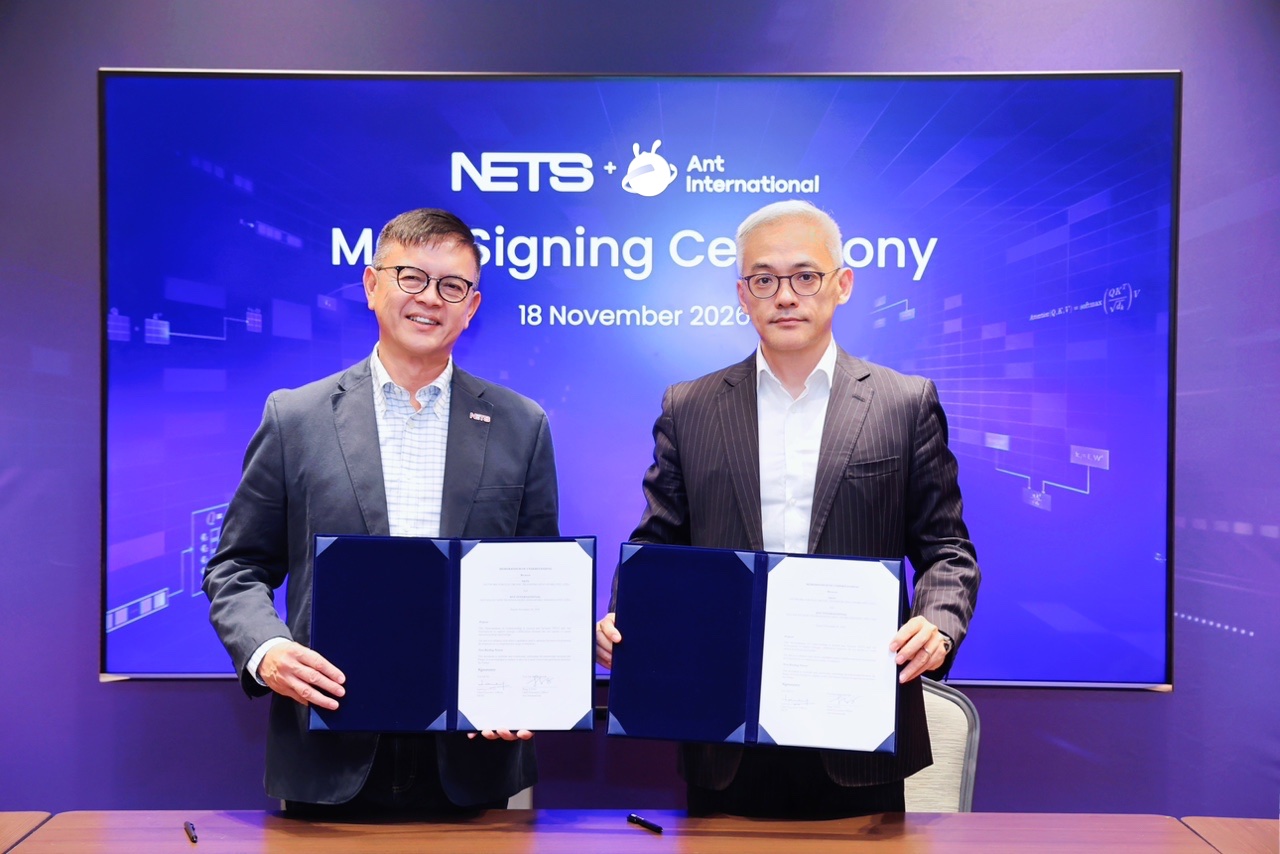
NETS to join Ant International’s AI agent payment protocol

NETS will become the first national payment rail to join Ant’s Agentic Mobile Protocol.

Read at Tech in Asia

arXiv (research papers) Chenyuan Zhou

A$^2$-VLA: Adapting Vision-Language-Action Policies to New Tools through Agentic Affordance Discovery

Tools with different shapes can have similar functions, but transferring manipulation skills across tools requires understanding how tool geometry relates to the specific task and adjusting the manipulation strategy accordingly. The key challenge is to discover the common affordances that contribute to task completion across different tools and verify whether they support new tools in performing similar work. We present A$^2$-VLA, a tool-adaptation framework that combines an…

Read at arXiv (research papers)

MarkTechPost Asif Razzaq SI

Google DeepMind Releases Gemini 4 Neon: 1M Context, #1 on AA Coding Agent Index

Google released Gemini 4 Neon, a 1M-context Gemini 4 model priced at $3/$15 per million tokens. It scores 61 on the AA Intelligence Index and ranks #1 on AA’s Coding Agent Index.

Read at MarkTechPost

arXiv (research papers) Yuseon Choi

FlashX: Scaling Robotic Experience Reuse for Embodied Agents with CBA-Based NAND Flash

Embodied agents are emerging as a promising paradigm for complex robotic tasks, leveraging Vision-Language-Action (VLA) and World Action Models (WAMs) to generate actions through Diffusion Transformer (DiT)-based iterative denoising. However, existing models often struggle to generalize to out-of-distribution (OOD) environments. We observe that retrieving successful experiences and using them to warm-start denoising enables agents to better adapt to unfamiliar situations…

Read at arXiv (research papers)

Help Net Security Sinisa Markovic Security

AI agents inherit employee access, and nobody’s watching how they use it

AI agents that employees build inside project trackers, CRMs and automation tools often run on the credentials of the person who created them and carry that person’s access to company data, according to Nudge Security. Source: Nudge Security The AI Adoption in Practice 2026 report draws on anonymized, aggregated telemetry from Nudge Security customer environments. It tracks which AI tools show up in organizations, what those tools connect to, which agents are running and how…

Read at Help Net Security

arXiv (research papers) Ahmet Tuğrul Bayrak SI

When Should a Voice Agent Speak? End-of-Turn Detection in Turkish

A voice agent that waits for a fixed silence before replying either interrupts users who pause mid-utterance or responds late to users who have finished. This study examines the decision at the onset of silence, using turn ends and turn-internal pauses extracted from the Real-TurnTurk corpus of Turkish dyadic video calls. A fine-tuned Turkish TurnGPT model, a zero-shot Turkish language model and a deployed multilingual detector are compared, together with voice-activity…

Read at arXiv (research papers)

arXiv (research papers) Zihao Dan Security

ToolPulse: Side-Channel Eavesdropping on Tool-Using LLM Agents

Large language models (LLMs) are increasingly deployed as agents that translate user requests into sequences of local tool invocations. While prior cache-based side-channel attacks target the locally deployed models, they typically require the adversary to share model-related components or hardware resources with the victim's inference process. These assumptions do not apply to the predominant agentic settings, in which commercial LLMs execute on vendor-controlled…

Read at arXiv (research papers)

The New Stack Chris J. Preimesberger

Why Groundcover’s CEO says agents are the power users of observability

An AI coding agent can write a patch in minutes. Ask it whether that patch slows down the API endpoint

Read at The New Stack

arXiv (research papers) Boyin Tan SI

Evolve Where It Matters: Coverage-Guided Self-Evolution of Agent Skills

Agent skills package procedural knowledge as natural-language instructions, and a skill helps only when its instructions are correct and properly followed by the agent. Self-evolving agents revise their own skills from the runs they make, but existing methods judge each run as a whole, by its outcome or by where it went wrong, and cannot tell whether a failure comes from a wrong instruction or from one the agent did not follow. Instruction-level coverage was introduced to…

Read at arXiv (research papers)

arXiv (research papers) Geon Lee SI

Toward a Science of AI Agent Societies

AI agents are rapidly evolving from isolated personal assistants into networked actors that interact with one another at scale. We envision the emergence of AI agent societies, with their own social and economic dynamics, as a new research frontier. We argue that AI agent societies should be studied as a distinct object of inquiry: neither simply larger collections of individual agents nor merely simulations of human society. To formalize this perspective, we propose four…

Read at arXiv (research papers)

arXiv (research papers) Hao Xue SI

Falsifiable Compositional Reasoning in Time Series Forecasting

Time series foundation models as well as the language-guided analytical agents achieve strong accuracy on standard chronological benchmarks. However, models that rank highest on historical validation splits often degrade across non-stationary regime transitions. We hypothesise that this gap arises from using historical backtesting as an open-ended search and model-selection objective instead of using it to test pre-specified compositional assumptions. Real-world time series…

Read at arXiv (research papers)

arXiv (research papers) BoHao Chen SI

Beyond Weight Updates: Evolving Agent Harnesses for Domain Specialization

Domain specialization of LLM agents is usually framed as a weight-update problem: collect trajectories, run reinforcement learning (RL) or supervised fine-tuning (SFT), and deploy a new checkpoint. We study a complementary axis: evolving the \textbf{agent harness}---the system prompt, tool schemas, skill library, and planning scaffolding---while keeping the policy frozen. We cast harness evolution as an RL-style outer loop and instantiate it with GEPA, a reflective…

Read at arXiv (research papers)

arXiv (research papers) Zeming Yu SI

Stop Going in Circles:Loop-Triggered Routing for System 1 Decision Agents

System 1 decision models (represented by Jev) provide fast, low-cost action selection, but existing agent integrations do not reliably translate these local advantages into task completion. At certain points during execution, an agent may repeatedly select the same actions without making progress toward its goal. LLM-based policies offer strong reasoning capabilities that support planning within an agent, but invoking them at every step incurs substantial overhead. The…

Read at arXiv (research papers)

arXiv (research papers) Sanjari Srivastava SI

AppSci-Bench: Can LLMs Build AI Agents and Make Them Better?

Large language models (LLMs) are increasingly used not only to power AI agents but also to build them. While many benchmarks assess the quality of LLM- powered agents, few ascertain how good LLMs are at building them. To this end, we introduce AppSci-Bench, where we construct a setting akin to how human Applied Scientists build agents for businesses - through eliciting task requirements from stakeholders, exploring the business's infrastructure, and scientifically improve…

Read at arXiv (research papers)

arXiv (research papers) Yixiong Chen SI

Pro$^2$ Agent: Scientific Problem Probing for Autonomous AI R&D

Large language model (LLM) agents can now autonomously conduct AI research by writing code and running experiments. They typically do so by iteratively optimizing a codebase, while ignoring the problem structure behind the task. This formulation is effective on simpler tasks, but on difficult problems it often gets stuck in the wrong solution region because the agent never explicitly represents its understanding of the problem. We introduce Pro$^2$ Agent, which shifts the…

Read at arXiv (research papers)

arXiv (research papers) Luke Ztz Hu SI

FPGA-GEN: Target-Aware RTL Generation via HLS

Successful C/C++ compilation does not guarantee correct or efficient FPGA hardware after high-level synthesis (HLS). FPGA-GEN is an agentic HLS-C generation workflow that encodes specification, readiness, selection, repair, and admission rules in explicit task contracts and bounded tool-feedback loops for candidate-level decisions. On HLS-Eval, five shared-context outputs per task yield 407/425 (95.8%) public-testbench passes. In a cumulative conversion campaign, FPGA-GEN…

Read at arXiv (research papers)

Iran International

Bessent's relocation linked to Iran chemical threat – NYT

US Treasury Secretary Scott Bessent's relocation to a military base was linked to Israeli intelligence about an alleged Iranian plot to use chemical agents against senior American officials, The New York Times reported Wednesday, citing a person briefed on the intelligence.

Read at Iran International

arXiv (research papers) Jungmin Park Security

From FIPS to FPGA with LLM Agents: Measuring What Tests and Reviews Miss in Post-Quantum Cryptographic Hardware

As LLM agents increasingly generate RTL alongside the tests and reviews that validate it, self-generated evidence is a weak foundation for trustworthy hardware. We present our seven-stage verification-gated workflow, evolved during a post-quantum design port, in which a gate counts only if shown able to fail on negative controls and fault mutants, and reviewer agents audit work before commit. We then audit this evidence with tool-selected netlist mutants, flaw replays, and…

Read at arXiv (research papers)

arXiv (research papers) Ahmet Efe Security

Verified Netlist-to-RTL Recovery with LLM Agents

Gate-level netlists circulate among IP integrators and foundries and can be extracted from chips. Reverse engineering them into readable register-transfer-level (RTL) code would help an adversary understand and modify a design, but remains difficult because word-level operations are scattered across many gates. Large language models (LLMs) can write and optimize RTL, but often fail to recover it from a whole netlist. We propose LOCA (LOgic Cone Attack), an LLM-based attack…

Read at arXiv (research papers)

Older stories