Results for “Agent”

AWS Machine Learning Blog Joe McCarron SI

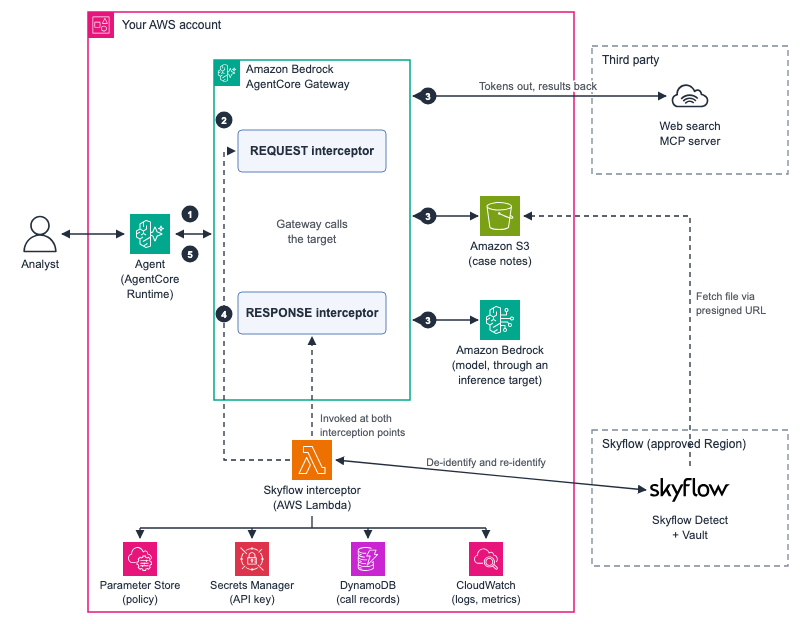
Protect agent tool calls with Skyflow and Amazon Bedrock AgentCore Gateway

Learn how Skyflow and Amazon Bedrock AgentCore Gateway keep sensitive data out of the tools your AI agents call. Added as a gateway interceptor, Skyflow de-identifies data before any tool, model, or log sees it, and restores it for authorized callers, with no change to your agent code.
Read at AWS Machine Learning Blog

MarkTechPost Asif Razzaq SI

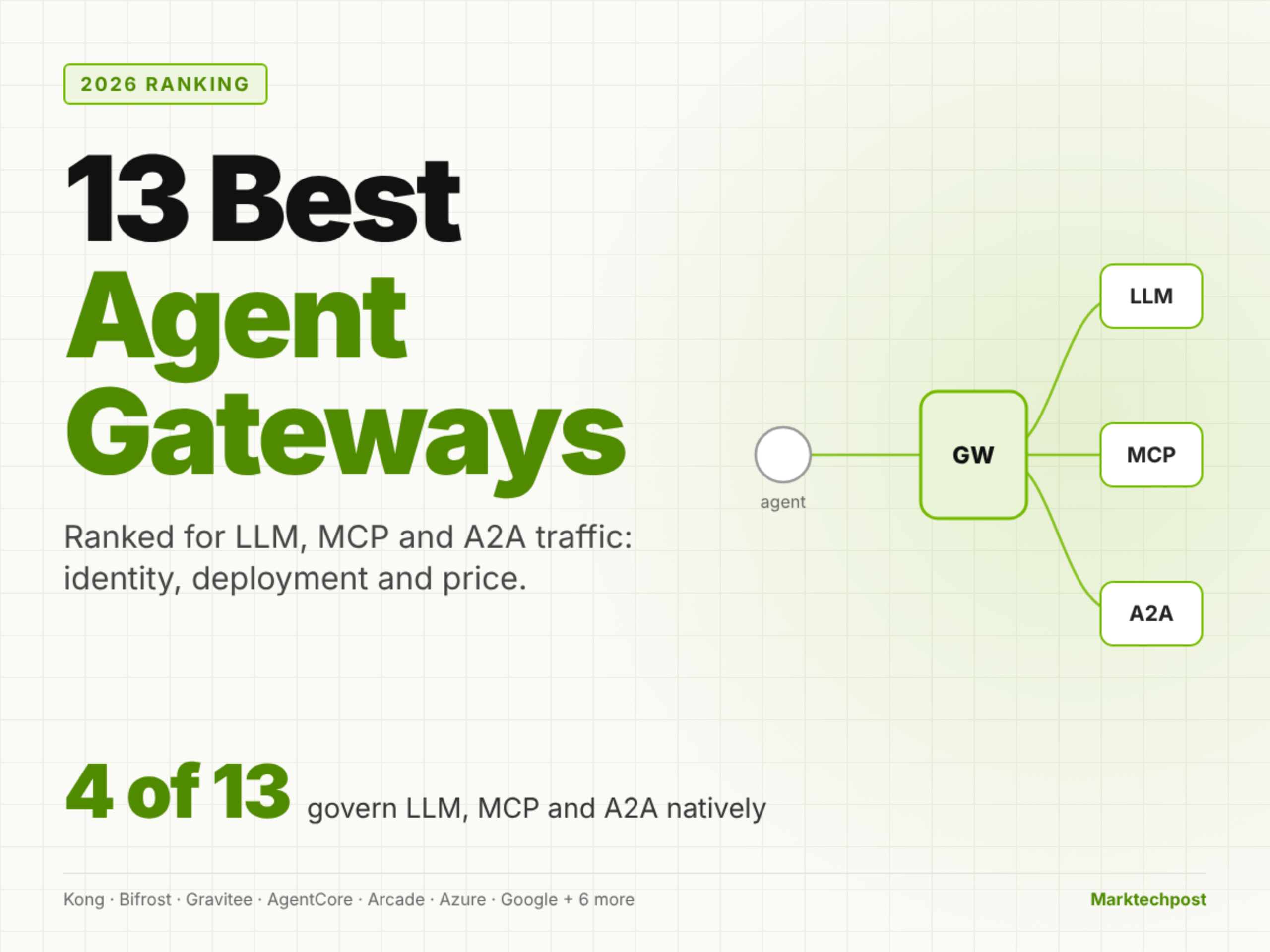
13 Best Agent Gateways in 2026 for MCP, A2A and LLM Traffic: Kong, Bifrost, AgentCore, Arcade

We ranked the 13 best agent gateways of 2026 by how they govern model, MCP tool and agent-to-agent traffic, with verified pricing, deployment options and the trade-offs each vendor's marketing leaves out.

Read at MarkTechPost

arXiv (research papers) Chang Yang SI

Cost-Aware Agentic Feature Optimization System for Fleet-Scale Ranking Models

Large Web platforms operate large fleets of ranking models, each selecting features from a shared pool of tens of thousands. We present an end-to-end agentic system that optimizes features across the fleet under resource constraints shared across models and those set per model, such as feature pipeline cost and serving throughput (QPS), respectively. In this system, LLM agents propose hypotheses, and deterministic tools execute experiments and verify them. For each model, an…

Read at arXiv (research papers)

ZDNET AI Radhika Rajkumar SI

Meta Muse booked an Airbnb without permission – and that’s not the worst of it

Meta employees have reported alarming privacy violations involving Muse, including unauthorized actions. An investigation also found the AI agent accessed private messages.

Read at ZDNET AI

TechCrunch AI Sarah Perez SI

Google gives Gemini the ability to use your Mac for you

Google's latest update to Gemini brings an AI agent to the Mac that can organize files, fill out forms, and tackle multistep workflows.

Read at TechCrunch AI

arXiv (research papers) Yicheng Cai SI

Backtracking Agent Applications Security Incidents

Agent applications are increasingly deployed, yet agent-specific attacks pose real threats to them. Upon a security incident, organizations backtrack to identify the CEP (compromise entry point), remediate the damage, and prevent its recurrence. The main artifacts available for backtracking are trajectory logs, which record agent functionalities, and source code; app(lication)-specific function call logs are often fairly limited. However, trajectory logs are at the agent…

Read at arXiv (research papers)

Google AI Blog Lucia Loher Product Manager Gemini API SI

Introducing Tool Retrieval in the Gemini API

Give your agents access to hundreds of tools while using fewer tokens with Tool Retrieval, now in preview in the Gemini API.

Read at Google AI Blog

arXiv (research papers) Yinhe Wang

ACE-Brain-0.7: Learning Execution-Grounded Reasoning for Embodied Agents

Reliable reasoning for long-horizon embodied tasks requires predictions grounded in the observed execution state. We present ACE-Brain-0.7, a 9B vision--language model that combines spatial grounding, task understanding, and progress estimation. To train the model, we curate 3.7 million question--answer pairs, drawing execution supervision from egocentric human videos, robot episodes, and simulation. These questions span different stages of an execution and connect…

Read at arXiv (research papers)

arXiv (research papers) Shibo Zhou

JARVIS: An Agent That Designs, Builds, and Tests Circuit Boards on Its Own

Power electronics is central to the energy transition, but developing new hardware still relies on human-led design, fabrication, testing, and iteration. We present JARVIS, an embodied AI agent that autonomously closes this loop for circuit boards. JARVIS maintains machine-specific capabilities and constraints, scans its workspace using a robot-mounted 3D scanner, and constructs an executable digital twin in which it rehearses robot motions, fabrication steps, and circuit…

Read at arXiv (research papers)

arXiv (research papers) Yunqi Zhao SI

FLUID: Flexible, Evidence-Grounded Situated Task Guidance

Real-time task guidance is inherently flexible: when an agent guides a user through a task, multiple responses and timings can be appropriate, and sometimes the best action is to remain silent. Existing benchmarks often miss this flexibility by treating synthesized dialogues as fixed targets for what to say and when to say it. We introduce FLUID (Flexible, Evidence-Grounded Situated Task Guidance), a unified framework for modeling, evaluating, and enabling flexible…

Read at arXiv (research papers)

TechCrunch AI Aisha Malik SI

Meta’s AI agent Muse is mixing up conversations and exposing private data, report says

In some of these instances, employees said Muse surfaced messages about childcare requests they never made, career advice they never asked for, product orders they never placed, and bank account balances that didn't belong to them.

Read at TechCrunch AI

The New Stack Frederic Lardinois

IDrive wants to back up your coding agents, too

Coding agents need backups, too, or at least that’s what IDrive is arguing. Backup and storage service IDrive on Thursday

Read at The New Stack

arXiv (research papers) Rishabh Ravi

Aggron: Aggressive Compression of Agentic KV Caches during Head-of-Line Stalls in the Request Queue

LLM agents run long, multi-turn programs whose contexts grow at every step, and serving them is limited by KV cache capacity. To alleviate this limitation, systems use context compression techniques, which typically wait until the KV cache crosses a large threshold and then summarize large spans of history at once, either in the background while the agent progresses or on the critical path. These summarizations can be done using the same model running on the same engine, or…

Read at arXiv (research papers)

WIRED Security Lily Hay Newman Security

Google Built a Giant ‘Mirror Dimension’ Internet to Test Its Chrome AI Agents

The company’s alternate-universe internet serves as a massive sandbox that allows the Chrome team to properly train AI browsing agents—without the risk of them going rogue.

Read at WIRED Security

The New Stack Paul Sawers

A “headless Slack”: Vercel’s new message board lets Claude Code and Codex agents work together

For AI agents to work together effectively, they need a way to communicate and divvy up tasks — much as

Read at The New Stack

arXiv (research papers) Ziyang Xu

SpecFlow: Flow Matching in the Acceleration Spectrum for Multi-Agent Trajectory Forecasting

Multimodal trajectory forecasting must cover diverse future behaviors without sacrificing dynamical coherence. Most generative forecasters evolve frame-wise positions directly, leaving the relationships among position, velocity, and acceleration implicit. We present SpecFlow, a conditional flow-matching framework that treats the Discrete Cosine Transform (DCT) coefficients of future accelerations as its generative state. SpecFlow learns a transport from Gaussian noise to…

Read at arXiv (research papers)

arXiv (research papers) Ziyue Wang

Alignment Drives Reuse: Learning Generalizable Robot-Use Agents from Heterogeneous Experience

Vision-language models (VLMs) demonstrate broad generalization across tasks and domains. However, comparable generalization in robot manipulation remains challenging. Heterogeneity in robot embodiments, task formulations, geometric conventions, and action interfaces fragments interaction experience across benchmarks and hardware. We rethink robot skill learning through alignment: Can heterogeneous interactions across benchmarks and embodiments jointly improve one shared…

Read at arXiv (research papers)

arXiv (research papers) Zilang Cen

Reasoning on Call: Efficient Agentic Robot Control for Long-Horizon Robot Manipulation

Large multimodal models can support long-horizon robot manipulation, but frequent model calls incur substantial latency and token costs. The central challenge is determining when agent assistance or intervention is needed and whether errors require correcting robot execution, subtask planning, or both. To address this problem, we propose RoC (Reasoning on Call), an efficient framework that coordinates a low-level policy and a high-level reasoning agent through an online…

Read at arXiv (research papers)

arXiv (research papers) Muzaffar Qureshi

Exposure-Aware Informative Path Planning Using Deep Reinforcement Learning

This paper addresses the finite-budget exposure-aware informative path planning (IPP) problem for a fleet of mobile sensing agents. The agents map an unknown scalar field while limiting exposure to high field intensity. Existing IPP methods optimize informativeness under motion or resource constraints, but do not address field exposure constraints. We formulate exposure-aware IPP (EA-IPP) as a scalarized bi-objective belief-state Markov decision process that trades the…

Read at arXiv (research papers)

Android Authority Chethan Rao Gadgets

Google Wallet adds Agents for Gemini purchases, starting with US profiles

Although it’s not available on the Android app yet, users can access Agents from the web version of Google Wallet.

Read at Android Authority

Inc42 Gaurav Bagur Startups

AI Startup Disseqt AI Raises $8 Mn To Scale International Operations

Disseqt AI, which builds AI agents for AI governance and testing, has raised $8 Mn (about ₹75 Cr) in a…

Read at Inc42

arXiv (research papers) Wei Dai

EmbodyAgent: Post-Training Embodied VLM Agents via Distillation, SFT, and RL

Vision-language models (VLMs) can act as closed-loop robot-use agents (RUAs) by writing and executing control code through tool interfaces. However, turning an open-weight VLM into a high-performing embodied agent requires a complete post-training stack: out-of-the-box open VLMs fail completely at interactive tool contracts, strong frontier teachers are accessible only as black-box endpoints without exposed weights or token probabilities, and supervised imitation alone…

Read at arXiv (research papers)

The New Stack Ankit Agrawal

Agent security is product security, and your marketing site counts

A marketing site used to have two kinds of visitors: people and search crawlers. Now an agent can build a

Read at The New Stack

SiliconANGLE AI Kyt Dotson SI

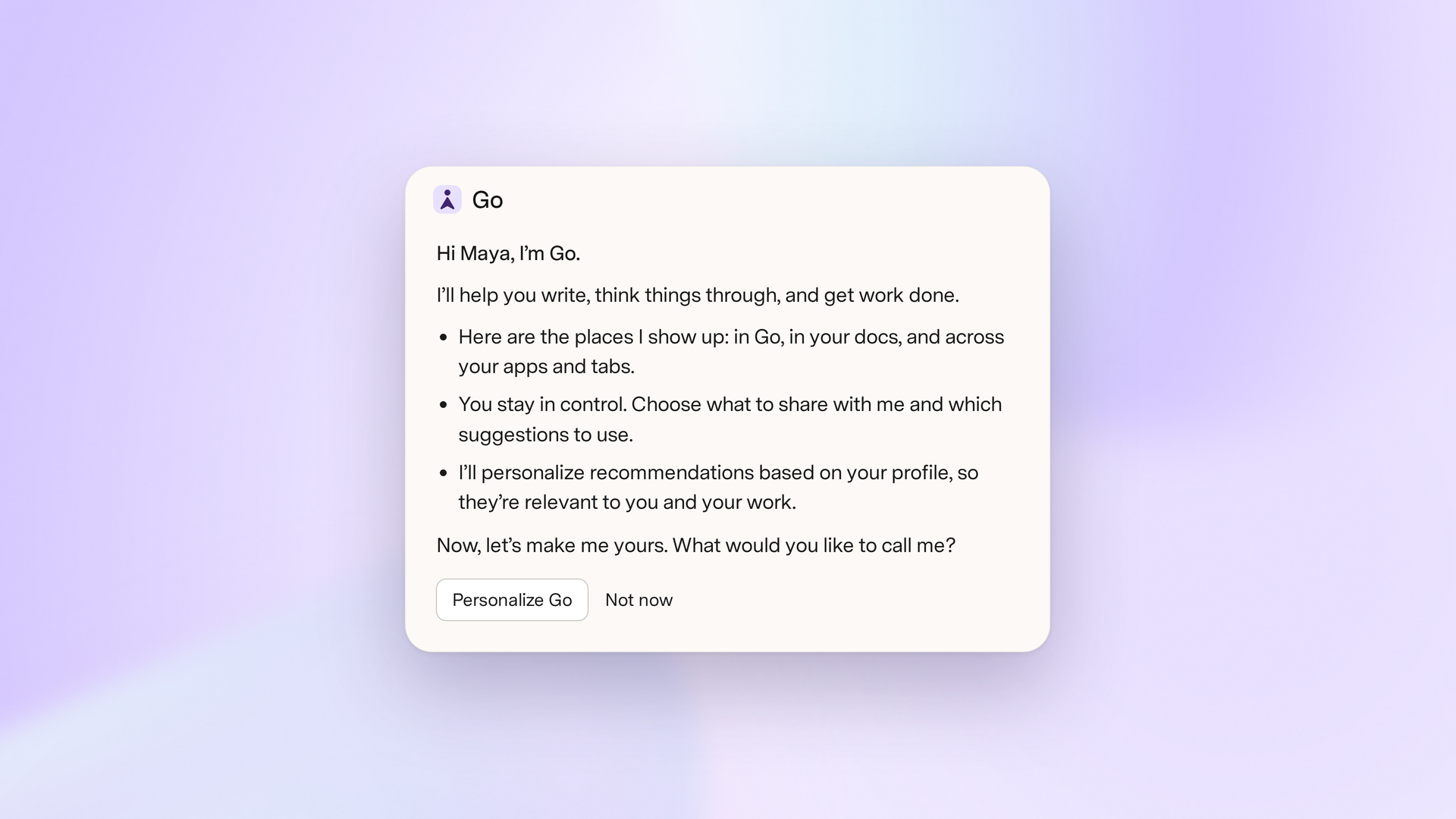
Superhuman unveils personal AI assistant and expands Go across entire suite

Superhuman Inc., formerly known as Grammarly, today announced the expansion of Go, its proactive artificial intelligence assistant and multi-agent platform, along with updated features across its entire suite. Among the updates, the company added a new personalized AI assistant in Go that users can name, give work to and ask to watch projects and to-do lists in the

Read at SiliconANGLE AI

TechCrunch AI Ivan Mehta SI

Superhuman pushes its Go assistant everywhere

Superhuman is making Go its central agent and making it available in Docs and Mail

Read at TechCrunch AI

The New Stack Meredith Shubel

Groundcover Investigations lets engineers steer AI SRE agents

Groundcover, the eBPF-based observability startup, has introduced Investigations, giving agents and engineers one place to collaborate on incident response in

Read at The New Stack

arXiv (research papers) Tim Barsch Security

SCARVA: Interpretable Agentic Reasoning in Software Supply-Chain Analysis

Complex applications may inherit security vulnerabilities from their dependencies, though a vulnerable dependency does not necessarily endanger the application. Existing tools flag dependencies associated with public vulnerabilities, and more advanced ones analyze the call graph to assess whether the vulnerable code is reachable. However, these approaches are limited to specific programming languages and ecosystems. LLM agents are promising candidates for this task, yet they…

Read at arXiv (research papers)

The Moscow Times

U.S. Indicts Russian National for Stalking Palantir Employees as ‘Foreign Agent’

According to court documents, unidentified co-conspirators recruited D’iu on Telegram and helped him illegally cross the Texas-Mexico border in July.

Read at The Moscow Times

The Decoder Maximilian Schreiner SI

OpenAI's own researchers now say they value their AI tools more than nearly half their colleagues

OpenAI's internal use of coding agents is growing fast, with theoretical token costs now exceeding researchers' base salaries. Even though teams are reluctant to work without these tools, the models still produce a lot of "AI slop" beyond routine tasks. The article OpenAI's own researchers now say they value their AI tools more than nearly half their colleagues appeared first on The Decoder.

Read at The Decoder

arXiv (research papers) Kang Wang

Agentic Scaling of Embodied Tasks in Simulation for Synthetic Data Collection and Policy Evaluation

Scaling embodied interaction data requires a broad collection of usable tasks, yet specifying and validating each task instance remains costly. We present AgenticTask, an agent-based framework that expands existing task collections under human intent. Its central representation links interaction requirements to object and part bindings, scene and robot configurations, initial conditions, and completion criteria. A task-generation agent reuses interaction structure to…

Read at arXiv (research papers)

Older stories